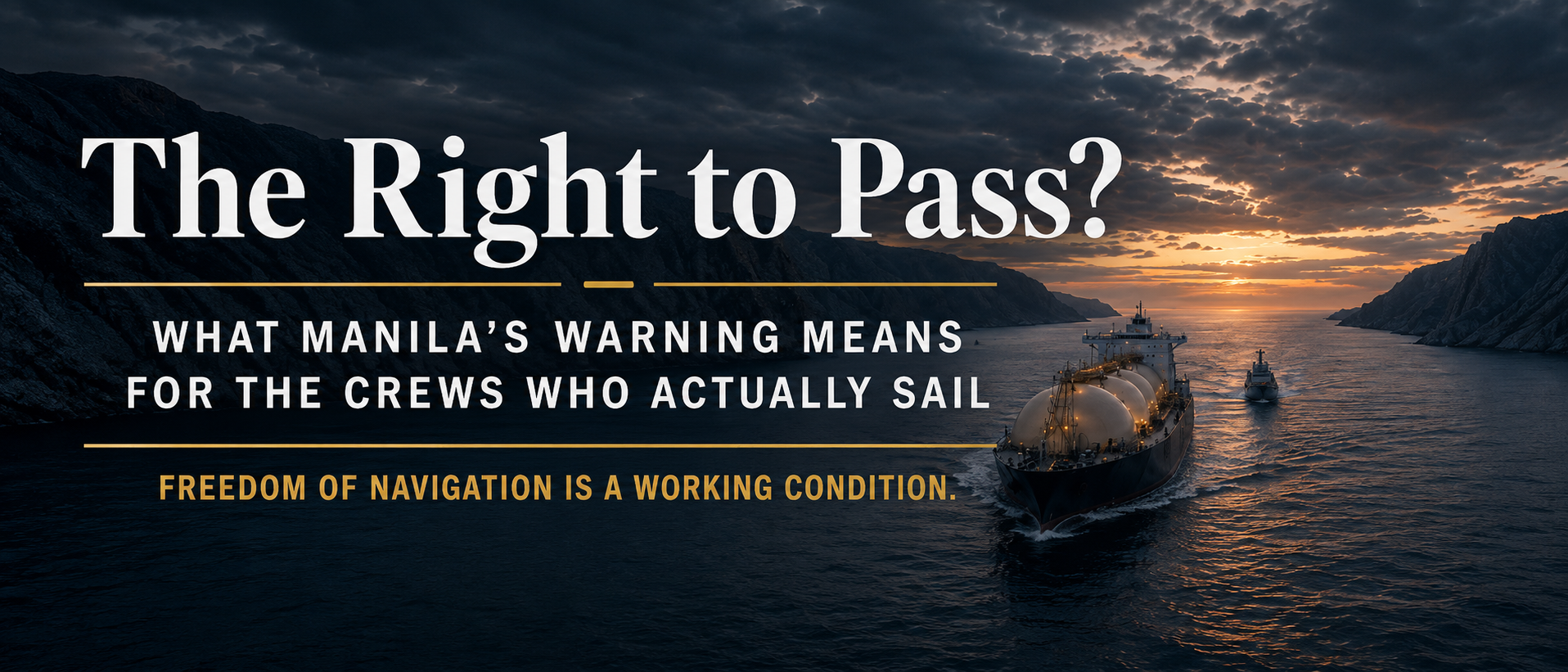
Southeast Asia’s foreign ministers spent a week in Manila discussing the right of a ship to pass. In those same days, a Filipino sailor was hit in the head by Chinese Coast Guard personnel, and a new blockade has developed at the mouth of the Red Sea. These developments show us how freedom of navigation is a vital working condition, and when it fails, it fails a mariner’s livelihood and wellbeing.
When the Association of Southeast Asian Nations (ASEAN) opened its 59th Foreign Ministers’ Meeting in Manila on July 21, 2026, the eleven-member bloc did something unusual: it put the “Freedom of the Seas” at the center of its agenda. The reason has been demonstrated in three of the world’s most important waterways at once.
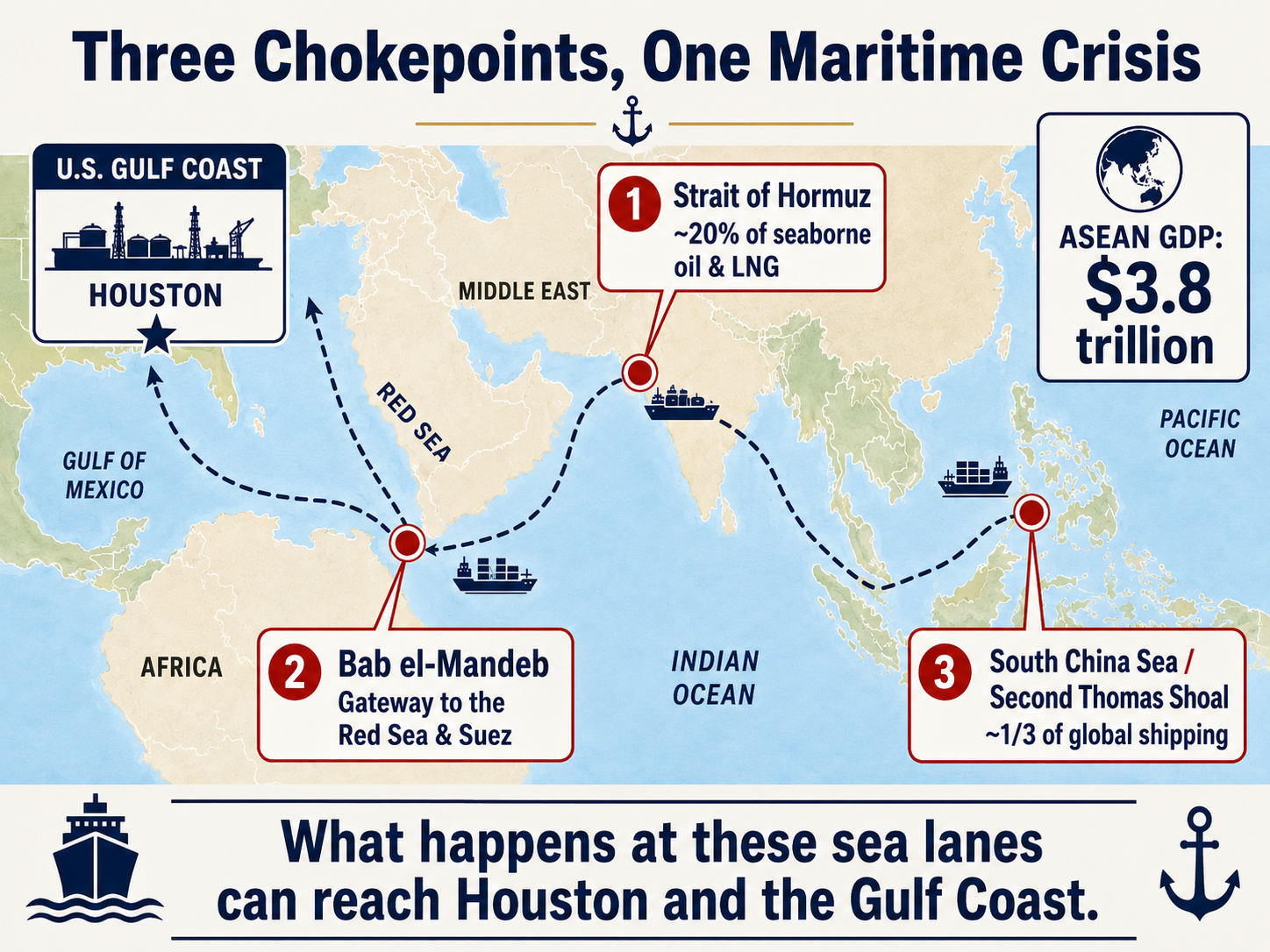
To the west, the U.S.–Iran war had shut the Strait of Hormuz — the artery through which roughly a fifth of the planet’s seaborne oil and liquefied natural gas (LNG) normally moves — and Yemen’s Houthis had just declared a fresh blockade at Bab el-Mandeb, the narrow gate to the Red Sea and the Suez Canal.
Closer to home, only two days earlier, China Coast Guard personnel reportedly had struck a Filipino sailor in the head with a wooden baton in the South China Sea, through which an estimated third of global shipping passes.
Southeast Asia imports most of its energy, carries a combined gross domestic product (GDP) of some $3.8 trillion, and floats nearly all of it across those same sea lanes — which is why the bloc pressed to fast-track an ASEAN regional oil-sharing arrangement and reached, in its closing statement, for language it had never used before. But behind the diplomacy sits a human fact that maritime lawyers on the Texas coast see up close: the ships in these disputes tie up at various Texas and Gulf ports, their cargoes are priced by what happens half a world away, and the seafarers who crew them — and many of them Filipino — bring their injuries, their unpaid wages, and their claims home to Houston.
A COMMUNIQUE ABOUT THE RIGHT TO PASS
Philippine Foreign Secretary Ma. Theresa Lazaro opened the session by calling for “active, deliberate problem solving” in a world of upheaval. Less publicly, the ministers issued a statement of deep concern that renewed U.S.–Iran hostilities were undermining mediation efforts. The draft communique, reported by wire services during the week, went further than ASEAN’s usual language, reaching for two ideas at once:
- “Freedom of Navigation” in — and overflight above — international straits, phrasing the bloc had not used before; and
- Restoration of the “safe, unimpeded, and continuous transit passage” of vessels and aircraft through the Strait of Hormuz.
U.S. Secretary of State Marco Rubio, in Manila for the meetings, warned that Iranian control over the Strait would set a dangerous precedent, and that “freedom of navigation” is by no means guaranteed. That the bloc reached for such pointed, first-of-its-kind wording — over the objection of members wary of provoking Beijing or Tehran — is itself a measure of how exposed these economies feel.
The words here are legally specific: “transit passage” is a term of art under the United Nations Convention on the Law of the Sea (UNCLOS). It reads that for a strait used for international navigation, ships and aircraft enjoy continuous and expeditious passage that a coastal state may not suspend (as opposed to “innocent passage”, which may be subjected to restrictions).
When a nation-state begins charging for that passage, or making it conditional, the whole system may be undermined — an issue we discussed when Tehran proposed a transit fee in “The Guardian and the Tollbooth.”
A SECOND FRONT AT BAB EL-MANDEB
Overshadowing the Manila talks was a development further west: Yemen’s Iran-aligned Houthi movement declared a naval blockade aimed at Saudi-linked vessels in the Bab el-Mandeb Strait, opening a potential new front and pushing the threat to energy supplies beyond the Persian Gulf. Rubio publicly accused Iran of flying Islamic Revolutionary Guard Corps (IRGC) personnel into Yemen ahead of the escalation.
We covered that declaration and what it means for crews in “Blockaded Between the Devil and the Deep Blue Sea.” The short version: a merchant sailor now faces two contested chokepoints on the same voyage, and the commercial pressure to run them anyway has not gone away — a pattern we also discussed “Dark Ship, Rich Cargo.”
THE BATON AT SECOND THOMAS SHOAL
Closer to the conference hall, the South China Sea produced its own casualty: on July 20, 2026, the Armed Forces of the Philippines (AFP) reported that a China Coast Guard (CCG) rigid-hull inflatable boat carrying eight personnel closed on the grounded Philippine outpost BRP Sierra Madre at Second Thomas Shoal — known in Manila as Ayungin Shoal — to photograph the position.
When two Philippine Navy boats moved to shepherd the CCG craft away, Chinese personnel struck a Philippine sailor in the head with a wooden baton, injuring him and damaging the boat. The AFP released the video. Manila summoned Beijing’s ambassador; Beijing summoned Manila’s; and the U.S. State Department called the conduct dangerous and aggressive, while China’s foreign ministry replied that ASEAN was not the forum for bilateral maritime disputes.
What did not change is the law: the 2016 arbitral award invalidating China’s sweeping claims remains, in Washington’s words, final and binding — and Beijing still does not recognize it. The code of conduct that ASEAN and China have negotiated for nearly a decade remains unfinished.
This is exactly where freedom of navigation stops being a slogan and becomes a policy backed by hulls. In the same waters, the Arleigh Burke-class guided-missile destroyer USS John Paul Jones (DDG 53) — forward-deployed with Destroyer Squadron (DESRON) 15 under the U.S. 7th Fleet — went on logging weather and standing its patrols. Warships like her are the reason a merchant master can still expect an open lane through contested water: the principle the diplomats debated in a Manila ballroom is enforced, when it is enforced at all, by a destroyer keeping presence on an ordinary Tuesday. That presence is not abstract to a mariner. It is the difference between a sea lane and a gauntlet.
WHAT U.S. LAW REQUIRES WHEN A CREW IS SENT INTO CONTESTED WATER
Roughly a quarter of the world’s merchant seafarers are Filipino, and they crew the tankers, box ships, and offshore vessels that call on various Texas ports every day of the year. So when their sea lanes turn contested, the operative question for a maritime lawyer is not who owns a shoal — it is what the law requires of the employer who orders a crew into one. For mariners who can invoke United States law, three obligations do the heavy lifting, and none is suspended because the hazard wears a uniform:
- The U.S. Jones Act (46 U.S.C. § 30104) lets a seaman recover where the employer negligence played “any part, even the slightest” in causing injury — a deliberately low bar reflecting that those who profit from sending sailors into danger should answer for what happens there.
- Unseaworthiness, under U.S. General Maritime Law, makes a vessel owner strictly liable when the ship — her gear, crew, condition, or fitness for the voyage ordered — is not reasonably safe. A voyage into a declared blockade zone — without hardened communications or convoy protocols is exactly what this doctrine tests.
- Maintenance and Cure — the admiralty duties to pay an injured seaman’s daily living expenses (maintenance) and medical costs (cure) until maximum medical improvement (MMI) — applies regardless of fault. Vaughan v. Atkinson, 369 U.S. 527 (1962), remains the anchor.
Overlaying all three is the duty to warn: an employer must disclose known dangers before ordering a crew into harm’s way. A declared blockade, a State Department condemnation, and a war-risk surcharge are not subtle signals — and neither is a bonus. When an owner offers extraordinary money for extraordinary risk, the money does not buy informed consent by itself, a point we worked through in “Six Months’ Pay to Cross a Minefield?” Most manning contracts also carry war risk provisions — clauses designating high-risk areas and triggering enhanced pay, added insurance, owner-paid repatriation, and, critically, a seafarer’s right to refuse the voyage. They are worth reading before signing anything, not after.
WHY THIS REACHES THE GULF COAST
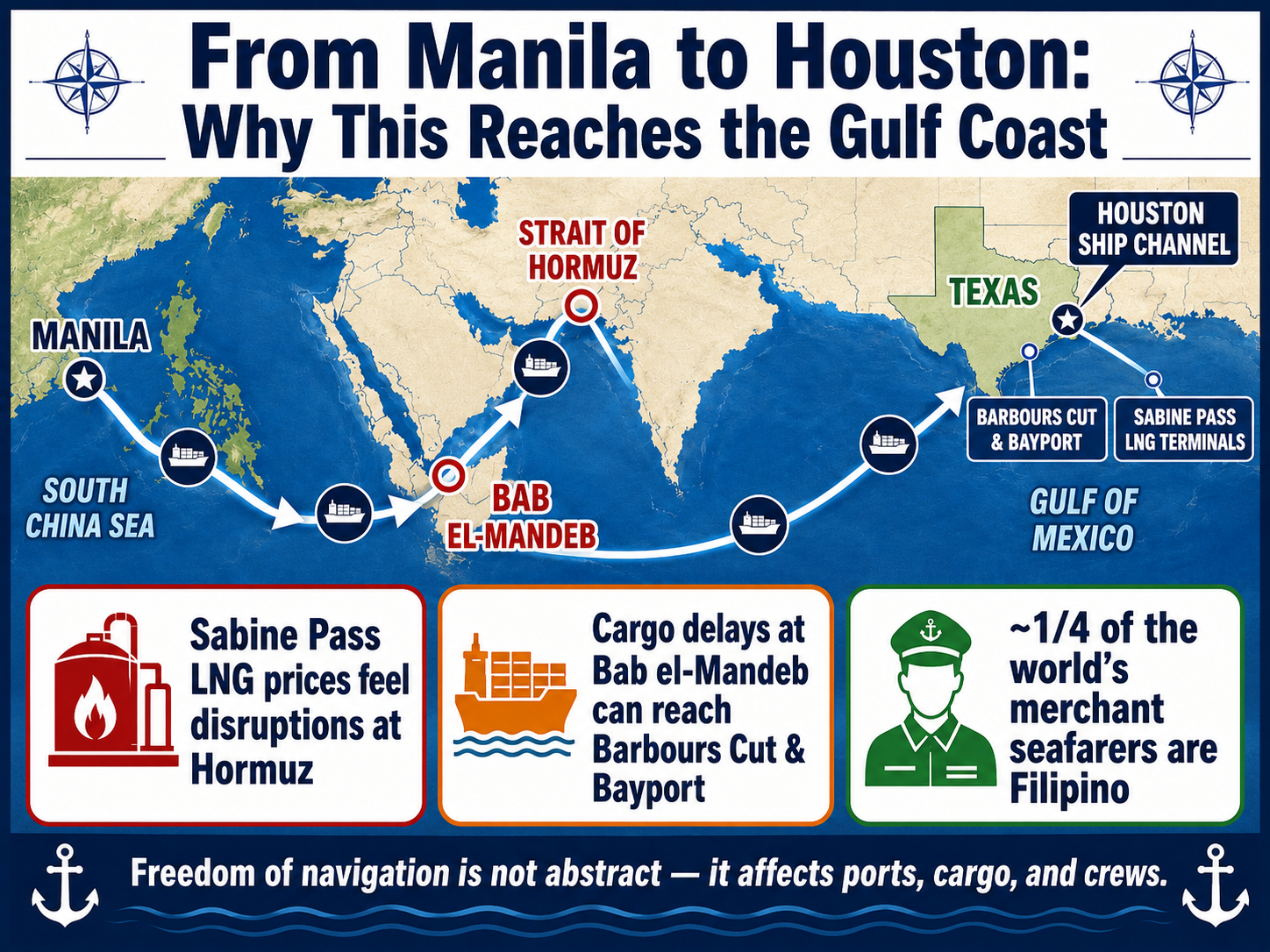
The Texas coast is the far end of every one of these sea lanes: an LNG cargo loaded at Sabine Pass is priced by what happens at Hormuz, a box that misses Bab el-Mandeb turns up late at Barbours Cut, and the deckhand stranded behind a chokepoint in the spring — a story we told in “The Human Freight of the Hormuz Strait” — may be standing a watch on the Houston Ship Channel by the fall, still owed cure for an injury nobody documented.
“Freedom of navigation” is usually argued as a more abstract concept, but aboard ship it is something very simple: the expectation that you can finish the voyage and go home. When that expectation fails, the law of the sea and the law of the workplace are based on one body of law — and a seaman does not forfeit the U.S. Jones Act, maintenance and cure, or the right to a seaworthy vessel by working somewhere the diplomats are still arguing about.
A communique can call for the right to pass. What that right is worth, in the end, is decided not in a conference hall but on the bridge — by whoever answers for the voyage a crew is actually asked to sail.
MARITIME TRIVIA QUESTION!
Q: Why is a narrow maritime passage called a “strait” rather than a “straight”?
A: The word “strait” comes from the Latin “strictus”, meaning narrow, tight, or constricted. It describes a narrow channel connecting two larger bodies of water. “Straight,” by contrast, refers to something without a bend. A strait may twist considerably—the defining feature is its narrowness, not its shape.
We at the Herd Law Firm are proud to fight for seamen, maritime workers and passengers in all types of personal injury and death claims. As maritime personal injury attorneys (and sailors ourselves!) located in northwest Houston, we never waver in our commitment to help these maritime workers, passengers, and their families when they are injured or mistreated.
The information in this post is for general informational purposes only and does not constitute legal advice. For questions specific to your maritime law issue, please contact us at 713-955-3699 or at Charles.Herd@HerdLawFirm.com.
SOURCES
- “ASEAN top diplomats meet, voice ‘serious concern’ over Middle East hostilities.” Reuters/Interaksyon, July 21, 2026. interaksyon.philstar.com
- “ASEAN diplomats voice ‘serious concern’ over Iran war and energy crisis.” Al Jazeera, July 21, 2026. aljazeera.com
- Strangio, Sebastian. “ASEAN Foreign Ministers Convene Meeting Under the Shadow of Iran War, Regional Crises.” The Diplomat, July 2026. thediplomat.com
- “Asean foreign ministers to demand freedom of navigation in Hormuz strait.” AFP/Malay Mail, July 23, 2026. malaymail.com
- “Philippine Marine Injured in Clash With China Coast Guard at Disputed South China Sea Shoal.” The Diplomat, July 2026. thediplomat.com
- “Chinese coast guard struck navy sailor in South China Sea encounter, says Philippine military.” Reuters/BusinessWorld, July 20, 2026. bworldonline.com
- “China Coast Guardsman Hits Philippine Sailor in the Head in Latest Clash.” The Maritime Executive, July 20, 2026. maritime-executive.com
- “Rubio accuses Iran of flying IRGC personnel into Yemen as Houthi threat escalates.” Fox News, July 22, 2026. foxnews.com
- Legal Information Institute, Cornell Law School. “46 U.S. Code § 30104 – Personal injury to or death of seamen” (the U.S. Jones Act). law.cornell.edu