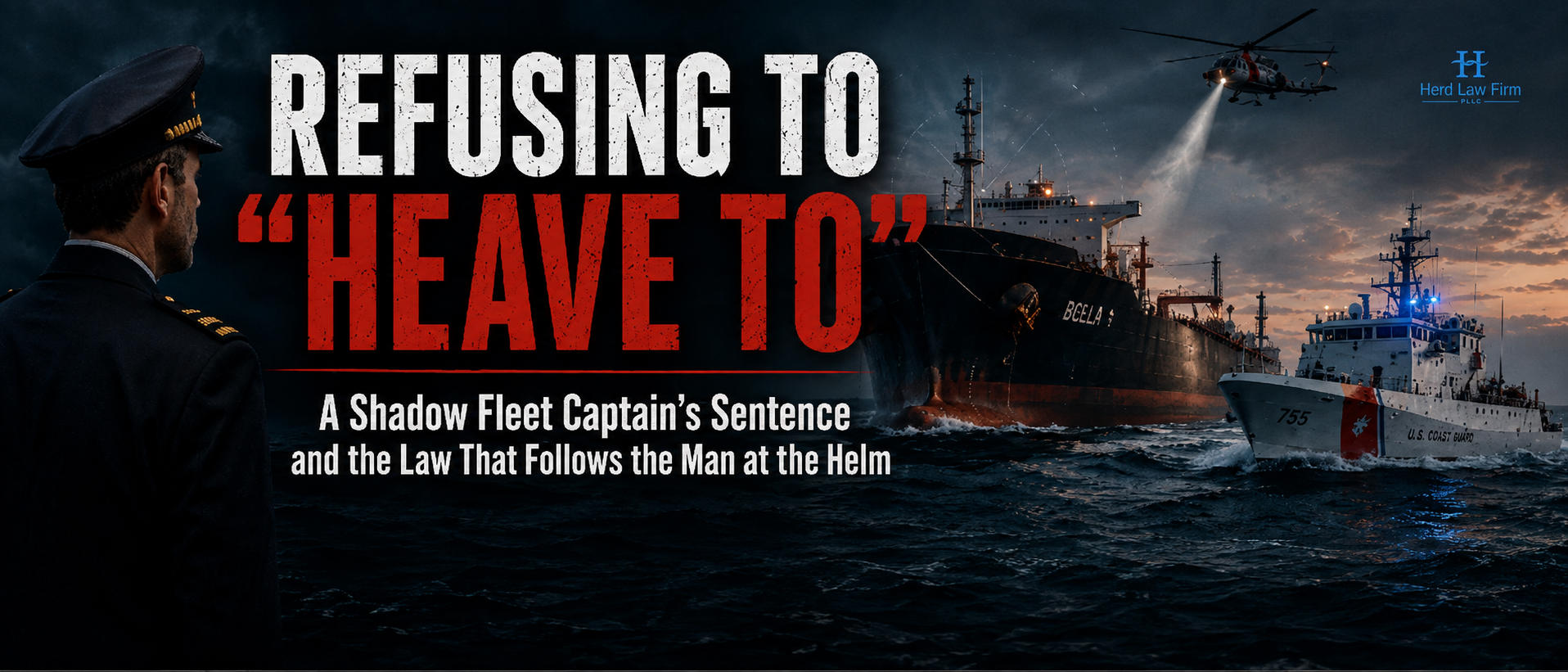
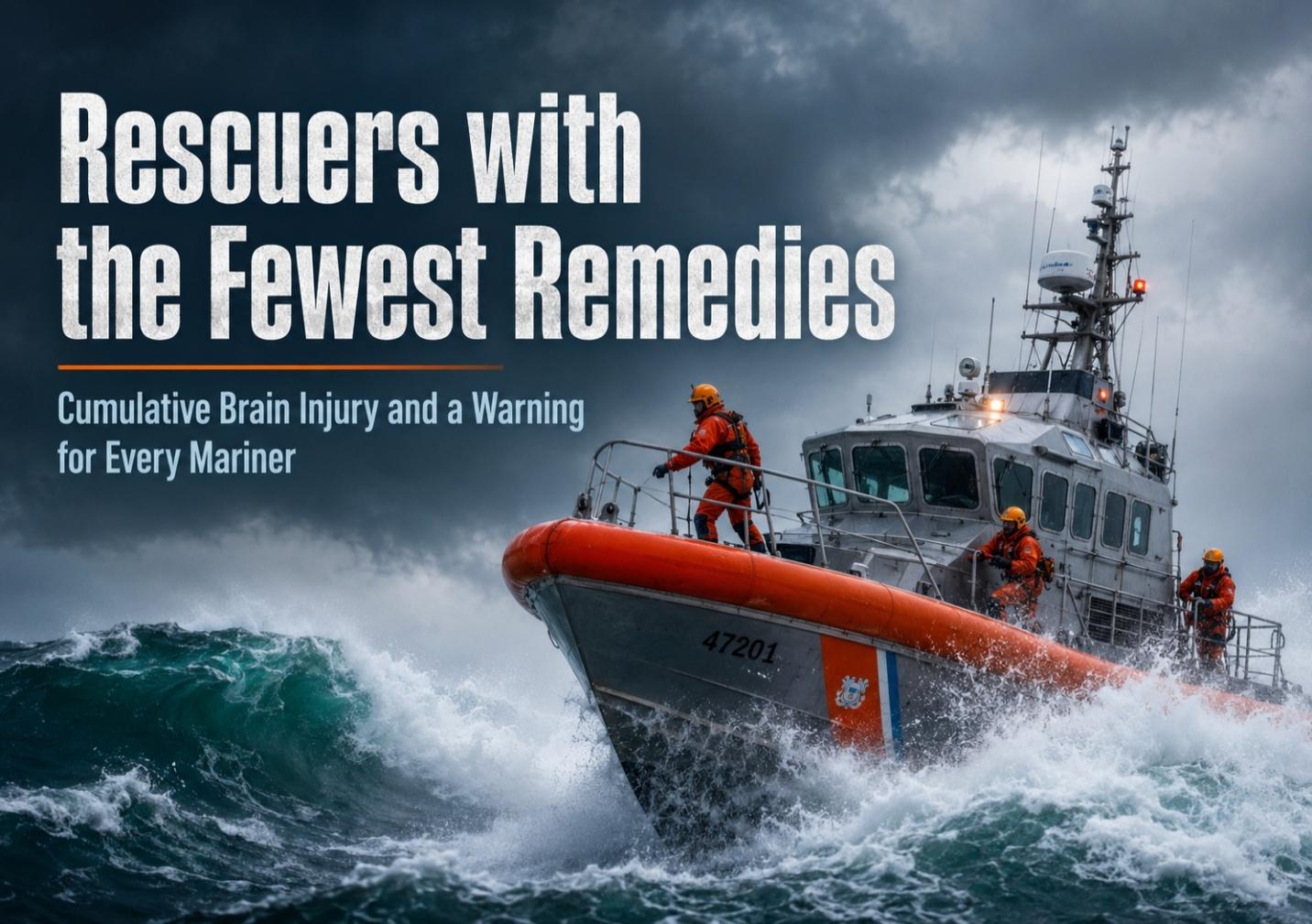
A new investigation finds that the elite crews who operate rescue boats through breaking surf may carry the same brain trauma as football players — and a seventy-five-year-old legal doctrine leaves them almost no one to sue. For the civilian mariners who run the same gauntlet off the U.S. coast, the U.S. Jones Act tells a very different, and more hopeful, story.
There is a cruel arithmetic in heavy-weather rescue work: the same force that drive a rescue lifeboat through relentless breaking waves to reach a ship in distress can also travel it right into the head of the crew piloting it. A new investigation by Pulitzer Prize–winning reporter Dave Philipps of The New York Times suggests that arithmetic has been running quietly for decades — and that the U.S. Coast Guard (USCG) has apparently not been keeping the tally.
A Life, and a Warning, in Seventy-Seven Surveys
After twenty-one years as an elite USCG “surfman” — a small, highly selective qualification of seaman trusted to drive motor lifeboats into the worst surf in America — Brett Bonner died by suicide in 2025, following years of worsening headaches, memory loss, mood swings, anxiety, seizures, and uncharacteristic violent behavior. His daughter, Kayleigh, began asking a hard question: could the repeated impacts of steering rescue boats through massive waves have caused cumulative brain damage of the kind now familiar from years of football?
Unable to find any Coast Guard research on the subject, she did what the service had not: she gathered data. She surveyed seventy-seven active and retired surfmen. Most reported symptoms consistent with traumatic brain injury (TBI) — chronic headaches, cognitive decline, memory problems, anxiety, depression, and emotional instability — yet few had ever been diagnosed by the Coast Guard. For years, the report notes, Bonner’s own symptoms were attributed to post-traumatic stress disorder (PTSD) and anxiety. Only later did a civilian neurologist identify brain abnormalities consistent with multiple concussions. He was returned to duty rather than referred for specialized brain-injury treatment.
How a Rescue Boat Becomes a Hammer
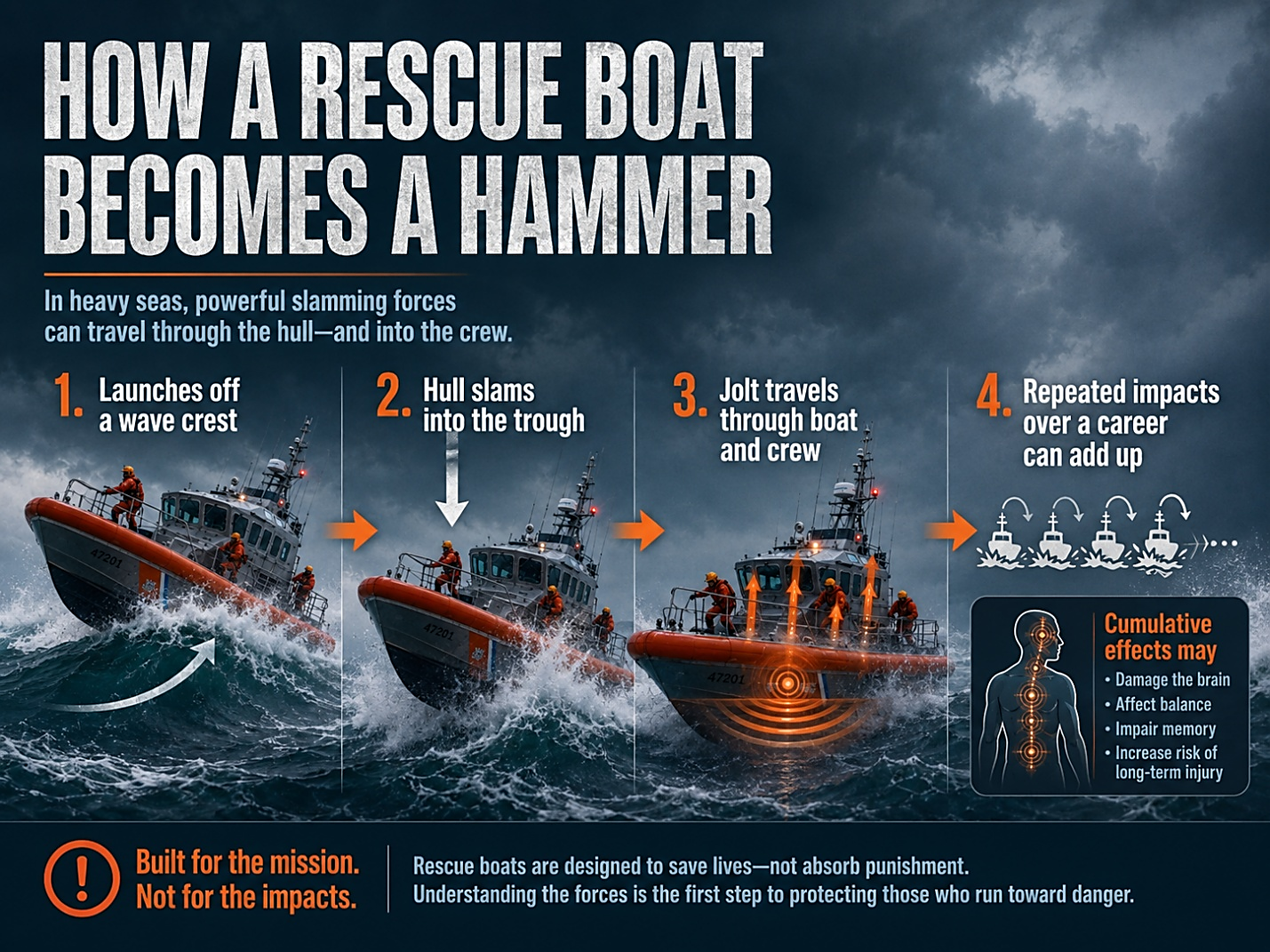
The mechanism of the injury is ultimately not mysterious, just simple physics. When a forty-seven-foot Motor Lifeboat (MLB) — the Coast Guard’s self-righting heavy-weather workhorse — launches off the crest of a large wave and slams into the trough below, an enormous jolt of energy travels up through the hull and into the bodies and brains of the crew. Repeated across thousands of impacts over a career, those sub-concussive shocks accumulate.
Physicians compare the injury profile point to chronic traumatic encephalopathy (CTE), the degenerative condition documented in boxers and football players — with the added complication that a mariner’s injury impacts are often cold, unpredictable, multi-directional, and sustained over hours.
Philipps won a Pulitzer for past reporting demonstrating how routine, supposedly “safe” military work — firing heavy artillery, flying high-performance jets, and, tellingly, running the Navy’s high-speed Special Boat Teams over open water — was inflicting serious brain injuries that were repeatedly mistaken for PTSD, which prompted corrective action from Congress and the Pentagon.
The Navy and the Department of Veterans Affairs (VA) have since built screening and research programs around impact and blast TBI. According to the new reporting, the Coast Guard had not routinely screened its boat crews or joined those research efforts — which is the true tragedy at the heart of this story.
Why the Rescuers Have the Fewest Remedies
Unfortunately, here the law can deliver a bitterly ironic message: The men and women with arguably the most punishing boat-handling job in America are affected by the highest legal thresholds. Under the Feres doctrine — named for the U.S. Supreme Court’s 1950 decision in Feres v. United States — active-duty service members, including the Coast Guard, generally cannot sue the federal government under the Federal Tort Claims Act (FTCA) for injuries deemed “incident to service.” It does not matter that the injury has nothing to do with combat; a cumulative brain injury from years of training and rescues is defined as the kind of harm the doctrine protects against.
For an active-duty surfman, that means no negligence lawsuit, no jury, and no damages for pain and suffering. The remedy runs instead through the VA disability system — important, but very different from the right to hold an employer accountable in court. That is the legal gap Kayleigh Bonner’s survey exposes: when the institution does not diagnose the injury, and the courthouse door is closed, a wound can go both unrecorded and uncompensated for even the hardest-working heroes.
The Same Waves, A Very Different Law
The crews who run fast crew boats and utility vessels offshore, the operators of pilot boats crossing a jetty in a building sea, the deckhands on tugs and towboats — all of these civilian mariners can take the very same beating in rough waters. But as they are not active-duty military, the Feres wall does not legally stand in their way. For them, the U.S. Jones Act and U.S. General Maritime Law apply with full force. Three protections matter most here:
- Jones Act negligence (46 U.S.C. § 30104). A seaman need only show that the employer’s negligence played “any part, even the slightest” in causing the harm — a deliberately low, worker-friendly threshold. Crucially, this covers not just single dramatic accidents but cumulative, repetitive-trauma injuries built up over time. A captain repeatedly ordered to run a small boat at speed into heavy seas, aboard a vessel with no shock-mitigating seats, is exactly the kind of situation that low threshold was written to test.
- Unseaworthiness. Under the General Maritime Law, a vessel owner is strictly liable when the vessel or its equipment is not “reasonably fit” for its purpose — missing suspension seats or restraints, or an operating speed unsafe for the conditions, can each render a boat unseaworthy regardless of anyone’s intent.
- Maintenance and cure. These ancient admiralty obligations require0 the employer to pay a seaman’s daily living expenses (maintenance) and medical costs (cure) after an injury in the vessel’s service — no matter who was at fault — until the seaman reaches maximum medical improvement (MMI). And under the “eggshell plaintiff” rule, an employer takes a worker as it finds him: if the job aggravates a pre-existing vulnerability, the aggravation is still compensable. We walk through these benefits in our earlier post, “Claims for Seamen Under the Jones Act: A Lifeline for Injured Sailors.”
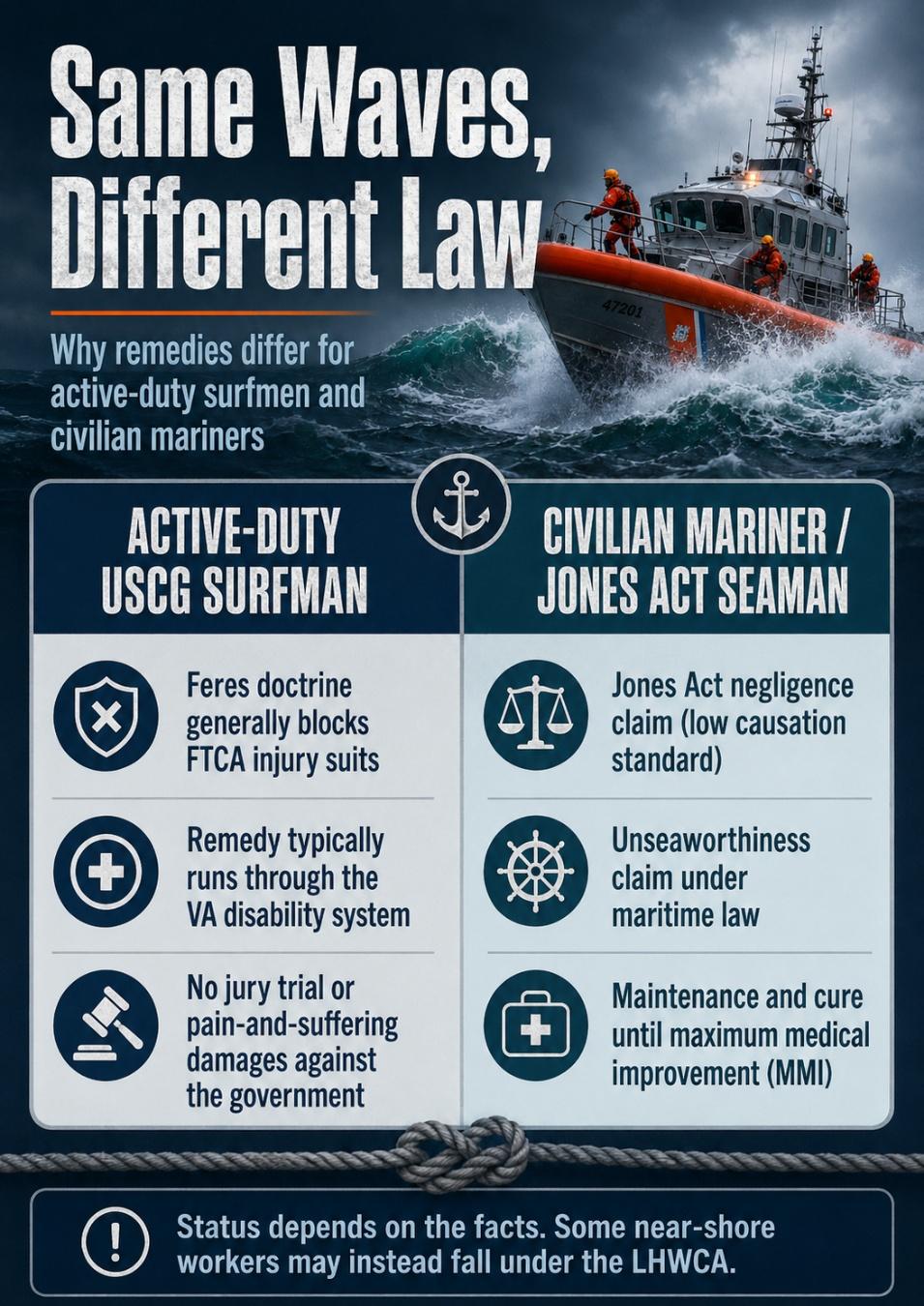
Not every maritime worker is a “seaman,” and the line can be fine; near-shore workers who fall outside seaman status may instead be covered by the Longshore and Harbor Workers’ Compensation Act (LHWCA). Because the classification turns on the specific facts of the job, we devoted a whole post to the question: “Who Is a Jones Act Seaman?”
Why This Reaches the Gulf Coast
The surfmen’s story carries a practical lesson for every mariner on this coast: the injuries that build slowly and silently — headaches, memory trouble, mood changes wrongly filed under “stress” — are the hardest to prove years later. It is critical to report symptoms early, get them documented, and never assume that what feels like chronic burnout is only burnout. Our firm handles these matters at the intersection of maritime work and traumatic brain injury, and we have written before about why safety statistics can look reassuring on paper while real hazards go unmeasured — see “Safer, But Only on Paper?” If your own symptoms also involve years working aboard a boat, that may be an occupational injury — not an individual health failing.
Maritime Trivia Question!
Q: The word “surfman” sounds modern, but the title is older than the Coast Guard itself. Where does it come from?
A: It descends from the U.S. Life-Saving Service, the nineteenth-century forerunner of the Coast Guard, whose “surfmen” rowed open, self-righting surfboats straight into the breakers to reach foundering ships — long before engines. When the Life-Saving Service merged with the Revenue Cutter Service to form the Coast Guard in 1915, the title and the tradition survived, and “surfman” still marks the service’s most demanding boat-handling qualification. Honesty compels a footnote: the creed often attached to these crews — “you have to go out, but you don’t have to come back” — is usually described as an unofficial motto rather than a line of formal regulation, its exact wording and origin debated. What is not debated is the spirit: they went out.
We at the Herd Law Firm are proud to fight for seamen, maritime workers, and passengers in all types of personal injury and death claims. As maritime personal injury attorneys (and sailors ourselves!) located in northwest Houston, we never waver in our commitment to help maritime workers, passengers, and their families when they are injured or mistreated.
The information in this post is for general informational purposes only and does not constitute legal advice. For questions specific to your maritime law issue, please contact us at 713-955-3699 or at Charles.Herd@HerdLawFirm.com.
Sources
- Philipps, Dave. “Coast Guard Rescue Boat Crews Show Evidence of Brain Injuries, and the Coast Guard Isn’t Looking.” The New York Times, July 30, 2026.
- Congressional Research Service. “The Feres Doctrine: Congress, the Courts, and Military Servicemember Lawsuits Against the United States.” congress.gov
- Legal Information Institute, Cornell Law School. “Feres doctrine.” law.cornell.edu
- Legal Information Institute, Cornell Law School. “46 U.S. Code § 30104 – Personal injury to or death of seamen” (the Jones Act). law.cornell.edu
- “Meet the U.S. Coast Guard’s Elite Surfmen.” 60 Minutes / CBS News (background on surfmen, the 47-foot Motor Lifeboat, and the National Motor Lifeboat School). cbsnews.com
- Herd Law Firm. “Claims for Seamen Under the Jones Act: A Lifeline for Injured Sailors.” herdlawfirm.com
- Herd Law Firm. “Who Is a Jones Act Seaman?” herdlawfirm.com