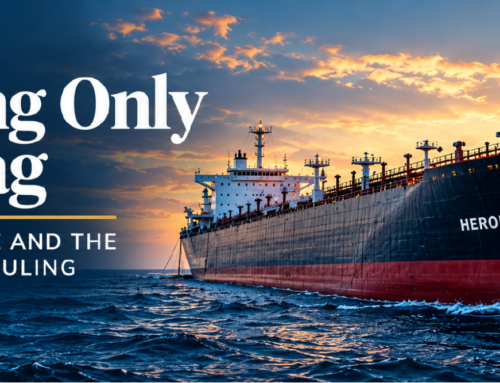
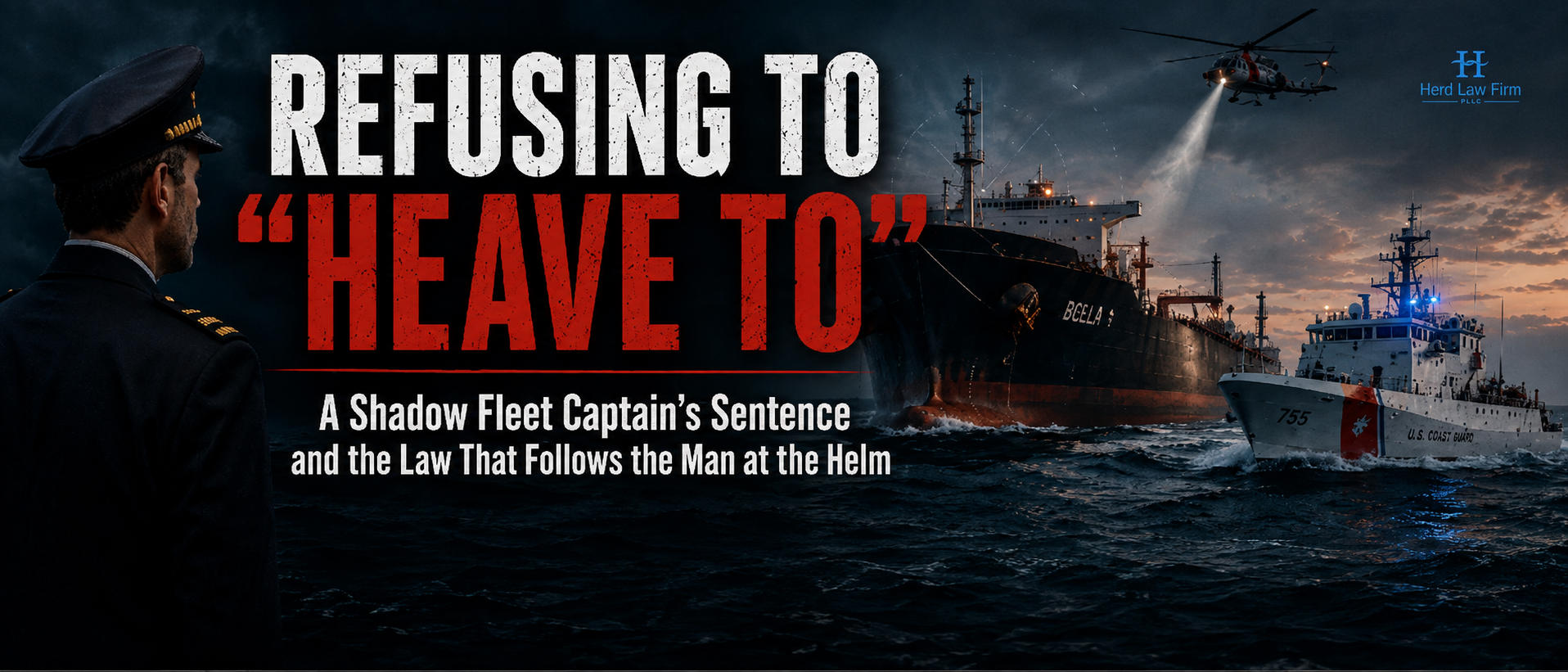
A Georgian tanker master has drawn ten months in a U.S. prison, and deportation after, for ignoring a U.S. Coast Guard (USCG) order to stop during a two-week chase across the Atlantic. The sentence is modest. What it signals is not — prosecutors are reaching past the shell companies and the swapped flags to the individual standing watch on the bridge.
On August 7, a federal court in Washington sentenced Avtandil Kalandadze, 47, a citizen of the Republic of Georgia and former master of the M/T Bella 1, to ten months in federal prison, with deportation to follow — the price of ignoring a single order from the U.S. Coast Guard (USCG): “heave to”, or to slow down and stop.
He pled guilty in June to one count of failing to “heave to” a USCG cutter, the end of a chase that ran more than two weeks and a thousand miles, from the Caribbean into the North Atlantic.
A Ship That Kept Changing Its Name
From September to late December 2025, prosecutors say, the M/T Bella 1 carried some 1.8 million barrels of Iranian-origin oil to Asia — and moved it the way the so-called “shadow fleet” (the often opaquely-owned tankers that haul questionably sanctioned crude) moves everything: in the dark.
She sailed with her Automatic Identification System (AIS) — the transponder that broadcasts a ship’s identity and position, which international convention requires most vessels to keep running — switched off, and hid her own name during a ship-to-ship transfer of the oil. This is the same “going dark” tradecraft we described in our Hormuz coverage, here turned to the opposite purpose.
When the U.S. Coast Guard closed in, the ship reached for the fleet’s oldest trick and “changed clothes”: mid-chase, she announced a new name — M/T Marinera — and a new Russian registry. U.S. officials were unmoved, noting she had been flying a false flag to begin with.
The scrutiny was not new. The Treasury Department had already sanctioned interests tied to the vessel over oil linked to Iran’s Islamic Revolutionary Guard Corps–Qods Force and to Hezbollah.
What the Charge Actually Was
The crime charged and sentenced here was not smuggling, but refusing to stop.
Under Title 18, Section 2237 of the U.S. Code (18 U.S.C. § 2237), it is a crime — punishable by up to five years — for the master of a vessel subject to U.S. jurisdiction to knowingly disobey a federal officer’s order to “heave to”. Congress also wrote the sailor’s phrase into the statute: to “heave to” is to slow, stop, or adjust course so a boarding can happen safely.
According to the U.S. Department of Justice (DOJ), the M/T Bella 1 was bound for Venezuela that December when the cutter USCGC Munro ordered her to heave to. She did not.
Instead — at the direction of the operator’s representative, their government says — the master kept running, defied repeated orders, and even destroyed records to frustrate the interdiction. The USCGC Munro shadowed her across the ocean until a seizure warrant was executed on January 7.
The Man Who Paid, and the Men Who Profited
Note: the person who went to prison was the one standing watch. Those who told him to burn the records and keep sailing — the operator, the voice on the other end of the line, whoever owned the oil — were not on that bridge, and are not named in the sentence. It is a pattern we have written about before: when a captain pleads guilty, the oldest duties on the water settle on one individual while the profit sits elsewhere.
Prosecutors flagged the shift themselves, calling the case part of a deliberate turn toward charging the people who operate these ships, not just the vessels and networks behind them.
For the seamen we represent, this is an example of the flag-of-convenience model: the owner lives in one country, registers the company in a second, flies the flag of a third, and collects the money — while the crew, often recruited from the world’s poorer ports, absorbs the risk. When something goes wrong, the man at the wheel is the easiest one to find — and punish.
The Order You Can Refuse
There is an irony in a case built on an order to stop, because American General Maritime Law is largely built around a different order — the one a seaman is allowed to refuse.
A seaman under U.S. law does not check his rights at the gangway. He is owed a seaworthy vessel and maintenance and cure if he is hurt in the ship’s service, and under the General Maritime Law, he generally may refuse an order that is unlawful or plainly unsafe — with the master’s overriding authority over ship and crew as the anchor of it all. That right to refuse a dangerous passage is not academic; we looked recently at what a flag state’s warning means for the crews who actually sail.
The shadow fleet quietly deletes those protections. A master pressured by an unaccountable operator to run dark, defy a lawful order, and burn the records has been stripped of the very authority the law means to give him. Whatever one makes of this captain’s choices, the structure that put him there deserves every mariner’s attention — it is the same structure that leaves an injured crewman with no seaworthy ship to sue and no solvent owner to find.
Why This Reaches the Gulf Coast
The Houston Ship Channel is a long way from the North Atlantic — but each works under a body of law that puts the duty on the employer and the vessel, and honors the seaman’s right to refuse a genuinely unsafe or unlawful order.
When the person giving the orders is far away and hard to name, those rights are not a technicality. They are the vital difference between a mariner who has recourse, and one who is left holding the wheel.
⚓ Maritime Trivia
Q: We measure the sea’s depth in fathoms — but where did the word come from, and why do we also “fathom” an idea?
A: A fathom is six feet — originally the span of a sailor’s outstretched arms, fingertip to fingertip. Before electronic depth-sounders, a leadsman found the bottom by paying out a weighted line hand over hand and counting the arm-spans as it ran out. To take the full measure of the water beneath you was, quite literally, to fathom it. From that we get the modern sense: to fathom a problem is to reach its bottom and understand it. A fitting word for a series about the hidden depths — and hidden lines — beneath a surface that looks like one plain sheet of water.
We at the Herd Law Firm are proud to fight for seamen, maritime workers, and passengers in all types of personal injury and death claims. As maritime personal injury attorneys (and sailors ourselves!) located in northwest Houston, we never waver in our commitment to help these maritime workers, passengers, and their families when they are injured or mistreated.
The information in this post is for general informational purposes only and does not constitute legal advice. For questions specific to your maritime law issue, please contact us at 713-955-3699 or at Charles.Herd@HerdLawFirm.com.
Sources
- U.S. Department of Justice, U.S. Attorney’s Office for the District of Columbia. “Master of Shadow Fleet Tanker Pleads Guilty in D.C. for Evading U.S. Coast Guard During Weeks-Long Pursuit.” June 12, 2026. justice.gov
- Schuler, Mike. “Shadow Fleet Tanker Captain Sentenced to 10 Months After Weeks-Long Coast Guard Chase.” gCaptain, August 10, 2026. gcaptain.com
- Schuler, Mike. “Shadow Fleet Tanker Captain Pleads Guilty After Weeks-Long Atlantic Chase by U.S. Coast Guard.” gCaptain, June 12, 2026. gcaptain.com
- “Tanker Captain Sentenced to Jail and Deportation for Not Obeying USCG.” The Maritime Executive, August 2026. maritime-executive.com
- “Master of Shadow Fleet Tanker Pleads Guilty to Not Obeying USCG Orders” (vessel history and sanctions background). The Maritime Executive, June 12, 2026. maritime-executive.com
- Legal Information Institute, Cornell Law School. “18 U.S. Code § 2237 — Criminal sanctions for failure to heave to, obstruction of boarding, or providing false information.” law.cornell.edu