When a Merchant Fleet Doubles as an Antenna
Two senior U.S. officials say China’s state-owned shipping giant has been hiding intelligence-gathering equipment aboard ordinary cargo ships — the same vessels that call at American ports every week. Beijing calls the claim baseless. Either way, it lands squarely on the docks and shipping lanes of the Gulf Coast.
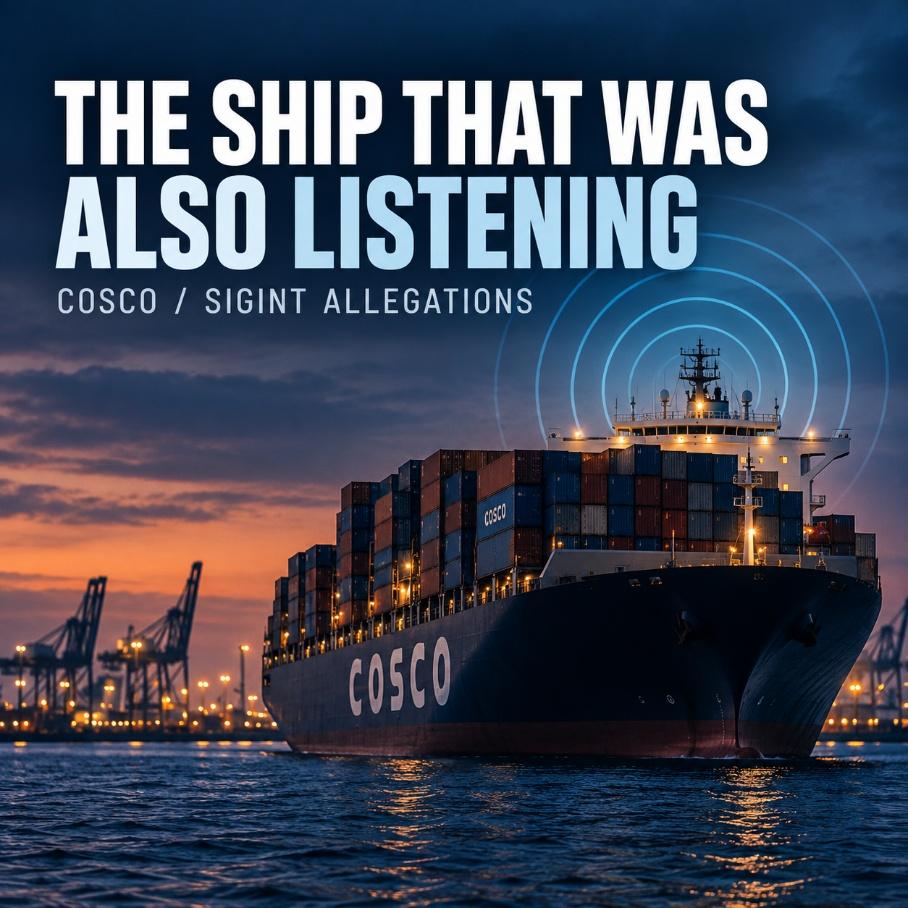
This month, two anonymous senior Trump administration officials gave that suspicion a startling new form. What they described to Reuters is a cargo of a very different kind. They allege that COSCO — the China Ocean Shipping Company, Beijing’s state-owned shipping colossus — has for years concealed sophisticated eavesdropping equipment aboard its merchant vessels, using them to spy on military communications near the coastlines of the United States and other nations.
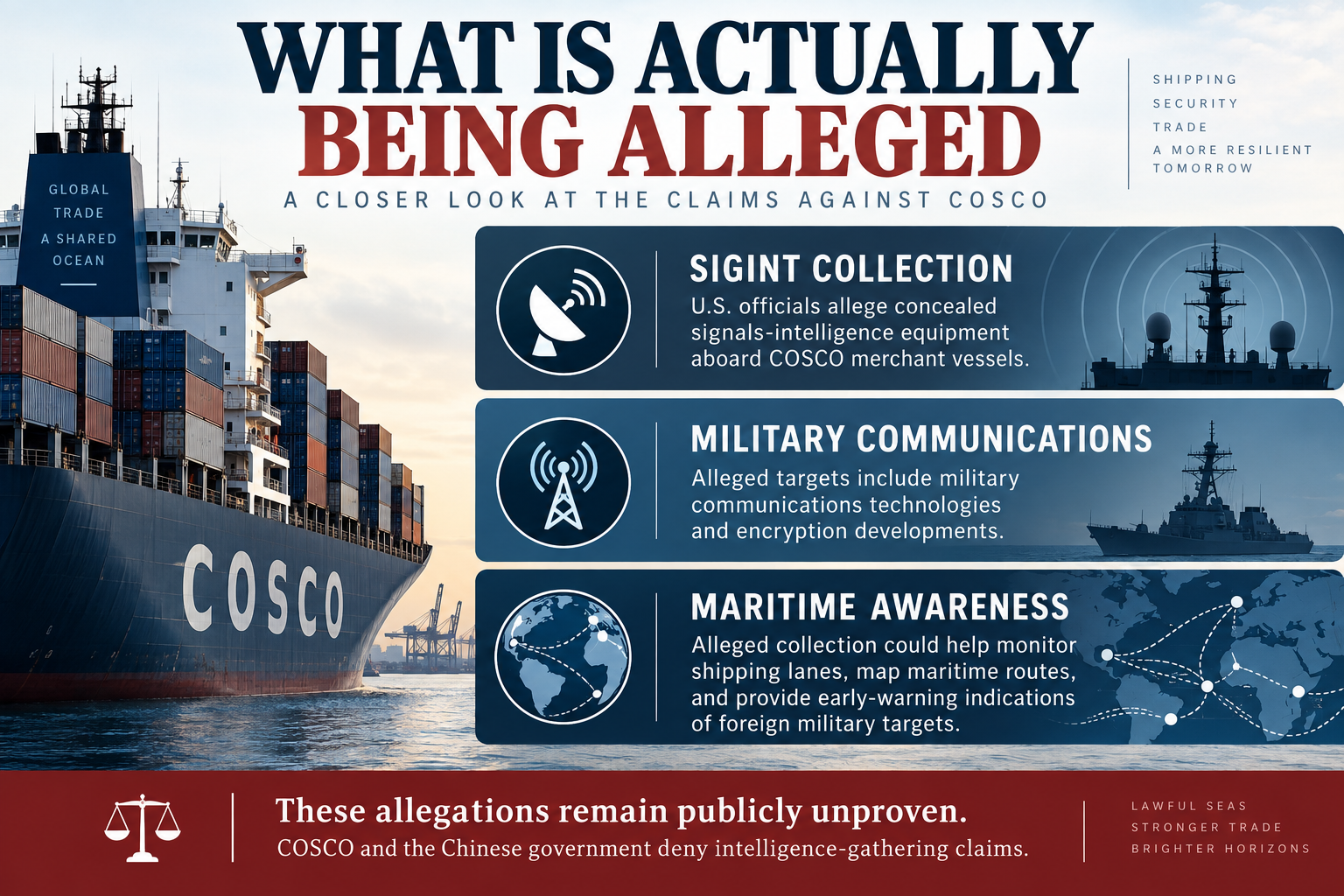
What Is Actually Being Alleged
According to the officials, who spoke on condition of anonymity, COSCO maintains a decades-long intelligence partnership with Beijing. They describe the gear aboard the ships not as routine communications hardware but as “sophisticated signals intelligence collection” platforms — SIGINT, in the trade, meaning the interception of electronic signals rather than spoken words.
The stated goals are pointed. One official said the equipment is meant to gather information on “military communications technologies and encryption developments.” The same collection, the officials added, lets China monitor key shipping lanes, map maritime routes, and generate early-warning indications of foreign military targets across Europe, North America, and Asia.
COSCO did not respond to Reuters’ request for comment. China’s embassy in Washington rejected the claim outright, with spokesperson Liu Chang saying Beijing “would never ask any company or individual to collect or provide data, information or intelligence located abroad against local laws,” and dismissing the “so-called ‘intelligence collection’ narrative” as “totally baseless.”
A Fleet That Is Also a Network
To understand why the allegation carries weight in Washington, it helps to grasp COSCO’s sheer reach. It is one of the largest shipping companies on earth, and it remains among the top carriers calling at U.S. ports, with stakes in several container-terminal joint ventures on American soil. A single vessel like the M/V Cosco Shipping Aries is one hull in a fleet woven deep into the global supply chain.
That saturation is precisely the problem. As Isaac Kardon, a scholar of Chinese maritime strategy at the Johns Hopkins School of Advanced International Studies, put it, removing COSCO from American trade would be no simple excision: “Taking COSCO out of our supply chains and transport networks could be life-threatening surgery to U.S. trade networks.”
This Is Not the First Warning
Two earlier signals set the stage for these allegations:
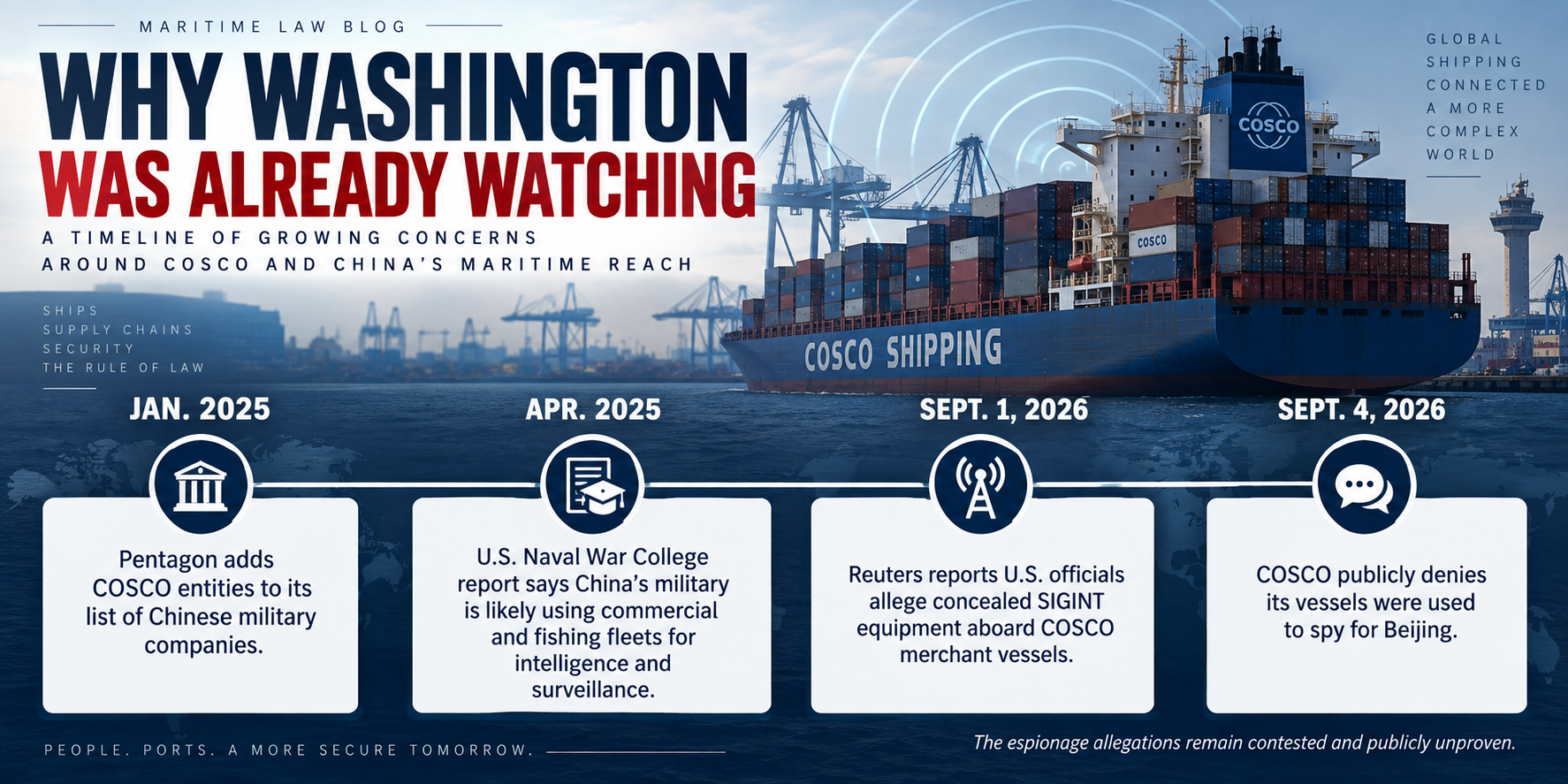
- In April 2025, a report from the U.S. Naval War College concluded it was likely that China’s PLA — the People’s Liberation Army — was already harnessing the country’s fishing and commercial shipping fleets for intelligence and surveillance.
- In January 2025, the Pentagon placed COSCO on its list of firms linked to China’s military. That designation carries real reputational and procurement consequences, though it stops short of formal sanctions.
Layered atop both is a legal reality Beijing does not dispute: Chinese law requires the country’s firms to support government intelligence work when asked. Whatever any single company intends, the statute leaves little daylight between a Chinese carrier and the Chinese state.
The Money Question Behind the Spy Story
The espionage allegation collides with a second, quieter contest over money and industrial power. The Trump administration had planned billions of dollars in port fees aimed squarely at Chinese shipping companies, COSCO among them, as part of a broader campaign to revive America’s atrophied shipbuilding and maritime industries — a campaign we examined in our earlier post, Trump Launches Bold Initiative to Revive U.S. Shipbuilding and Challenge China’s Maritime Dominance.
Those fees, developed through the Office of the U.S. Trade Representative’s Section 301 process, were paused after President Trump and Chinese leader Xi Jinping reached a year-long trade-war détente in October 2025. That truce is set to expire in November 2026, and a possible extension is expected to feature in the summit the two leaders plan to hold in Washington later this month. In other words, the spying claim surfaces at the exact moment the two governments sit down to bargain over the fees, the tariffs, and the terms that govern how Chinese ships reach American shores.
Why This Reaches the Gulf Coast
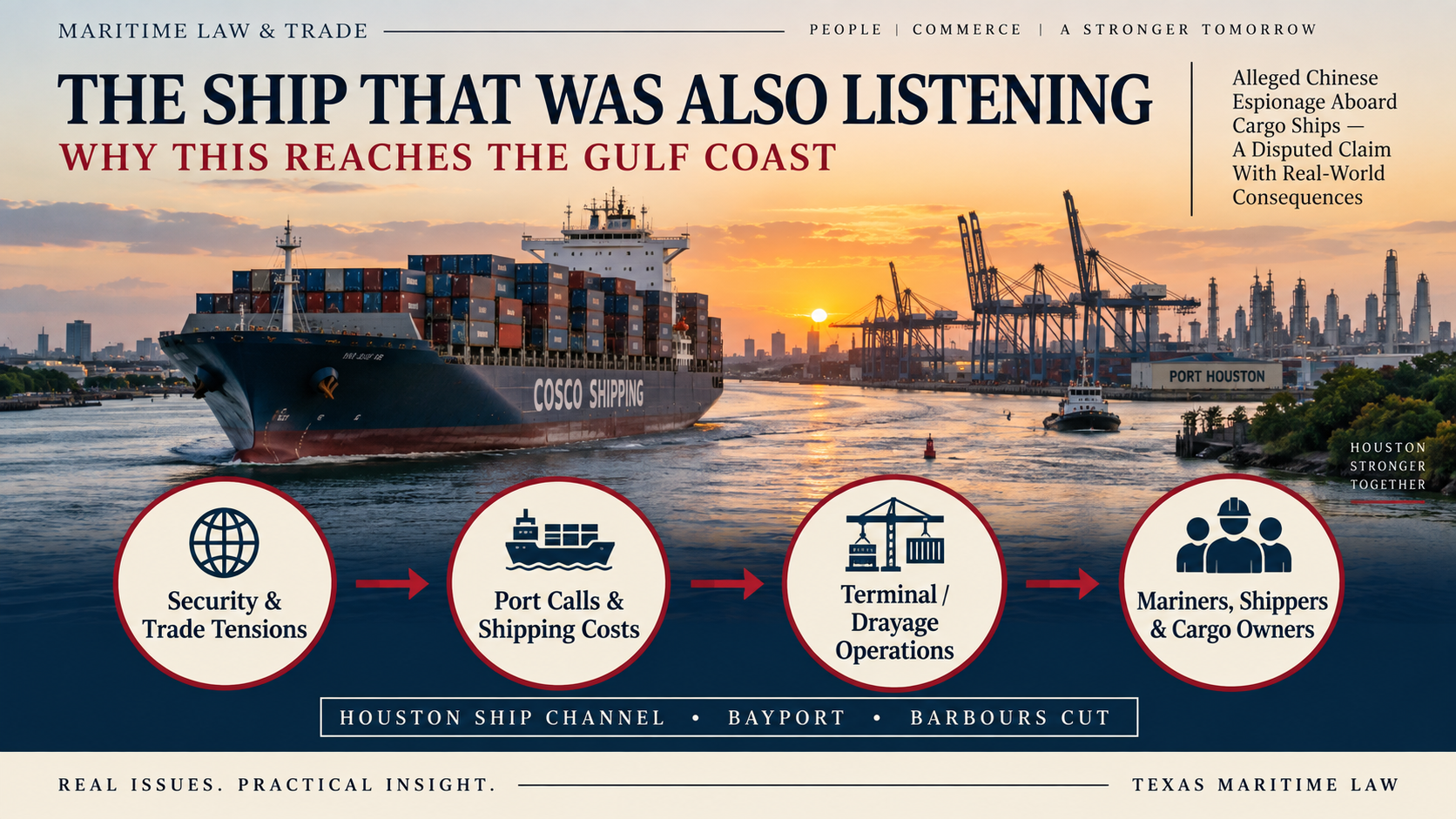
The Gulf Coast is not just a spectator here. COSCO vessels and the goods they carry move through the same waters our clients work every day — the container terminals feeding Bayport and Barbours Cut, the drayage lanes off the Houston Ship Channel, the shippers and cargo owners whose livelihoods rise and fall with the cost and reliability of a port call.
When the terms of maritime trade with China are unsettled — whether by a security scare, a fee that returns, or a truce that lapses — the tremors run straight down the supply chain to the people who load, haul, and insure the cargo. A deckhand’s overtime, a drayage company’s margins, a terminal’s throughput: these are not abstractions on the Texas coast. They are the practical weather of the maritime economy, and they shift with every headline out of Washington and Beijing.
None of this decides the truth of the allegation, which remains contested and, for now, unproven in any public forum. What it does is remind everyone who works these waters that the sea has always been a place where commerce and security travel in the same hull — and that the law, the market, and the mariner all have a stake in knowing which cargo a ship is really carrying.
After all, the oldest rule of the watch still holds: keep a weather eye, and never assume the horizon is empty just because it looks quiet.
Maritime Trivia Question!
Q: We still call electronic eavesdropping “listening,” but sailors have a much older word for keeping ears open at sea — the “scuttlebutt.” Why does a word for shipboard gossip come from a piece of deck equipment?
A: A scuttlebutt was the ship’s drinking-water cask — a butt (a large barrel) that had been scuttled, meaning cut open with a hole so the crew could dip a ration. Sailors gathered around it to drink, and, inevitably, to talk. The cask became the ship’s rumor mill, and its name became the Navy’s word for gossip and unofficial news — the original watercooler, centuries before there was a watercooler.
We at the Herd Law Firm are proud to fight for seamen, maritime workers, shippers, and passengers in all types of personal injury, death, and maritime commercial claims. As maritime attorneys (and sailors ourselves!) located in northwest Houston, we never waver in our commitment to help maritime workers, businesses, and their families when they are injured, mistreated, or shortchanged.
The information in this post is for general informational purposes only and does not constitute legal advice. For questions specific to your maritime law issue, please contact us at 713-955-3699 or at Charles.Herd@HerdLawFirm.com.
Sources
- Martina, Michael. “Chinese Shipper COSCO Collects Intel for Beijing With Concealed Equipment.” Reuters (via gCaptain), September 1, 2026. https://gcaptain.com/chinese-shipper-cosco-collects-intel-for-beijing-with-concealed-equipment/
- “Chinese Shipper COSCO Collects Intel for Beijing With Concealed Equipment, US Officials Say.” U.S. News & World Report / Reuters, September 1, 2026. https://www.usnews.com/news/world/articles/2026-09-01/exclusive-chinese-shipper-cosco-collects-intel-for-beijing-with-concealed-equipment-us-officials-say
- “China using COSCO’s merchant fleet for espionage, US says.” Baird Maritime, September 2026. https://www.bairdmaritime.com/security/non-naval-security/china-using-coscos-merchant-fleet-for-espionage-us-says
- “Port-Entry Fees on Pause: The USTR Suspends Section 301 Fees on China-Linked Vessels.” Vedder Price, November 2025. https://www.vedderprice.com/port-entry-fees-on-pause-the-ustr-suspends-section-301-fees-on-china-linked-vessels
- “USTR Port Fee Suspension: What You Need to Know.” Holland & Knight, November 2025. https://www.hklaw.com/en/insights/publications/2025/11/ustr-port-fee-suspension-what-you-need-to-know
- Herd Law Firm, PLLC. “Trump Launches Bold Initiative to Revive U.S. Shipbuilding and Challenge China’s Maritime Dominance.” https://herdlawfirm.com/firm-update/trump-launches-bold-initiative-to-revive-u-s-shipbuilding-and-challenge-chinas-maritime-dominance/