Two years after a towboat capsized in our own Houston Ship Channel, the National Transportation Safety Board has identified the cause — a thirty-nine-minute personal phone call, and three crews who stopped watching the water.
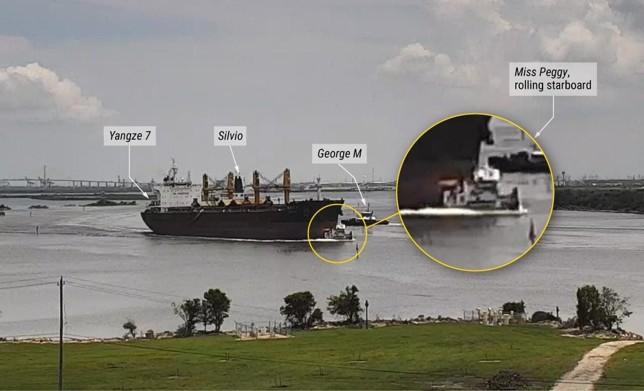
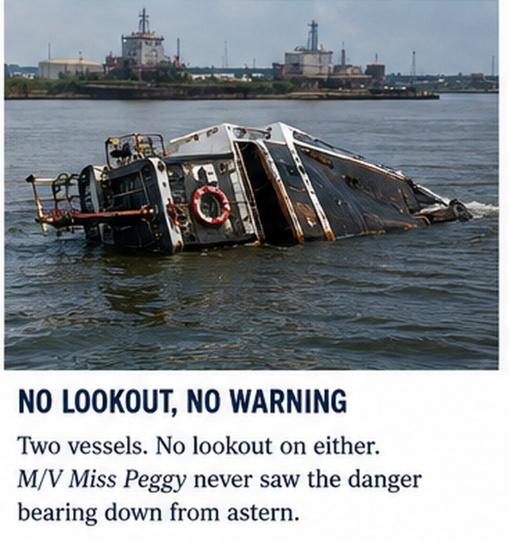
On a bright afternoon in July 2024, a mile or so above Lynchburg, the 55-foot towing vessel M/V Miss Peggy was running light back toward her fleet when the 656-foot bulk carrier M/V Yangze 7 overtook her from astern, struck her, and rolled her onto her side. She capsized and sank with five souls aboard; one mariner never came home. Though we wrote about that incident at the time, the National Transportation Safety Board (NTSB) has now reached the conclusion of its investigation in its report — and the answer is as familiar as the sea itself: nobody was keeping watch.
Thirty-Nine Minutes
The NTSB’s 92-page Marine Investigation Report reconstructs the transit almost minute by minute, and the through-line is a telephone.
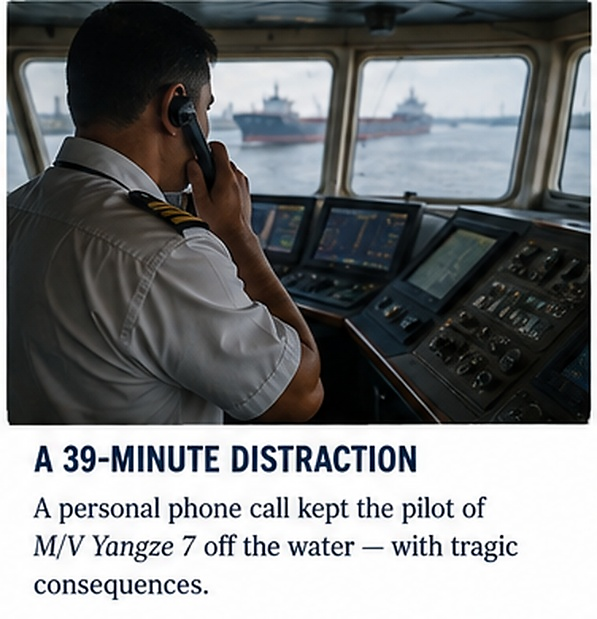
- A conversation with nothing to do with the ship. The Houston pilot conning M/V Yangze 7 took a personal call from a fellow pilot — that one aboard the outbound tanker M/T Petrel — and stayed on it, through a Bluetooth earpiece, for thirty-nine minutes while issuing rudder and engine orders. The call ended just two minutes and sixteen seconds before impact.
- A bridge team that saw the danger, and said nothing. One officer told investigators he was “very afraid,” listening to the pilot give helm commands between snippets of a chat about anything but navigation. No one intervened — a textbook failure of what mariners call bridge resource management (BRM).
- Two vessels, and no lookout on either. The captain of M/V Miss Peggy never saw M/V Yangze 7 bearing down from astern; the bulk carrier’s own bridge did not pick out the little towboat until she was less than a ship’s length ahead.
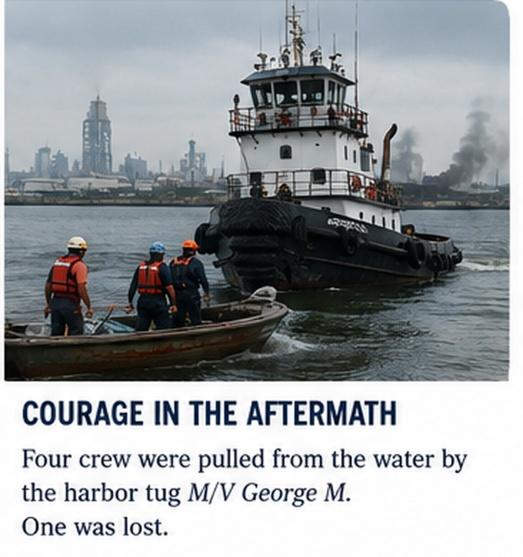
- The cost? Four crew were pulled from the water by the nearby harbor tug M/V George M, one of them seriously hurt; a fifth seaman was later found inside the wreck. The gas carrier M/T Silvio was closing on the far side of the channel at the time. Salvage and pollution cleanup ran about $3.7 million. M/V Yangze 7 was not even scratched.
The Oldest Rule at Sea
There is a duty older than the Jones Act, older than the Republic itself: the duty to keep a proper lookout. It is written plainly into the Inland Navigation Rules (Rule 5), and it is exactly what all three watchstanders let slip. This is not the first Houston Ship Channel collision the Board has taken apart — it issued a similar report on the M/V Genesis River allision — but seldom has the cause been so plainly human.
Admiralty law treats that lapse with unusual severity. Under a rule the Supreme Court laid down in The Pennsylvania back in 1873, when a vessel is breaking a safety regulation at the moment of a collision, the burden flips: she must prove her violation could not have caused the wreck — not merely that it probably did not. A missing lookout is precisely the kind of violation that trips that presumption. For grieving families and injured crew, a 150-year-old rule of evidence becomes a very present tailwind.
What the Law Offers the Crew
The mariners aboard M/V Miss Peggy were seamen, and American maritime law generally does not leave seamen to absorb a tragedy like this alone.
- Jones Act negligence. A seaman’s employer answers if its negligence played “any part, even the slightest” in the injury — the most forgiving causation standard in American law. Here’s more information about the U.S. Jones Act and its history.
- Unseaworthiness. A vessel owner is strictly liable when the ship is not reasonably fit — and a crew that fails to keep a lookout can itself render a vessel unseaworthy —wholly apart from any question of the owner’s own care.
- Maintenance and cure. An injured seaman is owed his daily living expenses and medical care until he reaches maximum medical improvement (MMI), regardless of who was at fault.
- A compulsory pilot’s error is not a dead end. Houston pilotage is compulsory, and a shipowner will sometimes argue it should not answer for a state pilot’s mistakes. But since The China (1868), the vessel herself remains liable in an action in rem for a compulsory pilot’s negligence — so an injured mariner is not left chasing a phantom defendant.
A Policy-Shaped Hole
The report’s most unsettling finding is not about one distracted pilot, but about a culture of distraction. The Houston Pilots had no rule against using personal devices for non-operational purposes while directing a ship, and omission, the NTSB found, quietly normalized the habit.
Nationally, the Board counted personal-electronic-device distraction as a cause or contributing factor in at least ten marine casualties between 2009 and 2024 — three deaths, forty-five injuries. It has recommended that the United States Coast Guard (USCG) prohibit the non-operational use of such devices by anyone directing a vessel, and urged the American Pilots’ Association (APA) to write the same rule into its own guidance.
Why This Reaches the Gulf Coast
This happened in our channel — the same water thousands of vessels and crew cross every single day. And because it happened in Texas’s own waters, rather than far out at sea, the families are not confined to the narrow Death on the High Seas Act (DOHSA); the Jones Act and General Maritime Law offer fuller remedies for the loss.
After all, a ship is a workplace where a single lapse of attention can kill; 39 minutes time is more than enough.
Maritime Trivia Question!
Q: What is the nautical origin of the phrase “taken aback”?
A: On a sailing vessel, the sails are aback when the wind strikes their forward surfaces rather than filling them normally from behind. An unexpected wind shift could suddenly press the sails against the masts and rigging, stop the vessel’s forward motion, or even force her backwards. A sailor whose ship was unexpectedly “taken aback” was therefore abruptly checked and thrown off course—exactly the sense the phrase later acquired on land.
We at the Herd Law Firm are proud to fight for seamen, maritime workers, and passengers in all types of personal injury and death claims. As maritime personal injury attorneys (and sailors ourselves!) located in northwest Houston, we never waver in our commitment to help these maritime workers, passengers, and their families when they are injured or mistreated.
The information in this post is for general informational purposes only and does not constitute legal advice. For questions specific to your maritime law issue, please contact us at 713-955-3699 or at Charles.Herd@HerdLawFirm.com. Herd Law Firm, PLLC, 8826 Louetta Road, Suite 310, Spring, Texas 77379.
Sources
- National Transportation Safety Board. Marine Investigation Report, Collision of Bulk Carrier Yangze 7 and Towing Vessel Miss Peggy, Houston Ship Channel (Accident No. DCA24FM051), 2026. https://www.ntsb.gov/investigations/Pages/DCA24FM051.aspx
- Schuler, Mike. “NTSB: Pilot’s Personal Phone Call Contributed to Fatal Houston Ship Channel Collision.” gCaptain, August 6, 2026. https://gcaptain.com/ntsb-pilots-personal-phone-call-contributed-to-fatal-houston-ship-channel-collision/
- “NTSB: Houston Pilot’s Cell Phone Call Contributed to Fatal Collision.” The Maritime Executive, August 6, 2026. https://maritime-executive.com/article/ntsb-houston-pilot-s-cell-phone-call-contributed-to-fatal-collision
- “NTSB Cites Cellphone Use by Houston Pilot Before Fatal Collision.” Professional Mariner, August 2026. https://professionalmariner.com/ntsb-cites-cellphone-use-by-pilot-before-fatal-texas-collision/
- “Pilot’s Cellphone Distraction Leads to Fatal Houston Ship Channel Collision.” Marine Insight, August 2026. https://www.marineinsight.com/pilots-cellphone-distraction-leads-to-fatal-houston-ship-channel-collision-involving-bulk-carrier-and-towboat-ntsb/
- Inland Navigation Rules, Rule 5 (Look-out), 33 C.F.R. § 83.05. Legal Information Institute, Cornell Law School. https://www.law.cornell.edu/cfr/text/33/83.05
- The Pennsylvania, 86 U.S. (19 Wall.) 125 (1873). Justia. https://supreme.justia.com/cases/federal/us/86/125/
- Legal Information Institute, Cornell Law School. “46 U.S. Code § 30104 – Personal injury to or death of seamen” (the Jones Act). https://www.law.cornell.edu/uscode/text/46/30104