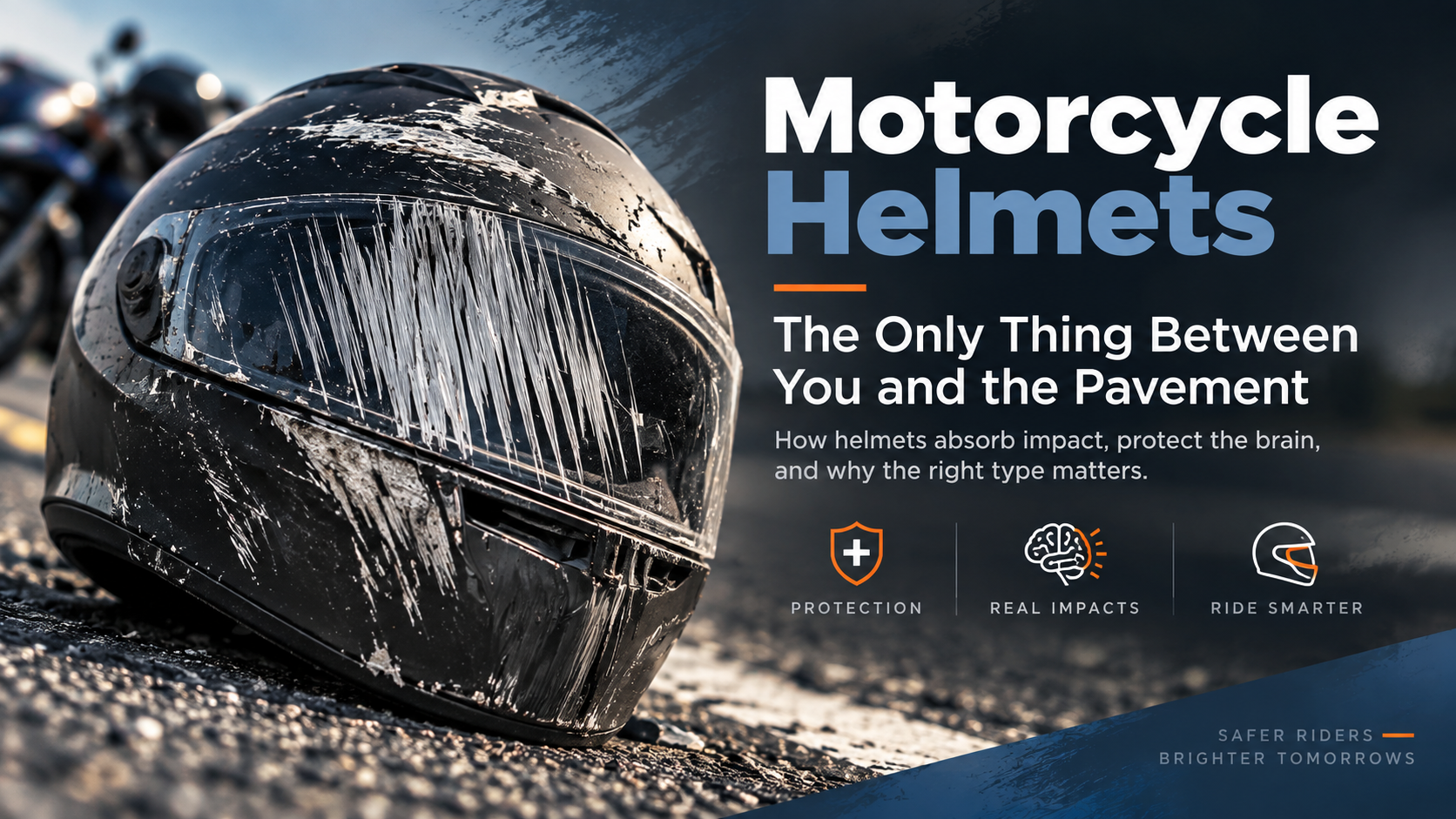
So many devastating images of safety helmets post-accident tell the same story: outer shell deep-gouged down to the weave, chin bar ground flat, liner shaved near clean down to the skull. Those marks represent deadly kinetic forces absorbed by the helmet instead of your head. And as a personal injury attorney and rider myself, I’ve always been concerned with how a helmet turns a deadly crash into a survivable one, what every part of it does, which style fits which activity, what the ratings on the sticker mean for consumers (and my clients!), and what Texas law says about going without.
Compared to the shield and plate armor of ancient times, the safety helmet is a high-tech modern marvel. Instead of just absorbing force, it functions as a tightly-engineered controlled-collapse device, working on the same principle as the crumple zone on a car: not to stop your head sooner, but to stop it slower.
What the Numbers Actually Show
The National Highway Traffic Safety Administration (NHTSA), the federal agency that writes motor vehicle safety standards, has studied this for decades:
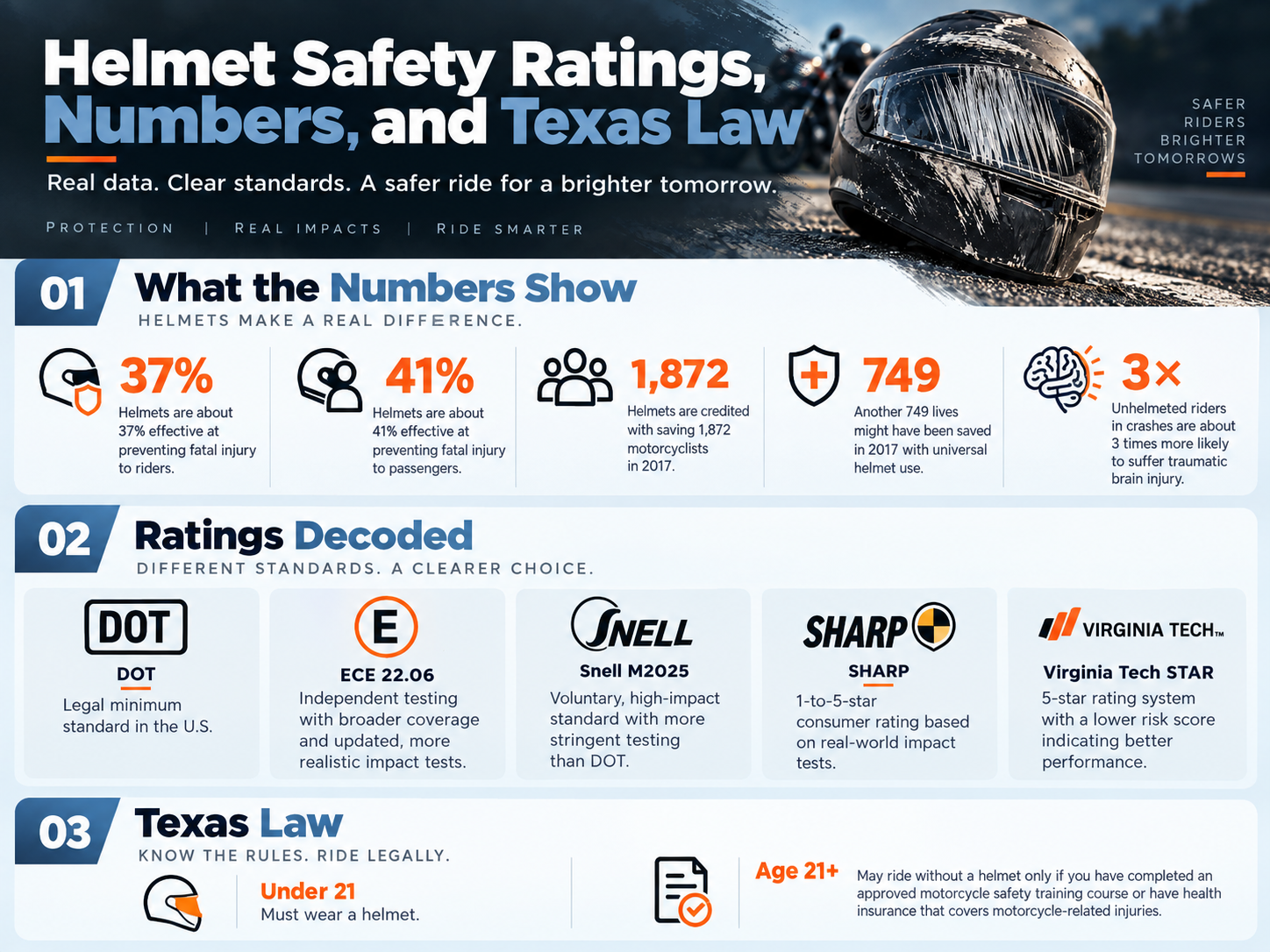
- Helmets are estimated to be 37 percent effective at preventing fatal injury to motorcycle riders, and 41 percent for passengers. Put plainly: for every 100 unhelmeted riders killed, 37 of them would likely have lived had all 100 worn helmets.
- NHTSA credits helmets with saving 1,872 motorcyclists in 2017 alone, and estimates another 749 lives would have been saved that year with universal helmet use.
- Unhelmeted riders involved in crashes are roughly three times more likely to suffer a traumatic brain injury (TBI) than helmeted riders.
These numbers are updated annually from the Fatality Analysis Reporting System, the federal census of fatal crashes.
The Science — Why Slowing Down Saves Brains
Injury comes from abrupt deceleration, not speed. A head traveling at 20 miles per hour that stops against bare pavement in about a millisecond experiences enormous forces, but the same head stopping over six or seven milliseconds because a foam liner is crushing beneath it will only experience a fraction of them. Stretching the stop by a few thousandths of a second and a few centimeters of crush distance is the heart of the entire engineering problem, and everything else in a helmet exists to solve it.
There are two distinct ways a head gets hurt, and good helmets will address both:
- Linear acceleration. A straight-on blow. The brain, floating in fluid, slams against the inside of the skull — the classic mechanism behind skull fracture, contusion, and the “back-and-forth” (coup-contrecoup) pattern where injury appears both at the impact site and opposite it. This is what the oldest standards measure, usually as peak g-force and as the Head Injury Criterion (HIC), a calculation that weighs how hard the deceleration was against how long it lasted.
- Rotational acceleration. A glancing, angled blow that twists the head. Real crashes are almost always angled, and twisting is what shears the long nerve fibers running through the brain — the mechanism behind concussion and diffuse axonal injury, which does not always show up on an initial scan. For decades, no helmet standards addressed these injuries.
The foam does its work by crushing permanently, which is why a helmet is almost always a one-impact device. Expanded polystyrene (EPS) — dense, closed-cell foam, cousin to the material in a shipping cooler — collapses at a predictable rate and does not spring back. A liner that has already been crushed has nothing left to give, and a shell that looks fine can hide it. Better helmets now use multi-density EPS: a softer layer that manages low-speed knocks (a parking-lot tip-over can still “ring your bell”) and a denser layer beneath it for the serious impacts.
Rotational forces are handled differently by letting the helmet some movement. A slip-plane layer, of which the Multi-directional Impact Protection System (MIPS) is the best known, sits between the liner and the head and allows a few millimeters of rotation during an angled hit, bleeding off twist before it reaches the brain. Competing designs achieve the same end with flexing liners or dual-shell construction.
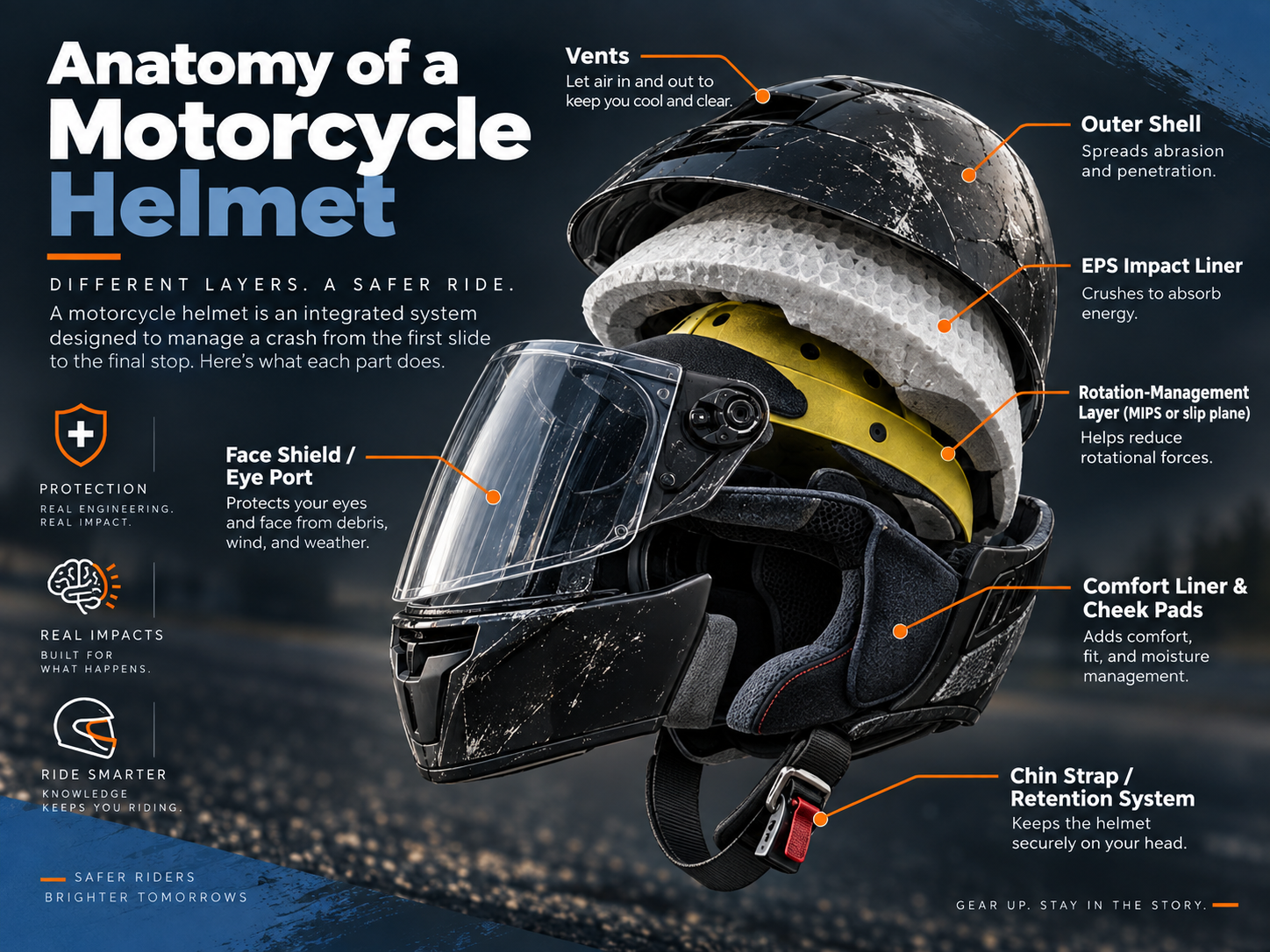
Anatomy of a Helmet
- Outer shell. Polycarbonate, fiberglass composite, or carbon fiber. It resists penetration and, just as importantly, spreads a point load — a curb edge, a bolt head — across a wide area of the foam beneath. It also slides on pavement instead of grabbing, which reduces the twist that reaches your neck.
- Impact liner. The EPS, and the actual safety system. Everything else is support staff.
- Rotation-management layer. MIPS or an equivalent slip plane, where fitted.
- Comfort liner and cheek pads. Removable, washable padding that sets the fit. The cheek pads are doing more than you think — they stabilize the helmet against your jaw and keep it from rotating on your head. Many now have emergency-release tabs so paramedics can deflate the fit and remove the helmet without moving the neck.
- Retention system. The chin strap and its double-D rings or micrometric ratchet. The one component that fails silently and completely if you skip it.
- Face shield and eye port. Optical-grade polycarbonate, ideally with an anti-fog insert and a locking mechanism. ECE certification tests the shield; the American standard does not.
- Vents and channels. Airflow in the brow and chin, exhaust at the rear. On the Gulf Coast in August this is not a luxury — heat stress degrades judgment faster than most riders admit.
- Chin bar, peak, or neck roll, depending on the style — which brings us to the styles themselves.
Styles and What Each One Is Suited For
A 1991 study by Dietmar Otte at Hannover Medical University examined 598 crash-damaged helmets and found that the highest single concentration of impact points — about 35 percent — landed on the chin-bar region, an area neither the American nor the European standard tested at the time. Keep that number in mind while reading the list.
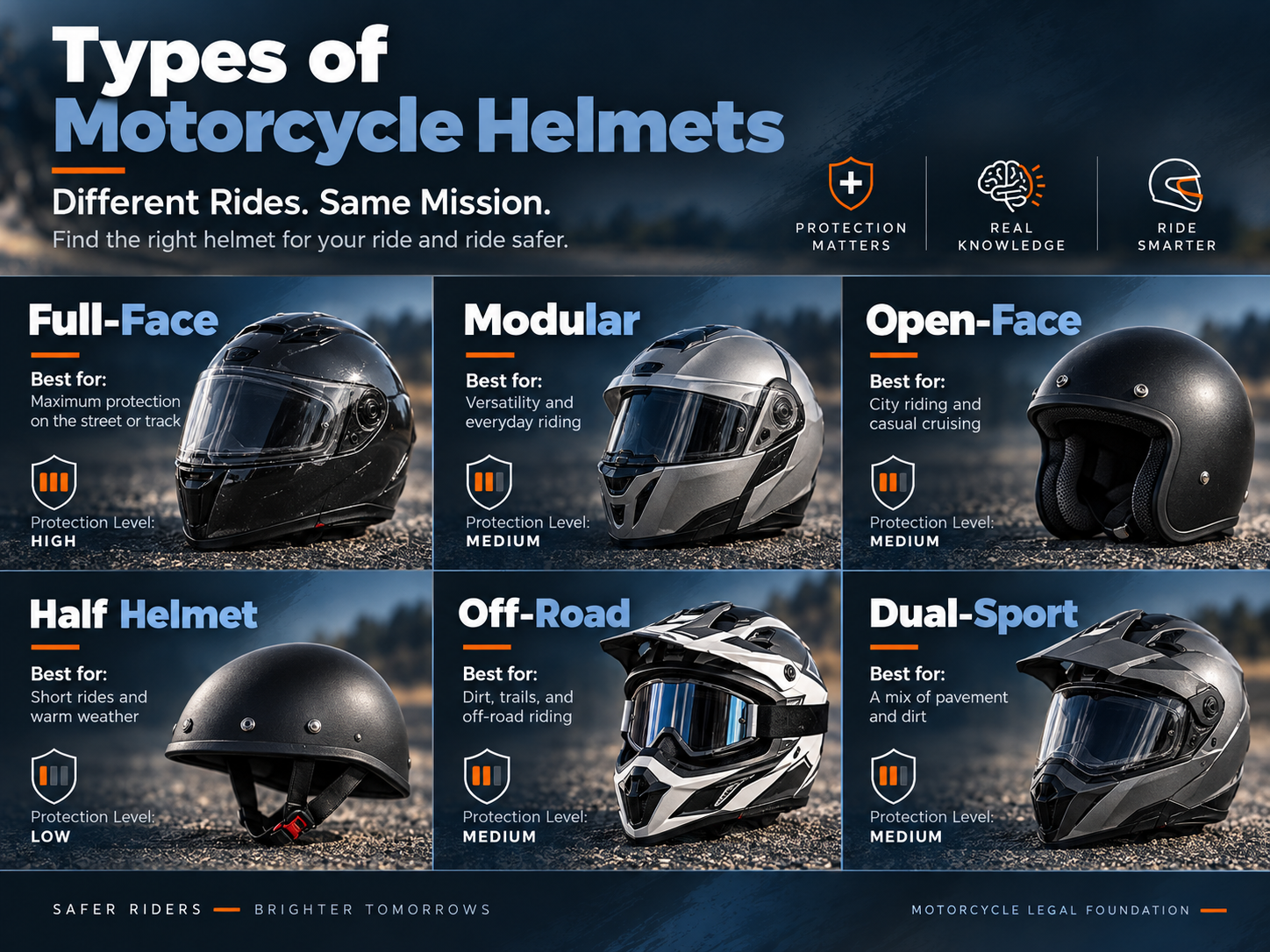
- Full-face. Fixed chin bar, sealed eye port. The most protective configuration available and the quietest at highway speed. Best for commuting, sport riding, touring, and anything on an interstate.
- Modular (flip-up). The full-face chin bar hinges up for conversation, glasses, or a gas stop. Slightly heavier, with a hinge that is one more thing to fail; look for one certified in both the open and closed positions, which ECE 22.06 requires. The versatile choice for touring and commuting.
- Open-face (three-quarter). Covers the skull, ears, and back of the head; leaves the face bare. Pleasant on a slow cruise, and it surrenders the single most-struck region of the helmet. Pair it at minimum with a face shield or goggles.
- Half helmet (“shorty”). Crown coverage only. Some are DOT-compliant, many sold at rallies are not, and none protect the face, jaw, or base of the skull. The least protective thing that can legally be called a helmet.
- Off-road / motocross. Elongated chin bar for airflow during hard breathing, a sun peak, no shield — goggles are mandatory with it. Very light, superb ventilation, poor aerodynamics and noise control on pavement.
- Dual-sport / adventure. The compromise: a full-face shell with an aerodynamic peak and a wide eye port that takes either a shield or goggles. The right answer for anyone riding pavement to get to dirt.
A helmet certified for one sport is not automatically right for another. Motorcycle helmets are built for a single high-energy impact; bicycle helmets, governed in the United States by the Consumer Product Safety Commission standard at 16 C.F.R. Part 1203, are lighter and cooler for a lower-speed crash; equestrian, climbing, whitewater, and hockey helmets are all tuned to different impact profiles, and several of those are designed for multiple minor impacts rather than one severe one. Always use the helmet built for what you are doing!
The Ratings, Decoded
Three of the marks on a helmet are certifications — pass or fail. Two more are ratings, or a score on a curve. Riders often confuse this, and the distinction matters when you are standing in a shop comparing options:
- DOT (FMVSS 218). The Department of Transportation standard, Federal Motor Vehicle Safety Standard 218, is the legal floor for any helmet sold for road use in the United States. It tests impact attenuation, penetration, retention, and peripheral vision — but it relies on manufacturer self-certification, backed by government spot-checks after the fact, and it does not test rotational impact, chin bars, or face shields.
- ECE 22.06. The United Nations Economic Commission for Europe standard, accepted in more than fifty countries and mandatory for new helmet sales in Europe since 2024. It requires independent laboratory testing before sale plus ongoing batch testing, covers more impact points and speeds, and — unlike DOT — tests rotational impact, chin bars, face shields, modular helmets in both positions, and even the effect of mounted communication accessories.
- Snell M2025. A voluntary standard from the private, non-profit Snell Memorial Foundation, updated roughly every five years and geared toward the high-energy impacts of racing. Snell tests helmets in its own lab and then buys them off retail shelves to re-test. Many track days require it.
- SHARP. The Safety Helmet Assessment and Rating Programme, run by the United Kingdom’s Department for Transport since 2007. SHARP is not a certification. It buys helmets at retail, strikes them at multiple points and speeds, and publishes a one-to-five-star score, so a rider can tell a helmet that barely cleared the bar from one that sailed over it.
- Virginia Tech STAR. The Virginia Tech Helmet Lab measures both linear and rotational acceleration and publishes a five-star rating with a numerical risk score for concussion and serious brain injury — lower is better. It is the most direct consumer answer to the rotational problem described above.
It’s often recommended to use all five.
- Start with what the law requires — a DOT-compliant helmet.
- Prefer one that also carries ECE 22.06, because that mark indicated it was tested independently it before it was sold.
- Then check the SHARP and Virginia Tech scores for the specific model, which indicate how far past the minimum that model actually performs.
The Rest of Your Kit
A helmet protects roughly nine percent of your body. The gear that goes with it depends on the activity:
- Street and commuting. Abrasion-resistant jacket and pants (leather or a technical textile with CE-rated armor at shoulders, elbows, hips, and knees), over-the-ankle boots, full-finger gloves with palm sliders, and eye protection. Filtered earplugs are a genuine safety item, not for comfort — sustained wind noise above highway speed causes permanent hearing loss and fatigue.
- Sport and track. One-piece leathers, a back protector, and (now increasingly) an airbag vest, which inflates in the fraction of a second before impact and is touted as the most significant addition to rider protection in decades.
- Off-road. Goggles, chest and roost protector, knee braces rather than only pads, and a neck brace to limit hyperflexion in a hard landing.
- Touring. Everything above plus high-visibility panels or reflective piping. Conspicuity (visibility) is protective equipment; most multi-vehicle motorcycle crashes involve a driver who says he never saw the bike.
- On the water. Whitewater, personal watercraft, and racing sailors use helmets built to shed water and take repeated low-energy knocks — and they always come paired with a properly fitted personal flotation device (PFD). A helmet that fills with water or will not release is a hazard of its own!
Choosing One That Will Do the Job
- Fit before brand. Measure your head at its widest point and buy to the manufacturer’s chart, not to a size you remember. The helmet should be snug enough that the cheek pads move your skin when you shake your head, with no hot spots after twenty minutes. Head shapes differ — round, intermediate, long oval — and a helmet that fits your neighbor may be wrong for you.
- Do the roll-off test. Fasten the strap, then try to roll the helmet forward off the back of your head. If it comes off, it will come off in a crash.
- Fasten the strap every time. Snug under the jaw, two fingers of clearance at most.
- Avoid “novelty” helmets. Thin shells with a questionable DOT sticker and little or no crushable liner satisfy neither safety nor the statute. A real helmet has significant thickness under the shell and a permanent manufacturer’s label.
- Replace after any real impact, including a solid drop onto a hard floor, and at least every five years — liners compress, adhesives age, and sweat and hair oils break down the foam from the inside. Never buy a used helmet; you cannot know its history.
What Texas Law Requires
Texas has what is called a partial helmet law. Under Texas Transportation Code § 661.003, every operator and passenger must wear protective headgear meeting federal standards — with one exemption. A rider or passenger who is at least 21 may go without a helmet only if he or she has either completed an approved motorcycle operator training course under Chapter 662 or carries health insurance covering injuries from a motorcycle crash.
Three details riders often miss:
- There is no exemption at all for anyone under 21, operator or passenger.
- A passenger 21 or older needs his or her own exemption. The operator’s does not carry over.
- The burden of proof sits with the rider. Carry the course certificate or insurance card, because an officer may add a helmet citation during an otherwise routine stop.
Riding without a helmet where the exemption applies does not bar a claim if someone else caused the wreck. But Texas is a proportionate responsibility state: under Chapter 33 of the Civil Practice and Remedies Code, a claimant found more than 50 percent responsible recovers nothing, and a defense lawyer will look for every percentage point available.
Remember: a helmet protects your head first and your case second, in that order.
Why This Reaches the U.S. Gulf Coast
This firm spends much of its time working with mariners, and the connection is closer than it looks. A great many of the seamen, longshore workers, and yard hands along the U.S. Gulf Coast, as well as their loved ones, commute two wheels. A crash on one of Texas’ many busy highways can end a career (or a life) as easily as a fall into a cargo hold.
The message is much the same one that runs through everything we write here: Whether the workplace is a tanker’s deck or a dark road, the law asks who controlled the risk, what was known about it, and whether the person who bore the danger was given a real chance to protect himself. A helmet is the rare case where that chance is entirely in the rider’s own hands.
Trivia Question (For Wheels and Water!)
Q: A rider wears a helmet; a sailor stands at the helm. Same word?
A: Likely not, but it’s a long-standing disagreement in language. The ship’s helm comes from Old English “helma”, a rudder or tiller, also to “helve” or handle of an axe — a thing you grasp.
Our modern helmet comes from the armored helm, from which “helmet” is a diminutive formed with the French -et or -ette, comes from a root meaning to cover or conceal. Essentially, terming it a “little helm”.
Etymologists still argue over whether the two eventually trace back to the same ancient source, and the major dictionaries split on it. Either way, English ended up with one word for the thing that steers you and another for the thing that saves you when steering was not enough.
We at the Herd Law Firm are proud to fight for seamen, maritime workers, shippers, passengers, and injured Texans in all types of personal injury, death, and maritime commercial claims. As maritime attorneys (and sailors ourselves!) located in northwest Houston, we never waver in our commitment to help working people and their families when they are injured, mistreated, or shortchanged.
The information in this post is for general informational purposes only and does not constitute legal advice. For questions specific to your personal injury or maritime law issue, please contact us at 713-955-3699 or at Charles.Herd@HerdLawFirm.com. Herd Law Firm, PLLC · 8826 Louetta Road, Suite 310, Spring, TX 77379.

Sources
- National Highway Traffic Safety Administration. “Traffic Safety Facts: Motorcycles” (helmet use and effectiveness; 37/41 percent). https://crashstats.nhtsa.dot.gov/Api/Public/ViewPublication/813466
- Deutermann, William V. “Calculating Lives Saved by Motorcycle Helmets.” NHTSA, DOT HS 809 861. https://crashstats.nhtsa.dot.gov/Api/Public/ViewPublication/809861
- National Highway Traffic Safety Administration. “Motorcycle Helmet Use in 2023” (Research Note; NOPUS observed use). https://crashstats.nhtsa.dot.gov/Api/Public/ViewPublication/813634.pdf
- Insurance Institute for Highway Safety. “Motorcycles” (helmet effectiveness and universal helmet laws). https://www.iihs.org/research-areas/motorcycles
- Texas Transportation Code ch. 661 (protective headgear) and ch. 662 (operator training). Texas Statutes. https://statutes.capitol.texas.gov/Docs/TN/htm/TN.661.htm
- Texas Civil Practice & Remedies Code ch. 33 (proportionate responsibility). https://statutes.capitol.texas.gov/docs/cp/htm/cp.33.htm
- UK Department for Transport. SHARP — The Safety Helmet Assessment and Rating Programme. https://sharp.dft.gov.uk/
- Snell Memorial Foundation. Standards for protective headgear (M2025). https://smf.org/
- RevZilla. “Helmet Safety Ratings 101.” https://www.revzilla.com/common-tread/helmet-safety-ratings-101
- Otte, Dietmar. “Technical Demands on Safety in the Design of Crash Helmets” (SAE 912911; 598 crash helmets, chin-bar impact distribution). https://doi.org/10.4271/912911
- COST 327 — Motorcycle Safety Helmets, Final Report. European Commission / UK Department for Transport. https://sharp.dft.gov.uk/wp-content/themes/sharp2017/pdfs/COST-327-Motorcycle-Safety-Helmets-Final-report.pdf
- Consumer Product Safety Commission. Safety Standard for Bicycle Helmets, 16 C.F.R. pt. 1203. https://www.ecfr.gov/current/title-16/chapter-II/subchapter-C/part-1203
- Online Etymology Dictionary. “helm” (n.1 and n.2). https://www.etymonline.com/word/helm