
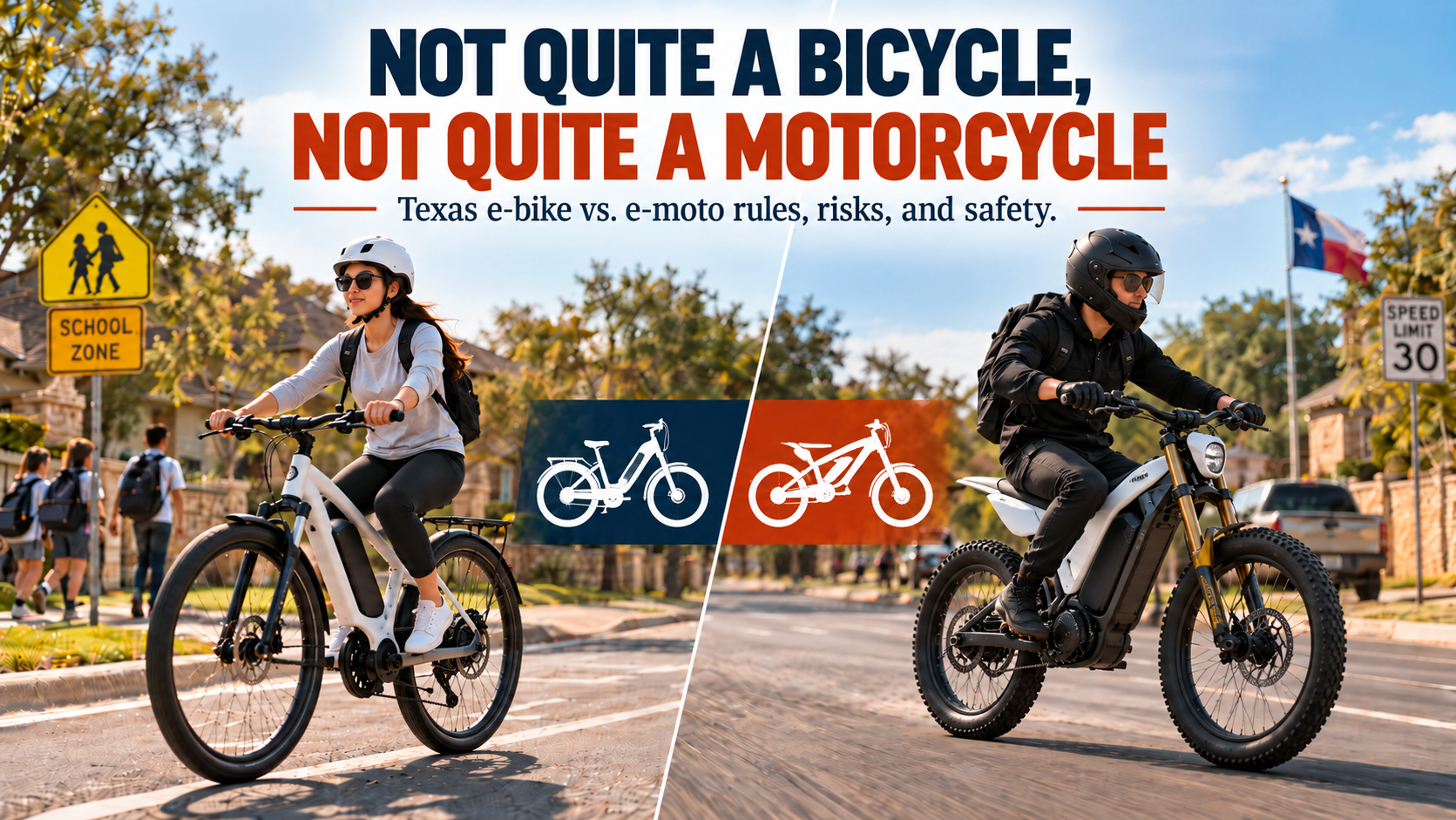
Electric bicycles or e-bikes are multiplying on Texas streets, and many of the machines sold under that name are dangerously mislabeled. This is a guide for riders (and parents) for telling them apart, the rules of the road for each, their risks and dangers, and the habits that help keep you safe, all from a lawyer who rides, too!
Watch most neighborhoods and school pickup lines this fall, and you will see the newest vehicle on the road: an electric bicycle or e-bike, often with a teenager (or younger) riding, sometimes moving at speeds my son’s first dirt bike would have envied.
School districts and authorities across the nation have taken notice. Officers and emergency services are reporting a sharp increase in injuries involving high-powered electric vehicles ridden by children and teens; Just this past month, a 14-year-old near Austin, Texas tragically died after losing control of an electric motorbike while riding with friends; police said he was not wearing a helmet.
When looking at these e-bikes on the market, you may notice something: some of these are not e-bikes at all, and are dangerously mislabeled. High-powered electric dirt bikes, commonly called “e-motos,” are routinely listed and sold online as “e-bikes,”; the families buying them often have no idea that Texas law treats the two very differently and for very good reason. A true e-bike is legally a bicycle, while e-moto is functionally (and legally) a type of motorcycle.
My family and I ride both bicycles and motorcycles, so I understand the appeal. There is nothing quite like two wheels, clear skies, and an open road. The trouble is that the same word, “e-bike,” now covers everything from a gentle pedal-assist cruiser to a 50 mph electric motorcycle, while the law (and common sense) can draw a sharp line between them.
A Fast-Growing Toll
The U.S. Consumer Product Safety Commission (CPSC) published its latest micromobility report in April 2026, and the e-bike numbers climb steeply:
- Deaths: CPSC staff are aware of 310 e-bike-related deaths from 2017 through 2024 — none reported in 2017, and 97 in 2024 alone. Recent years are still being counted, so those figures will likely rise.
- Emergency rooms: an estimated 59,200 e-bike injuries were treated in emergency departments in 2024, up from an annual average of roughly 6,300 between 2017 and 2021.
- Cars, not crashes alone: collisions with moving or parked motor vehicles caused 170 of the 310 deaths; loss of control caused another 61.
- Older riders: of 92 micromobility deaths among riders 65 and older, 75 involved e-bikes.
- Helmets: in the CPSC’s 2024 follow-up study, only 40 percent of injured e-bike riders were wearing a helmet.
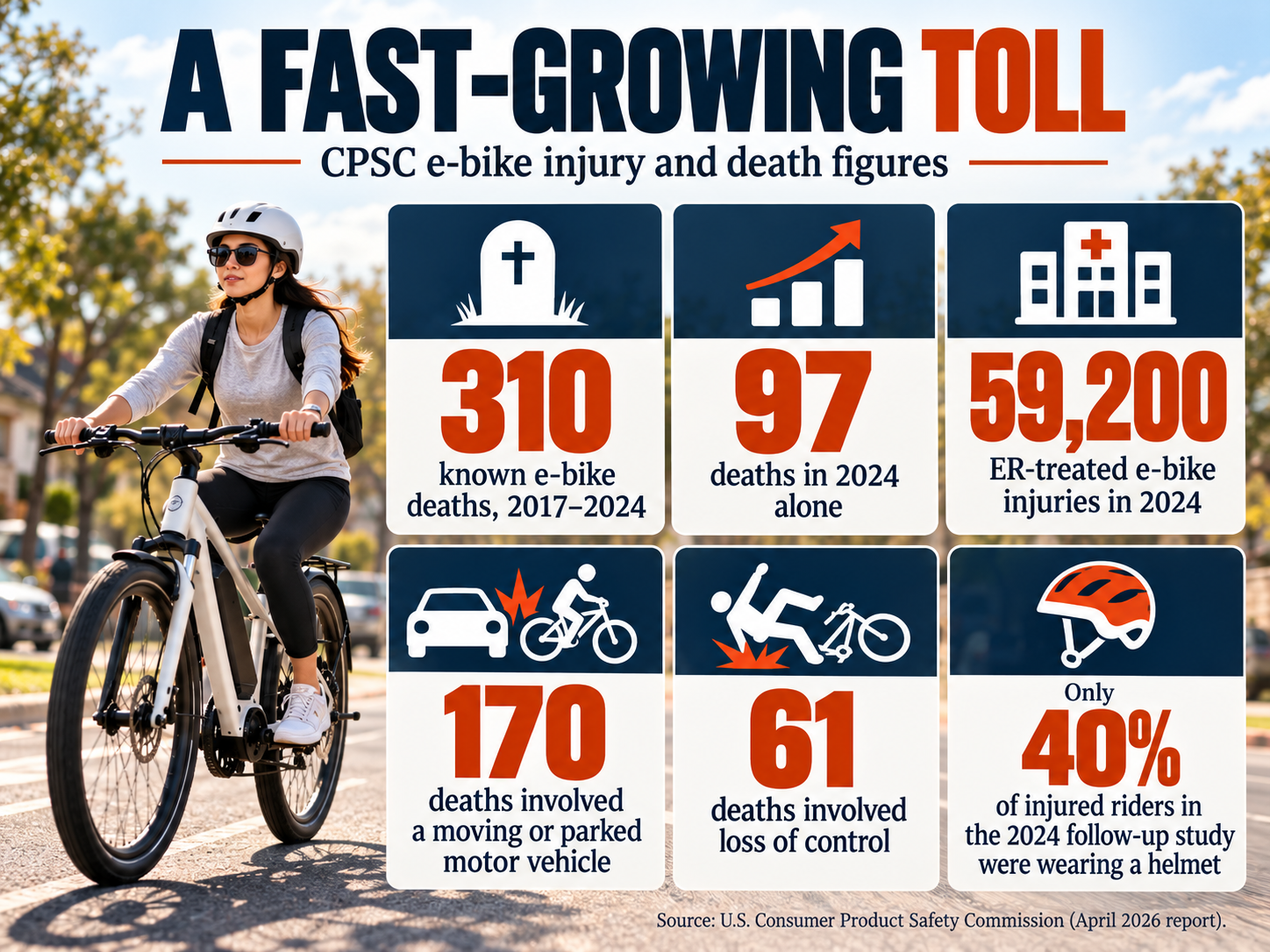
These numbers depend on how riders, families, and hospitals describe the machine involved, and only some of them distinguish a legal e-bike from an e-moto sold under the same name. The “e-bike” statistics very likely include both, which underscores the need for regulators to better distinguish the two.
E-Bike, E-Moto, or Electric Motorcycle?
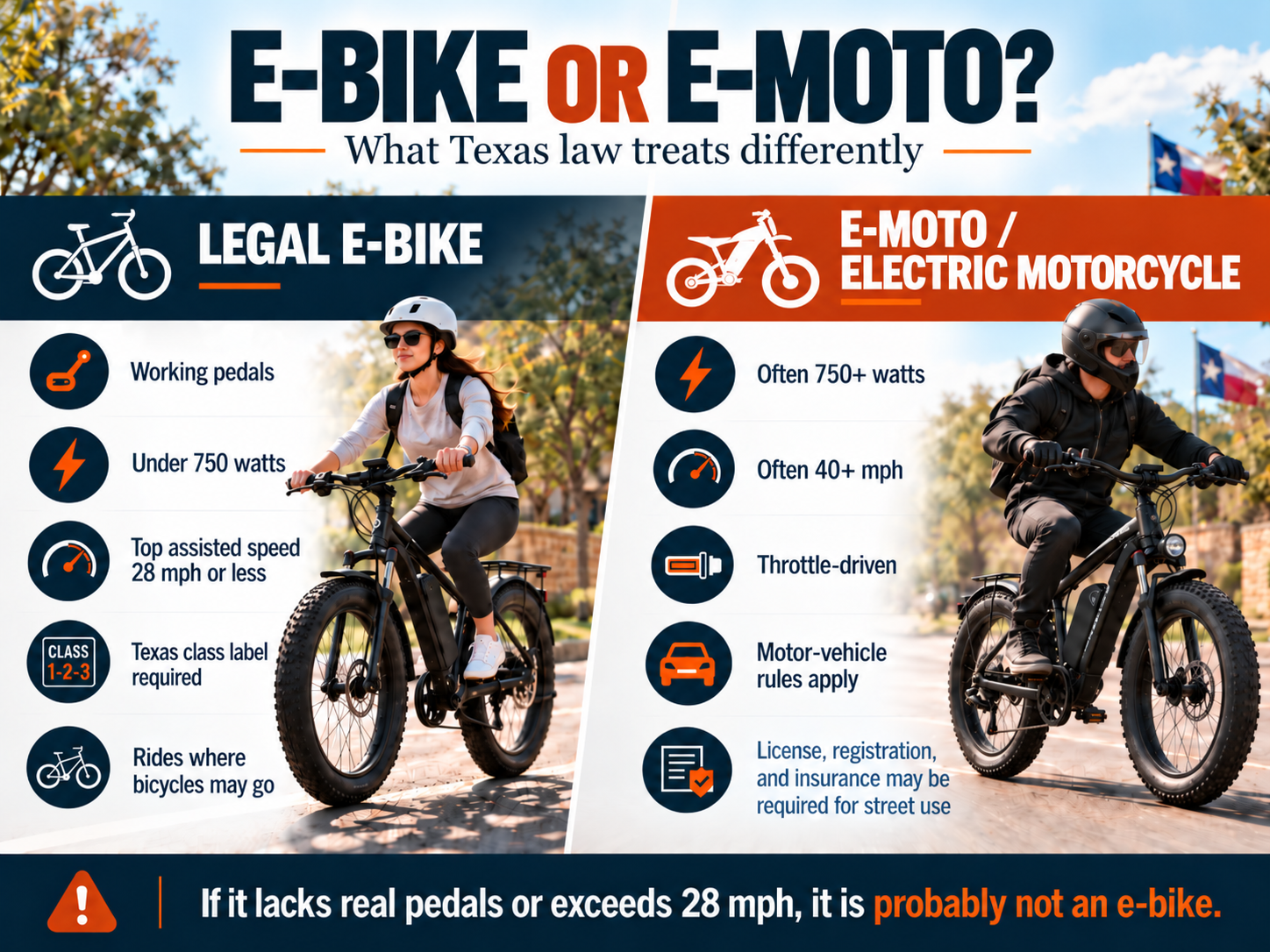
Federal law defines a “low-speed electric bicycle” in the Consumer Product Safety Act (CPSA) as “a two- or three-wheeled vehicle with fully operable pedals, a motor under 750 watts (about one horsepower), and a top motor-only speed under 20 miles per hour (mph).” That makes it a consumer product regulated by the CPSC, rather than a motor vehicle.
Texas adopted the industry’s three-class system in 2019 through House Bill (H.B.) 2188: an “electric bicycle” must have:
- fully operable pedals,
- a motor of fewer than 750 watts, and
- a top assisted speed of 28 mph or less.
Anything beyond those limits is legally classified in the U.S. as a “motor vehicle”.
| E-Bike Class 1 | E-Bike Class 2 | E-Bike Class 3 | E-Moto (Electric Moto) | Electric Motorcycle | |
|---|---|---|---|---|---|
| What it is | Pedal-assist bicycle | Bicycle with a throttle | Faster pedal-assist bicycle | Lightweight electric dirt bike or moto-style bike, often sold online as an “e-bike” | Full-size electric motorcycle built for streets and highways |
| How the motor works | Helps only while you pedal | Throttle can move the bike without pedaling | Helps only while you pedal; speedometer required | Twist throttle; pedals small, vestigial, or absent | Twist throttle; no pedals |
| Motor and top speed | Under 750 W; assist stops at 20 mph | Under 750 W; assist stops at 20 mph | Under 750 W; assist stops at 28 mph | Typically well over 750 W; many models exceed 40 mph | Highway speeds |
| Typical uses | Commuting, recreation, fitness | Commuting, errands, riders who need help from a stop | Longer, faster commutes | Off-road trail riding and recreation | Commuting and touring on public roads |
| Driver’s license | None | Class M (motorcycle) license, or moped license if it cannot exceed 30 mph | Class M license, which requires an approved motorcycle safety course | ||
| Title and registration | None | Required for street use, but most cannot be registered because they are not built to federal motor vehicle safety standards | Required | ||
| Insurance | Not required by state law | Liability coverage required on public roads | Liability coverage required | ||
| Minimum rider age | None in state law | None in state law | 15 to operate | Licensing ages apply on public roads | Licensing ages apply |
| Helmet (Texas) | No statewide requirement; local rules may apply | Required under 21; riders 21+ exempt only with an approved course or qualifying health insurance | Same as e-moto | ||
| Where it can ride | Roads, bike lanes, and anywhere ordinary bicycles may go; cities may bar sidewalks and unpaved natural-surface trails | Private land and designated off-highway vehicle (OHV) areas; a Texas OHV decal is required on public OHV land | Public streets and highways | ||
| Legal status | A bicycle, not a motor vehicle (§§ 541.201, 551.107, 664.001) | A motor vehicle (motorcycle, or moped if limited to 30 mph), not an e-bike, whatever the listing says | A motorcycle (§ 541.201) | ||
A few e-bike rules are easy to miss:
- The motor must cut out when the rider stops pedaling or applies the brakes (§ 551.107(b)).
- Every e-bike sold in Texas must carry a permanent label stating its class, top assisted speed, and motor wattage, and anyone who changes the bike’s speed or motor engagement must replace that label (§ 664.002).
- At night, a white headlamp visible from 500 feet and a red rear reflector or lamp are required (§ 551.104).
(Bills to rewrite these rules were filed in 2025 but died in committee, so the 2019 framework still applies)
Sold as an E-Bike, Built Like a Motorcycle
Most of the controversy centers on the middle of that chart, as faster, riskier E-motos are routinely sold online under the “electric bike” label and marketed directly to parents and children. Some brands ship machines above legal limits, or include a switch that overrides the speed cap.
This was the case in late July, when 17-year-old Gabriel Nacato was killed in New York City when the e-moto he was riding collided with an SUV. The uncle who bought it told reporters he did not know it was illegal, and the seller’s own website called it an e-bike.
Due to incidents like these, constables in Texas’ Harris and Fort Bend counties asked seven school districts to ban high-powered electric motorcycles from campus, and several districts tightened their rules for the new school year.
How to Tell What You Are Buying
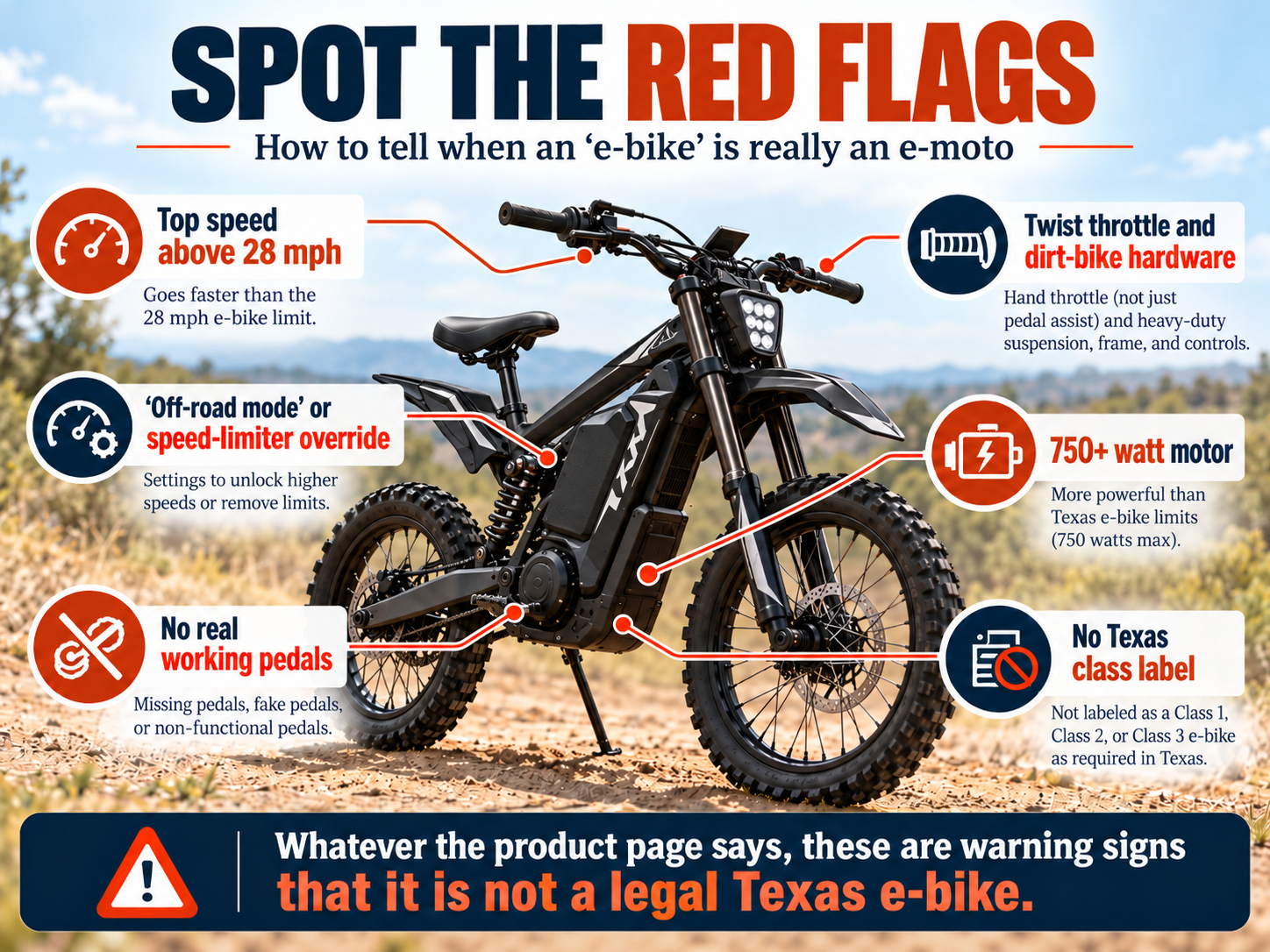
Whatever the product page says, the machine is probably an e-moto, and NOT an e-bike, if it has any of these:
- No working pedals, or small foot pegs and decorative pedals that cannot actually propel it.
- A motor rated at 750 watts or more, often listed in kilowatts or as “peak” power.
- A top speed above 28 mph, or an “off-road mode,” “unlocked” setting, or speed-limiter override.
- No Texas class label showing class, top assisted speed, and wattage, which every e-bike sold here must carry (§ 664.002).
- Motorcycle hardware: a dirt-bike frame, long-travel suspension, knobby tires, and a twist-grip throttle.
- Fine print calling it “for off-road use only” or a warning that it may require registration where you live.
What the Wrong Label Can Cost
- For the rider: Riding a motor vehicle on a public road without a license is an offense (§ 521.021), and most e-motos cannot be registered or insured for street use at all. After a crash, an unlicensed, uninsured rider on an illegal machine is at a severe disadvantage when it comes to determining who is at fault.
- For parents: Texas law forbids a parent from knowingly permitting a child under 18 to operate a motor vehicle on a highway in violation of the licensing chapter (§ 521.458). The owner of the machine may also face a negligent-entrustment claim if a child injures someone else, and homeowner’s and auto policies often exclude such motorized vehicles.
- For sellers: The Texas Deceptive Trade Practices Act (DTPA) prohibits representing that goods have characteristics or uses they do not have, and allows up to three times economic damages when the misrepresentation is made knowingly. So, a retailer that sells a 50 mph machine as a “bicycle,” or unlocks a speed limiter before handing it over, may also lose the protection Texas product-liability law ordinarily gives sellers that did not themselves make the product (§ 82.003).
A Regulatory Patchwork Across the States
This year has brought real upheaval in how states treat two-wheeled electric machines, and they are not moving in the same direction:
- New Jersey signed S4834/A6235 into law on January 19, 2026, scrapping the three-class system. Nearly every e-bike now needs a license or permit and registration, throttle-equipped and faster models need liability insurance, no one under 15 may ride, and the sale of kits that convert slower bikes into faster ones is banned. The compliance grace period ended July 19. Supporters pointed to fatal crashes to justify; cycling advocates argue the law burdens legal riders while missing the illegal e-moto market.
- California legislators signed Senate Bill (S.B.) 1167 at the end of September 2026, now defining e-motos separately, bars selling them as e-bikes, requires sellers to disclose that they are motor vehicles subject to registration, licensing, and insurance, and reaffirms the 750-watt ceiling for true e-bikes.
- Florida Governor DeSantis vetoed a statewide bill that would have imposed a 10 mph limit near pedestrians and passing rules on shared trails, calling it government overreach and leaving the rules to local communities.
- Texas has, so far, left its 2019 statute alone, leaving school districts, homeowners’ associations, and cities to fill gaps with local rules.
The Battery in the Garage
The other half of the story is the infamously inflammable lithium-ion battery. Of 145 e-bike incidents the CPSC investigated in depth, 106 involved fire, and 62 of those began while the bike was charging. Nineteen e-bike deaths were tied to battery fires, some involving homemade or shop-built battery packs.
On June 24, 2026, the CPSC published a proposed rule, to be codified at 16 C.F.R. Part 1265, that would create the first mandatory federal safety standard for lithium-ion batteries and electrical systems in e-bikes and other micromobility products.
The Rad Power Bikes case shows what is at stake: In November 2025, the CPSC told owners of two Rad battery models (RP-1304 and HL-RP-S1304) to stop using them immediately, citing 31 reported fires. One such Alabama widow filed suit in federal court in April 2026, citing the Rad e-bike battery the cause of a house fire that injured her and killed her husband.
The company then disputed the warning, said it could not afford a recall, and filed for Chapter 11 bankruptcy three weeks later. Because of this, injury claimants and their families may never collect from the company itself.
When Something Goes Wrong
Most e-bike cases fall into two categories, and Texas law treats them differently.
- Crashes with drivers. A negligent motorist owes an e-bike rider the same duty owed to anyone else on the road. But Texas follows proportionate responsibility under Chapter 33 of the Civil Practice and Remedies Code: a rider’s recovery shrinks by his own share of fault, and a rider found more than 50 percent responsible recovers nothing. Riding at night without lights, on a sidewalk where cities forbid it, or on a modified bike all hand the other side something to argue.
Juries look at everyone: in July 2026, a Florida jury valued a 12-year-old’s catastrophic e-bike injuries at more than $5.1 million after he collided with a car leaving an apartment complex where overgrown landscaping allegedly blocked the view, then split fault 40% to the property owner, 40% to his mother, and 20% to the boy.
- Defective products. Battery fires, failed brakes, and frames that snap are product liability claims against the manufacturer. Under § 82.003, a retailer that did not make the product is generally not liable — unless an exception applies, including when the manufacturer is insolvent or not subject to the court’s jurisdiction, or when the seller altered or modified the product. Both exceptions matter in a market full of overseas brands and bankrupt start-ups.
If you or a loved one is in an e-bike/e-moto-involved incident and/or fire:
- Preserve everything: the bike, the battery and charger (even burned), the receipt, the online listing, and photographs.
- Do not hand the remains to an insurer or seller before someone working for you has inspected them.
- Ask your insurance agent as soon as possible (ideally today!) whether your auto, homeowner’s, or renter’s policy covers e-bikes — many policies exclude motorized vehicles. Many policies have exceptions written in.
What’s on the Horizon
The rules are still moving, and several changes are close enough to plan around:
- A final federal battery rule. The CPSC’s comment period closed in August of this year; the agency regained a working quorum in September with two new commissioners. A final rule would make UL-based battery testing mandatory for e-bikes sold nationwide.
- A battery law from Congress. The Setting Consumer Standards for Lithium-Ion Batteries Act, which would require the CPSC to adopt a mandatory battery standard and let regulators stop non-compliant imports at the border, has passed the House; its Senate companion, S. 389, cleared the Senate Commerce Committee and awaits a floor vote.
- California, January 1, 2027. S.B. 1167 takes effect, and a companion law will require speedometers on Class 2 e-bikes sold after 2029 and set a 10 mph limit for sidewalk riding.
- Illinois, January 1, 2027. A new law will require a driver’s license, title, registration, and insurance for electric bikes and motorbikes capable of more than 28 mph, making Illinois the second state, after New Jersey, to require insurance for high-speed e-bikes.
- A federal line between e-bikes and e-motos. The bipartisan Safe Standards for Personal E-Bike and E-Moto Device Specifications (Safe SPEEDS) Act, introduced in the House this spring, would direct the CPSC to define e-bike classes nationally and set labeling requirements and minimum age recommendations for e-motos.
- Mechanical standards. The industry’s own trade group has asked the CPSC to adopt mandatory mechanical safety standards for e-bikes and e-motos, covering brakes, frames, and the like, as a 2027 priority.
- Texas, January 2027. The 90th Legislature convenes in January, and the e-bike bills that died in committee in 2025 could return. With school districts, cities, and law enforcement now raising the e-moto issue on their own, a clearer statewide line between e-bikes and electric motorcycles may well be on the agenda.
A Rider’s Checklist
- Know what you are buying. Read the class label and the spec sheet, not the product title. A machine with no label, a motor over 750 watts, a top speed over 28 mph, or no working pedals is not an e-bike under Texas law, whatever the listing calls it.
- Buy certified. Look for UL 2849 certification for the bike and UL 2271 for any replacement battery, from a seller likely to be in business next year.
- Check recalls. Search CPSC.gov and SaferProducts.gov by brand and battery model.
- Charge with care. Use the manufacturer’s charger on a hard surface, away from exits, and not overnight or unattended. Never charge a pack that is hot, wet, swollen, or dented, and do not store it in a Texas truck bed in August.
- Leave the limiter alone. “Unlocking” a bike can change its legal class, void warranties, and shift fault after a crash.
- Wear a real helmet. For Class 3 speeds, some riders choose helmets certified to the Dutch NTA 8776 standard, designed for faster e-bikes. We covered fit, ratings, and replacement in What’s the Only Thing Between You and the Pavement?.
- Ride as if invisible. Run lights day and night. More than half of the e-bike deaths in the CPSC’s data involved a motor vehicle.
- Parents, check the machine. A Class 3 bike requires a rider of 15 or older. A throttle machine capable of 40 mph is a motorcycle, and letting an unlicensed child ride it on the street can put the legal risk on you.
Why This Matters Here
Texas cities are built for cars, with massive highways, fast frontage roads, and few protected bike lanes; now e-bikes are now sharing that space with commuters, delivery riders, retirees, and kids riding to school. Summer heat bakes batteries left in garages and truck beds, and weather exposure can dangerously compromise packs and wiring with water and debris. The legal principle is the same one that runs through every product case: the people who build and sell a machine owe the people who use it a product that is reasonably safe, and the drivers who share the road owe riders the same care they owe anyone else.
An e-bike is a genuinely good machine, and I would rather see more riders than fewer. Just a word of advice to all riders (and their loved ones!): Always know what kind of machine you are using, buy from someone you trust, follow all laws, safety, and maintenance standards, and ride as though no one in the next lane can see you. No law or safety label can guarantee a safe ride, but those habits can help put the odds back on your side!
We at the Herd Law Firm are proud to fight for seamen, maritime workers, and passengers in all types of personal injury and death claims. As maritime personal injury attorneys (and sailors — and riders — ourselves!) located in northwest Houston, we never waver in our commitment to help maritime workers, passengers, and their families when they are injured or mistreated.
The information in this post is for general informational purposes only and does not constitute legal advice. For questions specific to your maritime law or personal injury issue, please contact us at 713-955-3699 or at Charles.Herd@HerdLawFirm.com.
Sources
- U.S. Consumer Product Safety Commission. “Micromobility Products-Related Deaths, Injuries, and Hazard Patterns: 2017–2024.” April 2026. https://www.cpsc.gov/s3fs-public/Micromobility_Products-Related_Deaths_Injuries_and_Hazard_Patterns_2017-2024.pdf
- Legal Information Institute, Cornell Law School. “15 U.S. Code § 2085 – Low-speed electric bicycles.” https://www.law.cornell.edu/uscode/text/15/2085
- Texas Transportation Code, Chapter 551 (Operation of Bicycles and Mobility Devices), §§ 551.101–551.107. https://statutes.capitol.texas.gov/Docs/TN/htm/TN.551.htm
- Texas Transportation Code § 541.201 (Definitions: Moped, Motorcycle, Motor Vehicle), via Public.Law. https://texas.public.law/statutes/tex._transp._code_section_541.201
- Texas Transportation Code, Chapter 521 (Driver’s Licenses and Certificates). https://statutes.capitol.texas.gov/Docs/TN/htm/TN.521.htm
- Texas Transportation Code, Chapter 661 (Protective Headgear for Motorcycle Operators and Passengers). https://statutes.capitol.texas.gov/Docs/TN/htm/TN.661.htm
- Texas Parks and Wildlife Department. “Off-Highway Vehicle Program (OHV).” https://tpwd.texas.gov/spdest/ohv/
- Texas Transportation Code, Chapter 664 (Standards for Electric Bicycles). https://statutes.capitol.texas.gov/Docs/TN/htm/TN.664.htm
- Texas Legislature. H.B. 2188, 86th Legislature (2019), Bill Analysis. https://capitol.texas.gov/tlodocs/86R/analysis/html/HB02188E.htm
- Texas Civil Practice and Remedies Code, Chapter 33 (Proportionate Responsibility). https://statutes.capitol.texas.gov/Docs/CP/htm/CP.33.htm
- Texas Civil Practice and Remedies Code, § 82.003 (Liability of Nonmanufacturing Sellers). https://statutes.capitol.texas.gov/Docs/CP/htm/CP.82.htm
- “Houston-area school districts update e-bike rules ahead of new school year.” FOX 26 Houston, 2026. https://www.fox26houston.com/news/e-bikes-rules-houston-schools-katy-conroe-barbers-hill-isd-2026-2027
- Beveridge & Diamond, P.C. “Electric Scooters and e-Bikes: CPSC Proposes Lithium-Ion Battery Restrictions.” July 2026. https://www.bdlaw.com/publications/electric-scooters-and-e-bikes-cpsc-proposes-lithium-ion-battery-restrictions/
- Morrison Foerster. “A New Charge for Micromobility: CPSC Proposes Mandatory Battery Standards.” July 16, 2026. https://www.mofo.com/resources/insights/260716-a-new-charge-for-micromobility-cpsc-proposes
- “CPSC warns to stop using Rad Power Bikes e-bike batteries immediately.” WFTV / Cox Media Group, November 2025. https://www.wftv.com/news/trending/cpsc-warns-stop-using-rad-power-bikes-e-bike-batteries-immediately/AE3XWFKYMRB4VI66G7NPKZBSVQ/
- “Rad Power Bikes files for bankruptcy protection.” Bicycle Retailer and Industry News, December 16, 2025. https://bicycleretailer.com/industry-news/2025/12/16/rad-power-bikes-files-bankruptcy-protection
- “California signs into law legislation to differentiate e-motos from e-bikes.” Bicycle Retailer and Industry News, October 1, 2026. https://bicycleretailer.com/industry-news/2026/10/01/california-signs-law-legislation-differentiate-e-motos-e-bikes
- “Grace Period Ends July 19: What New Jersey E-Bike Owners Need to Know Now.” The National Law Review, July 2026. https://natlawreview.com/article/grace-period-ends-july-19-what-new-jersey-e-bike-owners-need-know-now
- “Lawmakers Aim at Illegal E-Motos but Hit E-Bikes Instead.” Streetsblog NYC, August 6, 2026. https://nyc.streetsblog.org/2026/08/06/lawmakers-aim-at-illegal-e-motos-but-hit-e-bikes-instead
- “Electric vehicles suspected in Pacific car carrier fire.” WorkBoat, June 2025. https://www.workboat.com/bluewater/electric-vehicles-suspected-in-pacific-car-carrier-fire
- “Teenager killed in crash involving electric bike in Lago Vista.” CBS Austin, September 2026. https://cbsaustin.com/news/local/teenager-killed-in-crash-involving-electric-bike-in-lago-vista
- “Woman files wrongful death suit against Rad Power Bikes after fire kills husband.” Bicycle Retailer and Industry News, May 12, 2026. https://bicycleretailer.com/industry-news/2026/05/12/woman-files-wrongful-death-suit-against-rad-power-bikes-after-fire-kills
- “Inside South Florida’s e-bike boom: Crashes, confusion and consequences.” CBS12 News, July 13, 2026. https://cbs12.com/news/local/i-team-whats-legal-whos-liable-inside-south-floridas-growing-e-bike-debate
- “Florida governor vetoes e-bike bill, leaving local communities to set own rules.” CBS12 News, June 2026. https://cbs12.com/news/local/florida-governor-vetoes-e-bike-bill-leaving-local-communities-to-set-own-rules-illegal-e-scooter-electric-motorized-july-1-2026
- “California cracks down on e-motos, youth e-bike riders with new laws.” KQED, October 1, 2026. https://www.kqed.org/news/12102184/california-cracks-down-on-e-motos-youth-e-bike-riders-with-new-laws
- “New Illinois Law Requires Insurance for High-Speed E-Bikes.” Insurance Journal, August 28, 2026. https://www.insurancejournal.com/news/midwest/2026/08/28/883281.htm
- BOMA International. “S. 389, Setting Consumer Standards for Lithium-Ion Batteries Act: Issue Brief.” April 15, 2026. https://boma.org/wp-content/uploads/2026/04/S.-389-Lithium-ion-Battery-Safety-Bill-Issue-Brief-4-15-26.pdf
- PeopleForBikes. “Regulatory Update: CPSC Adds Two Commissioners, Considers Battery Safety Rule.” September 4, 2026. https://www.peopleforbikes.org/news/regulatory-update-september-2026
- Texas Transportation Code § 521.458 (Permitting Unauthorized Person to Drive), via Public.Law. https://texas.public.law/statutes/tex._transp._code_section_521.458
- Texas Business and Commerce Code, Chapter 17, Subchapter E (Deceptive Trade Practices-Consumer Protection Act). https://statutes.capitol.texas.gov/Docs/BC/htm/BC.17.htm
- “Local Law Enforcement Escalates E-Bike Warning as Youth Crashes, Illegal Riding and School Concerns Grow.” My Neighborhood News, July 21, 2026. https://myneighborhoodnews.com/local-law-enforcement-escalates-e-bike-warning-as-youth-crashes-illegal-riding-and-school-concerns-grow-champions-park
- “New e-bike bill in Congress could bring long-awaited federal regulation.” Electrek, March 30, 2026. https://electrek.co/2026/03/30/new-e-bike-bill-in-congress-could-bring-long-awaited-federal-regulation/
- Herd Law Firm, PLLC. “What’s the Only Thing Between You and the Pavement?” September 2026. https://herdlawfirm.com/firm-update/whats-the-only-thing-between-you-and-the-pavement/









Leave A Comment