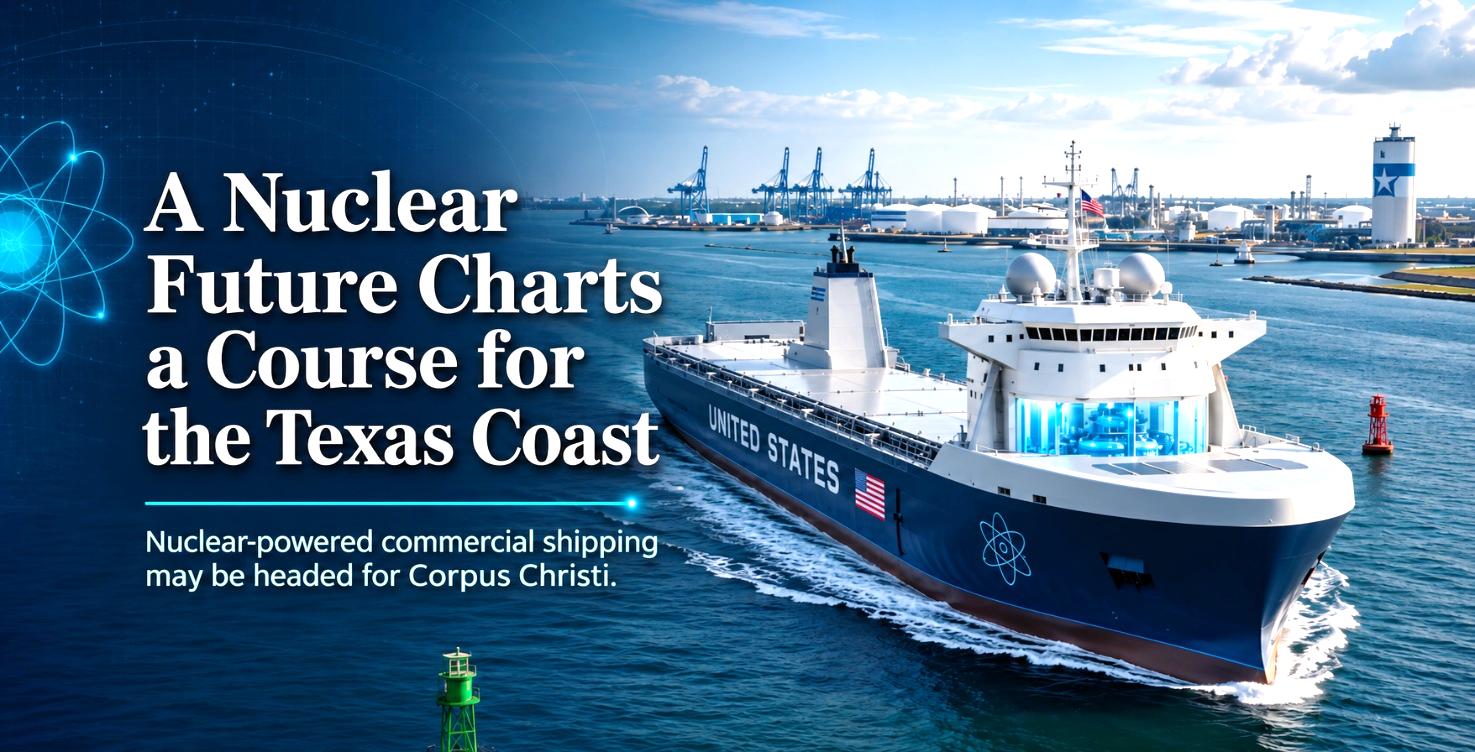
More than sixty years after the NS Savannah first carried a reactor into a working harbor, Washington has signed its first agreement with a nuclear developer to put atomic-powered merchant ships back under the American flag — and the Texas coast is already on the chart.
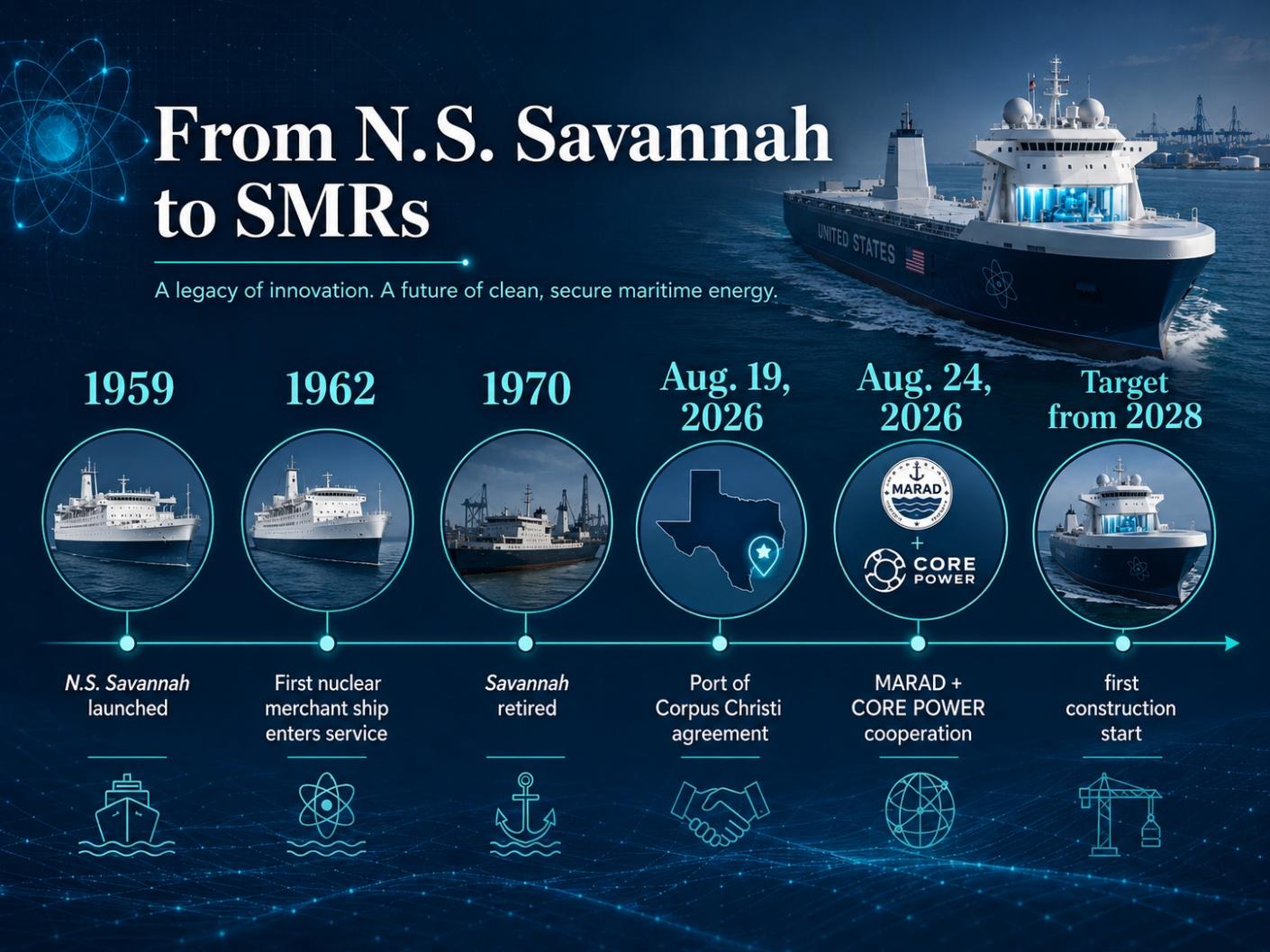
In 1962, a sleek white ship named the NS Savannah slipped out to sea carrying something no merchant vessel had ever carried before: a nuclear reactor. She was the centerpiece of President Eisenhower’s “Atoms for Peace” program, and over the better part of a decade she logged some 450,000 nautical miles on a remarkably small amount of uranium, drawing crowds in every port she visited.
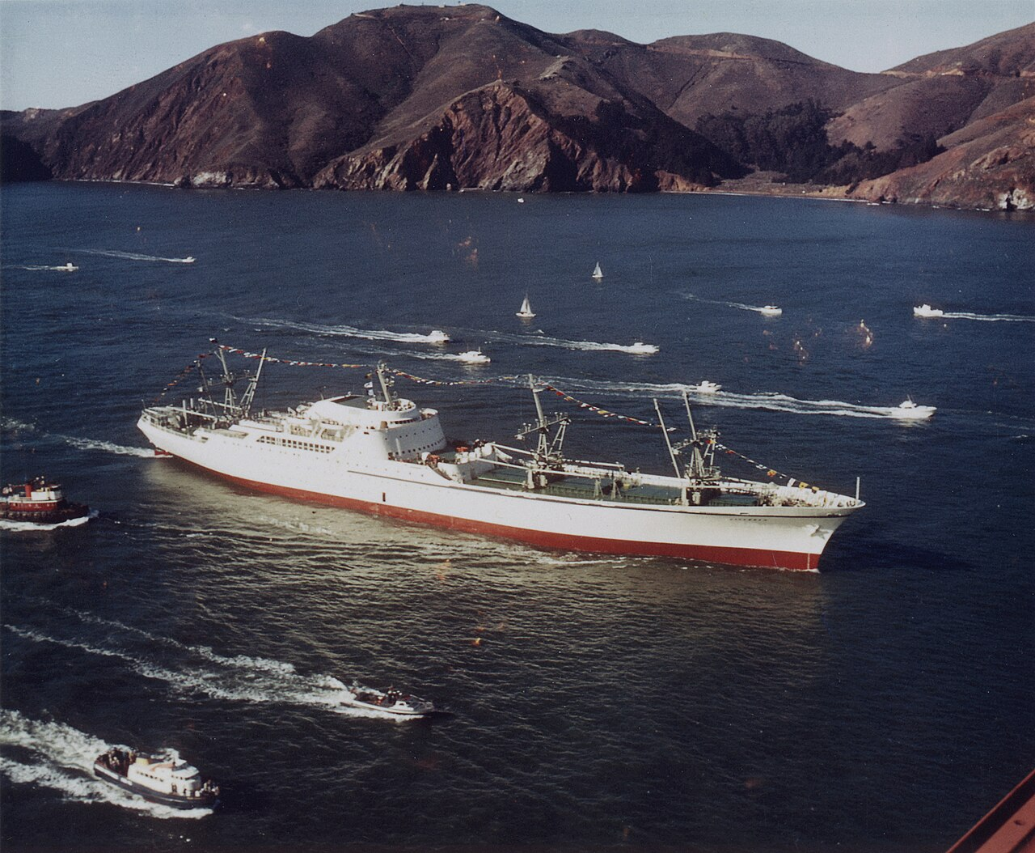
Unfortunately, she was also costly to run, hard to insure, and retired by the end of 1971. For half a century, she remained the answer to a question no one was asking anymore: could a cargo ship run on the atom?
Washington is now asking again.
The U.S. Maritime Administration (MARAD) in early fall signed a Memorandum of Cooperation (MOC) with the nuclear technology developer CORE POWER (US) Inc. to map a pathway toward U.S.-flagged, nuclear-powered commercial ships built around small modular reactors (SMRs). Modest in its terms and expansive in its reach, the agreement rewards a close reading by anyone who makes a living looking after the people who crew these vessels.
A Framework, Not Yet a Fleet
While the agreement does not yet approve any reactor designs or ships for construction, it does lay out the official framework that commercial nuclear shipping would need long before keels are laid:
- regulatory acceptance of small reactors operating at sea;
- port operations and safe harbor for a reactor-bearing hull;
- crew credentialing and training;
- nuclear fuel supply and lifecycle services; and
- the insurance and financing needed to make any of it bankable.
In the months after U.S. Transportation Secretary Sean Duffy launched a maritime SMR initiative in May 2026, the Department of Transportation signed three such agreements — this one and earlier memoranda with the Port of Long Beach and the Port of Corpus Christi. CORE POWER, which says it is targeting a first construction start “from 2028,” frames the effort partly as a race with China, which is pursuing nuclear propulsion for large commercial vessels of its own.
That ambition also aligns with the administration’s broader Maritime Action Plan (MAP) and its push to rebuild American shipbuilding and challenge China’s dominance of the seas.
The Gulf Coast Is Already on the Chart
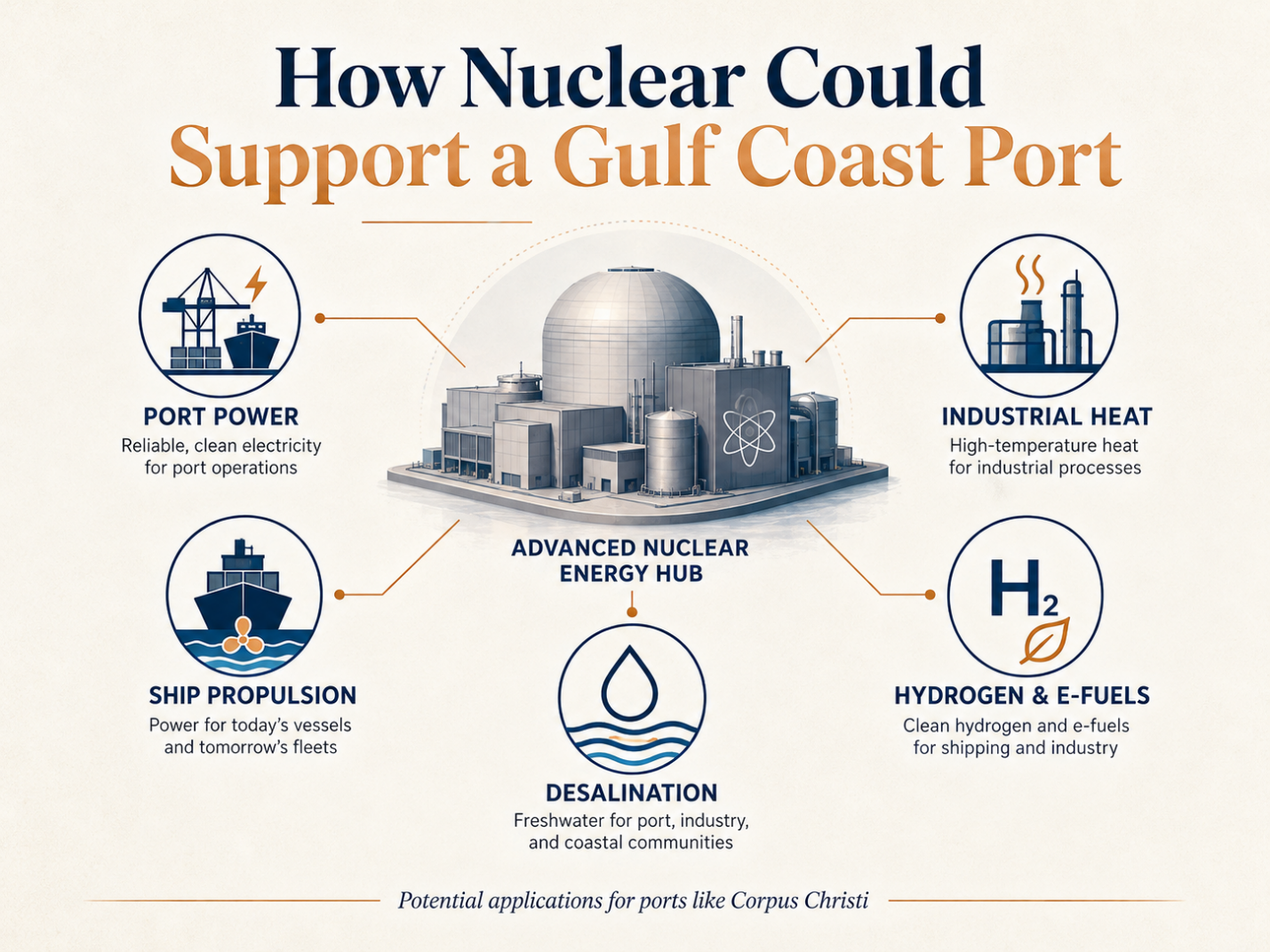
In mid-August 2026, the Port of Corpus Christi — the nation’s leading energy-export gateway — became the second U.S. port to sign a cooperation agreement with MARAD, and separately agreed to study with CORE POWER how a port might host a floating nuclear power plant and prepare to receive nuclear-powered ships.
Maritime Administrator Stephen Carmel tied the technology directly to Gulf Coast supply-chain resilience and to “training the next generation of high-skilled American mariners.” If atomic propulsion returns to American commerce, there is a fair chance it arrives right here, on our Gulf coast.
New Propulsion, Old Promises
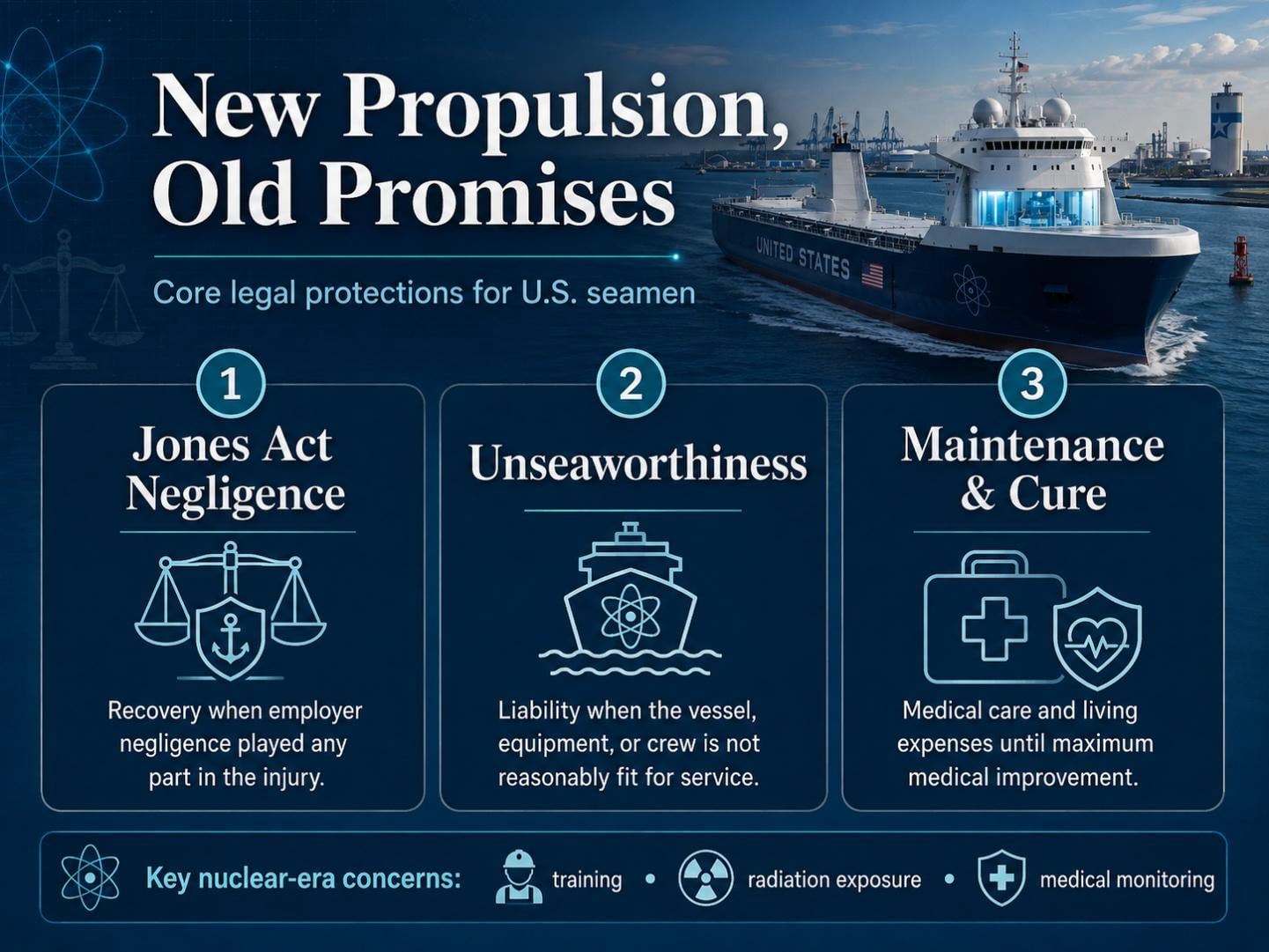
Despite the changing technology, the law that protects the people aboard these ships is old and unchanged. Whatever drives the vessel — wind, steam, diesel, or a nuclear fission core — the men and women who crew a U.S. vessel keep the same three bedrock protections:
- Jones Act negligence (46 U.S.C. § 30104) lets an injured seaman recover when the employer’s negligence played, as courts have put it, “any part, even the slightest,” in causing the harm — a deliberately low bar that reflects how little control a crewmember has over the conditions of the ship.
- Unseaworthiness, under the General Maritime Law, holds the vessel owner strictly liable when the ship is not reasonably fit for its service — a category that has long included an untrained or undermanned crew. A novel reactor plant run by people who were never properly trained to run it is close to a textbook seaworthiness question.
- Maintenance and Cure, the ancient duties we have written about before, oblige the owner to cover a seaman’s living expenses and medical care for an injury or illness incurred in the ship’s service, regardless of fault, until the seaman reaches maximum medical improvement (MMI).
However, two elements of nuclear operation sharpen those old doctrines particularly:
- Training — The NS Savannah learned this the hard way; her early years were marked by labor disputes over the specialized skills (and the pay!) that a reactor crew demanded — in 1963, a pay dispute in Galveston, Texas, led to a reactor shutdown and a strike by her nuclear engineering officers. Credentialing is a centerpiece of the MARAD framework, precisely because a mishandled reactor is a different order of danger than a mishandled diesel.
- Radiation — A hazard whose effects can surface years, even decades, after exposure. Maritime and toxic-tort law has traveled this road before, with asbestos and various “forever chemicals” our firm has written about at length. Latent injuries put a premium on the employer’s duty to warn, to enforce exposure limits and to provide medical monitoring, and on preserving a worker’s right to seek recovery long after. Building that culture of transparency now is far better than litigating in its absence later.
The Same Rights, Whatever Is Below Deck
As always, the same protections that will one day cover a reactor technician aboard a U.S.-flagged tanker already cover a Gulf seaman today. A seaman does not give up the Jones Act, the right to a seaworthy vessel, or Maintenance and Cure by signing onto a ship whose technology the public may find unfamiliar or intimidating. If anything, the more novel and powerful the tech below deck, the more those protections matter.
Maritime Trivia Question!
Q: The word “embargo” surfaces whenever nations quarrel over oil and trade — and this story runs straight through the nation’s leading energy-export port. It sounds like pure bureaucracy. So what does it have to do with ships?
A: It comes from the Spanish “embargar” — “to seize, to bar, to impede” — by way of the Latin for setting a bar across something. In its oldest sense an embargo was a physical act of trade policy: a government order holding ships fast in port and barring them from sailing. The word has always described a vessel kept from open water by the hand of the state.
We at the Herd Law Firm are proud to fight for seamen, maritime workers, and passengers in all types of personal injury and death claims. As maritime personal injury attorneys (and sailors ourselves!) located in northwest Houston, we never waver in our commitment to help these maritime workers, passengers, and their families when they are injured or mistreated.
The information in this post is for general informational purposes only and does not constitute legal advice. For questions specific to your maritime law issue, please contact us at 713-955-3699 or at Charles.Herd@HerdLawFirm.com.
Sources
- Schuler, Mike. “U.S. Takes Next Step Toward Nuclear-Powered Commercial Ships.” gCaptain, August 24, 2026. https://gcaptain.com/u-s-takes-next-step-toward-nuclear-powered-commercial-ships/
- U.S. Maritime Administration. “MARAD, CORE POWER to Explore Nuclear-Powered Shipping Technologies” (via MarineLink), August 24, 2026. https://www.marinelink.com/news/marad-core-power-explore-nuclearpowered-542393
- World Nuclear News. “Core Power teams up with US Administration on maritime nuclear.” August 25, 2026. https://www.world-nuclear-news.org/articles/core-power-teams-up-with-us-administration-on-maritime-nuclear
- Smart Maritime Network. “Agreement signed for US-flagged nuclear-powered merchant ships.” August 25, 2026. https://smartmaritimenetwork.com/2026/08/25/agreement-signed-for-us-flagged-nuclear-powered-merchant-ships/
- WorkBoat. “MARAD, Port of Corpus Christi announce partnership to explore nuclear tech for commercial shipping.” August 2026. https://www.workboat.com/marad-port-of-corpus-christi-announce-partnership-to-explore-nuclear-tech-for-commercial-shipping
- U.S. Maritime Administration. “N.S. Savannah — World’s First Nuclear Merchant Ship” (history and decommissioning). https://www.maritime.dot.gov/nssavannah
- Legal Information Institute, Cornell Law School. “46 U.S. Code § 30104 — Personal injury to or death of seamen” (the Jones Act). https://www.law.cornell.edu/uscode/text/46/30104
- Wikipedia. “NS Savannah” (service history, 1963 Galveston labor dispute). https://en.wikipedia.org/wiki/NS_Savannah



Leave A Comment