From the medieval Rolls of Oléron to the courts of Texas, an injured seaman’s right to be healed at the ship’s expense has proven one of the most durable promises maritime law has ever made. This is its long history — and why nearly every seafaring nation, in every age, has maintained some version of it.
A deckhand slips on a wet grating in the Houston Ship Channel and wrecks his knee. Before a single lawyer says the word “negligence,” before anyone argues who was at fault, his employer already owes him two things: the cost of keeping him fed and housed while he heals, and the costs of his medical care.
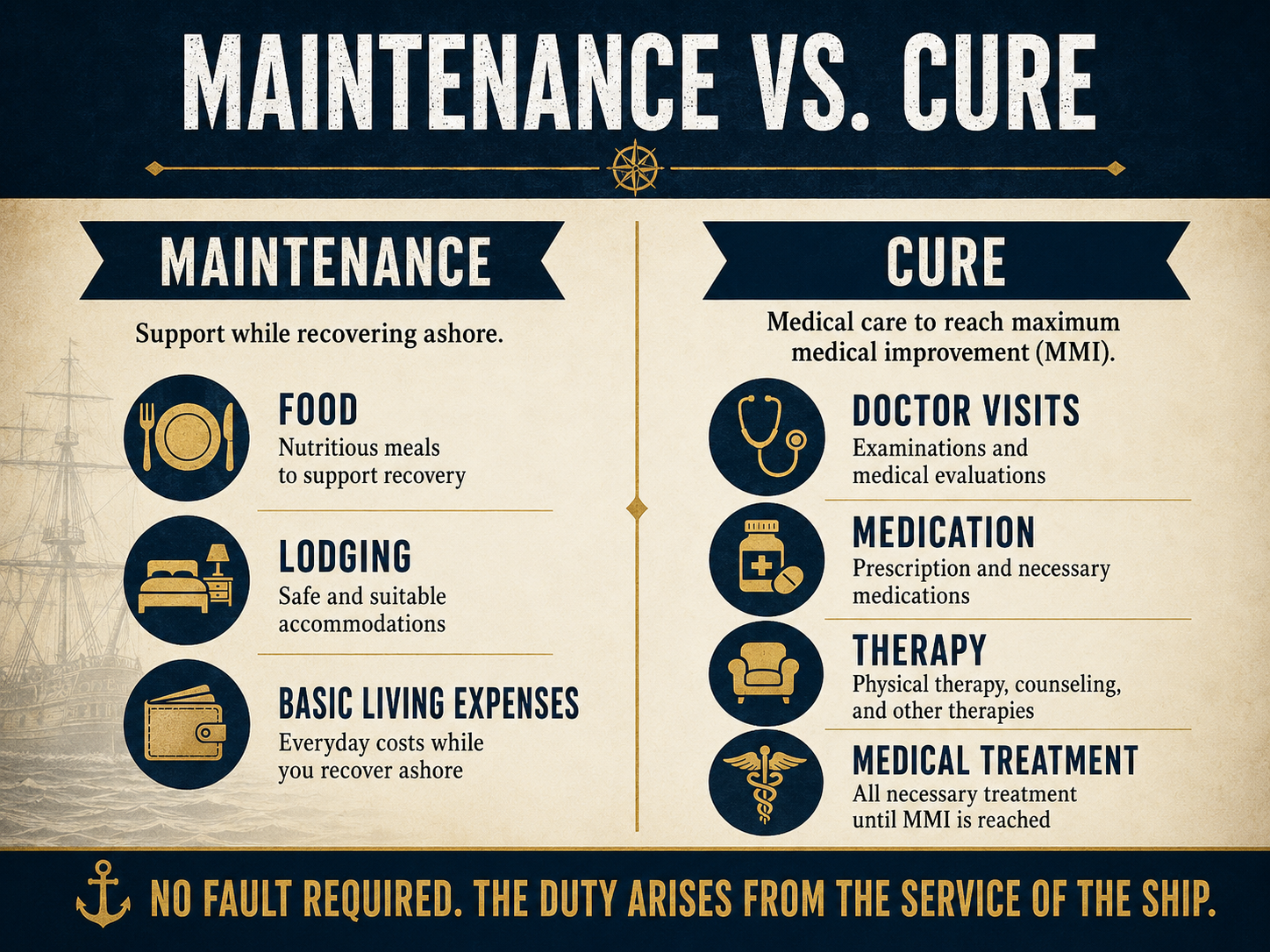
Those obligation have a name — “Maintenance and Cure” — and they are some of the oldest rules in all of law. Older than the United States. Older than the printing press. Older than the naming of the Gulf that deckhand works on. Its wording has barely shifted since the Middle Ages: a seaman hurt or taken ill in the service of a vessel is owed maintenance (his living expenses ashore) and cure (his medical treatment), no matter who was at fault, until he reaches maximum medical improvement (MMI).
Where did such a rule come from, and how did it end up protecting workers on Galveston Bay and the Gulf of Mexico? The answer runs back nearly a thousand years, across every ocean.
An Ancient Custom, Older Than Its Codes
The sea had law before it had statutes. The merchants of the ancient Mediterranean sailed under the Lex Rhodia, the Rhodian sea law, whose fragments survive in Roman compilations and whose most famous rule — that when cargo is thrown overboard to save the ship, everyone who benefits shares the loss — is still with us today as “general average.”
Rome absorbed that customary law into its own, and Emperor Justinian’s jurists preserved it. None of these ancient sources spells out the duties of Maintenance and Cure in the modern sense. But they establish the deeper principle from which it grows: a ship is a small commonwealth, and those who profit from a voyage owe something to those who physically bear its risks. The duty of a shipowner to care for a sailor who falls sick in his service is, as one court put it, of “ancient vintage” and older than almost any law that mandates it.
The Rolls of Oléron and the First Written Promise
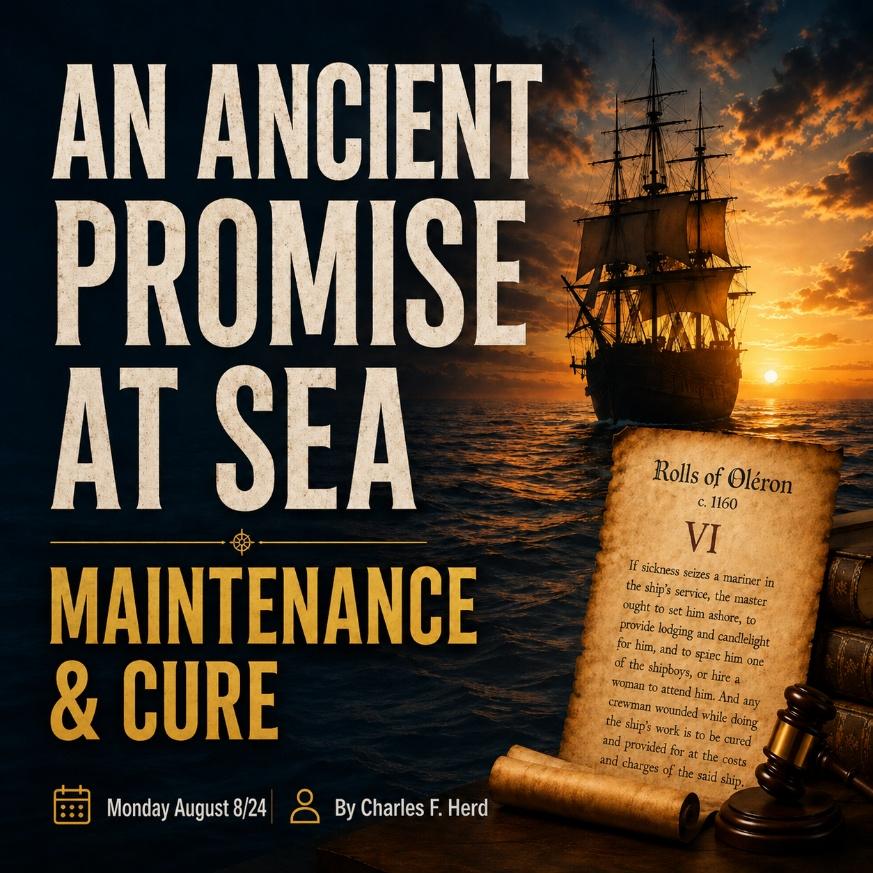
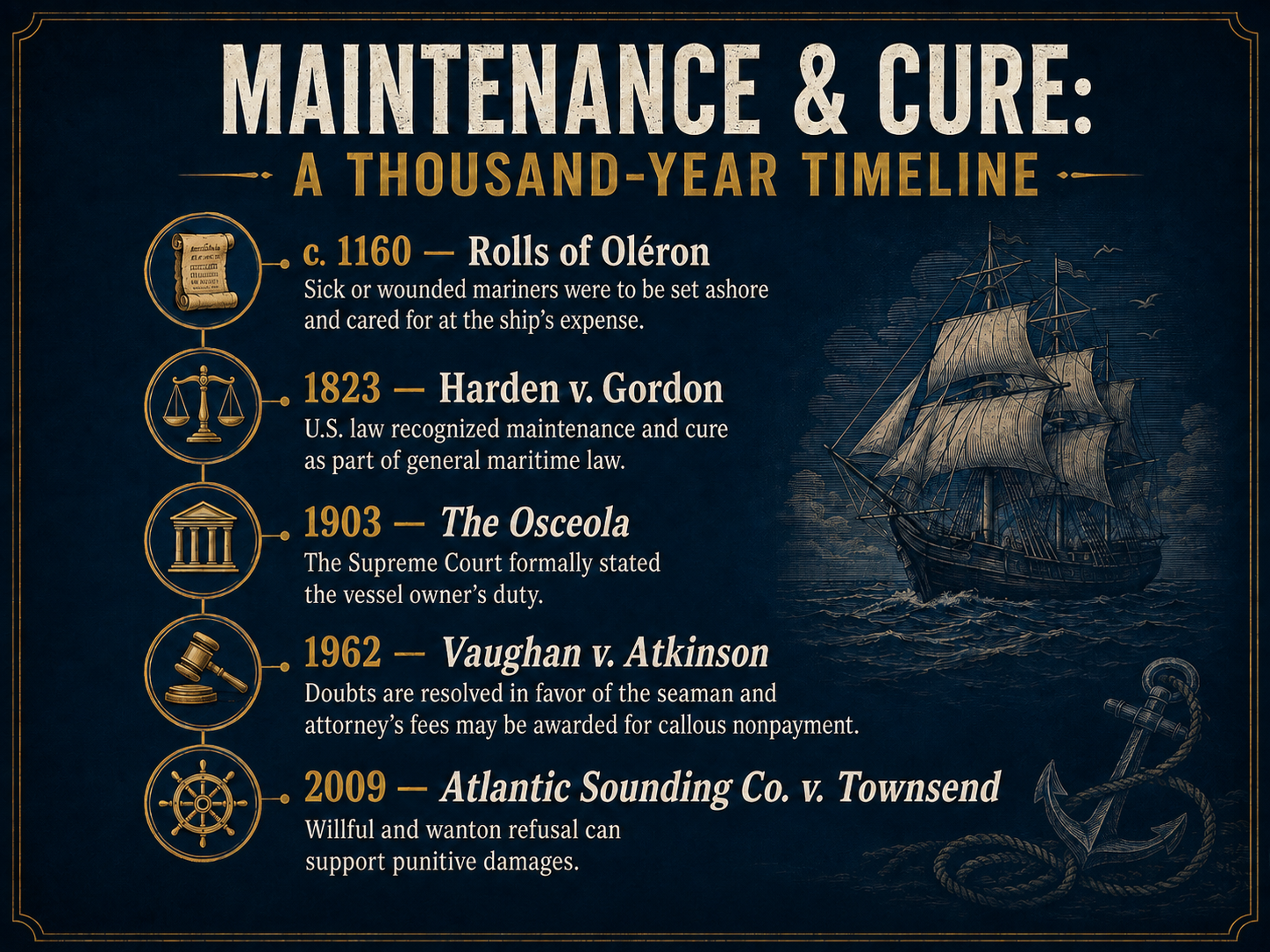
The first document to state the Duty in words we would recognize appeared around 1160. The Rolls of Oléron (French: Rôles d’Oléron or Jugements de la mer) — named for a small island off France’s Atlantic coast — are traditionally credited to Eleanor of Aquitaine, who is said to have gathered the customs of the sea after returning from a crusade.
Article VI (some historical sources cite VII) of the document is very direct: if sickness seizes a mariner in the ship’s service, the master ought to set him ashore, to provide lodging and candlelight for him, and to spare him one of the shipboys, or hire a woman to attend him. And any crewman wounded while doing the ship’s work is to be “cured and provided for at the costs and charges of the said ship.”
However, this same rule withholds care from a sailor injured, for example, in a drunken brawl ashore, undertaken without leave — an early version of today’s rule of “willful misconduct” can forfeit the benefit. Eight hundred years later, the shape is intact: care at the ship’s expense for the sailor hurt in her service, whatever the fault, with a narrow exception for the sailor who brings the harm upon himself.
England’s High Court of Admiralty
The customs of Oléron did not stay only in France. They were taken up across maritime Europe and reached England, where they became the seed of a distinct body of law administered by the High Court of Admiralty. English monarchs gathered the sea laws — the Rolls of Oléron chief among them, alongside later rulings of the Admiral’s court — into a compilation known as the Black Book of the Admiralty, which took shape in the fourteenth century and remained an authority for hundreds of years.
Unlike the common-law courts, the Admiralty court drew on the civil (Roman) law tradition, and specifically safe-guarded the jurisdiction. Through it all, it kept the old duties alive: by the custom of the sea, as an American judge would later summarize, the hiring of sailors had for centuries included food and lodging at the ship’s expense — their “maintenance” — and care when they were hurt.
A Continent of Codes: the Netherlands, Germany, Italy, and Spain
France and England were not alone, as the same duty surfaced under different names and in different tongues across western Europe:
- In the Baltic and the Low Countries, the Laws of Wisby (Visby) — named for the Gotland trading town and closely modeled on Oléron — governed the sea trade of the northern world; their nineteenth article provided care to the sick and wounded mariner.
- In the German-speaking Hanse towns, the Hanseatic Ordinances carried the same rule; their forty-fifth article, like Oléron and Wisby, charged the ship with the injured sailor’s cure.
- In the Mediterranean, the Consolato del Mare — the “Consulate of the Sea,” compiled from the customs of Barcelona and the rulings of seaport consuls in Venice, Genoa, Pisa, Marseilles, and Barcelona, set out the responsibilities of owner and master, the crew being among them.
These were not isolated innovations, but regional expressions of one shared custom, and later lawmakers and jurists treated them as such. When a future American judge went looking for the roots of maintenance and cure, he cited Oléron, Wisby, and the Hanse in a single breath.
The Doctrine Comes Ashore in America
That judge was Justice Joseph Story, and the case was Harden v. Gordon (1823). Riding circuit, Justice Story confronted a claim for the expenses of a seaman who had fallen sick abroad during a voyage of the brig Enterprise. He reached back to the medieval codes — the seventh article of Oléron, the nineteenth of Wisby, the forty-fifth of the Hanseatic Ordinance — and held that the cost of curing a sick seaman was, in law, part of the contract for wages and a charge on the ship.
Story called maintenance and cure “wages in another form,” and defended it in humane and practical terms: the rule protects a class of men peculiarly exposed to sickness and injury far from home, and by lowering the risks of the calling it encourages seamen to go to sea “with more promptitude, and at lower wages.” A decade later, in Reed v. Canfield (1832), he confirmed the seaman is to be cured at the ship’s expense.
For eighty years American courts followed those “analogies of the English and Continental codes.” Then, in The Osceola (1903), the Supreme Court gathered the strands and stated the modern law in four propositions. The first ismost significant here: a vessel and her owners are liable, when a seaman falls sick or is wounded in the ship’s service, to the extent of his maintenance and cure — whether the injury came of negligence or mere accident. From there, the Supreme Court kept widening and specifying the duty:
- Cortes v. Baltimore Insular Line (1932) — Justice Cardozo called Maintenance and Cure a duty “annexed to the employment itself”: contractual in origin, but one which a private agreement cannot bargain away, even upon death.
- Calmar Steamship Corp. v. Taylor (1938) — the Court defined the outer limit: the duty runs to the point of maximum medical recovery (MMI), and no further than the seaman’s need.
- Aguilar v. Standard Oil Co. (1943) — the Court called the shipowner’s liability among “the most pervasive” in the law, not to be “narrowly confined,” and extended it to a seaman hurt on shore leave, crossing a pier between his ship and the street.
- Farrell v. United States (1949) — the Court traced the duty once more to Oléron and the Laws of the Hanse Towns, while holding that maintenance ends when maximum cure is reached, including in case of permanent disability.
- Vaughan v. Atkinson (1962) — the rule injured American mariners lean on today: whenever there are ambiguities or doubts about a claim, they are resolved in favor of the seaman — and a shipowner who callously refuses to pay can be made to cover the seaman’s attorney’s fees.
- Atlantic Sounding Co. v. Townsend (2009) — the Court confirmed that a willful and wanton denial of Maintenance and Cure can expose a shipowner to punitive damages.
Notice what did not change across two centuries and a dozen opinions: the core promise set down on a French island around 1160. The U.S. Supreme Court did not invent the concept of Maintenance and Cure, but inherited it.
The Same Promise in the Orient
That duty never stopped at the edge of the western world. The great seafaring nations of Asia — which today supply and carry an massive share of the world’s mariners and merchant tonnage — keep essentially the same duty, generally through the modern successor to those medieval codes: the Maritime Labour Convention, 2006 (MLC), an International Labour Organization (ILO) treaty sometimes called the seafarers’ bill of rights.
The MLC obliges a shipowner to bear the cost of medical care for a seafarer sick or injured in service, to keep paying wages while he is unable to work, and to repatriate him home — maintenance, cure, and unearned wages.
Japan — the world’s second-largest ship-owning nation, whose own Mariners Act has long required owners to shoulder a sick seafarer’s medical costs — helped lead the way and ratified the MLC in 2013. Singapore, the Philippines (the single largest supplier of the world’s crews), Vietnam, and other Asia-Pacific states ratified followed, with China (home to the world’s largest body of seafarers) soon afterward.
Why This Reaches the Gulf Coast
All of which brings the story home to Texas. When Jeremiah Hill, an able seaman aboard the offshore supply vessel M/V Blizzard, was injured in 2023, his employer at first did exactly what the law — and the Rolls of Oléron — required: it dutifully paid his Maintenance and Cure. The fight that followed (over an arbitration clause) is a story we told elsewhere; but that starting point was never in doubt: a seaman does not surrender Maintenance and Cure by taking a dangerous job— it’s what it was built for.
Can we say that nearly every maritime nation has kept some version of maintenance and cure for centuries? We definitely can, and the courts have said as much: the right is as old as maritime law itself, and has been recognized for centuries by most all seafaring nations. From Rhodes to Oléron, from the Baltic to Barcelona, from Story’s circuit court to the Maritime Labour Convention, the sea keeps arriving at the same answer. It is one of the lasting assurances every flag, in every age, has felt bound to make: no sailor hurt in the ship’s service is abandoned to heal alone.
Maritime Trivia!
Q: Why did the medieval Rolls of Oléron specifically promise a sick mariner lodging and candlelight?
A: Because “cure” meant more than paying a doctor. A mariner put ashore sick could be stranded in an unfamiliar port with no household, family, or shipboard berth to fall back on. The Rolls therefore required the master to provide lodging, candlelight, and even an attendant while the sailor recovered.
Modern Maintenance and Cure separates those needs into maintenance (basic living expenses ashore) and cure (medical treatment), but the old candle is a reminder of the doctrine’s original promise: the ship did not leave its sick sailor on the dock and simply sail away.
We at the Herd Law Firm are proud to fight for seamen, maritime workers, and passengers in all types of personal injury and death claims. As maritime personal injury attorneys (and sailors ourselves!) located in northwest Houston, we never waver in our commitment to help these maritime workers, passengers, and their families when they are injured or mistreated.
The information in this post is for general informational purposes only and does not constitute legal advice. For questions specific to your maritime law issue, please contact us at 713-955-3699 or at Charles.Herd@HerdLawFirm.com.
Sources
1. Admiralty and Maritime Law Guide. “The Rolls of Oléron (late 12th century).” admiraltylawguide.com.
2. Oxford Reference. “Rules of Oleron” (Article VI, “Rules of Maintenance and Cure”). oxfordreference.com.
3. Ballard v. Alcoa S.S. Co., 122 F. Supp. 10 (S.D. Ala. 1954) (discussing Harden v. Gordon and the 7th article of Oléron, 19th of Wisby, 45th of the Hanseatic Ordinance). law.justia.com.
4. “Black Book of the Admiralty” (High Court of Admiralty; Rolls of Oléron). en.wikipedia.org.
5. The Osceola, 189 U.S. 158 (1903). supreme.justia.com.
6. Aguilar v. Standard Oil Co., 318 U.S. 724 (1943). supreme.justia.com.
7. Farrell v. United States, 336 U.S. 511 (1949). loc.gov.
8. Vaughan v. Atkinson, 369 U.S. 527 (1962). courtlistener.com.
9. John B. Shields, “Seamen’s Rights to Recover Maintenance and Cure Benefits,” Tulane Law Review (“recognized for centuries by most all seafaring nations”). tulanelawreview.org.
10. The Shipowners’ Club. “A Shipowner’s liability under the Maritime Labour Convention (MLC) 2006.” shipownersclub.com.
11. International Labour Organization. “Japan ratifies the Maritime Labour Convention, 2006 (MLC, 2006).” ilo.org.
12. Legal Information Institute, Cornell Law School. “46 U.S. Code § 30104 — Personal injury to or death of seamen” (the Jones Act). law.cornell.edu.