Sixteen companies bid $82.7 million for the right to drill fifty-nine tracts of the Gulf of Mexico. Behind every one of those tracts stands a future worksite — and a body of law that follows the men and women sent to work it, out past the last sight of land.
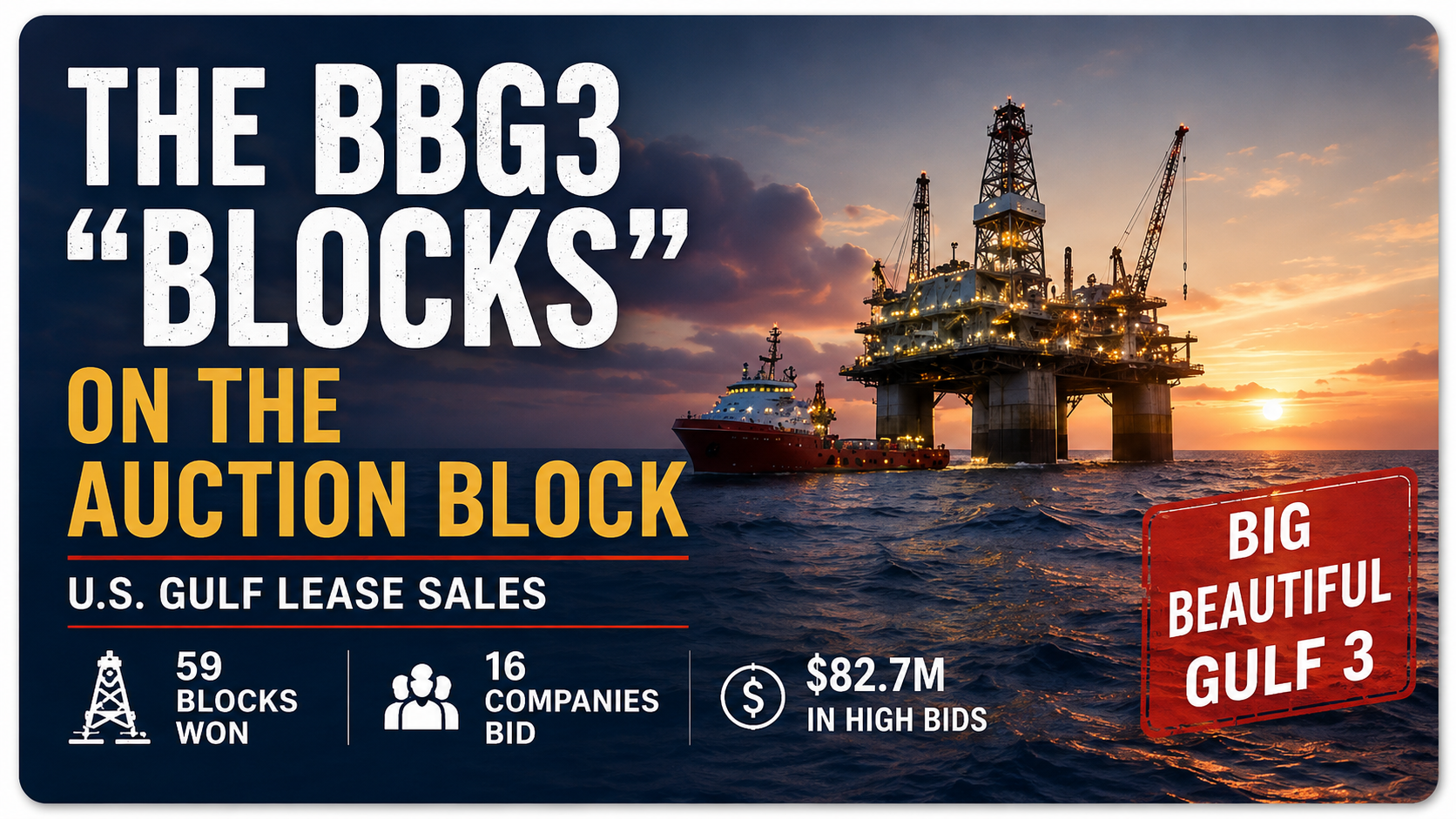
On Wednesday, August 12, 2026, in a hall inside The National WWII Museum in New Orleans, sixteen companies bid a combined $82.7 million for the right to drill fifty-nine blocks on the Gulf of Mexico (also styled the “Gulf of America (GOA)” by the current Administration). The sale, styled Big Beautiful Gulf 3 (BBG3), was the third of thirty Gulf auctions Congress mandated in its 2025 budget-reconciliation law, and the U.S. Department of the Interior (DOI) reported total bids of roughly $99.5 million across the day.
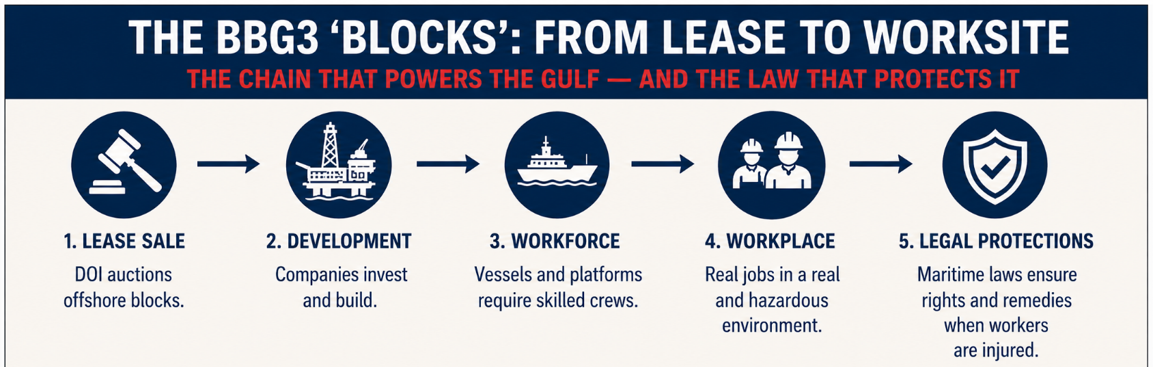
A lease sale might make a news headline, then evaporate. But in reality, every offshore block a company develops becomes a workplace — a drillship, a production platform, an offshore supply vessel (OSV) running crew and cargo across open water. And every workplace raises the question this attorney has spent decades answering: when a mariner is hurt out there, what law reaches them?
A Rebound, Not a Boom
By the numbers, BBG3 was a recovery from a dismal spring:
- The haul. $82.7 million in high bids on 59 blocks, from 16 companies — up sharply from the March sale (BBG2), which drew just $47 million, but still roughly 70 percent below the program’s December 2025 debut, which pulled in $279 million.
- Vast on offer, fewer takers. The government put up about 15,100 blocks across some 80 million acres. Bidders wanted only 59 of them.
- The money went deep. The real competition was in deep water. A single ultra-deepwater tract — Keathley Canyon Block 258, in roughly 6,000 feet of water about 250 miles southeast of Houston — drew a four-way contest among BP, Chevron, Shell, and Anadarko.
- Minimum royalties. Every lease carries a 12.5 percent royalty, the lowest the 2025 law allows.
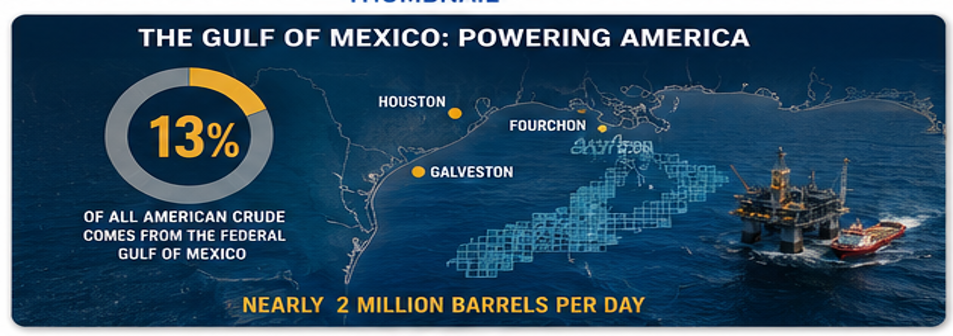
The U.S. Energy Information Administration (EIA) puts the federal Gulf of Mexico/GOA near two million barrels a day — about 13 percent of all American crude. When these leases produce, it will likely be Texas and Louisiana crews producing them.
The Workers Behind the Bids
Each offshore lease is a potential staffing order. Developing one takes drillship and semisubmersible crews, platform operators and roustabouts, welders, crane operators, remotely operated vehicle (ROV) technicians, and the deckhands who run the supply and crew boats out and back — most of them mustering from Gulf Coast docks like Fourchon, Galveston, and the yards along the Houston Ship Channel.
When a company christens a new deepwater platform — as Shell did with its Whale facility, which we covered here — the achievement is real. So is the risk carried by the people who keep it running.
Two Doors: The Jones Act or the Longshore Act
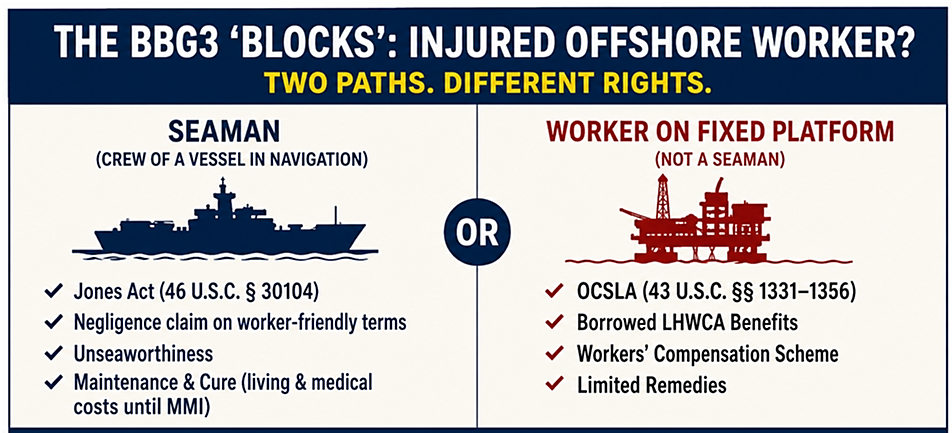
When an offshore worker is hurt, the remedy usually turns on one fiercely litigated distinction: are they a seaman, or a maritime worker on a fixed structure?
- Seamen — defined as the crew of a vessel in navigation, seamen sail under the Jones Act (46 U.S.C. § 30104) and the general maritime law. That means a negligence claim on worker-friendly terms, the owner’s non-delegable duty to provide a seaworthy ship, and maintenance and cure duties (defined as living and medical costs the owner must pay, regardless of fault, until the seaman reaches maximum medical improvement (MMI)).
Even a jack-up drilling rig can be a “vessel,” and its crew seamen — a line we mapped in “Who Is a Jones Act Seaman?” When the Fifth Circuit recognized the seaman status of a technician who served aboard the drillship M/V Deepwater Conqueror, it restored Jones Act rights his employers had tried to strip — a case we wrote about here.
- Workers on fixed platforms are generally not seamen. For them, the Outer Continental Shelf Lands Act (OCSLA, 43 U.S.C. §§ 1331–1356) borrows the compensation scheme of the Longshore and Harbor Workers’ Compensation Act (LHWCA, 33 U.S.C. § 901 and following) and applies it to injuries arising from extraction operations on the Outer Continental Shelf (OCS). Read about that framework more in “The LHWCA: What You Need to Know.”
The boundaries of those categories are not always where you would expect. In Pacific Operators Offshore, LLP v. Valladolid (2012), the Supreme Court held that OCSLA can reach even an injury that happens on shore, so long as it bears a “substantial nexus” to a company’s offshore extractive work. Which door a worker walks through governs everything that follows — what they can recover, from whom, and in which court.
Where the Regulator Comes Back In
BBG3 was also the first Gulf sale run by the Administration’s new Marine Minerals Administration (MMA), which folds together the Bureau of Ocean Energy Management (BOEM), the office that sells offshore leases, and the Bureau of Safety and Environmental Enforcement (BSEE), the office that polices them.
That merge may be worth some examination. The two bureaus were split apart in 2011, after the mobile offshore drilling unit (MODU) Deepwater Horizon exploded off Louisiana on April 20, 2010, killing eleven. The commission that investigated the blowout found that keeping the office that profits from leasing under the same roof as the office that enforces safety had bred a “culture of complacency.” Splitting them was the solution, which the merger has now undone, as we noted in “The Deepwater Horizon Spill: 13 Years Later.”
Critics call that a return to an already-discredited model. The old combined regulator was abolished for cause — investigators found it could not credibly promote drilling and police it at once — and recombining those roles rebuilds the conflict just as the government expands leasing, eyes first-ever offshore mining, and thins the agency’s own staff.
The record offers little comfort: as recently as 2016, the U.S. Chemical Safety Board (CSB) found Gulf oversight still inadequate, citing a lingering “culture of minimal regulatory compliance.” The U.S. Department of the Interior answer is that the merger only trims duplication, and keeps every safety standard in place.
Which side is right? For the crews on these leases, the cost will be measured in lives.
What does not change is this: a worker’s private remedies should not depend on a regulator’s bureaucratic organization — whoever signs the inspection reports ashore.
Why This Reaches the Gulf Coast
The crews who will work BBG3’s blocks are our Gulf neighbors. They live in Pasadena and Pearland and Port Arthur; they leave from Galveston and Sabine and the docks off the Brazoria County coast; and they return to the same Gulf, day after day.
Rising energy prices — driven this year partly by disruption at distant chokepoints like the Strait of Hormuz, whose “long shadow” we examined here — are part of what makes new Gulf leasing attractive.
But the law that protects the people producing that energy does not disappear in deep waters offshore.
An auction is a wager on what the sea will yield. The duties an owner owes the crew he sends to collect it is not a wager at all , but a binding promise, and the law still means to see it kept.
Maritime Trivia Question!
Q: “Chock-a-block” sounds like it should mean full of blocks. It doesn’t — at least not those blocks. Where does the phrase come from?
A: From the rigging. A block is a pulley in a ship’s tackle; haul a line until the two blocks are drawn so tight they meet and jam — “chock” being an old word for wedged hard against — and the tackle is chock-a-block: hauled to the limit, with no room left to run. Sailors carried the phrase ashore to mean crammed as full as a thing can get.
We at the Herd Law Firm are proud to fight for seamen, maritime workers, and passengers in all types of personal injury and death claims. As maritime personal injury attorneys (and sailors ourselves!) located in northwest Houston, we never waver in our commitment to help these maritime workers, passengers, and their families when they are injured or mistreated.
The information in this post is for general informational purposes only and does not constitute legal advice. For questions specific to your maritime law issue, please contact us at 713-955-3699, at Charles.Herd@HerdLawFirm.com, or at our new office: 8826 Louetta Road, Suite 310, Spring, Texas 77379.
Sources
- U.S. Department of the Interior. “Interior Advances American Energy Dominance with Third Gulf of America Lease Sale.” August 12, 2026. doi.gov
- Schuler, Mike. “Trump’s Third ‘Big Beautiful’ Gulf Lease Sale Draws $82.7 Million in High Bids.” gCaptain, August 12, 2026. gcaptain.com
- “U.S. Gulf Lease Sale Draws $82.7 Million in High Bids from 16 Companies.” World Oil, August 12, 2026. worldoil.com
- “BBG3 Oil and Gas Lease Sale Attracts $82.7M in High Bids.” Marine Log, August 2026. marinelog.com
- “Gulf Lease Sale Nets $82.7M in Apparent High Bids.” Journal of Petroleum Technology (SPE), August 2026. jpt.spe.org
- U.S. Energy Information Administration. “Gulf of America Oil and Natural Gas Production Expected to Remain Stable Through 2026.” eia.gov
- Liskow & Lewis, APLC. “Coming Full Circle: DOI to Combine BOEM and BSEE into a New Agency, the Marine Minerals Administration.” liskow.com
- Northey, Hannah, and Ian M. Stevenson. “Shrunken Offshore Energy Regulator Faces an Outsize Challenge.” E&E News by POLITICO, April 27, 2026. eenews.net
- Natural Resources Defense Council. “Interior Department Plans to Recombine Offshore Agencies Split After Deepwater Horizon Disaster.” April 3, 2026. nrdc.org
- U.S. Chemical Safety Board. “The U.S. Chemical Safety Board’s Investigation into the Macondo Disaster Finds Offshore Risk Management and Regulatory Oversight Still Inadequate in Gulf of Mexico.” April 13, 2016. csb.gov
- Pacific Operators Offshore, LLP v. Valladolid, 565 U.S. 207 (2012). FindLaw. caselaw.findlaw.com
- Legal Information Institute, Cornell Law School. “43 U.S. Code § 1333 — Laws and regulations governing lands” (OCSLA). law.cornell.edu
- Legal Information Institute, Cornell Law School. “46 U.S. Code § 30104 — Personal injury to or death of seamen” (the Jones Act). law.cornell.edu