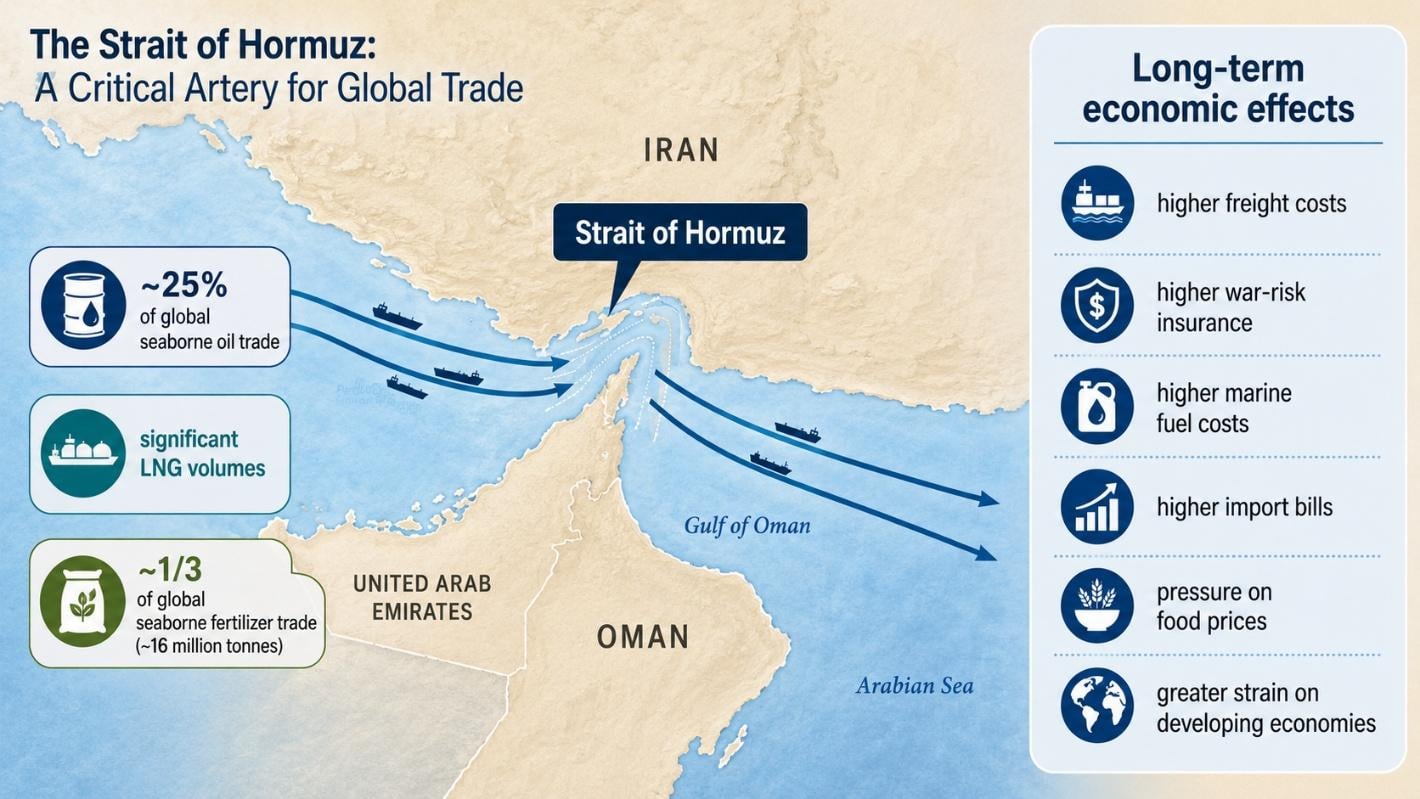
The Strait of Hormuz is” reopening”, and the tankers are moving again — but a new United Nations report warns that the economic wake of a hundred-day closure will keep rolling toward the world’s poorest households long after the waters calm.
Released on June 30, 2026, the United Nations Conference on Trade and Development (UNCTAD) report Strait of Hormuz Disruptions—Beyond Reopening: Lasting Impacts on Vulnerable Economies has a simple message: reopening one of the world’s most vital chokepoints of shipping and energy trade is good news — but it is not the end of the story. For many poor, import-dependent countries, the hardest part may be still to come.
One-Fifth of the World’s Fuel in a Twenty-One-Mile Gap
Separating the Persian Gulf from the Gulf of Oman, the Strait of Hormuz is barely twenty-one miles across, and through it passes roughly one-fifth of the world’s oil and gas. When a waterway that narrow carries a cargo that large, any disruption becomes a global event. The conflict touched off by joint U.S.-Israeli strikes on Iran in late February 2026 effectively paralyzed the Strait for more than one hundred days, and the shockwaves reached far beyond the tanker decks.
Why Cheaper Oil Doesn’t Mean the Crisis Is Over
Since an interim U.S.-Iran agreement opened the door to reopening the Strait, the benchmark price for Brent crude oil has fallen back to around $73 a barrel, which is close to where it sat before the conflict began. Energy markets, in other words, have largely stabilized. However, UNCTAD points out that shipping and food systems move on a slower clock. For example: the International Grains Council’s (IGC) Grains and Oilseeds Freight Index (GOFI), which tracks the cost of moving grain across 68 major routes, remained stubbornly elevated even as oil prices sank. Supply chains, freight contracts, and trade patterns all take months to reset.
In other words: while a price at the pump can drop overnight, a rerouted supply chain cannot.
There is a second dynamic at work as well: the same disruption that raised the price of oil and gas also raised the price of nitrogen fertilizer, which is manufactured from natural gas. Costlier fertilizer means costlier farming, and costlier farming feeds into food prices that can keep climbing long after energy prices have settled. UNCTAD’s own data show food-price inflation in developing countries continuing to rise even as oil and grain prices fell — a lag that can turn a short-term shock into long-term problems.
Where the Wake hits Hardest
UNCTAD identifies 61 vulnerable economies caught in what it calls “dual exposure”, or reliant on imports of both oil and grains, and so experience both market shocks at once. Most are least developed countries (LDCs) or small island developing States (SIDS): places like Cabo Verde, where net oil imports alone equal nearly a quarter of gross domestic product (GDP). These are nations with thin public finances, heavy debt loads, and shrinking foreign aid, and consequently the least able to cushion a spike in the cost of fuel and food.
The report’s most concerning figures relate to children. Drawing on a study of more than a million preschool children across 44 developing countries, UNCTAD notes that a five percent rise in real food prices is associated with a 15 percent increase in the risk of child “wasting” or “failing to thrive” (medically defined as dangerously low weight for age and/or height) among poor children, and a 26 percent increase among children in rural, landless households. Bottom line: a brief stretch of unaffordable food can leave a mark that outlasts the crisis that caused it.
UNCTAD also warns that an expected strong El Niño hurricane season could deepen these food-security risks in the months ahead.
What This Means for the Crew
Though the report can be interpreted through abstract macroeconomics — indexes, benchmarks, and percentages — every transit through the Strait is crewed by human beings, many thousands of which remain stranded in a war-risk zone. Only days before this report, the International Maritime Organization (IMO) confirmed it had evacuated roughly 2,500 stranded mariners from the Persian Gulf before an attack on a commercial vessel forced it to suspend the operation.
Mariners working in or transiting a conflict zone should always remember that their legal protections do not evaporate in a war-risk area. A vessel owner’s duty to provide a reasonably safe workplace, a seaman’s right to maintenance and cure benefits when injured or stranded, and the broader protections of the Jones Act and general maritime law follow the crew into dangerous waters — and may even matter most there.
If you are a maritime worker who has been injured, abandoned, or left exposed by a decision to sail into or linger in a hazardous area, contact a knowledgeable maritime attorney to discuss your options.
The Long swell
Sailors know that the most dangerous waves may not the ones a storm throws at you directly, but the long swell that keeps rolling in after the winds have died. UNCTAD’s warning reflects this: the Strait of Hormuz is opening, the ships are beginning to sail, and the headlines may move on — but the economic swell is still coming ashore for the countries that can least afford it. The reopening “paves the way for recovery,” the agency wrote, but for vulnerable economies “the path can be longer, uneven and costly.” So, while the ships may sail, for millions of people far from the water, the reckoning is just arriving.
Maritime Trivia Question! Q: When bad news leaves us “taken aback,” what would that mean was suddenly happening to a sailing ship?
A: A ship is “aback” when a sudden wind shift blows against the front of the sails, pinning them flat against the mast and stopping the vessel dead — or even shoving it backward. It was abrupt, alarming, and completely out of the crew’s hands. That jolt of being stopped cold by something you didn’t see coming is exactly what we mean today.
We at the Herd Law Firm are proud to fight for seamen, maritime workers and passengers in all types of personal injury and death claims. As maritime personal injury attorneys (and sailors ourselves!) located in northwest Houston, we never waver in our commitment to help these maritime workers, passengers, and their families when they are injured or mistreated.
The information in this post is for general informational purposes only and does not constitute legal advice. For questions specific to your maritime law issue, please contact us at 713-955-3699 or at Charles.Herd@HerdLawFirm.com.
Sources
- UN Trade and Development (UNCTAD). “Strait of Hormuz Disruptions — Beyond Reopening: Lasting Impacts on Vulnerable Economies.” UNCTAD/OSG/INF/2026/4, June 30, 2026. https://unctad.org/system/files/official-document/osginf2026d4_en.pdf
- United Nations News. “Strait of Hormuz: Gradual re-opening is no quick fix for developing nations, UN warns.” June 30, 2026. https://news.un.org/en/story/2026/06/1167844
- Reuters (via CNBC Africa). “Hormuz disruption may have lasting impact on vulnerable economies, UN trade agency says.” June 30, 2026. https://www.cnbcafrica.com/2026/hormuz-disruption-may-have-lasting-impact-on-vulnerable-economies-un-trade-agency-says
- Arab News. “Hormuz disruption may have lasting impact on vulnerable economies, UN trade agency says.” June 30, 2026. https://www.arabnews.com/node/2649098/middle-east
- Schuler, Mike. “UN Warns Hormuz Crisis Will Leave Lasting Economic Scars Despite Shipping Recovery.” gCaptain, June 30, 2026. https://gcaptain.com/un-warns-hormuz-crisis-will-leave-lasting-economic-scars-despite-shipping-recovery/
- United Nations News. “Strait of Hormuz: UN evacuates 2,500 seafarers before attack freezes rescue operation.” June 26, 2026. https://news.un.org/en/story/2026/06/1167818