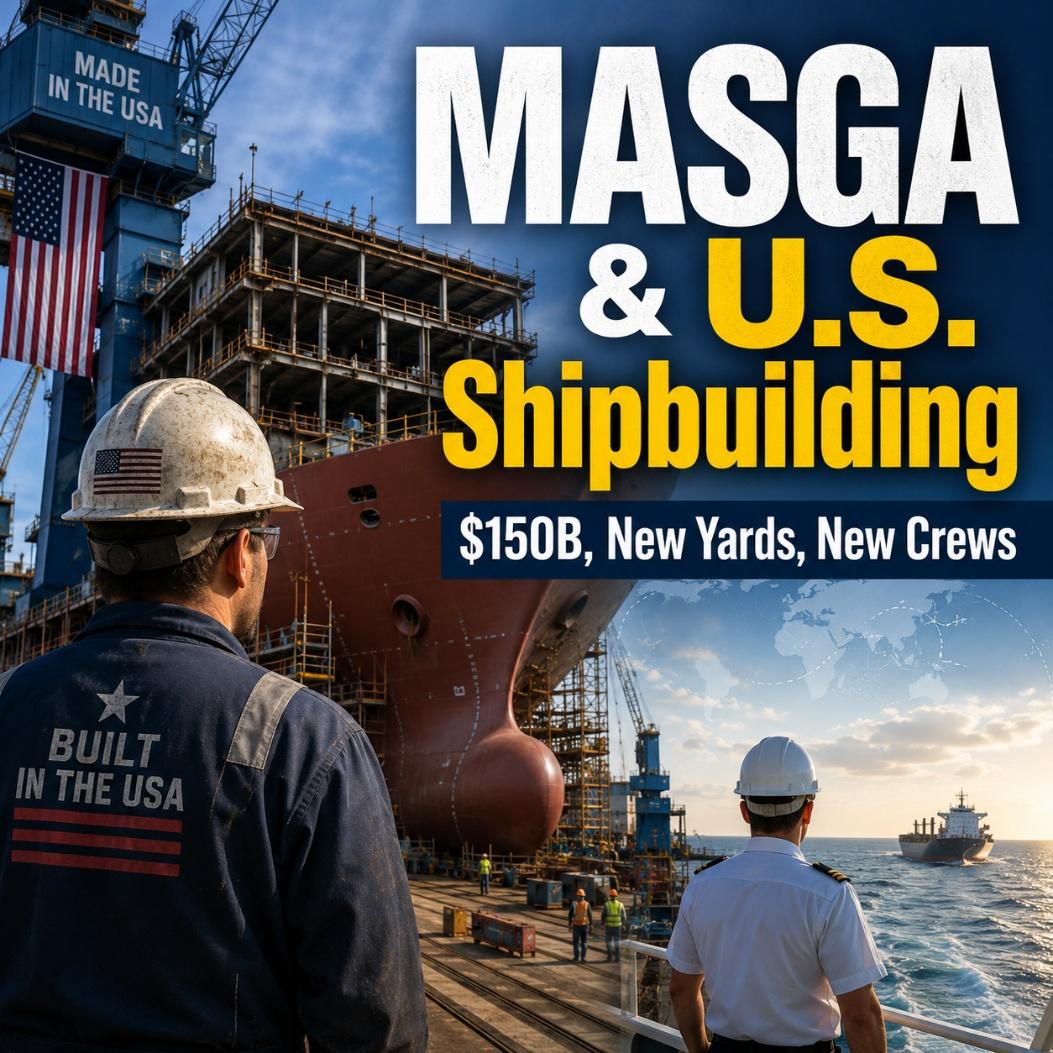
South Korea and the United States have opened a new center in Washington to steer $150 billion into American shipyards under the “MASGA” initiative. Every keel laid in an American yard will eventually carry an American crew — and two different bodies of U.S. law are already waiting to protect them.
Every ship has a special early milestone that comes before launch: the day her keel is laid. The first great length of steel set down on the blocks, the spine from which everything else grows. Shipbuilders, known historically as “shipwrights”, have marked it as an occasion for centuries, because the keel defines much about what a vessel will become long before she ever touches water.
Last week in Washington, the United States and the Republic of Korea laid down a keel of a different kind.
WHAT JUST HAPPENED IN WASHINGTON
On July 23, 2026, at the Mayflower Hotel in Washington, D.C., officials from both nations opened the Korea–U.S. Shipbuilding Partnership Center (KUSPC) — a permanent hub meant to channel a promised $150 billion into rebuilding the American shipbuilding industry.
The center is the working arm of an initiative with a deliberately familiar ring: MASGA, short for “Make American Shipbuilding Great Again” (and, more officially, the Korea–U.S. Maritime and Shipbuilding Growth Alliance). It grew out of last year’s U.S.–Korea trade agreement and a government-to-government memorandum of understanding (MOU) signed roughly two months earlier.
Around 130 officials and executives attended, including U.S. Commerce Secretary Howard Lutnick and South Korea’s Minister of Trade, Industry and Energy, Kim Jung-kwan. The particulars, in brief:
- Fifteen MOUs were signed across four areas — a coordinated “Team Korea” of shipbuilders, supply-chain cooperation, workforce training, and joint research.
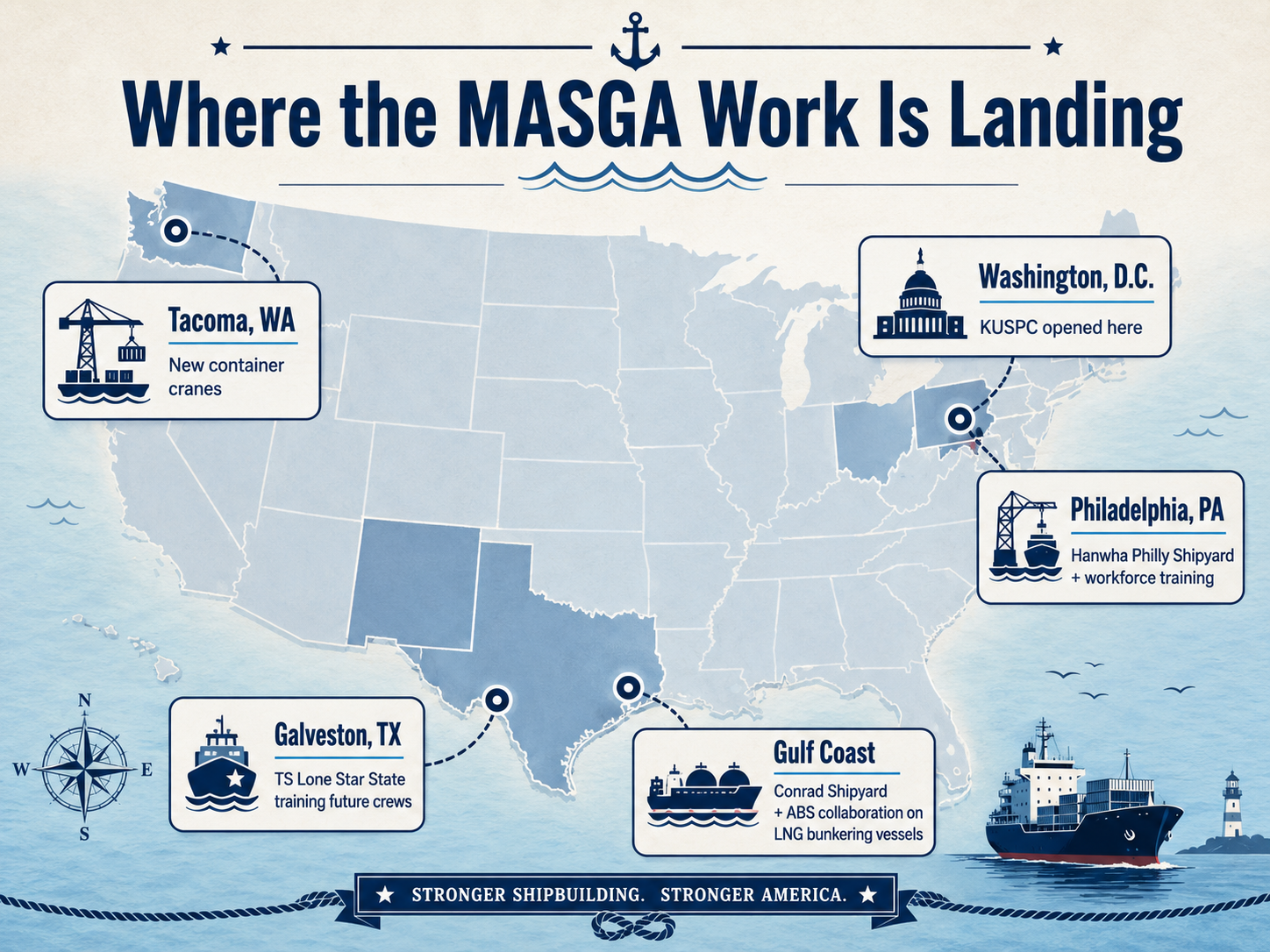
- Yards on both coasts are in play. Hanwha Philly Shipyard partnered with a Pennsylvania community college on worker-training pathways; other agreements target automation and productivity upgrades at U.S. yards, and new container cranes bound for the Port of Tacoma.
- A five-year, roughly $80 million joint research program will fund work on artificial-intelligence (AI)–enabled ship design, robotics, autonomous welding, and automated painting of large ship blocks.
- Gulf-relevant work is already on the list. Samsung Heavy Industries agreed to collaborate with Louisiana’s Conrad Shipyard and the American Bureau of Shipping (ABS) on liquefied natural gas (LNG) bunkering-vessel designs and certification.
Bottom line: if this partnership operates as intended, more ships will be built in America — and American-built ships come wrapped in American law.
WHY A SHIPYARD STORY IS A SEAMAN’S STORY
The reason a shipbuilding pact belongs on a maritime-injury blog runs straight through the U.S. Jones Act — the best-known name for the Merchant Marine Act of 1920. Its cargo provision (46 U.S.C. § 55102) says that to carry merchandise between two points in the United States, a vessel must be U.S.-built, U.S.-owned, U.S.-crewed, and carry a coastwise endorsement from the U.S. Coast Guard. That build-at-home requirement is why the American domestic (“Jones Act”) fleet is so small — on the order of only 90 to 100 large vessels.
Every hull MASGA helps produce in an American yard should be a potential addition to that fleet — and, by law, every berth aboard it is a job reserved for American mariners, who carry protections that many foreign-flag crews often only wish they had.
We have written before about how thin that fleet has become and how hard the government leans on it in a pinch, in The Waiver That Will Not Weigh Anchor, and about the men and women who crew it in The Fourth Arm of Defense. A promise like this one — “if you build these ships, we will crew them” — is the same promise Texas A&M’s cadets made when the training ship TS Lone Star State (TS for Training Ship) was christened this month, a story we covered in If You Build These Ships, We Will Crew Them.
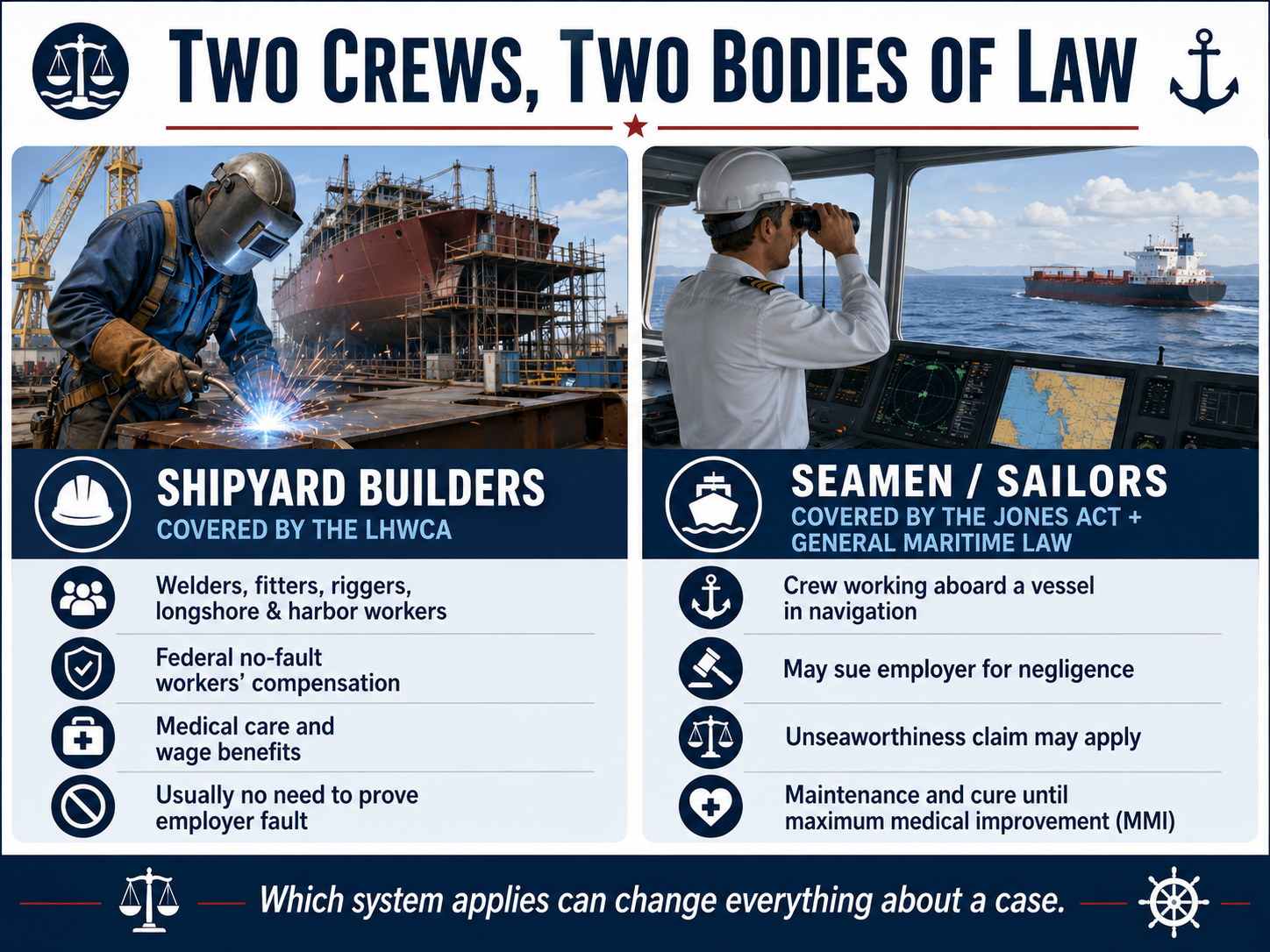
TWO CREWS, TWO BODIES OF LAW
However, though the people who build a ship and the people who sail her are both “maritime workers,” the law sorts them into two very different categories:
- The builders — covered by the LHWCA. The welders, fitters, and riggers in the shipyard fall under the Longshore and Harbor Workers’ Compensation Act (LHWCA) (33 U.S.C. § 901 and following), a federal no-fault workers’-compensation system for shipbuilders, ship-repairers, longshoremen, and harbor workers. “No-fault” means an injured worker is to receive medical care and wage benefits without having to prove the employer did anything wrong.
- The sailors — covered by the Jones Act and the General Maritime Law. Once a ship is finished, documented, and crewed, the people who work aboard her in navigation are seamen. A seaman does not use the LHWCA; instead he has the Jones Act (46 U.S.C. § 30104), which lets him sue his employer for negligence, plus the older general-maritime remedies of unseaworthiness (a vessel owner’s strict duty to furnish a reasonably safe ship) and maintenance and cure (the ancient duty to pay an injured seaman’s daily living expenses and medical care until he reaches maximum medical improvement (MMI)).
The boundary between the two is the classic “who is a seaman?” question, and it is no mere technicality: which system applies can change everything about a case — who you sue, what you must prove, and what your injury is worth. MASGA stands to grow the ranks on both sides of that line at once.
“BUILT IN THE UNITED STATES” — WHERE THE LINE HOLDS
A $150 billion pledge from a foreign shipbuilding power raises a fair question: can a ship built with Korean capital, Korean technology, and Korean-designed robots still count as “American” for Jones Act purposes? Mostly yes — with limits that matter. Foreign investment in a U.S. yard, foreign-held ship mortgages, and technology transfer are broadly permitted; what the statute guards is where the steel is actually assembled and who ends up owning and crewing the finished vessel.
The Coast Guard’s National Vessel Documentation Center (NVDC) polices the build requirement with two rules of thumb for steel ships: a major-component test (a separately built section weighing more than 1.5 percent of the vessel’s steel weight) and a considerable-part test (hull or superstructure work exceeding 7.5 percent) — either of which can strip a vessel of its coastwise eligibility if too much of the work is done abroad. American shipyard workers have gone to court over exactly this, arguing that outsourcing the assembly of modules and piping to foreign facilities cuts into work the Jones Act was meant to keep at home.
The goal for MASGA is plain: the investment can be foreign, but if these ships are to sail the domestic trade, the building — and the jobs —stay here.
WHY THIS REACHES THE GULF COAST
One of the first named partnerships pairs Samsung Heavy Industries with Conrad Shipyard (a Gulf Coast builder!) on LNG bunkering vessels, which means new fabrication work in yards our clients already know. Every vessel that pact helps launch may one day call at Bayport, Barbours Cut, on the Houston Ship Channel, or any number of other Texas and Gulf Coast ports worked by a crew standing watch under the Jones Act. And A&M Maritime Academy cadets aboard the TS Lone Star State down in Galveston are training to fill just those berths.
Whether a worker is fitting a hull on the Gulf Coast under the LHWCA or standing a watch on the Ship Channel under the Jones Act, the same truth holds: a stronger American fleet is only as strong as the protections for the people who build and sail it. A keel laid today is a livelihood tomorrow — and the law, used well, is the ballast that keeps both upright.
Maritime Trivia Question!
Q: A shipyard is full of shipwrights — but there is no “wright” anywhere in the tools they carry. Where does the word come from?
A: From work itself. “Wright” descends from the Old English “wyrhta” (a worker or maker), a cousin of the verb wyrcan, “to work,” and of the word “wrought.” It survives today only as a suffix bolted onto whatever a person makes — a wheelwright shapes wheels, a cartwright builds carts, a playwright fashions plays, and a shipwright builds ships.
We at the Herd Law Firm are proud to fight for seamen, maritime workers and passengers in all types of personal injury and death claims. As maritime personal injury attorneys (and sailors ourselves!) located in northwest Houston, we never waver in our commitment to help these maritime workers, passengers, and their families when they are injured or mistreated.
The information in this post is for general informational purposes only and does not constitute legal advice. For questions specific to your maritime law issue, please contact us at 713-955-3699 or at Charles.Herd@HerdLawFirm.com.
SOURCES
- Schuler, Mike. “Korea–U.S. Shipbuilding Partnership Center Launches to Advance $150 Billion MASGA Initiative.” gCaptain, July 28, 2026. gcaptain.com
- “Korea, US open shipbuilding center under $150 billion partnership.” WorkBoat, July 2026. workboat.com
- “S. Korea, US open shipbuilding partnership center to advance MASGA initiative.” The Korea Herald, July 24, 2026. koreaherald.com
- “South Korea, U.S. open shipbuilding partnership center to advance $150 billion MASGA investment.” Korea JoongAng Daily, July 24, 2026. koreajoongangdaily.com
- “South Korea, U.S. open shipbuilding center in Washington.” UPI, July 24, 2026. upi.com
- U.S. Maritime Administration (MARAD). “Domestic Shipping” (the Jones Act, 46 U.S.C. § 55102). maritime.dot.gov
- U.S. Customs and Border Protection. “What Every Member of the Trade Community Should Know About: Coastwise Trade / Jones Act” (Informed Compliance Publication), Dec. 2024. cbp.gov
- Legal Information Institute, Cornell Law School. “46 U.S. Code § 30104 – Personal injury to or death of seamen” (the Jones Act). law.cornell.edu
- Legal Information Institute, Cornell Law School. “33 U.S. Code § 901 – Longshore and Harbor Workers’ Compensation Act.” law.cornell.edu