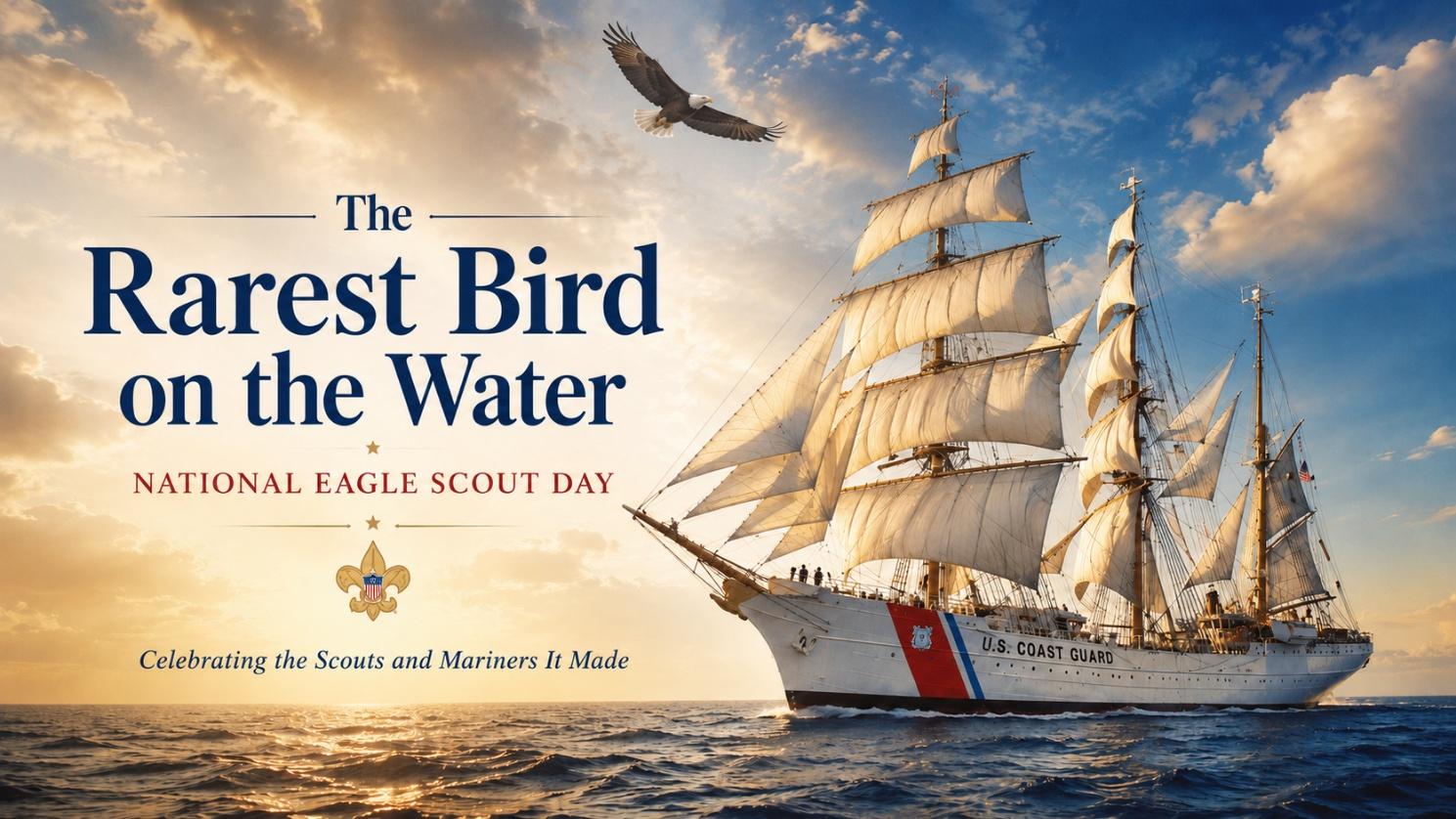
August 1 is National Eagle Scout Day — a salute to the rarest rank in American Scouting, first earned by a seventeen-year-old back in 1912. It is also, quietly, a maritime holiday: a remarkable share of the young people who pinned on that eagle went on to command warships, crew tall ships, and — on one famous occasion — fly to the Moon and steer a crippled spacecraft safely home.
Every so often, the Herd Law Firm can set aside the depositions and the damages models to celebrate something simpler. August 1 is one of those days. It’s National Eagle Scout Day, and for a maritime attorneys who happen to be a sailor himself, it’s a fine excuse to honor a tradition that has quietly sent generations of young Americans across the high seas — and, at least once, well beyond it.
A BADGE BORN IN 1912
The Boy Scouts of America (BSA) — today known as Scouting America — was founded in 1910, and the Eagle Scout rank appeared soon after in the 1911 Handbook for Boys. In 1912, a quiet seventeen-year-old named Arthur Rose Eldred, of Troop 1 in Rockville Centre, New York, became the first to earn it. His board of review was a landmark event: seated across from him was Robert Baden-Powell, the founder of Scouting himself. Though Eldred did not receive the award physically until Labor Day as the medal’s design had not yet been finalized, in the meantime, Eldred did something poetically in character — he saved two fellow Scouts from drowning.
BSA’s National Council later fixed August 1 as National Eagle Scout Day, first observed in 2012 on the rank’s centennial. On that day, Eagles young and old are encouraged to wear the badge and do a “good turn.”
THE RAREST RANK
An Eagle Scout must earn at least twenty-one merit badges, as well as (since mid-1960s) plan, lead, and complete a significant community service project; the “boyhood Ph.D”, as per Michael Malone the Wall Street Journal in 2015. Then, a presentation to a final board of review. Of the tens of millions of young people who have passed through Scouting, only about two and a half million have made Eagle: historically around two percent, rising to roughly four or five percent in recent years. The National Eagle Scout Association (NESA) once set out to tally the service hours behind all those projects, but stopped counting north of one hundred million. As acclaimed Georgia Author-of-the-Year Alvin Townsley puts it in Legacy of Honor: The Values and Influence of America’s Eagle Scouts, this is about as close to a gold standard of American youth as we have.
EAGLES WHO WENT TO SEA
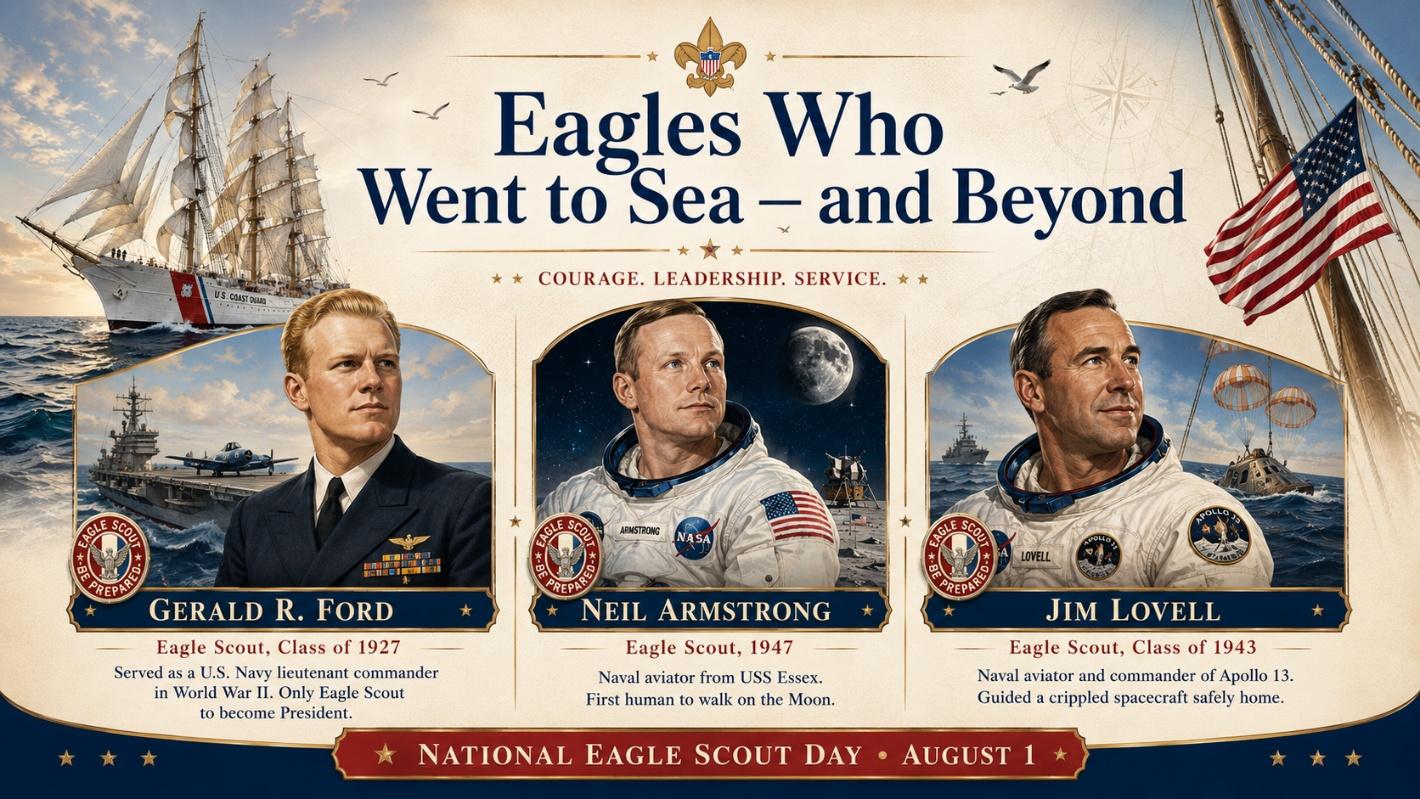
- President Gerald R. Ford (Eagle Scout, Class of 1927) — the only Eagle Scout to become President, but before Washington, he was sailor! President Ford served as a U.S. Navy lieutenant commander in the Pacific during World War II. He always considered his Court of Honor (the Eagle Scout Badge awards ceremony) to be one of his proudest moments, even after the White House.
- Neil Armstrong — earned his Eagle in 1947 and flew Navy fighters from the deck of the aircraft carrier USS Essex during the Korean War before becoming the first human to walk on the Moon. He even carried a World Scout(the international branch of the Scout Movement), which is a international with him to the lunar surface!
- Jim Lovell — (Eagle Scout, Class of 1943) Naval Academy graduate; commander of Apollo 13. Lovell flew jets off the carrier USS Shangri-La, guided his damaged spacecraft safely around the Moon and home in 1970, and spent much of his life leading NESA.
- For Texans — former Governor Rick Perry, former Secretary of State and ExxonMobil chief Rex Tillerson, and Dallas’s own Ross Perot all wear the eagle!
- Filmmaker Steven Spielberg (Eagle Scout, class of 1961) and former Defense Secretary Robert Gates (Eagle Scout, Class of 1958) have both linked their personal and professional successes to their success in scouting as well!
SCOUTING’S SALT-WATER COUSIN
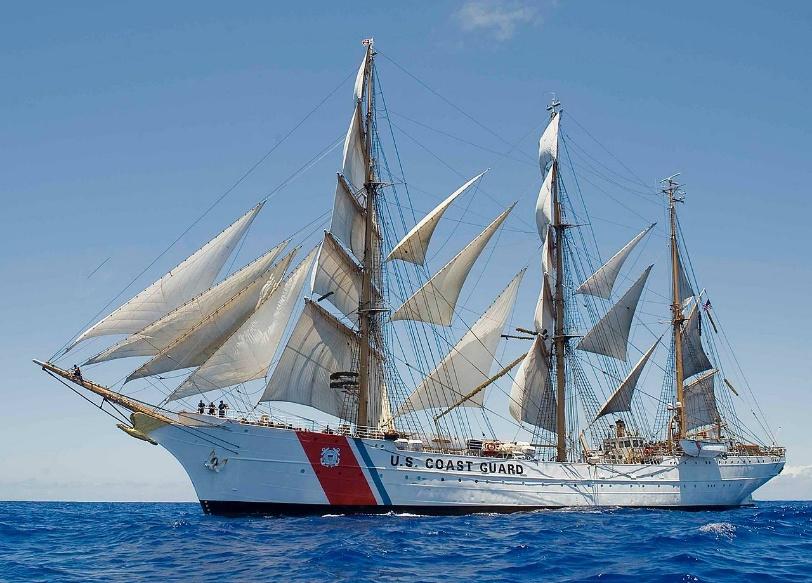
Many are unaware that Scouting has run a maritime program almost from the start: Sea Scouting was organized in the United States the same year as Eldred’s Eagle, 1912. In 2018, Sea Scouts became the official youth program of the U.S. Coast Guard (USCG) Auxiliary. Its highest honor, the Quartermaster Award, is regarded as the salt-water equivalent of Eagle, and it is roughly ten times rarer. Each summer, a handful of Sea Scouts crew the USCGC (United States Coast Guard Cutter) TS Eagle — built in 1936 and nicknamed “America’s Tall Ship,” a 295-foot square-rigged barque that trains Coast Guard cadets. A Sea Scout who reaches Quartermaster is well along the road to a USCG captain’s license.
WHY A CREW OF SAILORS SALUTES
We spend most of our working hours on the hard cases — the Jones Act injury, the unseaworthy vessel, the family left behind. So we tend to notice when an institution spends a century teaching young people to be prepared, to keep their heads when systems fail, and to look after the person standing next to them. Those are not merely Scout virtues; they are the very habits that keep a crew alive in heavy weather, and they mirror the duties maritime law places on every vessel owner who sends sailors to sea. On August 1, we simply say thank you — to the Eagles, to the Quartermasters, and to the mariners they became.
Maritime Trivia Question!
Q: Scouts are famous for their knots — but sailors were the original masters of the rope. Where does the everyday phrase “learning the ropes” actually come from?
A: The age of sail. A square-rigged ship carried literal miles of cordage, and every line had its own name and purpose. A green hand could not be trusted aloft until he had learned which rope raised which sail, trimmed which yard, and secured which spar — so to “learn the ropes” was the first, indispensable step from landsman to sailor. Fittingly, the humble reef (or “square”) knot a Scout ties on day one is the same knot mariners used to shorten — to “reef” — a sail in a rising wind.
We at the Herd Law Firm are proud to fight for seamen, maritime workers and passengers in all types of personal injury and death claims. As maritime personal injury attorneys (and sailors ourselves!) located in northwest Houston, we never waver in our commitment to help these maritime workers, passengers, and their families when they are injured or mistreated.
The information in this post is for general informational purposes only and does not constitute legal advice. For questions specific to your maritime law issue, please contact us at 713-955-3699 or at Charles.Herd@HerdLawFirm.com.
Sources
- On Scouting (Scouting America). “Meet 116 Scouts who became famous.” February 3, 2026. https://onscouting.org/2026/02/03/meet-116-scouts-who-became-famous/
- “Eagle Scout.” Wikipedia (history, requirements, and milestone statistics). https://en.wikipedia.org/wiki/Eagle_Scout
- On Scouting (Scouting America). “Jim Lovell, commander of Apollo 13 and Silver Buffalo recipient, dies at 97.” August 11, 2025. https://onscouting.org/2025/08/11/jim-lovell-commander-of-apollo-13-and-silver-buffalo-recipient-dies-at-97/
- CNN. “Apollo 13 astronaut Jim Lovell dead at 97.” August 8, 2025. https://www.cnn.com/2025/08/08/science/jim-lovell-dead-nasa-apollo
- Sea Scouts | Scouting America. “About” and “History” (Quartermaster Award; USCGC Eagle; USCG Auxiliary). https://seascout.org/about/
- “Neil Armstrong.” Wikipedia (Eagle Scout, naval aviator, USS Essex, World Scout Badge). https://en.wikipedia.org/wiki/Neil_Armstrong