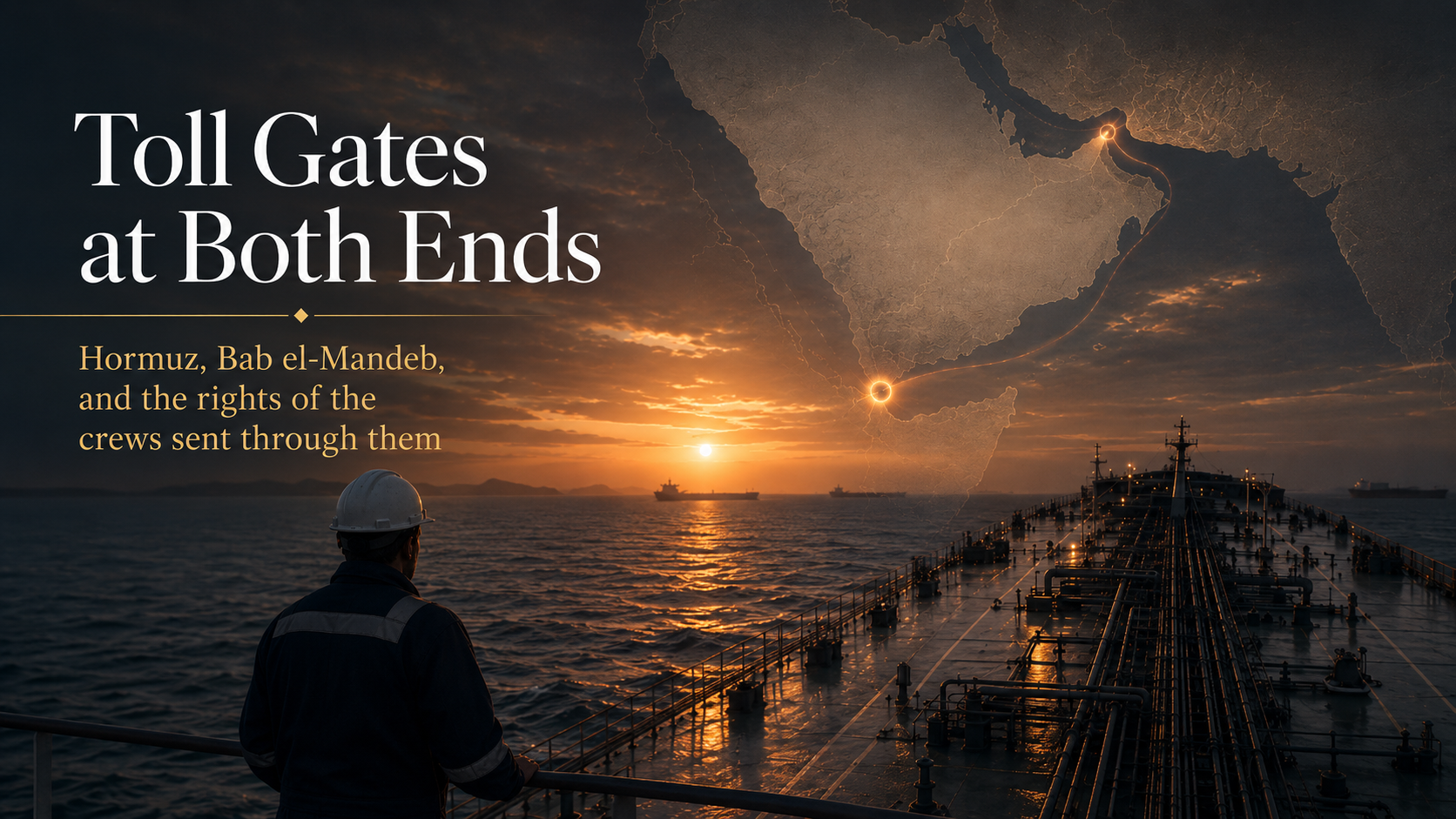
Washington has sanctioned Iran’s Strait of Hormuz “extortion network,” Tehran has rejected a compromise and claims fresh strikes on tankers, and Yemen’s Houthis are moving to raise a second toll booth at the Bab el-Mandeb. As the industry pleads for the safety of civilian seafarers, one principle holds fast for mariners under the U.S. flag: the law’s duties do not dissolve at the edge of a war-risk zone.
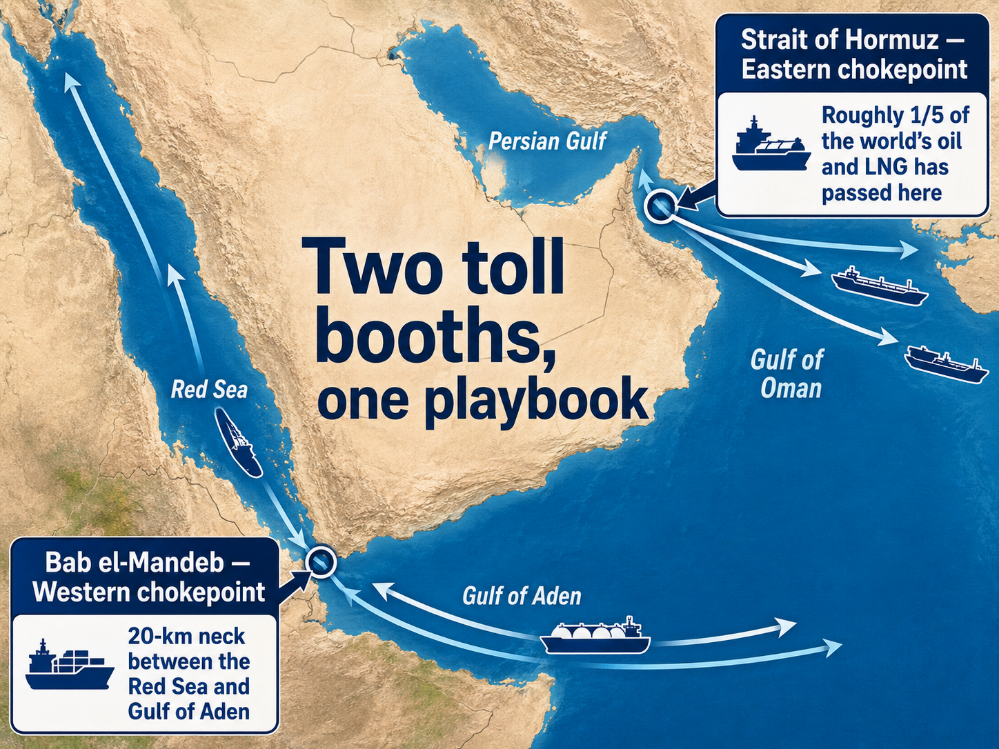
There is a grim symmetry taking shape at the two ends of the Arabian Peninsula. To the east lies the Strait of Hormuz, the narrow gate through which roughly a fifth of the world’s oil and liquefied natural gas once passed freely, and which has now spent the better part of five months as a war zone. To the west lies the Bab el-Mandeb, the twenty-kilometer neck where the Red Sea meets the Gulf of Aden. This week, both gates started to look less like waterways and more like turnstiles — and the merchant crews caught between them are once again asked to pay the real price.
For readers following this series, the throughline is familiar. In our earlier post, The Human Freight of the Hormuz Strait, we wrote about the roughly 8,000 seafarers left stranded behind the closed strait. The news since has only reiterated the severity of the situation. Over a single stretch this week:
- The U.S. Treasury’s Office of Foreign Assets Control (OFAC) sanctioned two Iranian entities it calls the Strait of Hormuz “extortion network.”
- Iran rejected a regional compromise to reopen the strait and claimed its forces had struck three tankers for taking an “unauthorized” route.
- Yemen’s Houthi movement, a week after declaring a naval blockade of Saudi Arabia, was reported to be preparing transit fees of its own at the Bab el-Mandeb.
- The world’s largest shipping associations issued a joint plea: “Stop treating civilian seafarers as military targets!”
A Toll Booth at Each Chokepoint
A chokepoint is exactly what it sounds like — a narrow stretch of water through which an outsized share of global trade must squeeze, and where whoever controls the banks can control the traffic. For months, Iran has tried to convert Hormuz from a waterway into a paying turnstile.
This week on July 29, OFAC designated the Persian Gulf Marine Insurance Company (PGMIC) and the HormuzSafe Marine Services Authority — two entities Treasury says force commercial vessels to buy mandatory “insurance,” sometimes payable in cryptocurrency, against dangers the regime itself manufactures. The action builds on the earlier sanctioning of the Persian Gulf Strait Authority (PGSA), the entity we examined in Tehran’s Toll Booth. The U.S. Treasury’s message was blunt: the United States will not let Iran hold global commerce hostage or turn a shipping lane into a revenue stream for the Islamic Revolutionary Guard Corps (IRGC).
At the far end of the Peninsula, the same script is being handed to new actors. After declaring a maritime blockade of Saudi Arabia on July 20, the Houthis — reportedly coached by Iranian advisers — are said to be weighing fees on most traffic through the Bab el-Mandeb, with Chinese vessels exempted. The message appears clear: “Two toll booths, one playbook.”
The Pressure to “Run the Strait Dark”
Here is where the danger reaches the deck plates: Iran this week rejected an Omani proposal for shared, voluntary-fee management of Hormuz, insisting instead on control of the inbound lane and a toll of its own; Tehran’s aim is for the strait “never to return to its prewar situation.” The IRGC then claimed it had fired on and stopped three oil tankers for using what it called an “unsafe and illegal route.”
Compare this against the industry’s guidance: the International Association of Independent Tanker Owners (INTERTANKO) has told owners plainly not to pay transit fees to either Iranian or Houthi authorities. This means a shoreside office may find itself wanting it both ways: refuse the toll, but send the ship anyway.
That leaves a master — the ship’s captain — with an unenviable choice we have written about before: pay an extortion the law and the insurers demand you not to pay, or make an unsanctioned, darkened, transponder-off run past a hostile navy, the maneuver we described in Running Dark Through Hormuz. Neither option is one a crew should be ordered to shoulder in silence.
The Industry Sounds the Alarm
This week, the major shipping bodies finally brought a united front. The International Chamber of Shipping (ICS), the International Association of Dry Cargo Shipowners (INTERCARGO), the International Transport Workers’ Federation (ITF), and the International Maritime Organization (IMO) each warned that mariners are being caught in conflicts that are not theirs — not only at Hormuz, but in the Black Sea as well. INTERCARGO put it plainly: seafarers are civilians doing their jobs, and should never be treated as military targets.
The numbers behind the appeals tell a sobering story: by late July, maritime-security trackers counted dozens of confirmed incidents in and around Hormuz this year, with roughly seventeen seafarers killed, many vessels damaged, and several crews forced to abandon ship; recent attacks alone killed one Indian seafarer, injured others, and left one missing. INTERTANKO’s latest advisory reads like a storm warning:
- Delay transits through the strait where possible;
- Keep close coordination with military reporting centers;
- Run enhanced, voyage-specific risk assessments; and
- Weigh carefully whether to broadcast on the Automatic Identification System (AIS) and Long-Range Identification and Tracking (LRIT) systems in high-risk waters.
Seems like sensible advice. But notice who is asked to actually live with it: the crew.
What U.S. Maritime Law Says When Crews Are Sent Into Harm’s Way
As we have said in past posts, none of a seaman’s protections are suspended because the hazard wears a uniform instead of arriving as weather. For mariners who can invoke United States law, three long-settled obligations bear directly on voyages like these.
- Jones Act negligence. Under the U.S. Jones Act (46 U.S.C. § 30104), an employer’s negligence need only have played “any part, even the slightest,” in causing a seaman’s injury. Ordering a vessel into a lane where a navy has already fired on merchant ships — after regulators condemned the attacks and insurers repriced the risk — is precisely the kind of decision that invites that question.
- Unseaworthiness. Under the U.S. General Maritime Law, a vessel owner is strictly liable when the ship, her gear, or her crew is not reasonably fit for the voyage ordered. A run into an active combat zone without adequate protection, communications, or a lawful means of complying with blockade instructions could qualify.
- Maintenance and cure. These ancient admiralty duties require an employer to pay an injured seaman’s daily living expenses (maintenance) and medical costs (cure), regardless of fault, until the seaman reaches maximum medical improvement (MMI) — the point at which further treatment is not generally expected to better the condition.
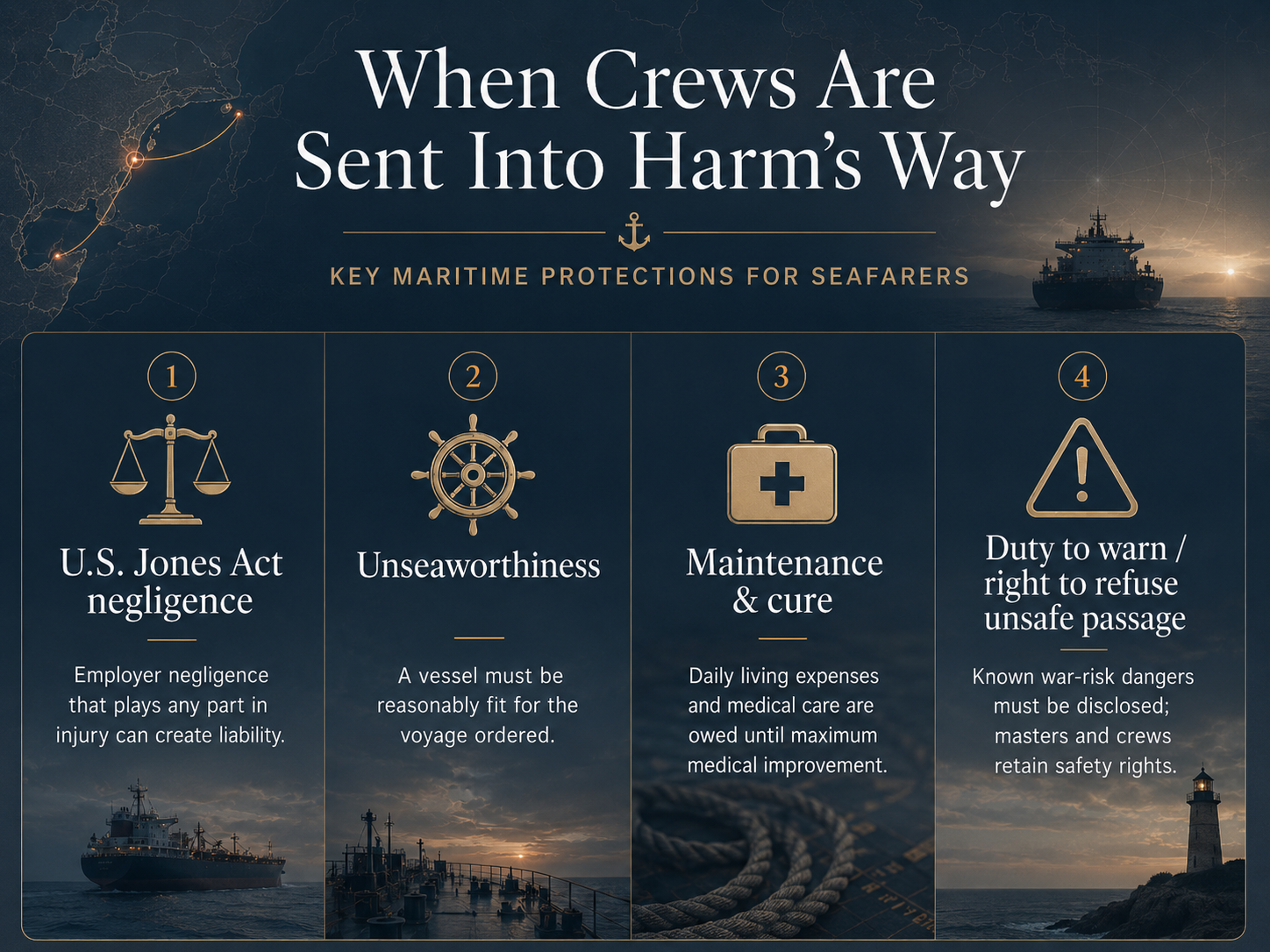
A critical addition to these affirmative “duty to warn” crews of known dangers — a duty that only grows heavier as the warnings grow louder. When the IMO has condemned attacks on merchant ships, flag states have restricted deployments, and tanker owners have been told point-blank not to pay tolls, an employer who nonetheless sends a crew into those waters without full warning, or without the crew’s informed consent, is standing on very thin ice. And a seaman retains the right to refuse unsafe passage, anchored by the master’s overriding authority to protect ship and crew. War-risk clauses in employment contracts and collective bargaining agreements (CBAs) often reinforce all of this with the right to decline a high-risk voyage, enhanced insurance, and war-risk bonuses.
Why This Reaches the Gulf Coast
The same laws and duties that protect a tankerman off the coast of Oman protect a deckhand on the Houston Ship Channel, a barge crew on the Gulf Intracoastal Waterway, and a charter hand crossing Galveston Bay. A seaman does not surrender the Jones Act, maintenance and cure, or the right to a seaworthy vessel simply by working somewhere dangerous. Dangerous water is exactly where those rights were meant to hold.
After all, the watch does not end when the shooting starts — someone still has to stand at the rail, and the law owes that person more than a toll receipt.
Maritime Trivia Question!
Q: This whole story turns on a single narrow passage — a strait. The word looks like “straight,” but its family tree runs somewhere more fitting. Where does “strait” come from?
A: It descends from the Latin strictus, “drawn tight, narrow” — the past participle of stringere, “to bind or draw close.” The same root gives us strict, stringent, and constrict, along with the old phrase “dire straits” for a tight spot with no easy way out. A strait, then, is water pulled taut between two shores — a place, as this month keeps proving, where the world’s margin for error is squeezed to almost nothing.
We at the Herd Law Firm are proud to fight for seamen, maritime workers, and passengers in all types of personal injury and death claims. As maritime personal injury attorneys (and sailors ourselves!) located in northwest Houston, we never waver in our commitment to help these maritime workers, passengers, and their families when they are injured or mistreated.
The information in this post is for general informational purposes only and does not constitute legal advice. For questions specific to your maritime law issue, please contact us at 713-955-3699 or at Charles.Herd@HerdLawFirm.com.
Sources
- U.S. Department of the Treasury. “Treasury Disrupts Iranian Regime’s Strait of Hormuz Extortion Network.” Press release SB0581, July 29, 2026. https://home.treasury.gov/news/press-releases/sb0581
- Schuler, Mike. “New U.S. Sanctions Target Iran’s Emerging Strait of Hormuz Maritime Services Network.” gCaptain, July 29, 2026. https://gcaptain.com/new-u-s-sanctions-target-irans-emerging-strait-of-hormuz-maritime-services-network/
- “US Sanctions Iran ‘Extortion Network’ Targeting Hormuz Shipping.” Bloomberg, July 29, 2026. https://www.bloomberg.com/news/articles/2026-07-29/us-sanctions-iran-extortion-network-targeting-hormuz-shipping
- “Iran rejects Omani proposal for regional management of Hormuz.” Reuters, via Daily Sabah, July 29, 2026. https://www.dailysabah.com/business/economy/iran-rejects-omani-proposal-for-regional-management-of-hormuz
- “Iran Rejects Omani Plan for Strait of Hormuz Management.” MarineLink, July 29, 2026. https://www.marinelink.com/news/iran-rejects-omani-plan-strait-hormuz-541592
- Saul, Jonathan, Parisa Hafezi, and Timour Azhari. “Yemen’s Houthis Considering Fees for Ships Sailing Through Red Sea, Sources Say.” Reuters, July 29, 2026. https://www.jpost.com/middle-east/article-904028
- Schuler, Mike. “Shipping Industry Urges Protection for Civilian Seafarers as Global Maritime Threats Escalate.” gCaptain, July 29, 2026. https://gcaptain.com/shipping-industry-urges-protection-for-civilian-seafarers-as-global-maritime-threats-escalate/
- “INTERCARGO Calls For Urgent International Action To Protect Seafarers And Merchant Shipping.” Marine Insight, July 29, 2026. https://www.marineinsight.com/intercargo-calls-for-urgent-international-action-to-protect-seafarers-and-merchant-shipping/
- International Maritime Organization. “Middle East – Strait of Hormuz” (situation updates and evacuation framework). https://www.imo.org/en/mediacentre/hottopics/pages/middle-east-strait-of-hormuz.aspx
- Legal Information Institute, Cornell Law School. “46 U.S. Code § 30104 – Personal injury to or death of seamen” (the Jones Act). https://www.law.cornell.edu/uscode/text/46/30104