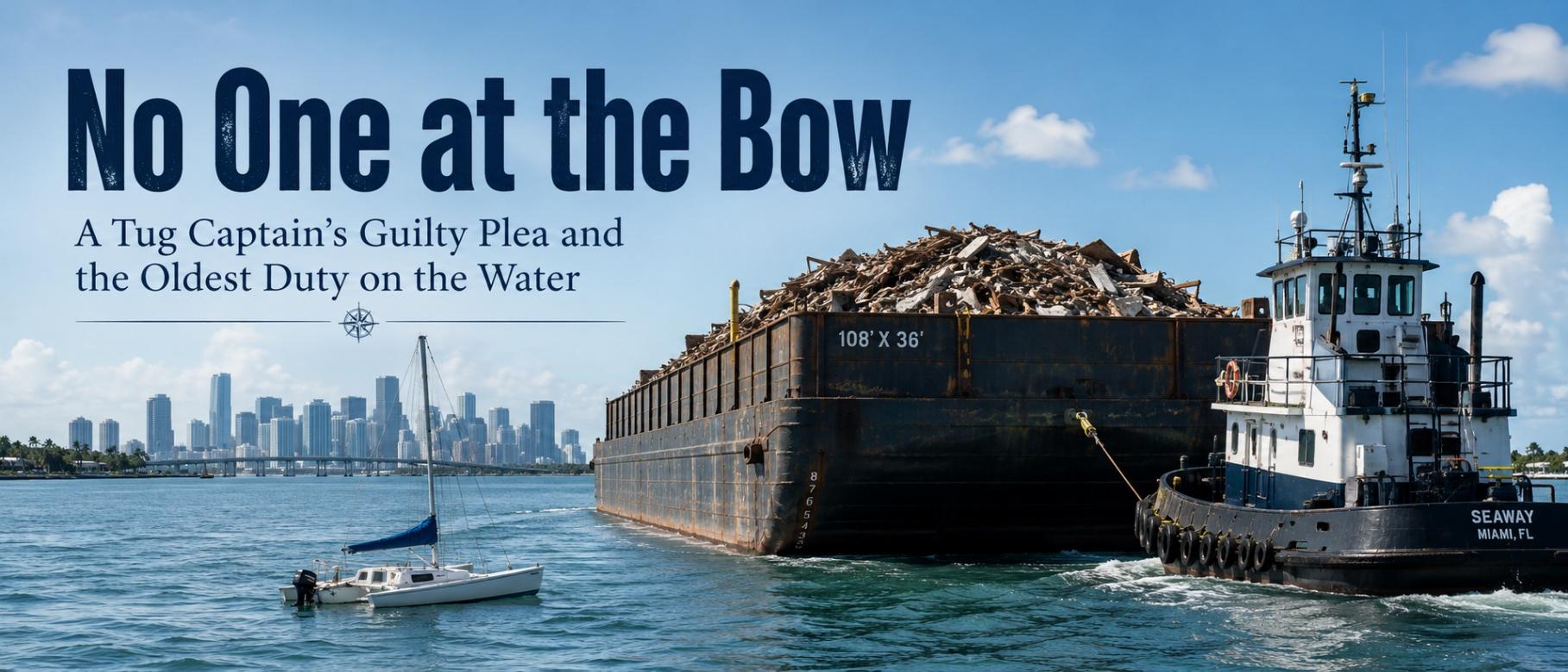
A Miami tug captain has admitted that a blocked view, an empty lookout post, and a phone in his hand cost three young sailors their lives on Biscayne Bay. His guilty plea invokes a federal statute older than the Civil War—and points to the civil duties every vessel owes the small craft sharing its water, from Florida’s bays to the Houston Ship Channel.
A vessel underway is only as watchful as the people aboard her; steel and horsepower see nothing on their own. Take eyes off the water, and even a slow boat in calm weather can become a dangerous blind animal, crashing through a crowd. On the morning of July 28, 2025, that is unfortunately what crossed Biscayne Bay—and three children died as a result.
Last week, the captain who was pushing that barge admitted fault in federal court. Though his guilty plea is not a civil, but a criminal matter, it sheds light on something every family on the water should understand: what the law expects of the larger vessel when a smaller one is in its path, and what rights the people on that smaller craft (and their families) still have when ignored.
What Happened on Biscayne Bay
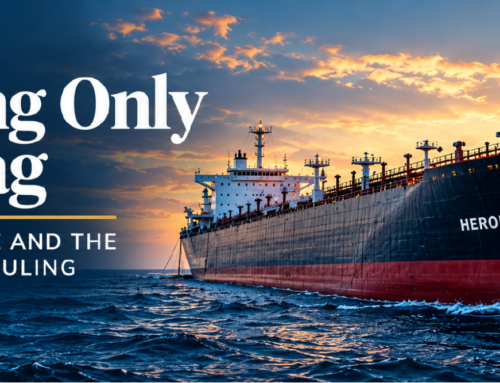
According to court records and the U.S. Attorney’s Office for the Southern District of Florida, Yusiel Lopez Insua, 46, was operating the 25-foot pusher tug, M/V Wood Chuck, shoving a 108-foot barge loaded with construction debris—roughly 149 gross tons all told—across the bay near Hibiscus Island.
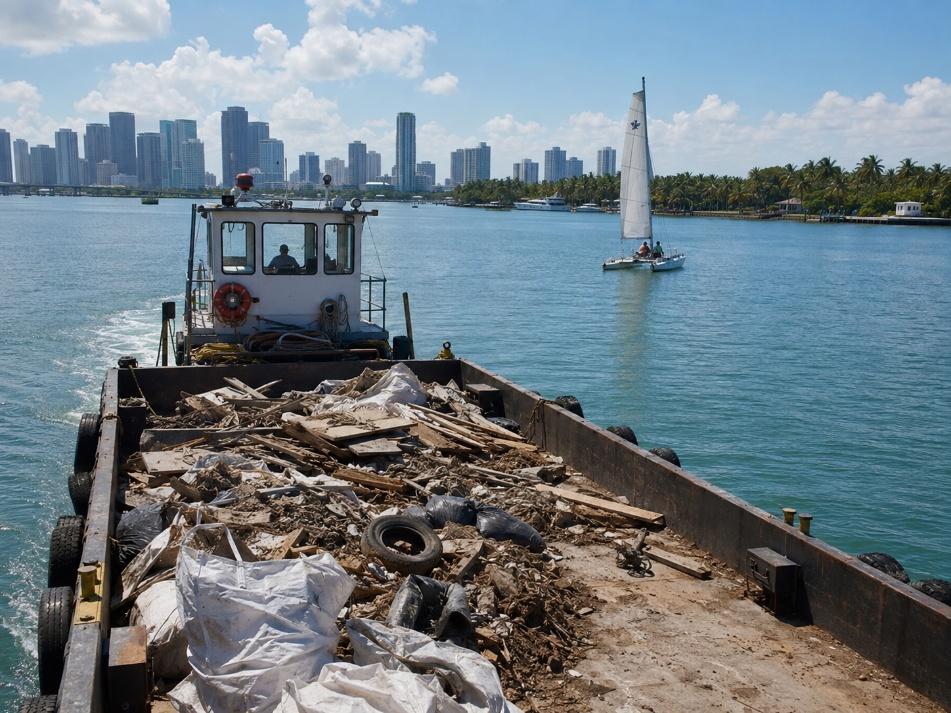
(A gross ton is a measure of a vessel’s enclosed volume, not its weight; the number is a rough proxy for how much ship is in motion.) Ahead of him, a 17-foot Hobie Getaway sailboat carrying a 19-year-old counselor and five girls from a Miami Yacht Club sailing camp had lost the wind and stalled, dead in the water, directly in his path.
Insua never saw them. Prosecutors say three separate failures stacked up on top of one another:
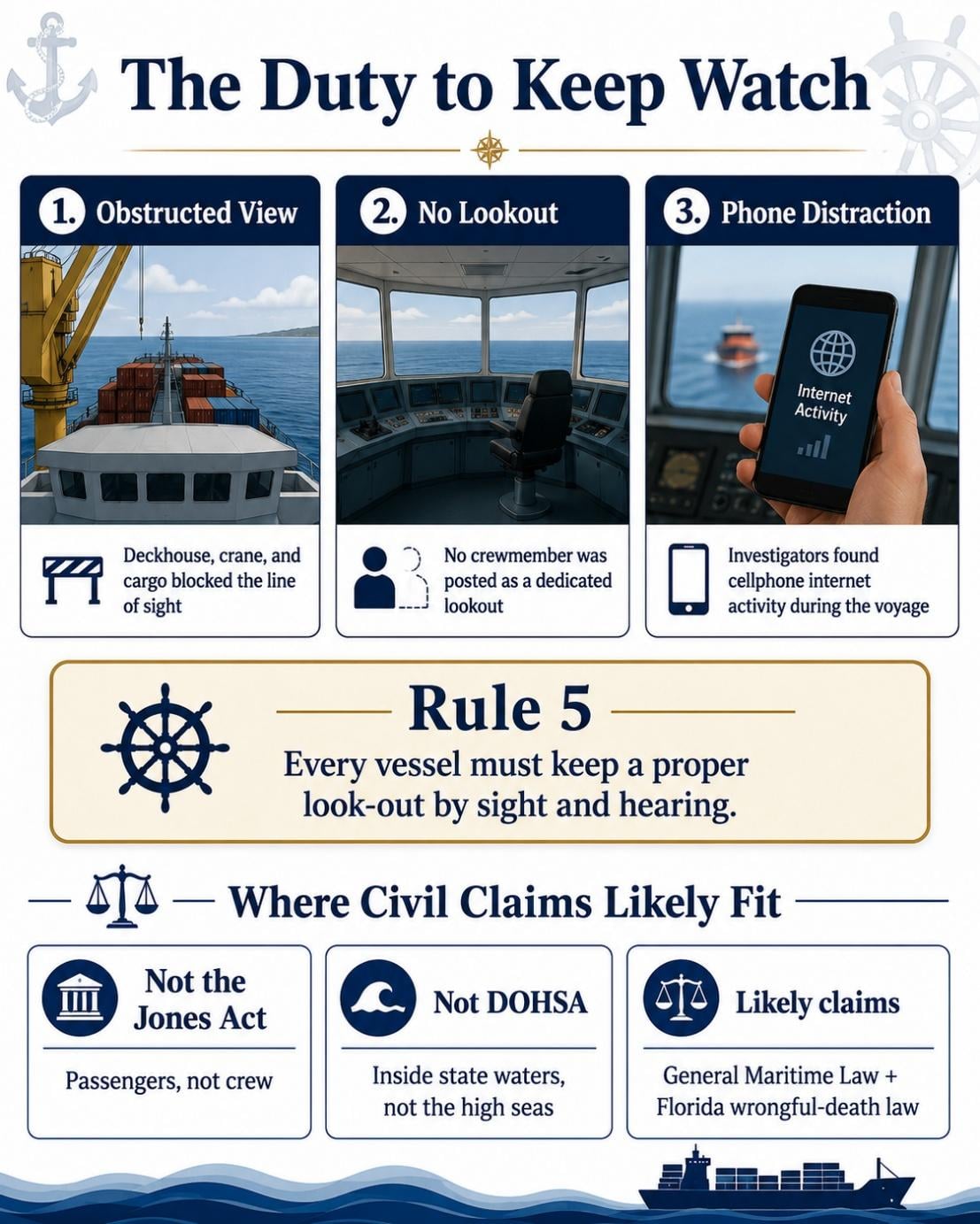
- Obstructed view. A deckhouse, a crane, and the debris cargo blocked the forward line of sight from the tug across the barge.
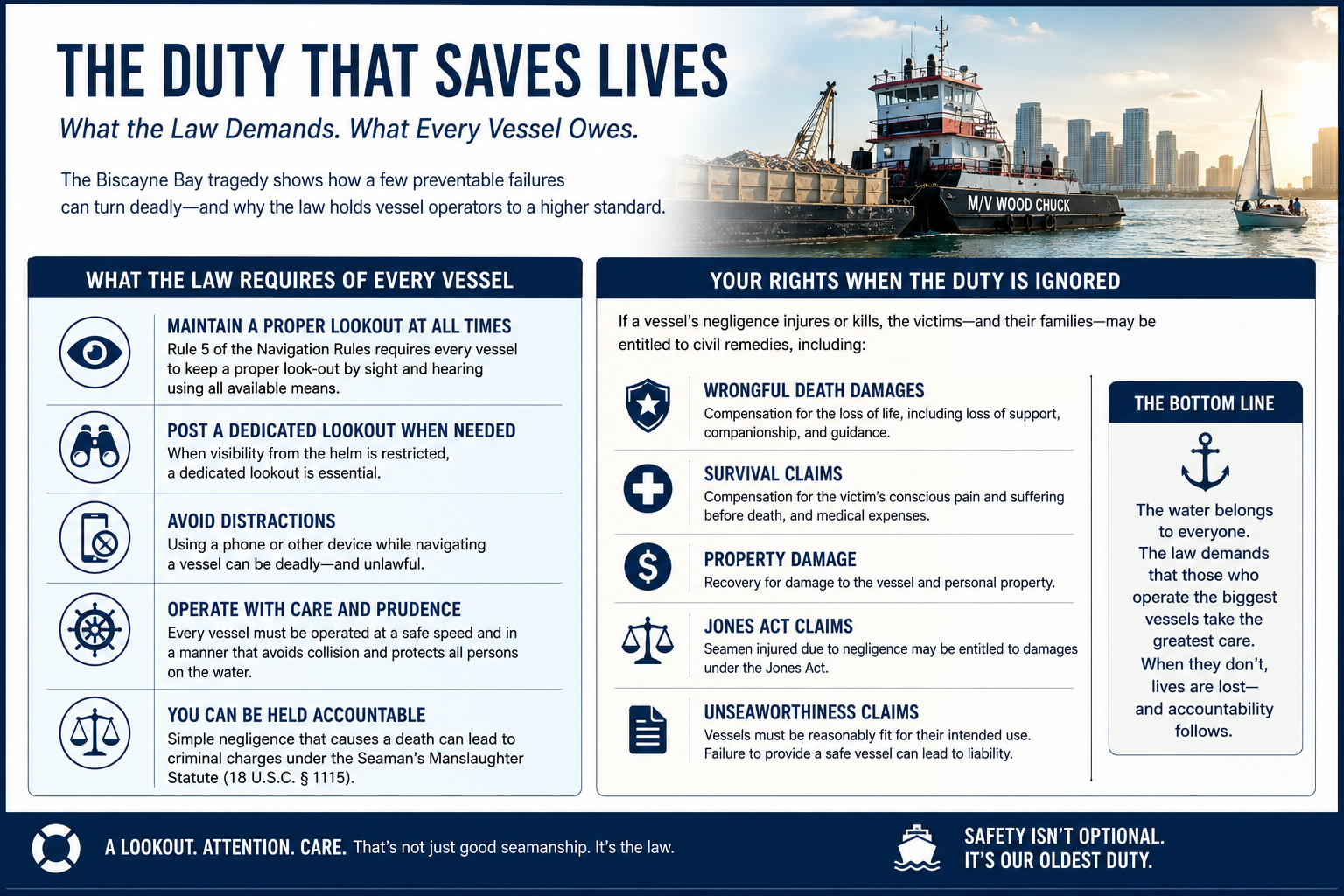
- No lookout. With visibility from the helm restricted, no crewmember had been posted as a dedicated lookout—the single most basic safeguard for exactly this situation.
- A phone in hand. Investigators recovered internet activity on the captain’s cellphone during the voyage, including at or near the moment of impact.
The barge ran the sailboat down and trapped it beneath the hull. The counselor and two of the girls were dragged under and survived; three did not. Mila Yankelevich, age 7; Arielle “Ari” Buchman, age 10; and Erin Ko Han, age 13, drowned in the wreckage. They were attending summer camp, learning on the very craft that should have been nothing but safe and enjoyable that bright morning.
On July 21, 2026, Insua changed his plea to guilty on a single count of seaman’s manslaughter. He is scheduled for sentencing on October 13, 2026. The charge carries a maximum of ten years in federal prison, though a plea agreement recommends a far lighter term; the sentencing judge is not bound by that recommendation. The case was built by the U.S. Coast Guard Investigative Service (CGIS), U.S. Coast Guard (USCG) Sector Miami, and the Florida Fish and Wildlife Conservation Commission (FWC).
Seaman’s Manslaughter: A Law Born of Boiler Explosions
The statute at the center of the plea—the Seaman’s Manslaughter Statute, codified at 18 U.S.C. § 1115—is one of the oldest criminal laws in the federal code, and its history is worth a review: In the early nineteenth century, steamboat boilers exploded with grim regularity, killing thousands of passengers. When a boiler blast killed a sitting United States Senator, Josiah Johnston of Louisiana, in 1833, President Andrew Jackson pressed Congress to act. The result was an 1838 statute “for the better security of the lives of passengers” aboard steam vessels—the ancestor of § 1115.
What makes the statute especially formidable is its low threshold. Ordinary manslaughter usually requires gross negligence or recklessness. Seaman’s manslaughter requires only simple negligence—an ordinary failure to exercise reasonable care by a captain, engineer, pilot, or other person employed on the vessel, where that failure causes a death. In plain terms, the law holds those who operate vessels to a stricter criminal standard than almost anyone else, precisely because a moment’s inattention on the water can be fatal to people who never chose the risk.
This is the same statute prosecutors used to secure guilty pleas after the 2003 Staten Island Ferry disaster, and the same principle that put this captain’s three failures—blocked view, no lookout, phone in hand—squarely within its reach.
The Oldest Rule on the Water: Keep a Lookout
Strip away the statute numbers and this case is about one duty that predates all of them. Rule 5 of the Navigation Rules—the collision-avoidance regulations that govern American waters, drawn from the International Regulations for Preventing Collisions at Sea (COLREGS) and the parallel Inland Navigation Rules—commands that every vessel keep “a proper look-out by sight and hearing” at all times, using every available means to judge the risk of collision. It is the first rule a child learns at a sailing camp, and the first rule a professional mariner should never break.
If the helmsman’s own eyes cannot see the water ahead—because a deckhouse or a crane or a stack of cargo is in the way—the rule does not excuse the blindness. It requires a remedy: post a lookout with a clear view and a direct line to the helm, which did not happen here. Additionally, a smartphone is the opposite of a proper lookout; it is the eyes and mind pointed exactly where they shouldn’t be.
Ultimately, the tragedy of Biscayne Bay is not that the rule was unclear, but that the simplest rule on the water was left unkept.
Where the Criminal Case Ends and the Families’ Rights Begin
A criminal conviction punishes the wrongdoer; it does not compensate the harmed. Under U.S. law, the children and their counselor were recreational passengers, not crew—so the U.S. Jones Act (46 U.S.C. § 30104), which protects seamen injured in the course of their employment, likely does not govern their claims. And since the collision happened in a bay well within state waters (not on the “high seas”), the Death on the High Seas Act (DOHSA) does not control either. What remains is the body of admiralty rules known as the General Maritime Law, as well as with Florida’s state wrongful-death statute.
For most of American history, admiralty law offered no remedy at all for a death on the water—a harsh rule that left grieving families with nothing. That changed in 1970, when the U.S. Supreme Court, in Moragne v. States Marine Lines, recognized a wrongful-death cause of action under the General Maritime Law for deaths in territorial waters.
Under that framework, families in a situation like this one may pursue civil claims grounded in the same failures the criminal case identified—a negligently operated vessel, an unposted lookout, a distracted operator—against those responsible for the tow, including potentially the owner and operator of the tug and barge. A guilty plea in the criminal case does not decide the civil claims, but the facts it establishes rarely help any defense against them.
Why This Reaches the Gulf Coast
Biscayne Bay is a long way from Galveston, but the water is the same in every way that matters. The Houston Ship Channel, the drayage lanes and anchorages off Bayport and Barbours Cut, the Gulf Intracoastal Waterway, the open reaches of Galveston Bay and dozens of other Texas coastal waters all mix heavy tug-and-barge traffic with sailboats, kayaks, fishing skiffs, and the crewed charters that carry families out for the afternoon. A pushed barge here is often far larger than the one on Biscayne Bay, and the forward blind zone even larger.
The duty is identical on each coast: Post the lookout, keep the eyes on the water, give the small craft plenty of room. When a commercial operator ignores those obligations and a recreational boater is hurt or killed, Texas families are not without recourse—the General Maritime Law and Texas’s own wrongful-death and survival statutes stand behind them. And the General Maritime Law asks, and will continue to ask, the most important fair question it has always asked of larger vessel: could you have seen them, if only someone had been watching?
Maritime Trivia Question!
Q: Sailors are told to “keep a weather eye open.” Watchfulness, yes—but why a weather eye, of all things?
A: On a ship, the “weather” side is the windward side—the direction the wind, and therefore the coming weather, arrives from. A squall shows itself there first: a darkening horizon, a shift in the swell, a line of cloud to windward. To keep a weather eye open is to keep watch on the quarter where danger is most likely to appear before it reaches you. The phrase has since drifted ashore to mean simple vigilance, but its origin is pure seamanship—the habit of looking hard at the place trouble comes from, early enough to do something about it. Which is, in the end, the entire point of a lookout.
We at the Herd Law Firm are proud to fight for seamen, maritime workers, passengers, and recreational boaters in all types of personal injury and death claims. As maritime personal injury attorneys (and sailors ourselves!) located in northwest Houston, we never waver in our commitment to help these maritime workers, passengers, and their families when they are injured or mistreated.
The information in this post is for general informational purposes only and does not constitute legal advice. For questions specific to your maritime law issue, please contact us at 713-955-3699 or at Charles.Herd@HerdLawFirm.com.
Sources
- Schuler, Mike. “Tugboat Captain Pleads Guilty in Collision That Killed Three Children.” gCaptain, July 27, 2026. https://gcaptain.com/
- “Captain Pleads Guilty in Boat Crash That Killed 3 Girls From Miami Sailing Camp.” Associated Press / ABC News, July 2026. https://abcnews.go.com/
- “Tugboat Captain Pleads Guilty in Crash That Killed 3 Girls From Miami Sailing Camp.” WLRN, July 24, 2026. https://www.wlrn.org/law-justice/2026-07-24/tugboat-captain-pleads-guilty-in-crash-that-killed-3-girls-from-miami-sailing-camp
- Goodhue, David. “Tugboat Captain Charged in Crash That Killed 3 Sailboat Campers in Biscayne Bay.” Miami Herald, 2026. https://www.miamiherald.com/
- “Tugboat Captain Pleads Guilty in Collision That Killed Three Children.” WorkBoat, July 2026. https://www.workboat.com/tugboat-captain-pleads-guilty-in-collision-that-killed-three-children
- Legal Information Institute, Cornell Law School. “18 U.S. Code § 1115 – Misconduct or neglect of ship officers” (the Seaman’s Manslaughter Statute). https://www.law.cornell.edu/uscode/text/18/1115
- U.S. Coast Guard Navigation Center. “Navigation Rules, International–Inland” (Rule 5, Look-out). https://www.navcen.uscg.gov/navigation-rules-amalgamated
- Moragne v. States Marine Lines, Inc., 398 U.S. 375 (1970). Legal Information Institute, Cornell Law School. https://www.law.cornell.edu/supremecourt/text/398/375
- Legal Information Institute, Cornell Law School. “46 U.S. Code § 30104 – Personal injury to or death of seamen” (the Jones Act). https://www.law.cornell.edu/uscode/text/46/30104