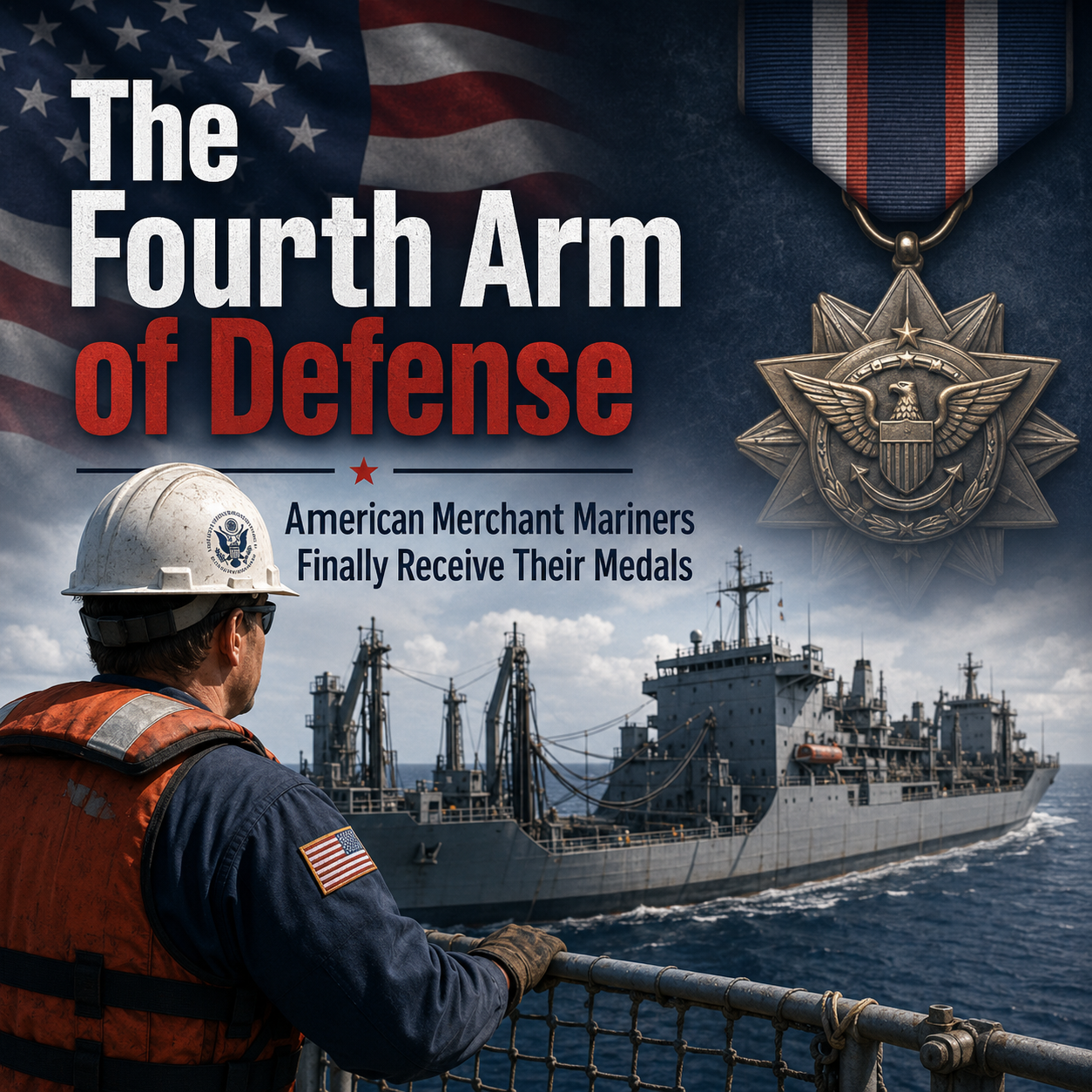
On July 17, 2026, a civilian-crewed ship received the Presidential Unit Citation for the first time in the 77-year history of the Military Sealift Command. It is a long-overdue nod to the merchant mariners who move American power and cargo — and a useful reminder that the men and women who earn those honors are still, legally speaking, workers with rights.
President Franklin Roosevelt called them the “Ugly Ducklings” — the plain, welded, hurriedly built cargo ships of the Second World War — and he called the men who crewed them the “Fourth Arm of Defense.” Not exactly flattering, but Roosevelt understood what gets lost between the battleship photographs and the war hero memoirs: no military can fight long past the end of its fuel supply. Nearly eighty years on, the Navy has said it out loud again, and this time it came with a medal.
A First in Seventy-Seven Years
At Naval Station Norfolk on July 17, Admiral Karl Thomas, commander of U.S. Fleet Forces Command, presented the Presidential Unit Citation (PUC) — the highest award a military unit can receive, given for extraordinary heroism in action against an armed enemy — to the crew of the fleet replenishment oiler USNS Kanawha (T-AO 196). The dry cargo and ammunition ship USNS William McLean (T-AKE 12) was awarded the citation as well, with its own ceremony to follow.
Both ships belong to the Military Sealift Command (MSC), which operates some 140 non-commissioned support ships crewed largely by Civil Service Mariners (CIVMARs) and commercial contractors, rather than uniformed sailors. In seventy-seven years, no MSC ship had ever received the PUC. Now two have.
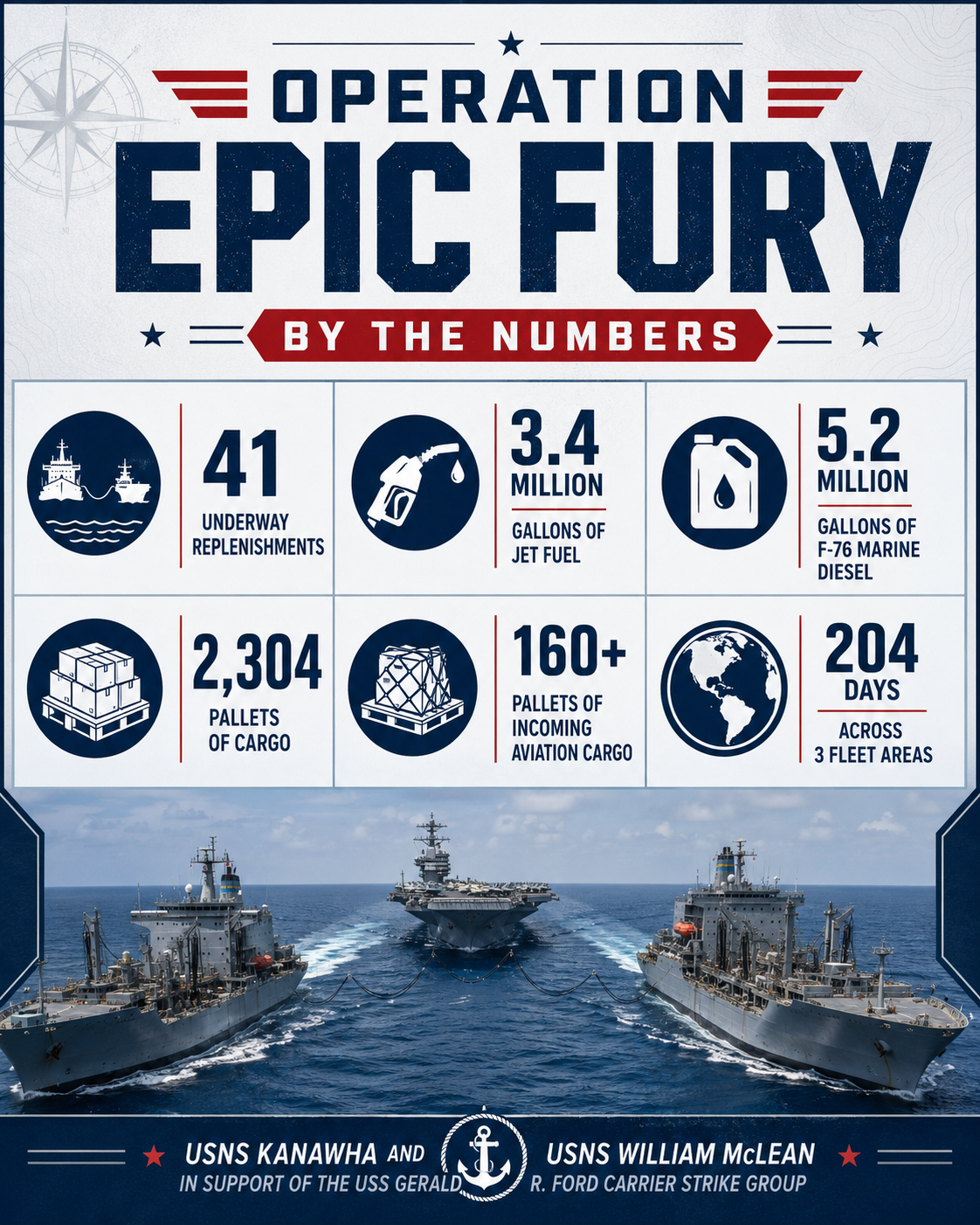
The award recognizes their support of the USS Gerald R. Ford Carrier Strike Group during Operation Epic Fury. Over a seven-month deployment, the two Combat Logistics Force (CLF) ships:
- Completed 41 underway replenishments;
- Transferred 3.4 million gallons of jet fuel and 5.2 million gallons of F-76 marine diesel;
- Moved 2,304 pallets of cargo and processed more than 160 pallets of incoming aviation cargo.
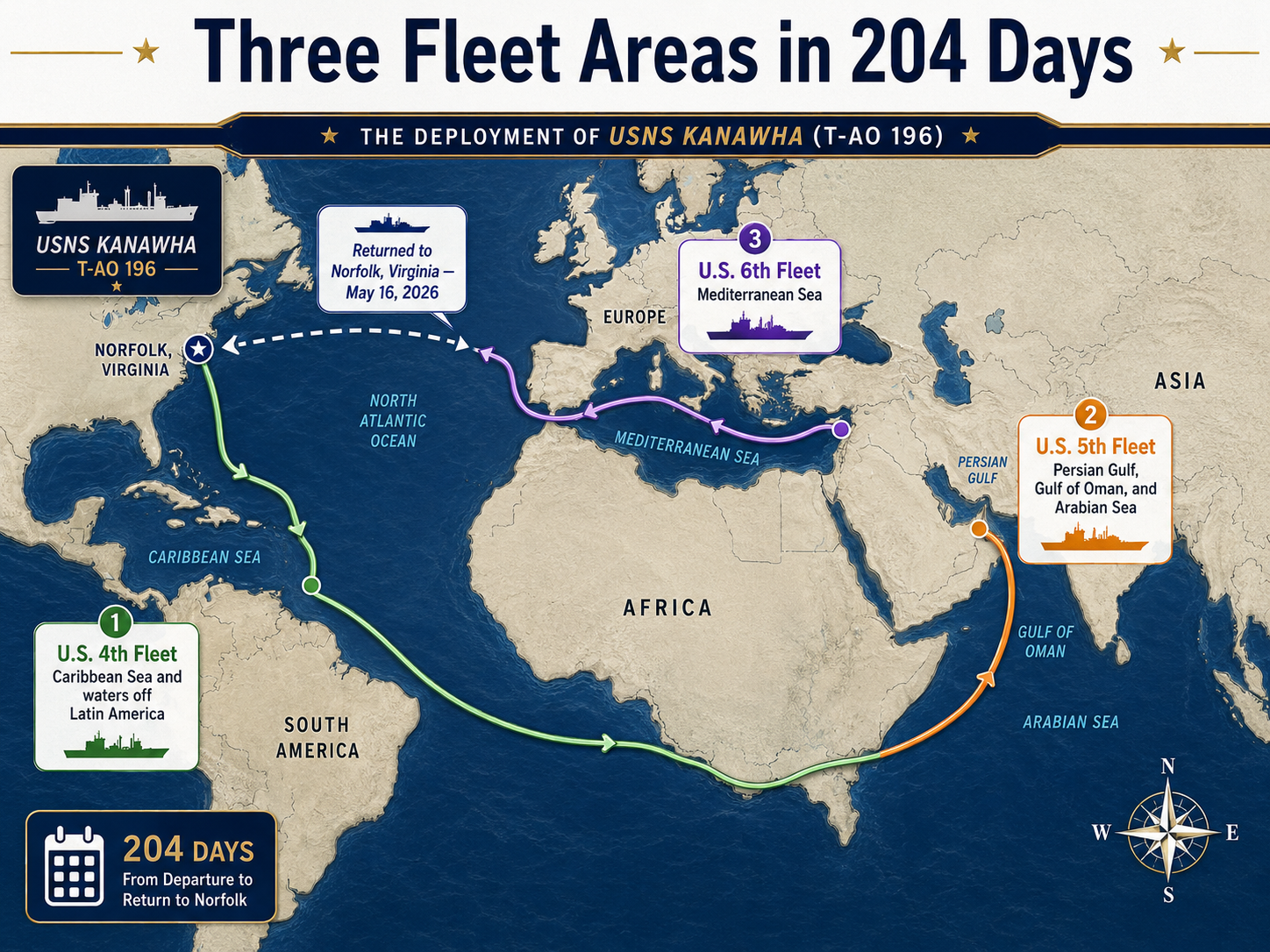
Twenty individual awards went to USNS Kanawha crewmembers alongside the unit citation. She had not been assigned anywhere near the Gulf of Oman, as Rear Admiral Benjamin Nicholson, who commands MSC, has noted. She was working the Caribbean under Operation Southern Spear when U.S. forces surged into the Middle East in late February, and she was rerouted.
Over roughly 204 days she worked from the Caribbean to the Gulf of Oman and on into the Mediterranean, where the USS Gerald R. Ford was operating that April; both ships returned to Naval Station Norfolk on May 16, 2026. With Iranian strikes making the Navy’s usual regional ports unusable, her crew improvised across far longer sea lines than anyone had planned for.
Strip away the citation language and that is the work itself: no guns, no glory, only the unglamorous arithmetic of keeping a strike group fed and fueled while other people do the shooting — dangerous and almost entirely invisible until somebody pins a ribbon on it.
The Gallant Ship Award and the Stena Immaculate
The Norfolk ceremony was the second recognition of American mariners this year. On National Maritime Day, May 22, 2026, the Maritime Administration (MARAD) presented the Gallant Ship Award to the 23-member Crowley crew of the U.S.-flagged tanker M/T Stena Immaculate.
On March 10, 2025, the tanker lay at anchor in the North Sea off the Humber Estuary, near Hull, carrying more than 220,000 barrels of jet fuel under charter to MSC and enrolled in MARAD’s Tanker Security Program. The container feeder M/V Solong struck her amidships at roughly sixteen knots in patchy visibility, rupturing a cargo tank and setting her afire. The crew got every one of them off without serious injury and kept a jet-fuel fire from becoming a far larger disaster.
Established by Roosevelt in 1944, the Gallant Ship Award has been given only a few dozen times; before this year, the last was in 2019. It is not handed out for showing up.
Why Recognition and Rights Travel Together
Both crews earned their honors doing the very thing maritime law was written to address: working aboard a vessel where the employer, not the worker, decides where she goes and what she sails into.
Three doctrines of American maritime law reflect that reality:
- Jones Act negligence. A seaman may recover where his employer’s negligence played “any part, even the slightest” in causing his injury. That famously low threshold exists because the ship is both workplace and only shelter — you cannot walk off the job three hundred miles from land.
- Unseaworthiness. Under the General Maritime Law, an owner is strictly liable when the ship, her gear, her crew, or her fitness for the voyage ordered is not reasonably safe. Fault is not the question; fitness is.
- Maintenance and cure. The oldest obligation in admiralty: an owner pays an injured seaman’s daily living expenses and medical costs, regardless of who was at fault, until the seaman reaches maximum medical improvement (MMI).
The General Maritime Law also imposes an affirmative duty to warn crews of known dangers — a duty that sharpens, rather than softens, when a voyage runs toward waters where merchant ships have already been fired upon.
Replenishing warships in contested waters; fighting a fuel fire at anchor. The honors say the country noticed. The law says noticing is not enough — that the employer who sends a mariner into that work owes him something concrete if it goes wrong.
Whose Employer, Whose Remedy?
There is a complication here, and it cuts against the intuition the medals create.
The Crowley mariners aboard M/T Stena Immaculate work for a private company operating a U.S.-flag vessel. Sailing under charter to MSC does not change who employs them. They are seamen in the ordinary sense, and the full set of remedies above is available to them.
Civil Service Mariners aboard USNS Kanawha and USNS William McLean stand differently. As federal employees, they face two obstacles:
- Sovereign immunity. One does not simply sue the United States. Claims involving government vessels run through the Suits in Admiralty Act and Public Vessels Act, which waive immunity only on the terms Congress set.
- An exclusive compensation scheme. CIVMARs fall under the U.S. Federal Employees’ Compensation Act (FECA). In Johansen v. United States (1952), the Supreme Court held that a federally-employed seaman covered by FECA cannot instead pursue an admiralty action against the government — the compensation scheme displaces the tort remedy.
So a mariner injured aboard a USNS ship is generally looking at scheduled FECA benefits — no jury, no recovery for pain and suffering — rather than the Jones Act and unseaworthiness remedies protecting his counterpart on a commercial hull. Claims against third parties can still survive, and that is often where more meaningful recovery is found.
Put plainly: the crews just decorated for heroism under fire may have narrower remedies than a deckhand on a Houston bunker barge, precisely because their employer is the United States. This is a highly-specific corner of admiralty law, however and no mariner should assume where he falls without asking an experienced maritime attorney.
Renewal, Not Just Medals
Recognition has arrived alongside policy. The bipartisan SHIPS for America Act — the Shipbuilding and Harbor Infrastructure for Prosperity and Security Act — is led by Senators Mark Kelly (D-AZ) and Todd Young (R-IN), with Representatives John Garamendi (D-CA) and Trent Kelly (R-MS).
It aims at one uncomfortable number: roughly 80 U.S.-flagged vessels in international commerce, compared to some 5,500 flying the flag of China. The bill would create a Maritime Security Advisor, a Maritime Security Trust Fund, and sustained investment in shipyards and mariner training.
We have written before about the criticisms and open questions surrounding the SHIPS Act — chiefly whether reflagging foreign-built hulls as American is truly rebuilding anything, and questions still remain.
However, there is another, greater controversy sitting on the calendar right now.
The blanket Jones Act waiver issued on March 17, 2026 in response to the Hormuz crisis — extended once already — is set to expire for cargo loaded after August 16, 2026. It is the broadest and longest use of the waiver power since the Second World War, and it opens U.S. coastwise trade to foreign-flag tonnage. Maritime Administration data indicates that roughly 95 percent of waiver voyages have gone to foreign operators who pay no U.S. taxes and answer to no U.S. regulator, with a substantial share tied to Chinese ownership or Chinese-built hulls.
We covered what the waiver data actually shows earlier this month.
So, the ledger reads strangely: In July, the country pins its highest military unit award on American civilian mariners for the first time ever. In August, it will decide whether to keep handing domestic work from these same civilian mariners to foreign-owned and operated crews which the Jones Act was written to exclude.
Ships do not sail themselves, as MSC leadership has frequently pointed out. A vessel without a trained crew may as well be a very expensive pier. Every serious plan to rebuild American sealift is, at its core, a plan to recruit and keep American mariners — which means it also is a plan that has to make the work survivable and the injured worker whole.
Why This Reaches the Gulf Coast
American civilian mariners, whether in the Gulf of Oman or the Gulf of Mexico, work aboard vessels in navigation and face hazards frequently chosen by somebody ashore. Most carry the Jones Act, maintenance and cure, and the right to a seaworthy vessel wherever the voyage orders send them — but as the distinction above shows, what a man can actually recover may turn on who signs his paycheck.
Texas mariners crew the tugs, tankers, supply boats, and barges that make this coast run, and a fair number have served on MSC charters or under the Tanker Security Program. That is exactly why the question is worth asking before anyone is hurt, rather than after.
Roosevelt’s “Ugly Ducklings” were never built to be beautiful, but to get a job done well. A medal is a great honor, and these crews earned theirs. But a citation is read once and framed, while enforceable rights as an American mariner are what a mariner and his family actually live on if the voyage goes wrong — and those rights do not reach every one of them the same way.
Maritime Trivia Question!
Q: Why do statutes speak of mariners and seamen rather than sailors?
A: Mariner comes from the Latin mare, “sea,” by way of Old French marinier — literally “one of the sea.” Sailor is a much later English word built on sail, and it originally meant the man who worked the canvas. A modern oiler has no sails at all, but everyone aboard is still, etymologically and legally, of the sea. The older word never depended on the type of vessel.
We at the Herd Law Firm are proud to fight for seamen, maritime workers and passengers in all types of personal injury and death claims. As maritime personal injury attorneys (and sailors ourselves!) located in northwest Houston, we never waver in our commitment to help these maritime workers, passengers, and their families when they are injured or mistreated.
The information in this post is for general informational purposes only and does not constitute legal advice. For questions specific to your maritime law issue, please contact us at 713-955-3699 or at Charles.Herd@HerdLawFirm.com.
Sources
- Military Sealift Command / U.S. Navy. “USNS Kanawha Earns Presidential Unit Citation.” July 17, 2026. https://www.navy.mil/
- Schuler, Mike. “MSC Ships Earn First-Ever Presidential Unit Citation in Military Sealift Command History.” gCaptain, July 14, 2026. https://gcaptain.com/msc-ships-earn-first-ever-presidential-unit-citation-in-military-sealift-command-history/
- Stars and Stripes. “USNS Kanawha receives Presidential Unit Citation, a first for a Military Sealift Command ship.” July 17, 2026. https://www.stripes.com/branches/navy/2026-07-17/usns-kanawha-presidential-unit-citation-22293470.html
- Military Times. “Military Sealift Command ship makes history with rare combat award.” June 29, 2026. https://www.militarytimes.com/news/your-military/2026/06/29/military-sealift-command-ship-makes-history-with-rare-combat-award/
- Crowley. “Crowley Mariners Honored with Gallant Ship Award on National Maritime Day.” May 26, 2026. https://www.crowley.com/news-and-media/press-releases/gallant-ship-award-stena-immaculate-maritime-day/
- gCaptain. “Stena Immaculate Crew Honored with Gallant Ship Award Following Deadly Tanker Collision.” May 27, 2026. https://gcaptain.com/stena-immaculate-crew-honored-with-gallant-ship-award-following-deadly-tanker-collision/
- Marine Log. “Crowley Stena Immaculate mariners honored with Gallant Ship Award.” May 27, 2026. https://www.marinelog.com/news/crowley-stena-immaculate-mariners-honored-with-gallant-ship-award/
- Office of Senator Mark Kelly. “Sen. Kelly, Sen. Young, Rep. Garamendi, Rep. Kelly Introduce SHIPS for America Act.” April 30, 2025. https://www.kelly.senate.gov/newsroom/press-releases/sen-kelly-sen-young-rep-garamendi-rep-kelly-introduce-ships-for-america-act-to-boost-american-shipbuilding-strengthen-us-economy-and-national-security/
- Legal Information Institute, Cornell Law School. “46 U.S. Code § 30104 – Personal injury to or death of seamen” (the Jones Act). https://www.law.cornell.edu/uscode/text/46/30104
- Johansen v. United States, 343 U.S. 427 (1952). Justia. https://supreme.justia.com/cases/federal/us/343/427/
- Legal Information Institute, Cornell Law School. “5 U.S. Code Chapter 81 – Compensation for Work Injuries” (FECA). https://www.law.cornell.edu/uscode/text/5/part-III/subpart-G/chapter-81
- U.S. Maritime Administration (MARAD). “Gallant Ship Award.” https://www.maritime.dot.gov/
- Pillsbury Winthrop Shaw Pittman LLP. “Pressure Mounts to Let Jones Act Waiver Expire.” July 2026. https://www.pillsburylaw.com/en/news-and-insights/jones-act-waiver-expire.html
- Center for Maritime Strategy. “The Jones Act Waivers Aren’t Achieving Stated Purpose But Hinder Long Term Maritime Goals.” May 8, 2026. https://centerformaritimestrategy.org/publications/the-jones-act-waivers-arent-achieving-stated-purpose-but-hinder-long-term-maritime-goals/
- Office of Rep. James Comer. “Comer, Speaker Johnson, and Republican Lawmakers Urge Trump Administration to Let Jones Act Waiver Expire.” June 30, 2026. https://comer.house.gov/2026/7/comer-speaker-johnson-and-republican-lawmakers-urge-trump-administration-to-let-jones-act-waiver-expire-to-bolster-america-s-maritime-industry