A supertanker owner is offering crews six months’ extra salary for a single month-long round trip through the Strait of Hormuz. Two tankers burned on Monday. A bonus is not a life preserver — and under U.S. maritime law, it is not a legal defense either.
Every great sea story seems to have a moment where great wealth is offered for task no sober person would agree to. This week, that may have arrived as a shipping company memo.
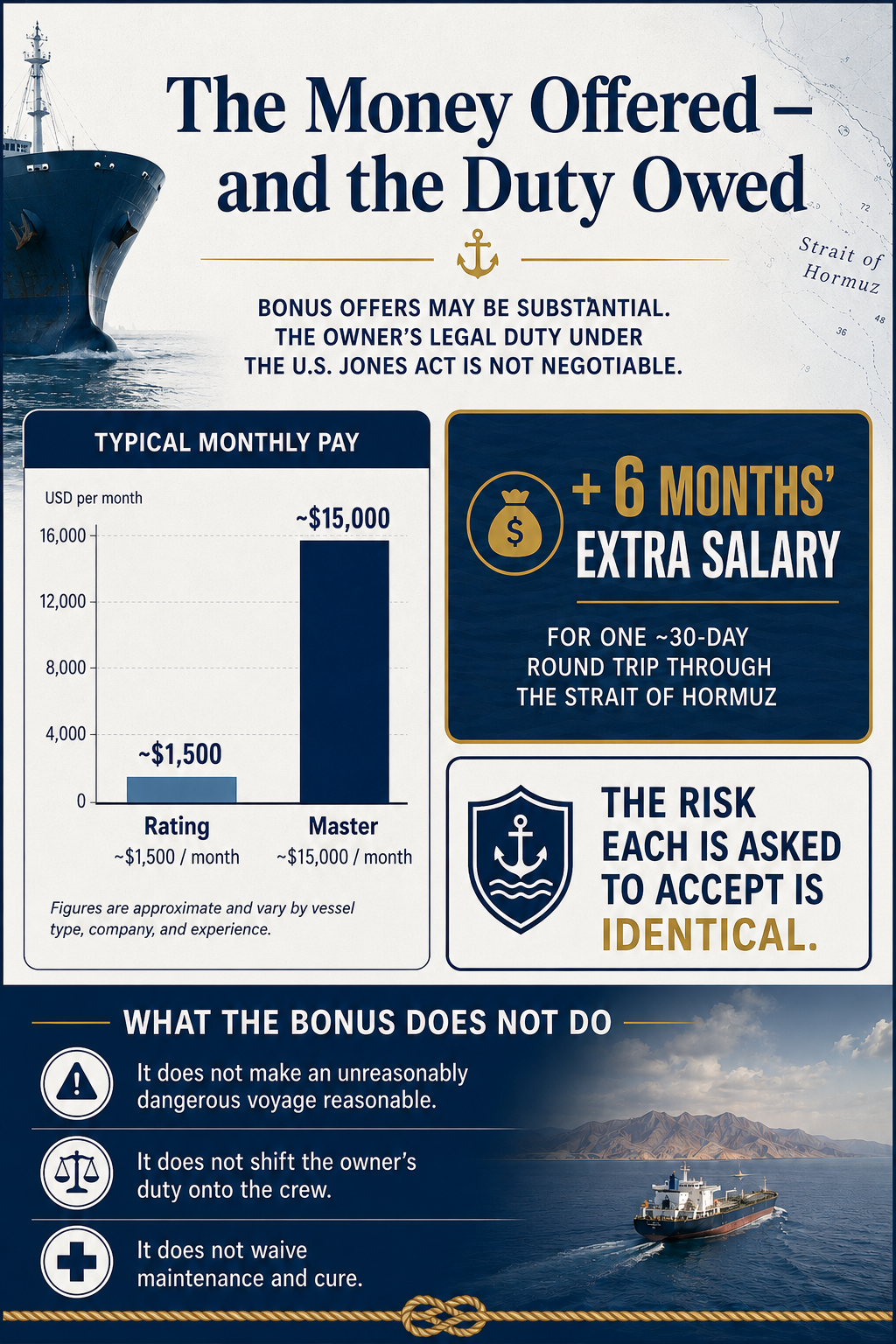
Sinokor Group — the world’s largest owner of very large crude carriers — circulated an offer to its seafarers of six months’ extra salary for a round trip to load crude in Saudi Arabia or Iraq and discharge it in the Gulf of Oman, a voyage the company put at roughly thirty days. Bloomberg reviewed the document. Other owners are making similar if smaller offers; one is reportedly adding sixty days’ pay to a thirty-day contract.
Consider what is actually being purchased. A junior sailor — or a “rating” — earns roughly $1,500 a month in ordinary times. A master (or ship’s captain) might earn $15,000. Six months’ pay is transformative money for the rating, but only very good money for the master.
However, the risk each is asked to accept is identical.
What Happened This Week
The offers went out before Monday; however, multiple developments have happened since:
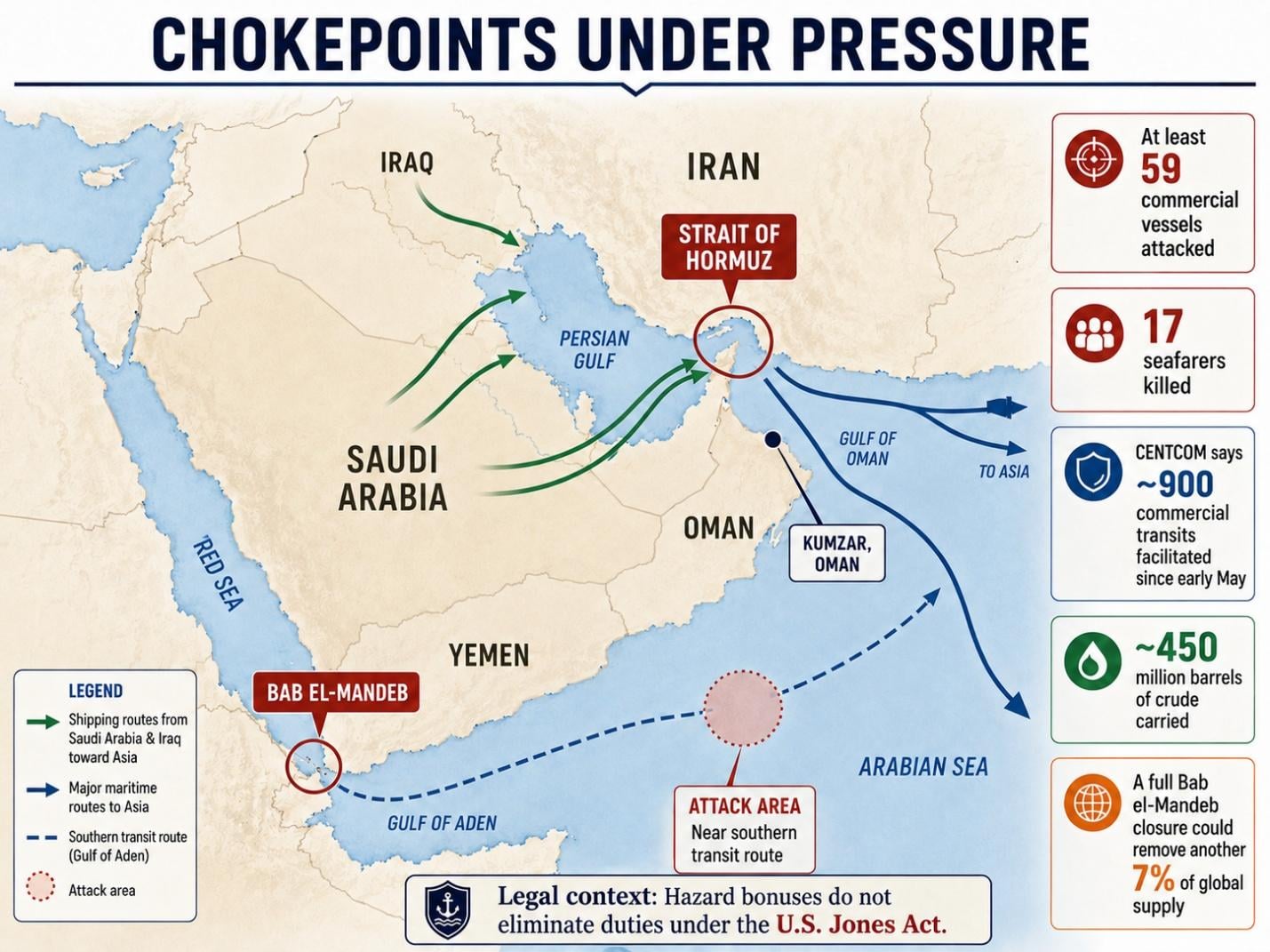
- The M/T Kavomaleas, a Malta-flagged Panamax tanker managed by Greece’s Dynacom Tankers, was struck by two projectiles roughly eight nautical miles northwest of Kumzar, Oman — along the U.S.-coordinated southern transit route. Fire broke out in the engine room, the shipboard suppression system failed to hold it, and the master ordered the ship abandoned. Omani authorities recovered the crew; the vessel was left adrift and burning.
- Hours later, the M/T Kaifan (IMO 9656046), operated by the Kuwait Oil Tanker Company, broadcast a distress call on VHF Channel 16 reporting a drone or missile strike and an engine-room fire.
- The United Kingdom Maritime Trade Operations (UKMTO) issued advisories on both incidents, urging transiting vessels to exercise caution.
- U.S. Central Command (CENTCOM) completed a tenth consecutive night of strikes on Iranian military targets, stating the operations are meant to degrade Iran’s ability to attack commercial shipping. CENTCOM reports that since early May its forces have helped facilitate roughly 900 commercial transits carrying some 450 million barrels of crude.
- Separately, as we posted about earlier this week, Yemen’s Houthi forces declared a naval blockade of Saudi Arabia, effective immediately. A full closure of the Bab el-Mandeb — the southern gate of the Red Sea — would halt Saudi crude moving to Asia and could take another seven percent out of global supply, atop the roughly ten percent the war has already removed.
- That threat arrived in writing. On July 20 the Houthis’ Sanaa-based Humanitarian Operations Coordination Center (HOCC) emailed shipping companies directly, barring vessels from loading or discharging cargo at any Saudi port as of 1201 GMT that day and warning that violators “may be subject to targeting” within the reach of Yemeni forces. The HOCC was the same channel the group used to warn shipping during its 2023–2025 campaign against merchant vessels.
- The market answered within a day. Two tankers loaded with Saudi crude for China and India reversed course in the Red Sea on Tuesday and headed back toward the Suez Canal rather than the Bab el-Mandeb — the first confirmed commercial routing changes since the embargo was declared. Saudi-operated tankers were reported to be switching off their tracking transponders. The U.S. Navy-led Joint Maritime Information Center (JMIC), for its part, advised that it had confirmed no attacks on Red Sea shipping in the preceding forty-eight hours.
Since the war began at the end of February, the UN’s shipping agency counts at least 59 commercial vessels attacked in and around the Persian Gulf and 17 seafarers killed. These are the circumstances of the job market into which six months’ salary is being offered.
The Money Does Not Move the Duty
A bonus is a contract term. It is negotiated, it is priced, and it is perfectly lawful to offer, and nothing in American maritime law forbids an owner from paying a consenting crew handsomely to sail into danger. Mariners have always been paid more for dangerous voyages that may offer worse conditions.
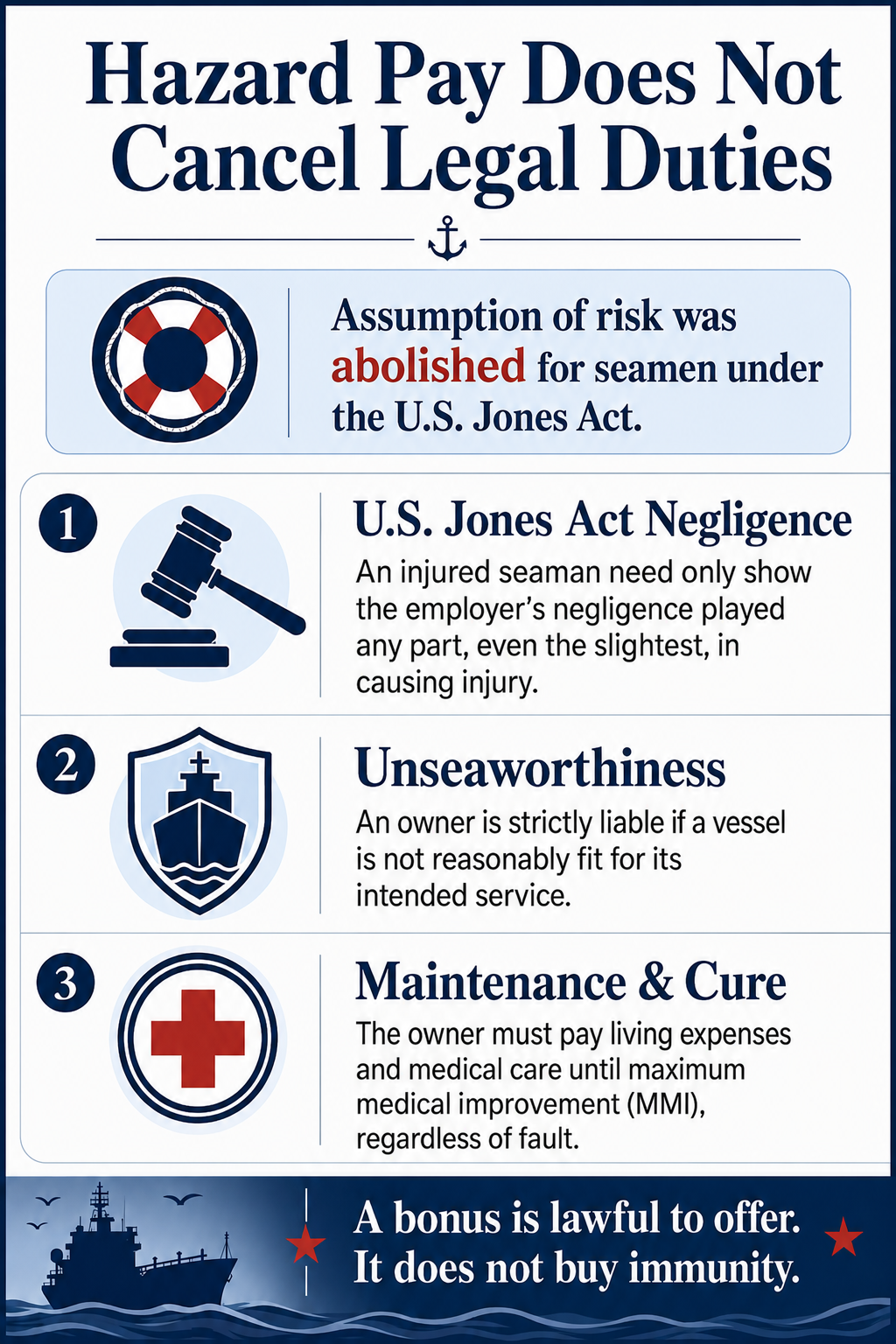
What a bonus does not do is buy immunity. A payment does not convert an unreasonably dangerous voyage into a reasonable one, and it does not shift the owner’s duty onto the crew. The doctrine of assumption of risk — the idea that a worker who knowingly accepts a hazard forfeits the claim — was abolished for seamen by the U.S. Congress when it enacted the Jones Act.
Three obligations bear directly on a voyage like this one:
- Jones Act negligence. An injured seaman need only show that the employer’s negligence played “any part, even the slightest” in causing the injury — a deliberately low threshold. Ordering a vessel into waters where fifty-nine merchant ships have already been hit, after two more burned on the very route in question, is precisely the decision that standard was written to examine.
- Unseaworthiness. Under the U.S. General Maritime Law an owner is strictly liable — fault is irrelevant — where the vessel is not reasonably fit for her intended service. That includes her hull, her gear, her crew, and her fitness for the voyage ordered. A ship dispatched into an active missile and drone environment without hardened protocols, escort coordination, or adequate damage control invites that inquiry. Note that the Kavomaleas‘s own fire suppression system did not save her engine room.
- Maintenance and cure duties. The oldest obligation in admiralty: an owner must pay an injured seaman’s living expenses and medical costs until that seaman reaches maximum medical improvement (MMI), regardless of fault. A signed bonus agreement does not waive it. Neither does a crewmember’s enthusiasm for the money.
The Duty to Warn — and the Right to Refuse
The General Maritime Law imposes an affirmative duty to warn crews of known dangers. The word doing the work here is known. By Monday, evening the hazard on the southern Oman route was neither speculative, nor obscure:
- UKMTO had publicly advised on two attacks in a single day;
- CENTCOM had publicly stated that Iran was targeting commercial vessels;
- The International Maritime Organization (IMO) had already tallied the casualties; and
- The Houthis had announced a blockade of a second maritime approach — and had emailed the shipping companies themselves to say so.
An owner circulating a bonus offer against that backdrop bears a heavy burden to show the crew received a full and current picture of the risk — not a recruitment pitch. We have written before about the pressure to keep tonnage moving through this chokepoint in Running Dark Through Hormuz: The Quiet Campaign to Keep Shipping Moving, and about the toll demands that preceded it in Tehran’s Toll Booth: What the Persian Gulf Strait Authority Means for Shipping. The transponder switch-offs now reported among Saudi-operated tankers are that same campaign at work — and they cut both ways for the crew: a darkened ship may be harder to target, but she is also harder to find when she needs help.
The corresponding protection is the seafarer’s right to refuse unsafe passage. A rating who does not wish to sail into the danger zone may request to be signed off the vessel and relieved by a replacement, and the master retains overriding authority to protect ship and crew.
That right is being exercised. Captain Pradeep Chawla, chairman of GlobalMET — a training body that works with the IMO — observes that large numbers of crew are indeed getting off: stepping ashore at the last safe port before the transit, in the Gulf of Oman or elsewhere outside the strait, rather than sailing into it. But he adds that owners are able to find people who are willing to go.
That second half is the part that matters. When one crew steps off and another steps on, the danger is not reduced — it is reassigned, and it tends to be reassigned downward, to mariners from labor-supplying countries for whom six months’ wages is not a windfall but a family’s year. The vessel sails on the same route into the same water. Only the names on the crew list change.
So a right you can exercise only by walking away from six months’ pay, is a right under real strain. Consent extracted by economic necessity is tenuous consent, and the law has long known it — which is why the duty stays with the employer rather than following the paycheck.
Closer to Home: The Same Duty on the Ship Channel
The same principles govern a tank vessel crewmember on the Houston Ship Channel, a deckhand pushing barges on the Intracoastal Waterway, and an offshore crew running out of Galveston. Hazard pay for a difficult job is common and legitimate. But if a Gulf Coast operator hands you a premium to work a rig, a dock, or a deck they know to be unsafe, that premium is evidence of what they knew — not a release from what they owed.
The extra money in the envelope proves the danger was foreseeable. Owners should think carefully about that, because it cuts both ways.
After all, a fair wage is what the work is worth. It was never meant to be the price of anyone’s safety.
Maritime Trivia Question!
Q: To be “shanghaied” means to be forced or tricked into service aboard a ship against your will. Why Shanghai, of all ports?
A: The term surfaced in American West Coast slang in the 1850s, when San Francisco crews deserted en masse for the goldfields and desperate masters turned to waterfront “crimps” — labor brokers who would drug, beat, or simply lie a sailor aboard and pocket their advance wages. Shanghai was among the longest and least desirable runs out of the Pacific coast, so to be sent there was the worst of a bad lot; the destination became the verb. The word survives as a reminder of something maritime law spent the next century correcting: a signature obtained from someone with no real choice is not much of a signature at all.
We at the Herd Law Firm are proud to fight for seamen, maritime workers and passengers in all types of personal injury and death claims. As maritime personal injury attorneys (and sailors ourselves!) located in northwest Houston, we never waver in our commitment to help these maritime workers, passengers, and their families when they are injured or mistreated.
The information in this post is for general informational purposes only and does not constitute legal advice. For questions specific to your maritime law issue, please contact us at 713-955-3699 or at Charles.Herd@HerdLawFirm.com.
Sources
- Gorrivan, Charles, Alex Longley, and Stephen Stapczynski. “Shipowner Offers Seafarers Six Months’ Pay to Sail Through Strait of Hormuz.” Bloomberg, via gCaptain, July 20, 2026.
- Schuler, Mike. “Crew Abandons Burning Tanker After Attack Near Strait of Hormuz.” gCaptain, July 20, 2026.
- Schuler, Mike. “New Tanker Attack Reported Near Strait of Hormuz as U.S. Continues Strikes on Iran.” gCaptain, July 20, 2026.
- Azhari, Timour, and Nayera Abdallah. “Houthis Declare Naval Blockade of Saudi Arabia.” Reuters, July 20, 2026.
- International Maritime Organization. “Middle East – Strait of Hormuz” (situation updates). https://www.imo.org/en/mediacentre/hottopics/pages/middle-east-strait-of-hormuz.aspx
- Legal Information Institute, Cornell Law School. “46 U.S. Code § 30104 – Personal injury to or death of seamen” (the Jones Act). https://www.law.cornell.edu/uscode/text/46/30104
- United Kingdom Maritime Trade Operations (UKMTO). Maritime security advisories, July 20, 2026. https://www.ukmto.org
- Reuters. “Houthis Threaten Targeted Attacks on Shipping Companies Visiting Saudi Ports.” Via MarineLink, July 21, 2026.