A new independent analysis of federal shipping data finds that the sweeping wartime waiver of America’s century-old Jones Act has not delivered cheaper gasoline, has not met the legal standard required to invoke it, and has (as many predicted) routed domestic cargo runs to foreign-flag vessels — including many ships built and controlled by China.
On March 17, 2026, the U.S. Department of Homeland Security invoked emergency authority under Section 501 of the Merchant Marine Act to waive the Jones Act — the 1920 law requiring that cargo moved between two U.S. ports travel on vessels built, owned, and crewed by Americans — for a broad list of 659 fuel and energy commodities. The stated justification was national defense: disruptions in the Strait of Hormuz, the administration said, threatened the domestic fuel supply badly enough to require opening U.S. waterways to foreign shipping. Extended twice, the waiver now runs through August 17, 2026.
Now, a new report seeks to answer the lingering question: has the waiver worked as intended?
A Standard Meant for Emergencies
The law reserves this kind of waiver for a narrow circumstance: an “immediate adverse effect on military operations” must exist. That distinction matters, because the Jones Act, the 1920 statute that governs who may carry cargo between American ports, is also the source of the injured seaman’s right to sue an employer for negligence.
Navigistics Consulting, a maritime analysis firm commissioned by the American Maritime Partnership (AMP, a coalition of U.S.-flag carriers and maritime unions), examined the first 60 days of waiver activity using data from the U.S. Maritime Administration (MARAD). The “Jones Act 2026 Waiver After Action Report” covered 659 cargo movements across 78 completed voyages. The finding: not one of them met the military-necessity standard. Every documented shipment involved ordinary commercial fuels, blendstocks, or crude oil — NOT the military-grade fuels, such as JP-5, JP-8, and F-76 (jet and marine fuels formulated to Department of Defense (DoD) specifications), that the waiver was supposedly needed to move.
Capacity Was There — It Just Wasn’t Used
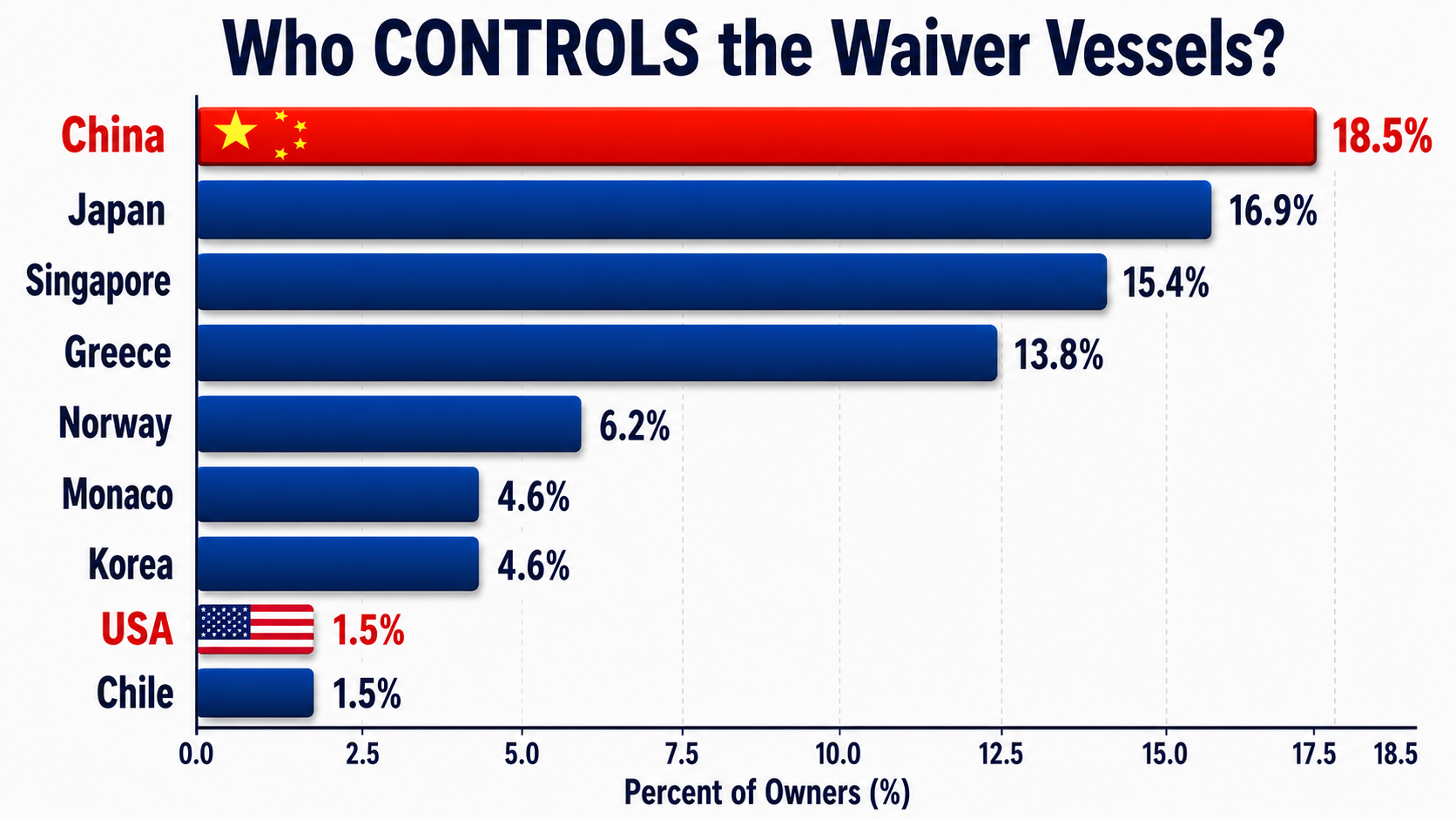
The report also found that U.S.-flag vessels were available to carry roughly 87% of the qualifying waiver voyages. Meanwhile, 23.1% of the vessels that did move cargo under the waiver were built in China, and 18.5% were controlled by Chinese interests, which was the largest ownership share of any group identified in the study.
For a policy justified on national-security grounds, handing cargo to Chinese-linked cargo caarriers appears to do the opposite of shoring up the homeland.
The Relief at the Pump That Never Arrived
The other headline justification for the waiver was consumer relief; specifically, cheaper gasoline for Americans. An eleven-week regression analysis found no statistically credible evidence that the waiver lowered retail gas prices, and on several domestic routes, Jones Act shipping rates were comparable to, or even cheaper than, foreign-flag rates.
Part of the explanation is scale: only about 6.5% of U.S. gasoline moves by vessel subject to the Jones Act at all, with the rest moving by pipeline, truck, and rail.
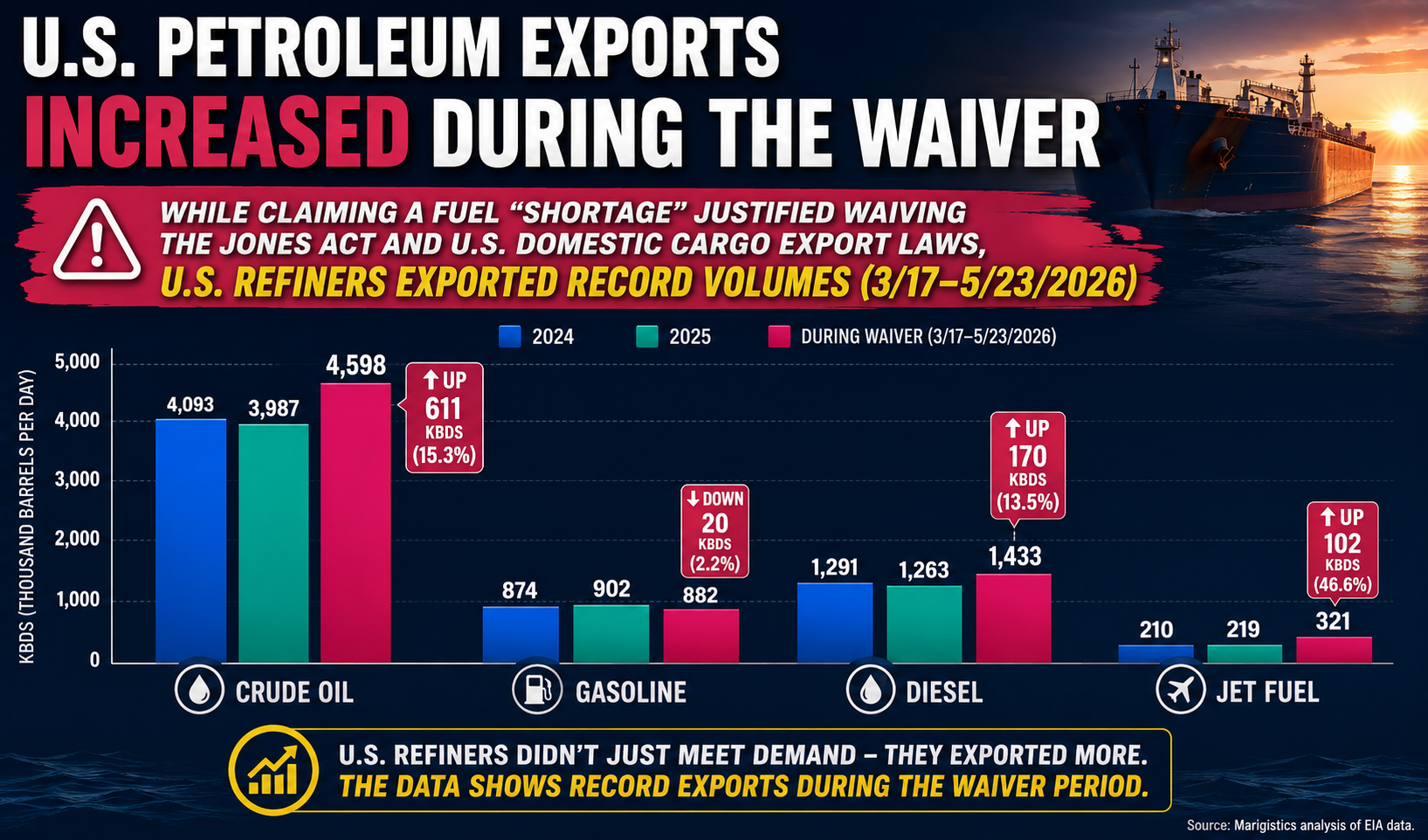
The report likewise found no domestic fuel shortage, pointing to roughly 731 million barrels of U.S. petroleum exports during the waiver period. Even California’s well-documented supply strain, the report notes, traces to refinery closures that removed about a quarter of the state’s refining capacity, not to any bottleneck caused by the Jones Act.
A Precedent With a Longer Wake
Numbers aside, the report warns the waiver is reshaping the market even beyond the voyages it covers. Charterers, Navigistics found, have begun invoking the mere availability of a waiver as leverage in freight-rate negotiations with Jones Act carriers, which erodes domestic rates, whether or not a single foreign ship ever loads. Moreover, the waiver’s use is accelerating: the 78 voyages Navigistics studied through MARAD’s June 1 dataset have since grown to 137 completed voyages, even as the emergency conditions cited back in March have clearly changed.
“This analysis confirms what American mariners have been saying for months: this waiver is not delivering for consumers, it is not justified by military necessity, and it’s handing American cargo to foreign fleets,” AMP President Jennifer Carpenter said in response to the findings.
With the waiver’s August 17 expiration approaching, AMP and other Jones Act supporters are pressing the administration to let it lapse, rather than extend it again. Because, while the figures can feel abstract, the stakes are concrete: fewer American-flag voyages mean fewer American jobs on American decks, and less security and independence for America as a whole.
We at the Herd Law Firm are proud to fight for seamen, maritime workers and passengers in all types of personal injury and death claims. As maritime personal injury attorneys (and sailors ourselves!) located in northwest Houston, we never waver in our commitment to help these maritime workers, passengers, and their families when they are injured or mistreated.
The information in this post is for general informational purposes only and does not constitute legal advice. For questions specific to your maritime law issue, please contact us at 713-955-3699 or at Charles.Herd@HerdLawFirm.com.
Sources
1. Schuler, Mike. “Report Challenges National Security Case for Extended Jones Act Waiver.” gCaptain, June 30, 2026. https://gcaptain.com/report-challenges-national-security-case-for-extended-jones-act-waiver/
2. American Maritime Partnership. “Jones Act Waiver 2026 – After Action Report For Initial Waiver Period.” Navigistics Consulting, June 23, 2026. https://www.americanmaritimepartnership.com/studies/jones-act-waiver-2026-after-action-report-for-initial-waiver-period/
3. American Maritime Partnership. “Navigistics Consulting Releases ‘Jones Act 2026 Waiver After Action Report.’” Press release, June 2026. https://www.americanmaritimepartnership.com/press-releases/navigistics-consulting-releases-jones-act-2026-waiver-after-action-report/
4. WorkBoat. “Trump Issues 60-Day Jones Act Waiver.” March 19, 2026. https://www.workboat.com/trump-issues-60-day-jones-act-waiver
5. American Maritime Partnership. “AMP Statement on Jones Act Waiver Extension.” April 24, 2026. https://www.americanmaritimepartnership.com/press-releases/amp-statement-on-jones-act-waiver-extension/
6. Lewis, Jeffrey H. “The Jones Act Waiver of 2026: Implications for American Shipping, Energy, and National Security.” MarineLink, 2026. https://www.marinelink.com/news/jones-act-waiver-implications-american-540542