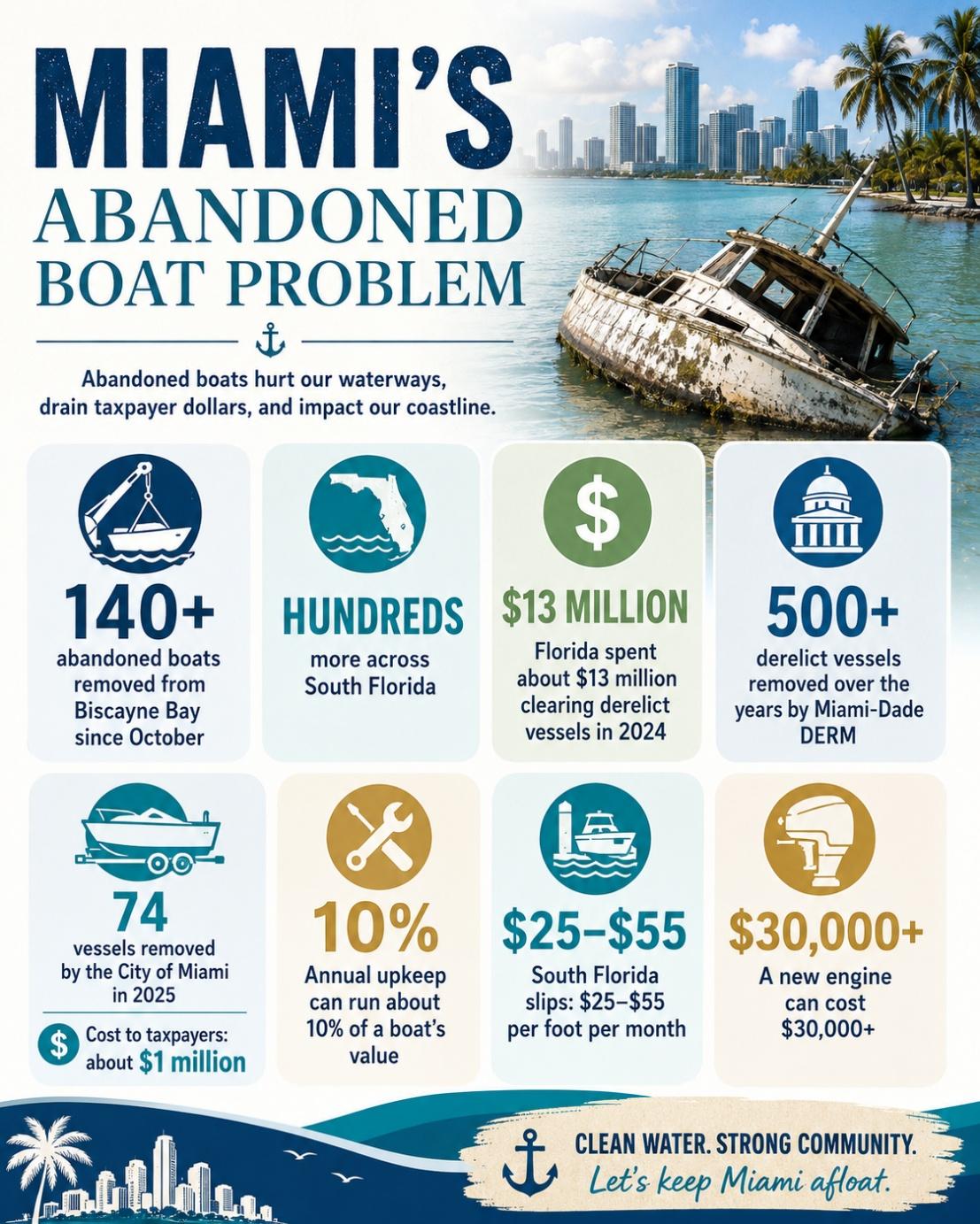
Abandoned and derelict recreational boats are becoming an incident problem across the U.S. This example, in Miami, is just the most recent. Miami Beach police have hauled roughly 140 abandoned boats out of Biscayne Bay since October 2025.
With hundreds more half-sunk across South Florida. The wreckage is a hazard to everyone still on the water — and walking away from a boat does not end the owner’s legal exposure.
Since October 2025, the Miami Beach Police Marine Unit has removed more than 140 vessels left to rot in Biscayne Bay, Bloomberg reported in June, with hundreds more half-submerged or anchored across South Florida, near some of the most expensive real estate in America. Owners who can no longer afford the fuel, upkeep, and marina fees simply stopped coming back; Florida spent roughly $13 million clearing derelict craft in 2024 alone.
The story reads as one about wealth reshaping the waterfront — the abandoned skiffs of the priced-out public decaying in the shadow of luxury crafts such as the M/V Aviva and the other three-hundred-foot yachts. Beneath the surface, though, lies a quieter problem that reaches every boater and every family on the water, here in Texas as elsewhere, including Florida.
A Marine Graveyard
The economics are simple, and unforgiving: too many people can buy a boat without realizing what fuel, maintenance, insurance, and marina fees actually cost over time. Annual upkeep can easily run to roughly a tenth of a vessel’s value, South Florida slips fetch $25 to $55 a foot each month, and a new engine can top $30,000. And when the bills outpace the pleasure, some owners stop paying and stop coming back.
Miami-Dade County’s Division of Environmental Resources Management (DERM) has pulled more than 500 derelict vessels from local waters over the years, and the city of Miami removed 74 in 2025 at a cost to taxpayers of about $1 million. The boats that get abandoned rarely sink cleanly and safely; they linger just below the surface, unlit, unmarked, leaking fuel, and extremely hazardous.
A Hazard You Cannot See
Strike a submerged hull at speed, and the result is the same as hitting a reef, except that no chart can warn you. Florida’s waters were already crowded and dangerous, with recorded 6.4 boating deaths per 100,000 registered vessels in 2024, about 50% above the national rate, according to U.S. Coast Guard (USCG) data. The Florida Fish and Wildlife Conservation Commission (FWC) reports that some 67% of fatalities involved boats run by captains with no formal training. Recent months bore that out: a man was killed near Key Biscayne when a larger boat ran over his dinghy, eleven people were seriously hurt when a boat exploded during a birthday celebration, and a woman snorkeling off Hollywood Beach was struck and killed. A submerged wreck adds one more hazard to waters that already have too many.
Abandoning a Boat Does Not End the Liability
Federal law has treated a sunken vessel as its owner’s responsibility for more than a century. Under the Rivers and Harbors Act of 1899, better known as the Wreck Act (33 U.S.C. § 409), the owner of a craft wrecked and sunk in a navigable channel must immediately mark it — a buoy or beacon by day and a light at night — and remove it diligently. That duty does not pass to the government.
The Coast Guard may mark a private wreck, but it has no obligation to, and if the United States removes the hazard, 33 U.S.C. § 414 makes the owner strictly liable for the cost — bills that have run to tens of thousands of dollars on boats owners assumed were nearly worthless. Florida law also adds: leaving a derelict vessel is a first-degree misdemeanor under Section 823.11, and amendments effective July 1, 2024 added civil penalties, full cost recovery, and registration suspension for the registered owner.
For maritime workers, injuries are first priority. Abandonment surrenders an owner’s rights in a boat, but not the owner’s responsibility. When someone leaves an unlit hull in a channel and another boater strikes it and is hurt or killed, general maritime law permits the injured person, or the family of the deceased, to pursue the negligent owner or operator.
The same principles reach the crewmember hurt aboard a vessel that hits a hazard the owner failed to guard against, and the passenger who trusted a captain to keep clear of known dangers. Leaving a boat to sink is not a way to leave responsibility behind.
Why This Reaches the Gulf Coast
None of this is a Florida peculiarity. The Wreck Act and general maritime law are federal, and they apply with equal force on Galveston Bay, the Houston Ship Channel, the Intracoastal Waterway, and the wider Gulf. Our stretch of coast sees the same rising costs and the same temptation for an overwhelmed owner to walk away, rather than pay to keep or scrap a boat. If you are injured in any boating collision, or have lost a loved one on the water, the party at fault is often less obvious than it looks, and the deadlines to act can be short. A maritime attorney can help you find the responsible owner or operator — even one who hoped that sinking a boat would sink the claim along with it.
The Long Wake
Like elsewhere in the U.S., Miami’s boats will be cleared, slowly and expensively, one hull at a time. But the legal lesson outlasts the cleanup. A boat can be abandoned, but the duty it carried — to warn, to remove, and to answer for the harm it causes — cannot.
Maritime Trivia Question!
Q: The phrase “by and large” — meaning on the whole — comes straight from the age of exploring the high seas. What two ways of sailing was it originally describing?
A: “By” meant sailing close to the wind (into it, at a sharp angle); “large” meant sailing with the wind behind you. A ship that handled well “by and large” performed reliably in both conditions. Over time, covering both cases came to mean “all things considered.”
We at the Herd Law Firm are proud to fight for seamen, maritime workers and passengers in all types of personal injury and death claims. As maritime personal injury attorneys (and sailors ourselves!) located in northwest Houston, we never waver in our commitment to help these maritime workers, passengers, and their families when they are injured or mistreated.
The information in this post is for general informational purposes only and does not constitute legal advice. For questions specific to your maritime law issue, please contact us at 713-955-3699 or at Charles.Herd@HerdLawFirm.com.
Sources
- Smith, Michael. “A Super Yacht Armada Came to Miami, Leaving a Marine Graveyard in Its Wake.” Bloomberg, June 27, 2026. https://www.bloomberg.com/news/features/2026-06-26/south-florida-s-super-yacht-boom-leaves-abandoned-boats-in-biscayne-bay-in-miami
- Legal Information Institute, Cornell Law School. “33 U.S. Code § 409 — Obstruction of navigable waters by vessels; marking and removal of sunken vessels” (Rivers and Harbors Act / “Wreck Act”). https://www.law.cornell.edu/uscode/text/33/409
- Legal Information Institute, Cornell Law School. “33 U.S. Code § 414 — Removal of sunken water craft; liability of owner, lessee, or operator.” https://www.law.cornell.edu/uscode/text/33/414
- The Florida Senate. “2024 Florida Statutes, Chapter 823, Section 11 — Derelict vessels; relocation or removal; penalty.” https://www.flsenate.gov/laws/statutes/2024/823.11
- Miami-Dade County, Division of Environmental Resources Management (RER-DERM). “Abandoned, Derelict and At-Risk Vessels.” https://www.miamidade.gov/global/environment/code-compliance/derelict-vessels.page
- De La Rosa, Christian. “Miami officials aim to solve ‘never-ending’ issue of abandoned boats dirtying waterways.” Local 10 News (WPLG), March 18, 2026. https://www.local10.com/news/local/2026/03/18/miami-officials-aim-to-solve-never-ending-issue-of-abandoned-boats-dirtying-waterways/
- U.S. Coast Guard, Recreational Boating Statistics (fatality and accident data cited by the Florida Fish and Wildlife Conservation Commission). https://uscgboating.org/statistics/accident_statistics.php