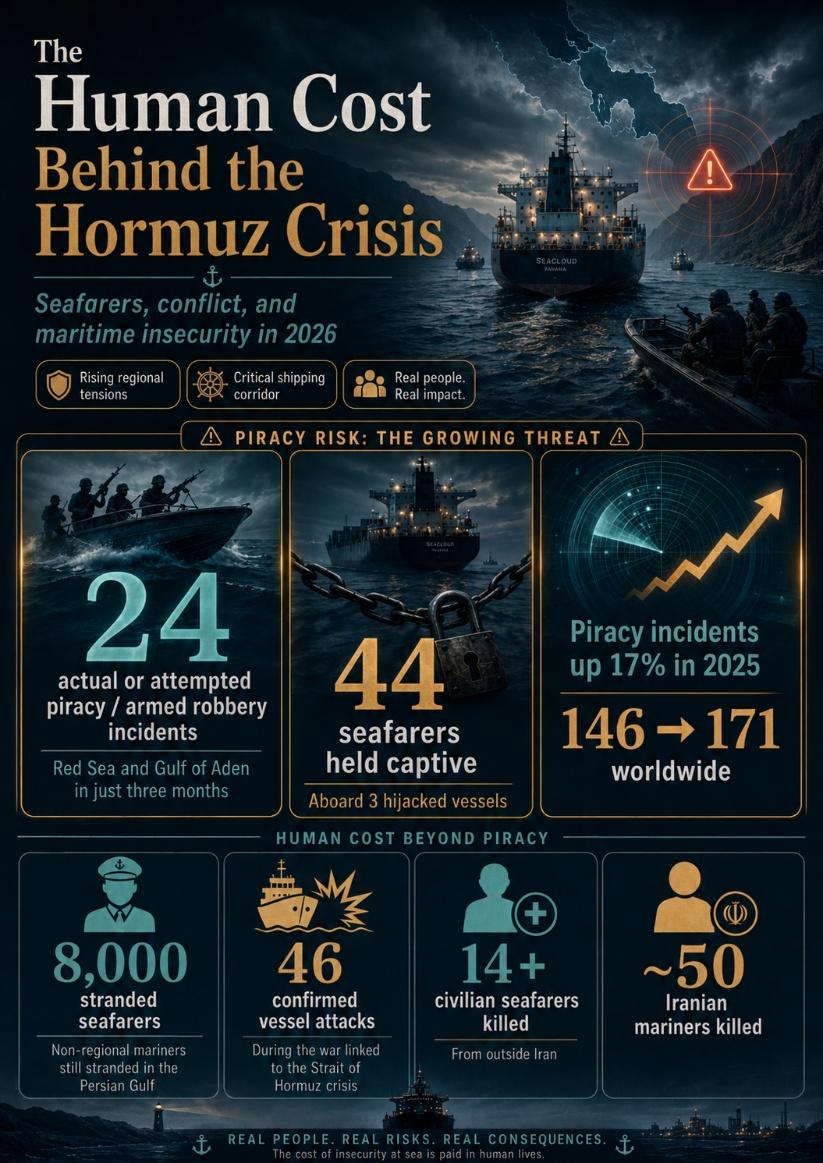
The Strait of Hormuz is open again, but the interim peace has not reached everyone. Roughly 8,000 seafarers who kept the world’s fuel moving through a hundred-day war are still stranded in the Persian Gulf, and a fresh surge of piracy off Somalia has made the passage home more dangerous than the waiting ever was.
When the International Maritime Organization (IMO) opened its 137th Council session in London earlier this week, Secretary-General Arsenio Dominguez did not begin with the news about the Strait reopening, but with the people still trapped there. Around 8,000 mariners who are not from the region remain stranded in the Persian Gulf, the IMO reports — months after joint U.S.-Israeli strikes on Iran in late February 2026 touched off a war that effectively closed the Strait of Hormuz over a hundred days. An interim U.S.-Iran agreement has since reopened the chokepoint (at least intermittently), and ships are cautiously transiting once more, often in convoy. However, getting stranded crewmen home is much slower than changing headlines.
Ordinary People, Extraordinary Cargo
Globally, nearly 2.6 million seafarers serve aboard roughly 85,000 merchant vessels, and together, they move more than 80 percent of global goods by volume. Most are recruited from lower-income countries; the Philippines and India alone supply around 30 percent of the workforce.
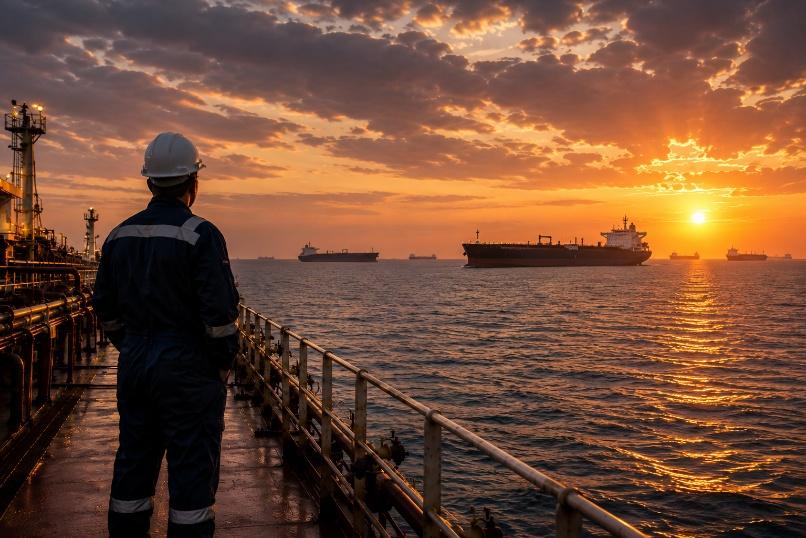
The reporting on those seamen caught in the Strait of Hormuz often read less like news, and more like a desperate story of survival. Many captains and crew have tightly rationed supplies for over four months, isolated from loved ones, celebrating passing holidays with what little they had, all while avoiding mines, missile strikes, and gunfire.
Some ship captains (or masters) reported quietly tightened access to knives and sharp tools — a precaution about crew mental health as the uncertainty dragged on.
In one instance in early March, several stranded crewmen reported watching the M/V Safesea Vishnu burn less than one nautical mile away after a drone strike targeted her during a ship-to-ship transfer of naphtha; one mariner was killed.
In another, a liquefied natural gas (LNG) tanker berthed at Qatar’s Ras Laffan terminal was given half an hour to clear the dock before a missile barrage destroyed the plant behind it.
By IMO and industry estimates, of the 46 confirmed vessel attacks, at least fourteen civilian seafarers from outside Iran have died during the war, along with roughly fifty Iranian mariners.
And Now, Pirates
In just three months during and following the Strait of Hormuz crisis, the IMO has recorded:
- Twenty-four (24) actual and attempted acts of piracy and armed robbery in the Red Sea and Gulf of Aden, with heavy artillery/escalating degrees of violence.
- Worldwide, reported incidents rose 17 percent in 2025, climbing from 146 to 171.
- Forty-four seafarers are being held captive aboard three hijacked vessels (the M/V Honour 25, the M/V Eureka, and the M/V Sward) seized off Somalia and in the Gulf of Aden between April and May, and are critically low on food and water.
- This past weekend, pirates attacked the M/V Lady Naeima, a Palau-flagged bulk carrier, in the Red Sea; she and crew were recovered safe.
The IMO has urged owners to follow industry Best Management Practices (BMP) and to run full risk assessments before sending crews through the region.
The Law Does Not Stay Ashore
An international seafarer’s welfare is governed in the first instance by the Maritime Labour Convention (MLC), a treaty of the International Labour Organization (ILO) that sets international baseline rights to seafarer wages, rest, provisions, repatriation, and safe working conditions. On paper, it covers these stranded crews; in practice, enforcement is only as strong as the flag flown on the stern.
For example, as one seafarers’ non-profit director put it: a vessel owner can live in London, fly a Liberian flag, register the shipping company in Greece, and collect the revenue, while enforcing the rights of the (often multi/international) crew “falls through the gaps” — one of the biggest recurring hazard of this “flag-of-convenience model”.
For mariners who can invoke United States law, the protections are considerably stronger— and they do not evaporate at the edge of a war-risk zone.
What U.S. Maritime Law Says When Crews Are Sent Into Harm’s Way
The Jones Act and America’s General Maritime Law were built around a simple fact of maritime work: it may be impossible to truly leave the job if conditions become dangerous. The ship is the workplace, and when the employer controls whether you go into harm’s way, the law puts significant obligations on that employer.
Three principle maritime law obligations bear on situations like this for U.S. Mariners:
- Jones Act negligence requires an employer’s negligence to have played “any part, even the slightest” in causing an injury. That deliberately low threshold reflects Congress’s judgment that those who profit from sending sailors to sea must bear responsibility when those sailors are harmed. Ordering a vessel into a zone where military forces have already fired on merchant ships — after regulators have warned against it and insurers have priced the risk accordingly — is the kind of decision that invites that inquiry.
- Unseaworthiness under The General Maritime Law holds a vessel owner strictly liable when the ship (including the equipment, her condition, the officers and crew, or her fitness for the voyage ordered) is not “reasonably safe”. A voyage ordered into an active combat zone — without adequate protection, communication protocols, or means of compliance with blockade instructions — could likely qualify.
- Maintenance and Cure benefits are the old admiralty common-law obligations requiring vessel owners to pay a seaman’s ongoing living expenses and medical costs after an injury incurred in service of the vessel, regardless of fault, until the seaman reaches maximum medical improvement (MMI).
War Risk Provisions and the Duty to Warn
As said above, none of these protections are suspended because the danger in question is a foreign navy, instead of a storm or a broken piece of equipment.
Employment contracts and collective bargaining agreements for mariners operating in conflict zones almost always contain war risk provisions. These may specify additional rights and compensations for voyages transiting designated high-risk areas, such as the right to refuse a voyage, enhanced employer insurance obligations, and war risk bonuses.
- The IMO had formally condemned military attacks on merchant vessels,
- India’s directorate issued an advisory restricting crew deployments,
- Other tankers in the region had previously been disabled by U.S. forces.
In these kinds of scenarios, if a vessel is ordered into these hazardous areas without adequate warning or without obtaining the crew’s informed consent to the voyage, that failure is a potential basis for legal liability.
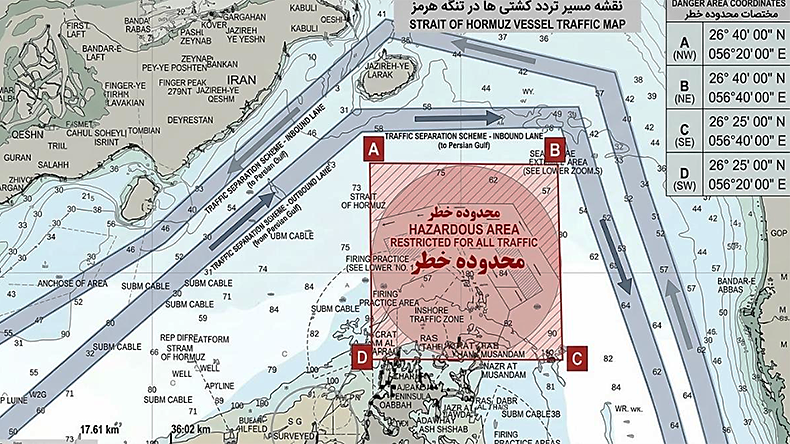
That last scenario is not hypothetical, as union officials such as at the International Transport Workers’ Federation (ITWF) noted : if a nation-state (for example, Iran’s Persian Strait Gulf Authority) demands a five-figure toll to cross, and the company refuses to pay, but still expects the ship to sail, could the captain and crew be compelled to assume the risk of “running the strait dark”?
Seafarer feedback from IMO confirms safe passage corridors, clear protocols, and seafarer’s protected right to refuse unsafe passage are top priorities, with the captain’s overriding authority to protect ship and crew as the “anchor”.
Why This Reaches the Gulf Coast
The same duties that protect a stranded tankerman in the Persian Gulf protect a deckhand on the Houston Ship Channel, a barge worker on the Intracoastal Waterway, and a crewed charter crossing Galveston Bay. A seaman does not surrender the Jones Act, maintenance and cure, or the right to a seaworthy vessel simply by working somewhere dangerous; such places are where those rights matter most.
After all, the watch does not end when the storm does — someone needs to keep standing at the rail through the quiet, dangerous hours after.
Maritime Trivia Question!
Q: The phrase “the bitter end” — meaning the very last extremity — sounds like it is about bitterness. It is not. What shipboard fitting does it actually come from?
A: The bitts are the stout posts on a ship’s deck to which the anchor cable or rope is made secure. The “bitter end” is the very last of that cable or line, the part nearest the bitts — so once you have paid out to the bitter end, there is no rope left to give. To hold on “to the bitter end” is to hold on until nothing more remains.
We at the Herd Law Firm are proud to fight for seamen, maritime workers and passengers in all types of personal injury and death claims. As maritime personal injury attorneys (and sailors ourselves!) located in northwest Houston, we never waver in our commitment to help these maritime workers, passengers, and their families when they are injured or mistreated.
The information in this post is for general informational purposes only and does not constitute legal advice. For questions specific to your maritime law issue, please contact us at 713-955-3699 or at Charles.Herd@HerdLawFirm.com.
Sources
- Schuler, Mike. “IMO Council Opens With Maritime Security, Hormuz, and Piracy High on Agenda.” gCaptain, July 6, 2026. https://gcaptain.com/imo-council-opens-with-maritime-security-hormuz-and-piracy-high-on-agenda/
- Schuler, Mike. “IMO Chief Urges Immediate Release of 44 Seafarers Held by Somali Pirates.” gCaptain, July 6, 2026. https://gcaptain.com/imo-chief-urges-immediate-release-of-44-seafarers-held-by-somali-pirates/
- Soon, Weilun, and Stephen Stapczynski. “The Race to Rescue 8,000 Sailors Still Stranded Behind Hormuz.” Bloomberg, July 5, 2026. https://www.bloomberg.com/news/articles/2026-07-03/strait-of-hormuz-sailors-remain-trapped-despite-iran-us-ceasefire
- International Maritime Organization. “Middle East – Strait of Hormuz” (situation updates, evacuation framework, and pause following an attack on a merchant vessel). https://www.imo.org/en/mediacentre/hottopics/pages/middle-east-strait-of-hormuz.aspx
- International Labour Organization. “Maritime Labour Convention, 2006 (MLC, 2006).” https://www.ilo.org/international-labour-standards/maritime-labour-convention-2006
- Legal Information Institute, Cornell Law School. “46 U.S. Code § 30104 – Personal injury to or death of seamen” (the Jones Act). https://www.law.cornell.edu/uscode/text/46/30104