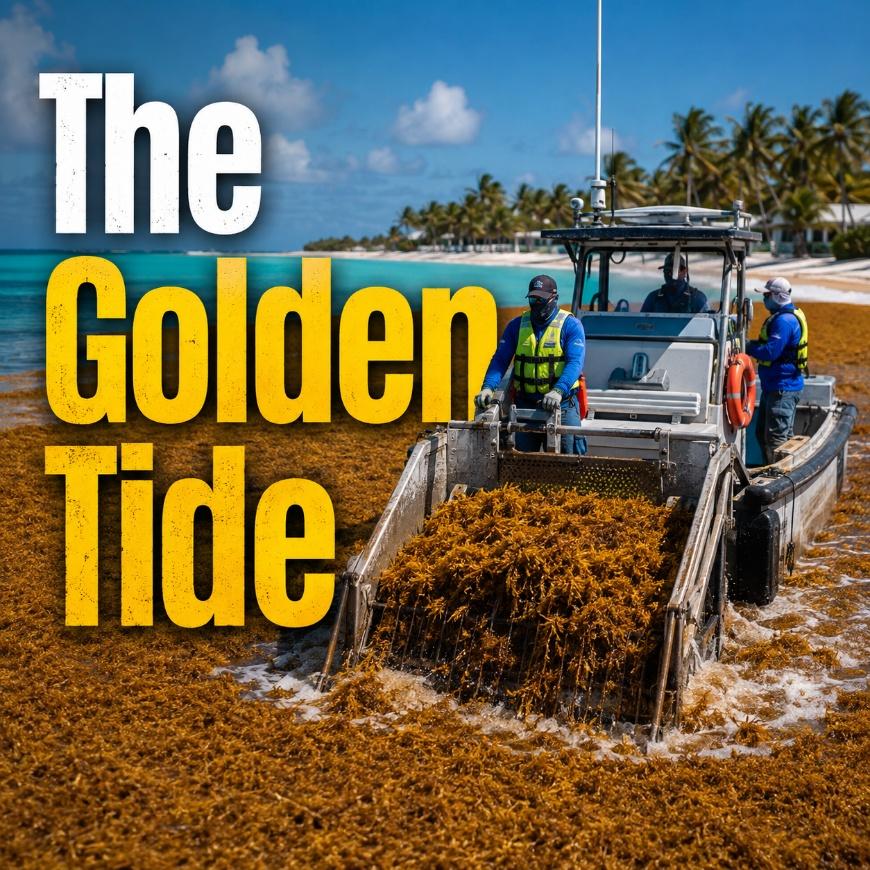
A record mass of sargassum seaweed is smothering Caribbean and Gulf coastlines, and a new fleets of boats — Navy vessels, hotel skiffs, and purpose-built harvesters — are being launched to fight it. And the weed is more than an eyesore: in bulk it can choke an engine, foul a propeller, and even poison the air a crew breathes.
Sargassum seaweed is a strange sort of problem — one that drifts in slowly like a bizarre tide of alien vegetation, risen up from the deep. All throughout Cancún, Tulum, and Playa del Carmen this summer, thick tangles of deep, rich brown with a rotten-egg reek have been reaching shore in mounds well before the tide does, the sheer volume overwhelming nearly everything sent to combat them. This free-floating brown seaweed which gathers into mats miles wide, and is having one of its heaviest growth years ever measured; 2026 is on track to break the record yet again.
Each morning before dawn, hundreds of Mexican hotel workers, tractor operators, and specialized Navy personnel head to the beaches to clear record masses of the rotting macroalgae. Hotels across the Caribbean have cut rates and spent millions hauling it away, while governments buy boats, float barriers farther offshore, and experiment with everything from biofuels to bioplastics to put the stuff to use.
Behind the tourism headline, though, is the maritime story, focused on the vessels and the crews now being sent out to meet the weed head-on.
A Curiosity That Became a Crisis
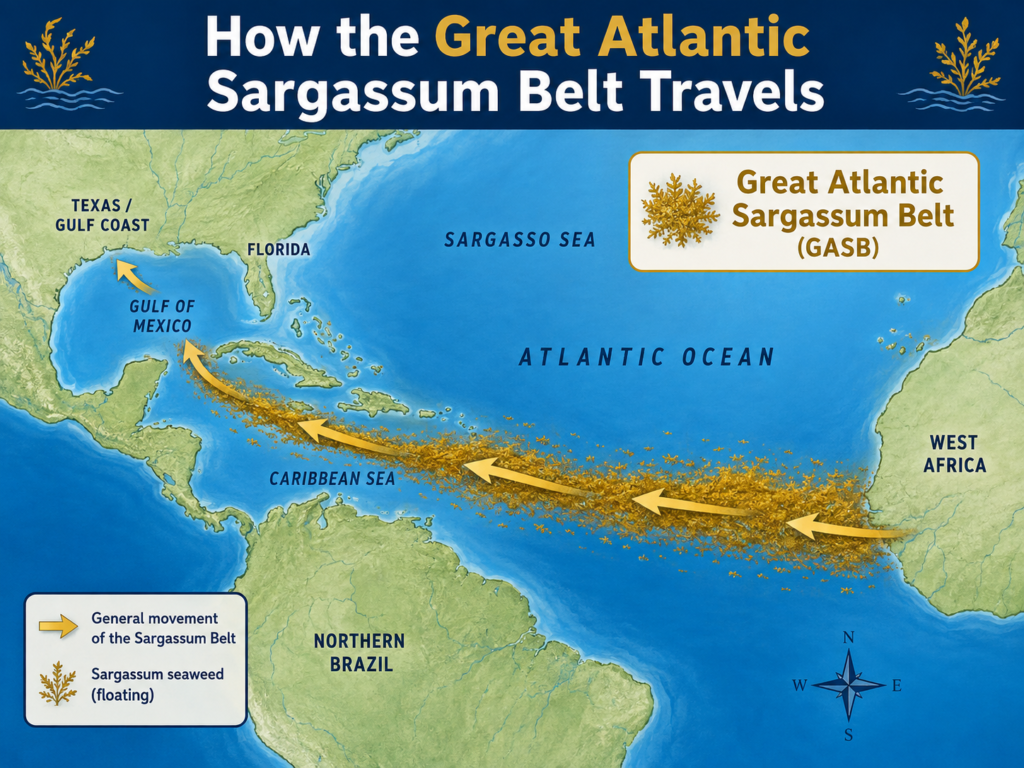
Sargassum was once a novelty, confined mostly to the eponymous Sargasso Sea, a calm area in the North Atlantic (and the only on earth ringed by ocean currents instead of coasts). Around 2010, unusually strong winds pushed the weed into the nutrient-rich tropical Atlantic, where it thrived and organized into a self-sustaining ribbon now called the Great Atlantic Sargassum Belt (GASB): a band that re-forms each year and rides the currents from West Africa and northern Brazil, through the Caribbean, and into the Gulf of Mexico.
According to the University of South Florida’s (USF) Optical Oceanography Lab, 2026 is expected to be at least the second-largest sargassum year on record. One of the lab’s researchers described the Sargassum’s explosion as near nonexistent before 2010, then roughly one million metric tons across the region in 2011, and about forty million tons last year — a mass that may be doubling every five years.
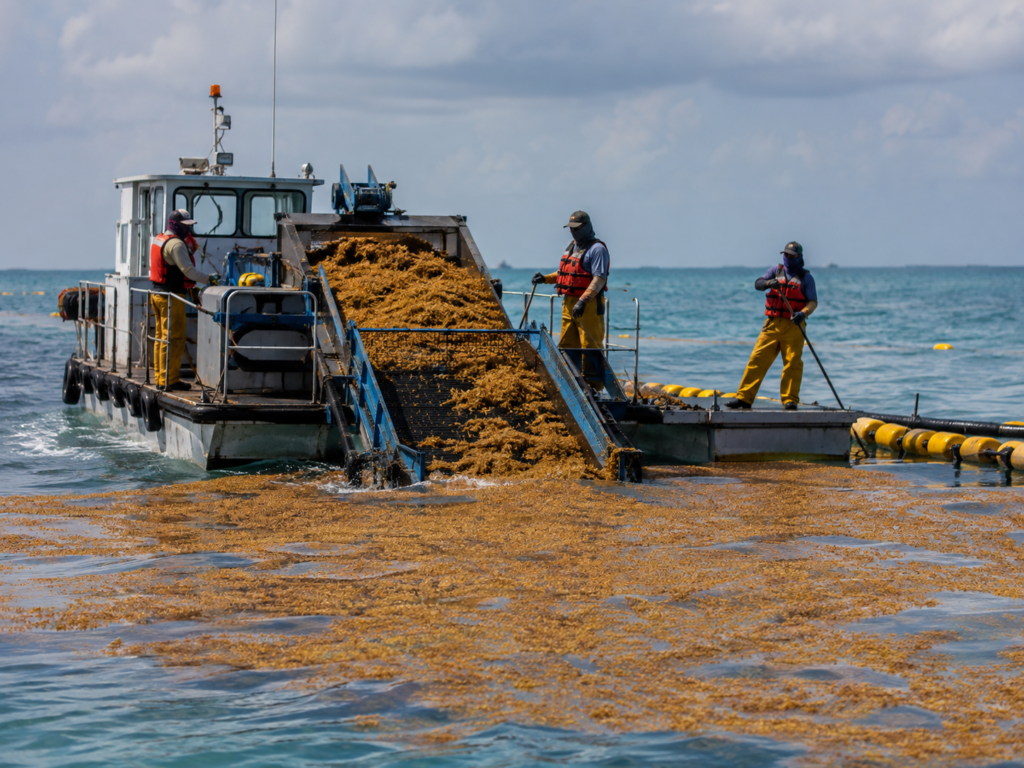
The response has been a mix of boats, barriers, and improvisation:
- Mexico has collected some 96,151 metric tons of sargassum so far this year, up from 92,783 tons last year, and is buying more vessels to intercept it offshore. As Quintana Roo’s governor put it, experience has taught that the best way to face sargassum is to catch it at sea before it reaches the coast.
- Federal officials, expecting a new open-sea sargassum vessel to arrive within a month, are looking to source more ships from Japan, and plan to supply smaller Mexican-built boats to the Dominican Republic.
- Entrepreneurs are turning the weed into fertilizer, fuel, laminates, bioplastics, and even craft sandals, with close to 200 projects underway in Mexico alone — though the algae’s habit of absorbing toxic metals makes that harder than it sounds.
- More controversially, some firms bale sargassum and sink it to the seafloor to claim carbon credits — a practice scientists warn could harm deep-sea ecosystems and the turtles and fish that shelter in offshore mats.
What’s Driving the Record?
Nearly all experts agree on two points: the modern blooms began as a regime shift after 2011, and they are fed by an oversupply of nutrients — mainly nitrogen and phosphorus — reaching the weed far from its old home. Beyond that, many disagree on the exact cause.
- Runoff from land. One influential camp ties the blooms to human activity ashore — deforestation, cattle ranching, and fertilizer use in the Amazon basin — which sends nitrogen and phosphorus down the Amazon, Orinoco, and Congo rivers into the tropical Atlantic, amplified by the severe Amazon flooding that has recurred since 2009.
- Saharan dust. Iron, nitrogen, and phosphorus carried thousands of miles on the trade winds have long been proposed as a second, airborne fertilizer.
- A natural nutrient engine. A 2025 study of coral cores from the Max Planck Institute for Chemistry pointed instead to phosphorus lifted to the surface by equatorial upwelling, paired with nitrogen fixed by bacteria living on the weed itself — and argued the dust and river-runoff theories did not match the record.
Warming seas, which encourage sargassum to grow faster, also affect all of these.
After more than a decade of study, leading oceanographers still describe the ultimate drivers as unsettled. However, what is not in doubt is that the growing belt is a predictable fixture, and likely here to stay.
The Toll So Far
This is not a hypothetical or a future problem; the damage is already happening. A few recent examples:
- In May 2025, USF measured a record — roughly 37.5 million metric tons of sargassum across the Atlantic, the most since satellite monitoring began in 2011, with nearly every region setting a new high.
- In the French Caribbean, the rotting weed has become a chronic public-health emergency. Guadeloupe’s air-quality agency has issued red alerts for dangerous hydrogen sulfide levels; a school in Martinique was temporarily closed when hydrogen sulfide and ammonia drifted in from the shore; and researchers have linked the exposure to respiratory and neurological complaints — and, in one 2024 study, to hypertension in pregnant women. The shoreline cleanup workers sent to move the weed are among those most exposed.
- The U.S. Virgin Islands declared a state of emergency when sargassum obstructed the seawater intake of a desalination plant on St. Croix — the same intake-clogging that idles power plants and disables ships.
- When sargassum damages boat engines and fishing gear and blocks access to harbors and mooring sites: in the British Virgin Islands it has fouled the Road Town ferry terminal on Tortola and obstructed harbors, and in Jamaica fishers report the weed jamming whole channels.
- Off Martinique, fishermen have at times been unable to launch through the mats at all, and in Sint Maarten cleanup crews with heavy equipment were rushed out for an eleven-day clearance after residents reported the sharp reek of ammonia and hydrogen sulfide.
The Danger the Postcards Don’t Show
For all its ecological value in the open ocean, sargassum in bulk is hazardous to boats and to the people aboard them. Three dangers stand out:
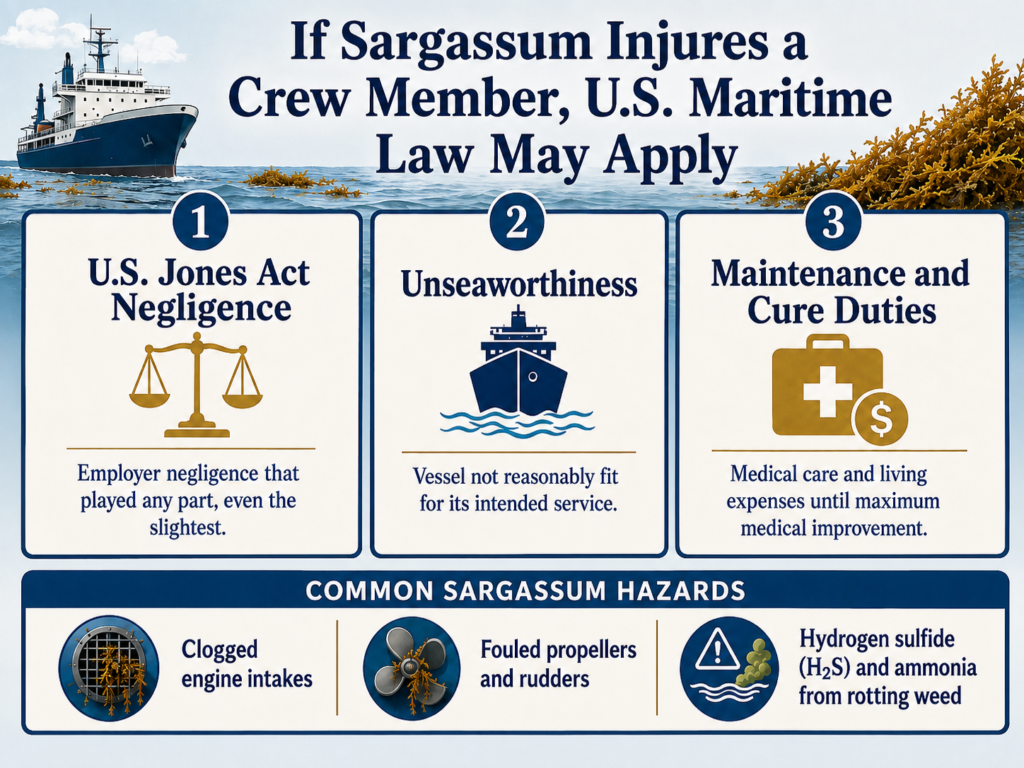
- It chokes engines. Most vessels cool their engines by drawing seawater through intakes below the hull. Enough sargassum can clog those intakes, starve the cooling system, and force an overheating engine to shut down as a protective measure. In 2022, the National Oceanic and Atmospheric Administration (NOAA) research ship NOAAS Okeanos Explorer had to cancel remotely operated vehicle (ROV) dives off Puerto Rico for exactly that reason — too much weed to keep her engines cool. An engine that quits will not sink a ship, but it takes away her ability to steer, and a vessel dead in the water is at the mercy of wind and current.
- It fouls propellers and rudders. A mat wrapped around a propeller or jammed against a rudder can leave a boat unable to maneuver — precisely when a working crew, with nets, booms, or conveyors deployed, most needs fine control.
- It poisons the air. As sargassum decomposes it releases hydrogen sulfide (H2S) — the rotten-egg gas — along with ammonia and methane. In open air these are a foul nuisance; in a hold, a bait well, or a poorly ventilated work area, they can sicken or kill. The crews now sent to gather, bale, and process this weed are working around a decomposing, gas-producing cargo.
The point is simple: the fleet expanding to fight sargassum is a fleet of working vessels, crewed by working mariners. And where mariners work, U.S. maritime law follows.
What U.S. Maritime Law Says
For a mariner who can invoke it, U.S. law puts firm, familiar duties on whoever sends a crew to sea. Three bear directly on sargassum work:
- U.S. Jones Act negligence. The Jones Act (the Merchant Marine Act of 1920) lets a seaman recover if an employer’s negligence played “any part, even the slightest,” in an injury — a featherweight burden. Sending a crew into thick weed without a lookout, or around decomposing sargassum without gas monitors and personal protective equipment (PPE), can meet it. (How the Jones Act protects mariners.)
- Unseaworthiness. Under U.S. General Maritime Law, an owner is strictly liable when a vessel is not “reasonably fit” for her service — clogged intakes, missing gas detection, or a harvester without the means to do its job safely can all qualify. (More on the warranty of a seaworthy vessel.)
- Maintenance and cure. Regardless of fault, an employer owes an injured seaman living expenses and medical care until maximum medical improvement (MMI) — whether a deckhand is overcome by H2S or hurt clearing a fouled propeller.
Two older duties hover over all three: the duty to warn of known dangers — and with USF and NOAA now forecasting blooms weeks out, sargassum is a known danger — and the duty to keep a proper lookout, which is what keeps a boat from steaming blind into a mat thick enough to stop her. We have written before about what happens when no one is watching the bow.
Why This Reaches the Gulf Coast
This is not someone else’s problem. Sargassum’s other common name is gulfweed — named for the Gulf of Mexico, where a great deal of it ends up. USF expects heavy landings around the Caribbean and southeastern Florida in the coming months, and the same currents feed the Texas coast. Any deckhand on the Houston Ship Channel, any shrimp-boat crew off Galveston, any charter captain running out of Freeport can find themselves dealing with the same weed, and the same problems.
Remember: an American seaman does not surrender the U.S. Jones Act, the warranty of a seaworthy vessel, or the rights to maintenance and cure simply because this season’s hazard happens to look like a harmless weedy brown raft drifting by. If neglected, even these ordinary-looking dangers can become the most devastating.
Maritime Trivia Question!
Q: Sargassum thrives in still, slow-moving water — which recalls a stretch of ocean every sailor once dreaded. What are the doldrums?
A: The doldrums are the belt of calms near the equator, where the trade winds meet and cancel out, leaving a sailing ship becalmed for days or weeks. The word shares a root with “dull”: a doldrum was first the word for a dull, sluggish person, from the old English “dol”, meaning dull. Sailors stalled in the equatorial calms were said to be “in the doldrums,” and only later did mapmakers mistake the mood for a place and pin the name to the sea itself.
We at the Herd Law Firm are proud to fight for seamen, maritime workers, and passengers in all types of personal injury and death claims. As maritime personal injury attorneys (and sailors ourselves!) located in northwest Houston, we never waver in our commitment to help these maritime workers, passengers, and their families when they are injured or mistreated.
The information in this post is for general informational purposes only and does not constitute legal advice. For questions specific to your maritime law issue, please contact us at 713-955-3699 or at Charles.Herd@HerdLawFirm.com.
Sources
- Morland, Sarah. “Explainer: As Sargassum Seaweed Piles Up, Caribbean Bets on Boats, Barriers and Biofuel.” Reuters wire, July 31, 2026. kfgo.com
- “Sargassum … Has Become a Self-Sustaining Disaster That Will Keep Coming Back.” WLRN / The Conversation, July 29, 2026 (scale, the Great Atlantic Sargassum Belt, and competing causes). wlrn.org
- Wang, M., Hu, C., et al. “The Great Atlantic Sargassum Belt.” Science, 2019 (nutrient enrichment; post-2011 regime shift). science.org
- Max Planck Institute for Chemistry, coral-core study on phosphorus and nitrogen fixation as bloom drivers (2025). ScienceDaily. sciencedaily.com
- U.S. Environmental Protection Agency. “Sargassum Inundation Events (SIEs): Impacts on the Economy” (U.S. Virgin Islands state of emergency; St. Croix desalination intake). epa.gov
- “Sargassum Is Choking the Caribbean’s White Sand Beaches, Fueling an Economic and Public Health Crisis.” The Conversation, 2025 (hydrogen sulfide, red alerts, plant intakes). theconversation.com
- “Sargassum Kills Fish, Clogs Ports.” The BVI Beacon, May 2026 (Road Town ferry terminal and obstructed harbors, British Virgin Islands). bvibeacon.com
- “After 13 Years, No End in Sight for Caribbean Sargassum Invasion.” Inside Climate News, 2024 (Jamaican fishers and blocked channels). insideclimatenews.org
- Banydeen, R., et al. “Sargassum Inundations and the Risk of Hypertension Disorders Among Pregnant Women … Martinique.” Int. J. Environ. Res. Public Health, 2024. ncbi.nlm.nih.gov
- NOAA Ocean Exploration. “What Is Sargassum and How Does It Impact Ship Operations?” Voyage to the Ridge 2022. oceanexplorer.noaa.gov
- “Doldrums,” etymology. Online Etymology Dictionary (etymonline.com) and Merriam-Webster (merriam-webster.com).
- Legal Information Institute, Cornell Law School. “46 U.S. Code § 30104 — Personal injury to or death of seamen” (the Jones Act). law.cornell.edu