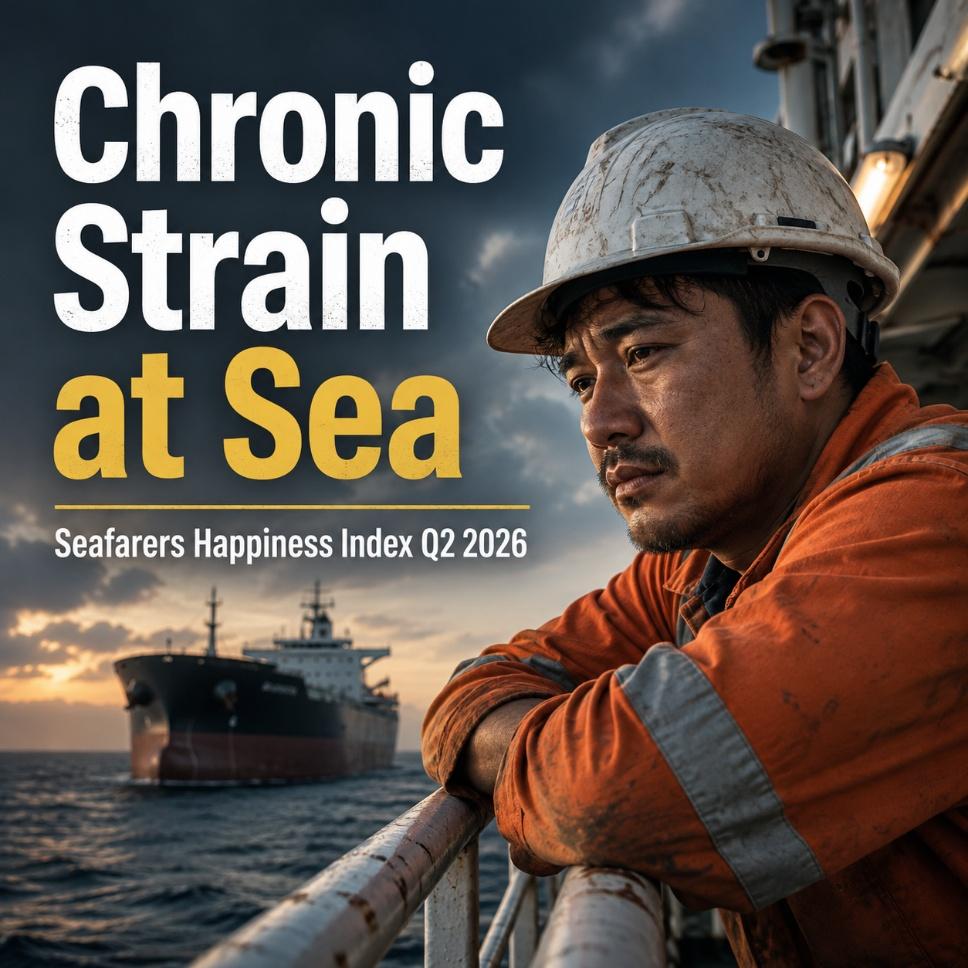
The guns have gone quiet in the Persian Gulf (for now, at least), yet the latest Seafarers Happiness Index finds morale sliding all the same — worn down not by any single catastrophe, but by short shore leave, relentless watches, and wages that no longer stretch. It is a wellbeing story with a legal spine, and it runs straight up the Houston Ship Channel.
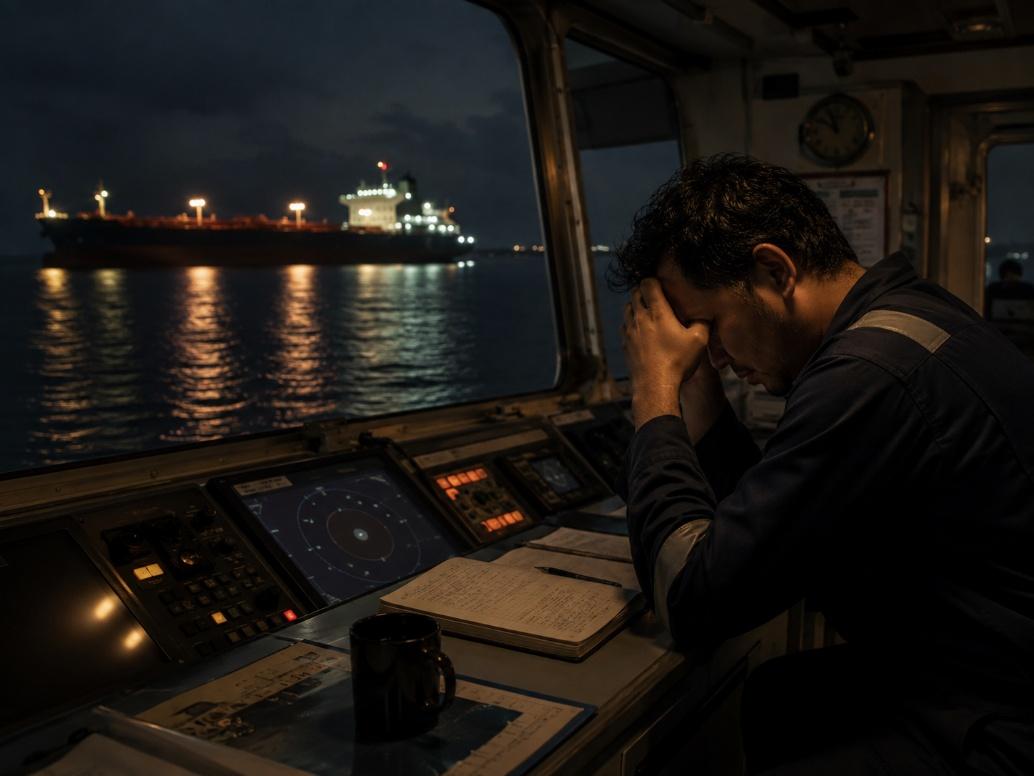
When acute danger announces itself — a siren, a squall, a fire in the hold — a ship’s crew rises to meet it. Chronic stress works differently, and often does the deeper harm: it’s the accumulated sleepless nights, the missed shore leave, the demands that never quite let up, wearing a person down — not through any single emergency, but degree by degree. The true final cost can be measured in the quiet erosion of a seaman’s health.
That is the story told by the most recent Seafarers Happiness Index (SHI), the quarterly survey of life at sea published by the maritime welfare charity The Mission to Seafarers, together with Idwal, NorthStandard, and Inmarsat Maritime.
From Acute Shock to Chronic Strain
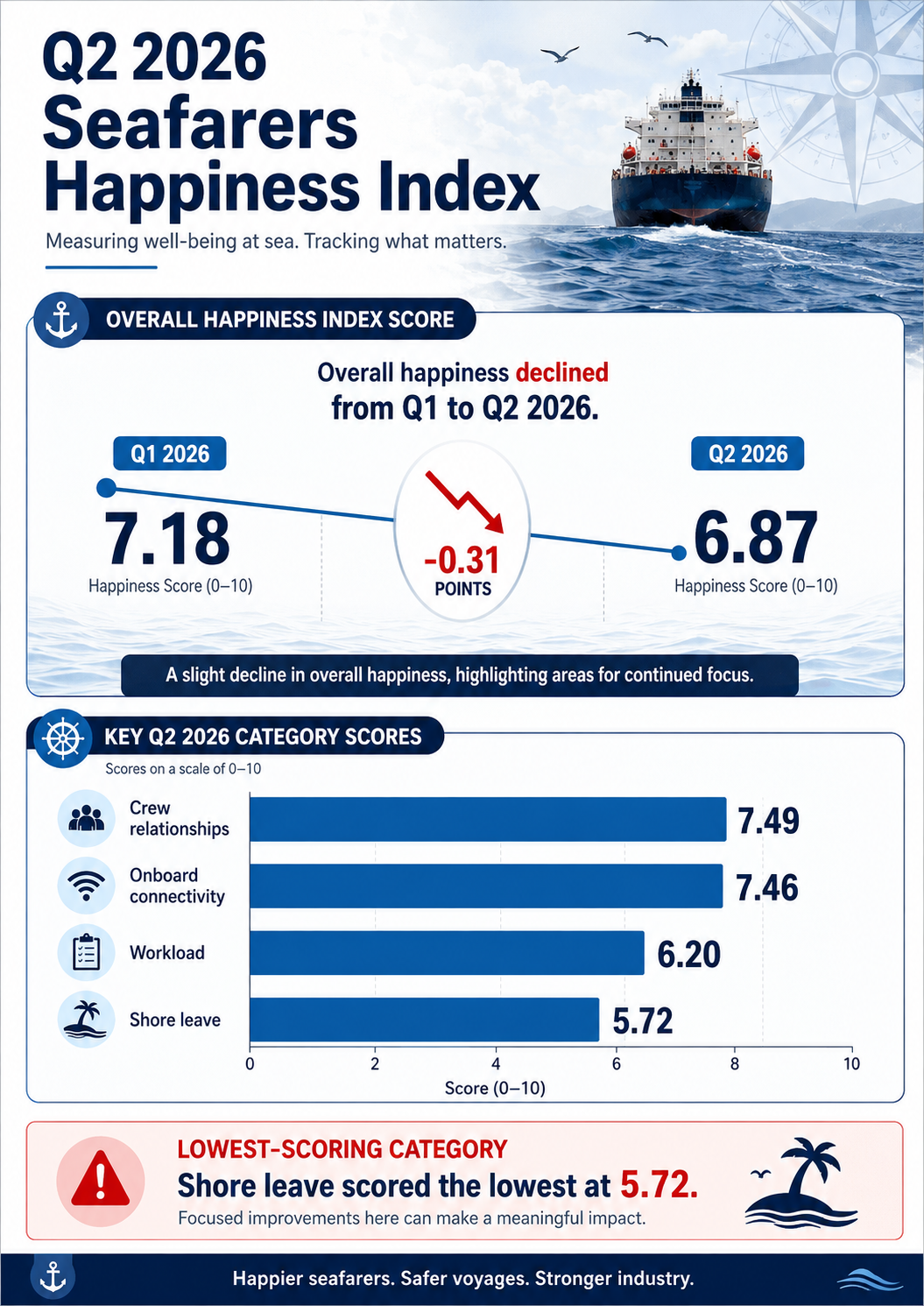
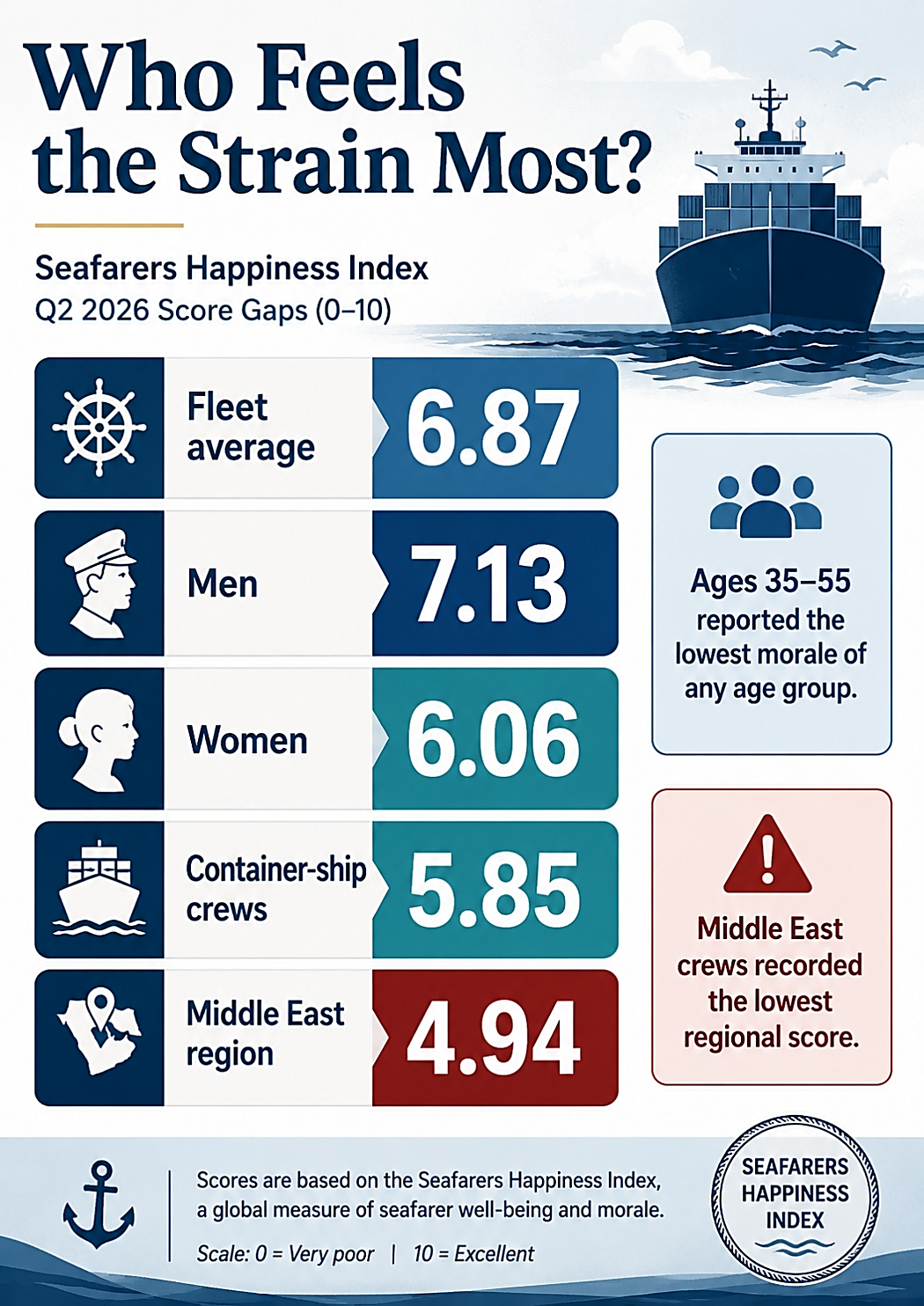
After a first quarter dominated by the shock of open conflict in the Persian Gulf, seafarers might reasonably have been expected to feel relieved. Instead, overall happiness fell to 6.87 out of 10 for the second quarter of 2026, down from 7.18 in the first; the report describes as a slide from “from acute shock to chronic strain.” The immediate terror of missiles and mines may have faded, but it appears to have given way to something more subtle — the steady, cumulative weight of the work itself, borne day after day with no clear end in sight.
Ben Bailey, the charity’s Director of Programme, did not soften the message, warning that seafarers are extraordinarily resilient— but “endurance is not the same as wellbeing.”
Where the Strain Shows
The Index scores ten dimensions of daily shipboard life. This quarter, the issues were concentrated in exactly the parts of the job that rarely make the news:
- Shore leave scored 5.72 — the lowest of any category by a wide margin — as short port calls, punishing schedules, and tightened terminal access leave crews with less and less time on solid ground.
- Workload came in at 6.20, with seafarers pointing to unending watch rotations, a rising tide of paperwork and inspections, and the uneasy sense that logged rest hours too often exist for the auditor rather than for the exhausted.
- Real wages are quietly losing their purchasing power — the costs of living keep rising, while the paychecks stay the same.
However, not every reading was grim. Crew relationships scored 7.49 and onboard connectivity 7.46 — a reminder that crew camaraderie and a reliable way to contact home are the ballast that keeps a vessel’s morale upright.
Who Feels It Most
The fleet-wide average can hide some sharp divides:
- Female seafarers reported an average happiness of 6.06, against 7.13 for men — a gap that echoes long-standing concerns about how women are supported and protected at sea, a subject we have explored before.
- Crews working the Middle East recorded the lowest regional score, 4.94 — the human residue of the Gulf crisis whose stranded crews we followed closely this summer.
- Container-ship crews averaged 5.85, well below the fleet-wide mark.
- Mid-career mariners aged 35 to 55 — often the very officers and senior crewmembers holding a vessel together — reported the lowest morale of any age group.
Most concerning for the industry’s future is a recruitment warning threaded through the responses: younger workers increasingly compare life at sea against a steady job ashore, and find little reason to choose the water. When wages stagnate, shore leave shrinks, morale nosedives, and a seaman’s rights are ignored, the profession’s next generation begins to take notice — and so do the families waiting on justice which, in the worst cases, never arrive at all.
The Wellbeing Story Has a Legal Spine
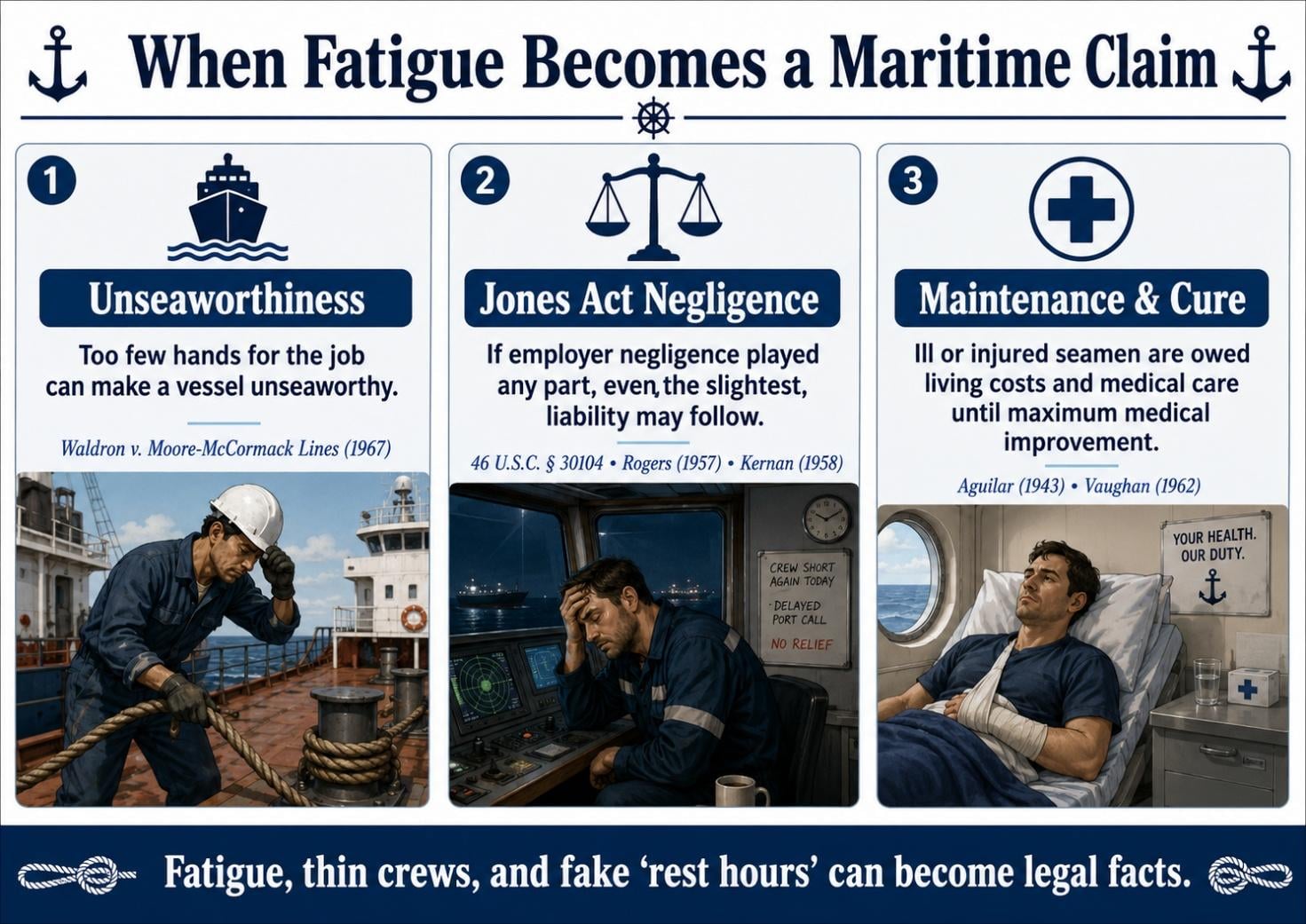
Start with fatigue and thin crews. A vessel owner owes its crew a seaworthy ship, and “seaworthy” has never meant merely watertight — it reaches the adequacy of the crew itself. When a mate ordered two men to carry a heavy mooring line when safe practice called for three or four, the U.S. Supreme Court held the injured seaman could argue the vessel was unseaworthy simply because too few hands were assigned to the task (Waldron v. Moore-McCormack Lines, 1967).
The U.S. Jones Act (46 U.S.C. § 30104) sets an even lower bar. Its “featherweight” causation test comes from the railroad case Rogers v. Missouri Pacific (1957), where the courts established the employer’s responsibility if negligence played “any part, even the slightest,” in the injury.
At sea, that means a staffing choice which leaves a watch shorthandeded does not need to be the sole cause of a mishap — only one contributing cause. And such negligence can lie in something simple, like a single broken safety rule.
That is where the “rest hours” come in. When crews report that logged “rest” exists for the auditor, rather than for the exhausted, they are describing precisely such a rule — the manning and hours-of-rest requirements meant to keep a crew fit to stand watch safely.
The law does not treat those requirements lightly. When a seaman died in a tug fire traced to a kerosene lamp hung lower than Coast Guard rules allowed, the Court imposed Jones Act liability for the violation even though the rule was never meant to prevent fire (Kernan v. American Dredging, 1958).
Hence, a safety rule that helps prevent harm can ground a claim even when the harm was not the one it was written to prevent — and insufficient rest records are exactly the sort of detail that later decides such a case.
Then there is illness itself. When a seaman falls sick or is hurt in the service of the ship, the owner’s ancient duties of Maintenance and Cure obliges it to cover the seaman’s living costs and medical care until maximum medical improvement — no fault required. That phrase, “in the service of the ship,” is read generously: a seaman struck by a vehicle on the dock while merely returning from authorized shore leave was still held covered (Aguilar v. Standard Oil, 1943).
For a workforce whose scarce shore leave is the very grievance this survey flags, that reach matters — the duty follows the seaman down the gangway, not only while the watch is stood.
The courts take it seriously when Maintenance and Cure duties are shirked. After a shipowner ignored a seaman’s request for the maintenance and cure owed him through a long recovery from tuberculosis — leaving him to drive a taxi and hire a lawyer just to collect — the Court resolved the doubt in the seaman’s favor and let him recover his maintenance and cure benefits an all of his attorney’s fees besides (Vaughan v. Atkinson, 1962).
None of this data turns the second quarter of 2026 into lawsuits by itself. It means only that the exhaustion, undermanning, and cut corners crews are quietly reporting are the same facts a court examines when a tired crew’s luck finally runs out.
Why This Reaches the Gulf Coast
You do not have to sail the Persian Gulf, or anywhere in particular, for any of this to matter. For those on the water, fatigue does not respect a latitude line; neither does the law that answers for it.
A morale score is easy to file away as an abstract number. But behind 6.87 are real people, standing real watches through the long, quiet hours — and a weary crew is not merely an unhappy one. It is, too often, the first link in the chain that ends in tragedy. A wise employer reads a survey like this as a warning; as a maritime attorney, I read it as a foreseeability.
After all, resilience is not a bottomless well. A crew can weather almost any danger that ends, but the strain that never quite ends is the kind that wears people down, day by day. Employers who understand this and give their crews real rest, relief, and a reason to stay, will be the ones still able to find sailors for future passages.
Maritime Trivia Question!
Q: When we call someone “groggy” — foggy-headed, dull, slow to shake off fatigue — we are borrowing a word straight from the age of sail. Where does it come from?
A: From “grog,” the watered-down rum once issued to sailors — which in turn comes from “Old Grog,” the nickname of British Admiral Edward Vernon, earned for the coarse grogram cloak he wore on deck. In 1740, worried about the health and discipline of his crews, Vernon ordered their daily rum ration diluted with water; sailors dubbed the mixture “grog” after him, and the heavy, muddled feeling it left behind became “groggy.” It is a fitting word for this quarter’s findings — a whole profession reporting, in effect, that it is “tired in the bones” — and a reminder that concern for a crew’s wellbeing is older than the Jones Act itself.
We at the Herd Law Firm are proud to fight for seamen, maritime workers, and passengers in all types of personal injury and death claims. As maritime personal injury attorneys (and sailors ourselves!) located in northwest Houston, we never waver in our commitment to help these maritime workers, passengers, and their families when they are injured or mistreated.
The information in this post is for general informational purposes only and does not constitute legal advice. For questions specific to your maritime law issue, please contact us at 713-955-3699 or at Charles.Herd@HerdLawFirm.com.
Sources
- Schuler, Mike. “Seafarer Happiness Slips as Chronic Strain Replaces Crisis, Survey Finds.” gCaptain, August 3, 2026. gcaptain.com
- “Seafarer Happiness Index Falls in Q2 2026 Amid Heavy Workloads and Limited Shore Leave.” Marine Insight, August 2026. marineinsight.com
- The Mission to Seafarers. “Seafarers Happiness Index” (Q2 2026 results and report archive). missiontoseafarers.org
- Legal Information Institute, Cornell Law School. “46 U.S. Code § 30104 – Personal injury to or death of seamen” (the Jones Act). law.cornell.edu
- Waldron v. Moore-McCormack Lines, Inc., 386 U.S. 724 (1967). Justia. supreme.justia.com
- Rogers v. Missouri Pacific R. Co., 352 U.S. 500 (1957). Justia. supreme.justia.com
- Kernan v. American Dredging Co., 355 U.S. 426 (1958). Justia. supreme.justia.com
- Aguilar v. Standard Oil Co., 318 U.S. 724 (1943). Justia. supreme.justia.com
- Vaughan v. Atkinson, 369 U.S. 527 (1962). Justia. supreme.justia.com