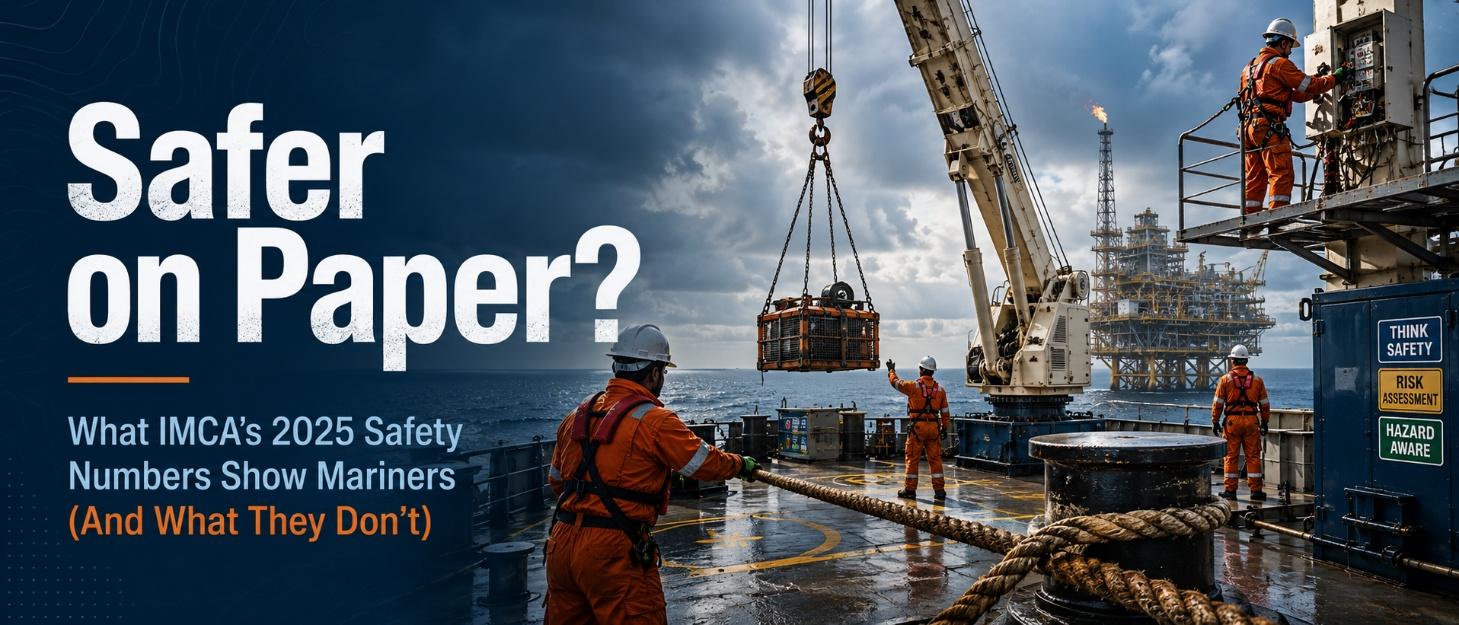
The offshore contracting industry’s injury rates just got better. Its death toll more than doubled. A new report from the International Marine Contractors Association (IMCA) argues that the numbers we have been celebrating are not the numbers that keep crews alive — and that has real consequences for what an employer owes the people it sends offshore.
A calm day at sea is not the same thing as a safe one. The weather can be perfect, the crew fully staffed and the deck clear, and a worker can still be killed in the few seconds it takes for a mooring line to snap. That difference, between conditions that look good and conditions that are safe, is the whole argument of IMCA’s latest Annual Safety Statistics Report, released this week.
The report draws on one of the largest safety datasets the sector has ever assembled: more than 1.02 billion working hours submitted by 167 contractor members. Across that enormous sample, nearly every conventional measure of safety performance moved in the right direction in 2025 — and yet the number of workers killed more than doubled.
THE NUMBERS, PLAINLY
Here is what the report found for 2025:
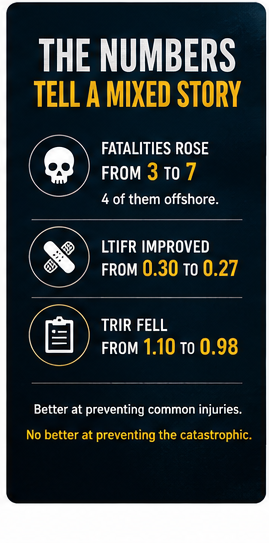
- Fatalities rose from three to seven — four of them offshore.
- The Lost Time Injury Frequency Rate (LTIFR) — the rate of injuries serious enough to keep a worker off the job — improved from 0.30 to 0.27.
- The Total Recordable Injury Rate (TRIR) — all recordable injuries, from the stitches to the stretcher — fell from 1.10 to 0.98.
- The Fatal Accident Rate (FAR) more than doubled, climbing from 0.30 to 0.69.
- Members reported 268 lost-time injuries and 996 total recordable injuries over the year.
Set side by side, those figures describe an industry getting better at preventing the common accident and no better at preventing the catastrophic one. Those are not the same skill. A crushed finger and a fall from height do not share the same kind of cause, and a program intended to minimize the first will not necessarily affect the second.
Mark Holmes, IMCA’s Safety and Security Manager, drew the conclusion employers should read twice: safety performance, he said, “should no longer be judged primarily by injury frequency rates, but by how effectively companies identify and control the hazards most likely to result in death or life-changing injury.”
WHAT ACTUALLY KILLED THEM WAS ROUTINE
Of the seven deaths, the report describes three: an electrocution, a fall from height, and a mooring incident involving a parted rope. Details of the other four were not disclosed.
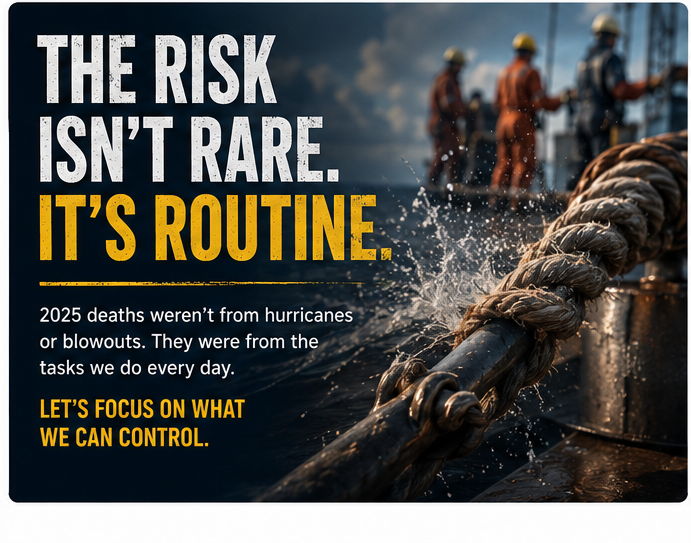
Notice what is missing from that list: no hurricane, no blowout, no collision at midnight in the fog. The tasks involved are ordinary shipboard tasks — energizing a circuit, working up high, handling a line — performed on what were otherwise unremarkable days. IMCA makes just this observation: the industry’s most serious incidents keep happening during familiar work, rather than exceptional operations. The real danger isn’t in the rare emergencies, but the “ordinary Tuesday”.
“LINE OF FIRE” INJURIES
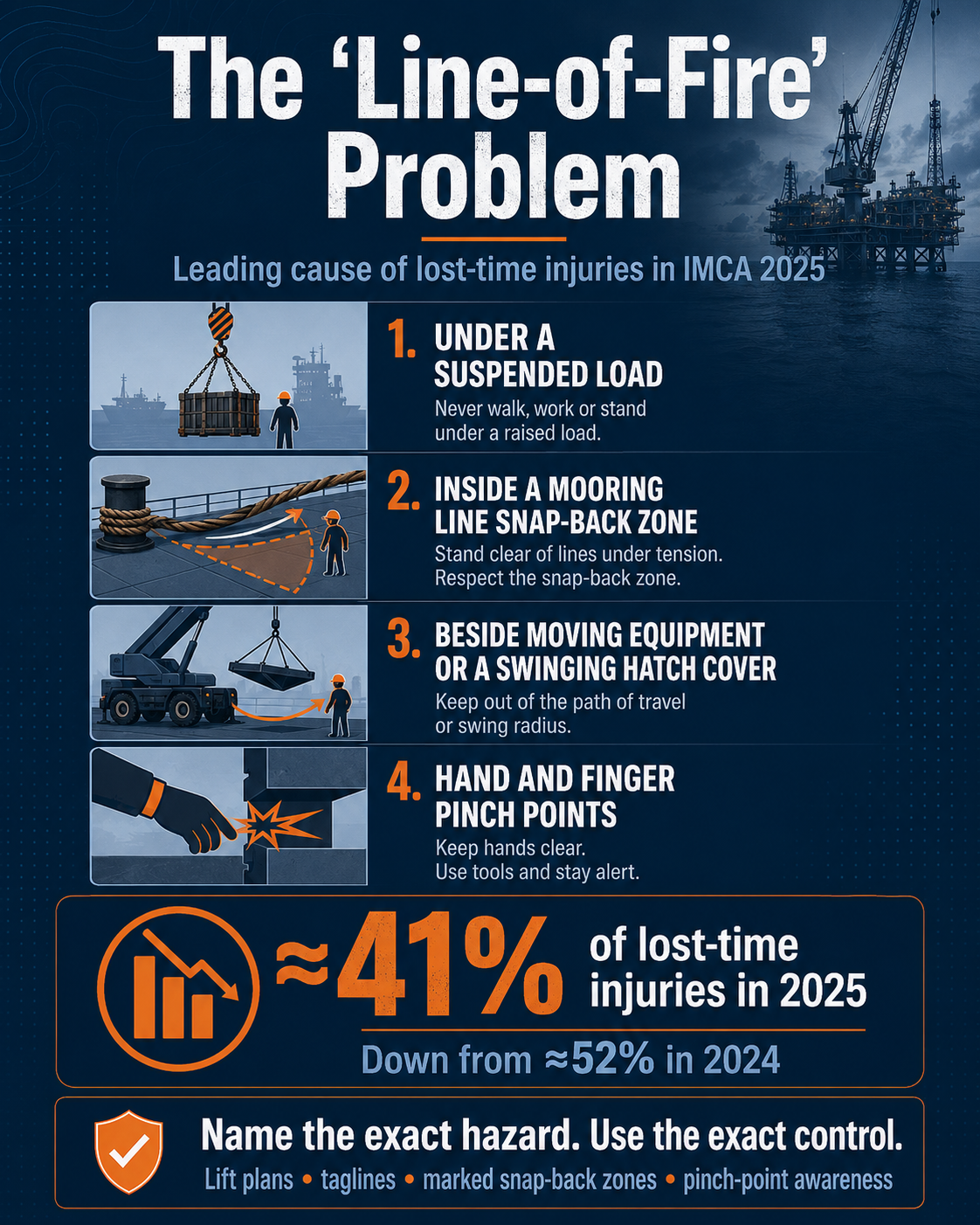
The single largest cause of lost-time injuries — injuries serious enough to keep a worker off his next scheduled shift, as opposed to the ones patched up in the medic’s office — was again a category the industry calls “line-of-fire.” The phrase has nothing to do with gunfire, but instead describes when a worker stands, kneels, or reaches into the path that a projectile or force is about to travel, such as:
- under a suspended load
- inside the loop of a mooring line
- beside a hatch cover that is about to swing
- in the arc of a snapped wire
Note: the hazard is not the equipment itself but the worker’s position relative to it when something is in motion.
Line-of-fire incidents accounted for roughly 41 percent of lost-time injuries in 2025, improved from about 52 percent the year before. However, in the opinion of this personal injury attorney, “line of fire” is too broad a definition to effectively prevent anything; a crew cannot simply be told to avoid all moving objects.
However, IMCA’s recommendation is that the industry stop treating the phrase as “one big bucket” and start naming the specific situations inside it, such as:
- Lifting and rigging operations
- Mooring work
- Suspended loads
- Moving equipment
- Dropped objects
- Hand and finger pinch points.
Each of these specific situations should have its own known hazard control — a premade lift plan and a tagline for suspended loads, a cleared and marked snap-back zone for mooring lines, each with its own records. That way, if there are questions years later, the question won’t be whether the employer had a safety program, but whether this hazard, on this job, had the control that everyone in the industry already knew was needed.
THE QUIETEST WARNING IN THE REPORT
One finding deserves more attention than it will get: the Safety Observation Frequency Rate (SOFR), or how often workers formally report a hazard they noticed, also fell about 20 percent, from 482.1 to 387.1 observations per 200,000 hours worked.
Safety observations are the industry’s best early-warning system. They are the small, unglamorous reports a worker files before anyone gets hurt, existing specifically to catch the hazards that the injury statistics record a little too late. This makes the 20 percent decline in that reporting the one figure in the report that describes the future, rather than the past.
IMCA states that it does not know the exact cause. It may reflect a change in reporting software, or a different mix of companies submitting data, but the ICMA acknowledges a third possibility: that crews stop reporting when they stop believing anything comes of it. IMCA’s own conclusions point that way, urging companies to worry less about the volume of observation cards, and more about whether an observation ever produces practical change.
Bottom line for mariners: A hazard reported and ignored is one of the most powerful pieces of evidence an injured seaman can have. A hazard that is never reported at all — because the culture taught the crew not to bother — is a harder legal case, and a more dangerous workplace.
WHAT UNITED STATES MARITIME LAW THINKS
An improving injury rate is not a legal defense. American maritime law does not ask how a company performed “on average”; it asks what happened to this worker, on this vessel, on this day. Three doctrines carry most of that weight:
- Jones Act negligence. Under 46 U.S.C. § 30104, a seaman may recover where the employer’s negligence played “any part, even the slightest” in causing the injury. It is a famously low threshold, and a corporate safety statistic does not raise it. If the rigging plan was inadequate on the morning the load swung, the fleet-wide LTIFR is beside the point.
- Unseaworthiness. Under the General Maritime Law, a vessel owner is strictly liable when the vessel, her gear, or her crew is not reasonably fit for its intended purpose. A mooring line that parts under normal load, a crew too thin to do the job safely, an undersized or fatigued watch — each can render a vessel unseaworthy regardless of how careful anyone was trying to be.
- Maintenance and cure duties. The oldest obligation in admiralty: an injured seaman’s daily living expenses and medical costs, owed by the vessel owner without regard to fault, until the seaman reaches maximum medical improvement (MMI).
Alongside all three is the employer’s affirmative duty to warn crew of known hazards. IMCA’s report is, in a real sense, an industry-wide notice: these are the tasks that are liable to kill people. A contractor who reads that and changes nothing has a much harder time later claiming the risk was unforeseeable. We have made a version of this point before in the context of crews sent into danger on company orders, and the principle still travels: knowledge of a hazard is the beginning of responsibility for it, not the end.
For workers who load, unload, build, or repair vessels but do not sail on them, the Longshore and Harbor Workers’ Compensation Act (LHWCA) — 33 U.S.C. § 901 and following — provides a separate federal compensation scheme, with its own benefits and its own deadlines. Which framework applies to a given offshore worker is a genuinely technical question, and it is worth asking early rather than late.
WHY THIS REACHES THE GULF COAST
IMCA’s members work everywhere, but the work it describes is our work, too. The seven deaths in that report belong to a category of labor that Gulf Coast workers — including Louisiana —perform every single day.
A falling injury rate is worth something, but it does not answer the question that actually matters offshore, which is what has been done about these specific hazards that can kill — lifting and rigging, mooring and snap-back zones, work at height, and live electrical work — the familiar jobs which stopped getting safety talks once everyone had done them a thousand times.
The distinction is worth stating clearly: a hazard-specific safety record tells you what already happened to other crews in past years. Properly-used hazard controls, such as taglines and snap-back zones, are what actually stand between a worker and the next hour of his shift, even the rest of his life.
So, this report is not just reassurance, and it should not be presented like it. This is an analysis of the kinds of work proven capable of hurting and killing people, delivered to every employer in the industry, while there is still time to act on it.
After all, the sea has never been impressed by a good average.
Maritime Trivia Question!
Q: Every mariner knows that “Mayday” is the call you make when lives are at risk. But the word has nothing to do with the month of May. Where did it come from?
A: From French. In 1923, a senior radio officer at London’s Croydon Airport was asked to invent a distress word that would be unmistakable over a scratchy radio and intelligible to both British and French operators, who handled most of the traffic across the Channel. He landed on m’aider — “help me,” from venez m’aider, “come help me” — spelled phonetically in English as Mayday. It was adopted internationally within a few years, and remains the standard distress call at sea and in the air, spoken three times so it cannot be mistaken. A century on, the most serious syllables in maritime communication are still a plain request for help, borrowed from a neighbor’s language.
We at the Herd Law Firm are proud to fight for seamen, maritime workers and passengers in all types of personal injury and death claims. As maritime personal injury attorneys (and sailors ourselves!) located in northwest Houston, we never waver in our commitment to help these maritime workers, passengers, and their families when they are injured or mistreated.
The information in this post is for general informational purposes only and does not constitute legal advice. For questions specific to your maritime law issue, please contact us at 713-955-3699 or at Charles.Herd@HerdLawFirm.com.
Sources
- Schuler, Mike. “Offshore Fatalities More Than Double Despite Improved Injury Rates, Industry Group Warns.” gCaptain, July 22, 2026. gcaptain.com
- “Offshore Safety: Improving Injury Rates May Be Masking Continued Fatalities.” MarineLink, July 22, 2026. marinelink.com
- “Improving Safety Record Masks Rise in Offshore Fatalities.” Splash247, July 2026. splash247.com
- “IMCA Reports Lower Injury Rates but Warns Fatalities Remain a Concern.” SAFETY4SEA, July 2026. safety4sea.com
- International Marine Contractors Association. “Annual Safety Statistics Report” (program background and historical data). imca-int.com
- Legal Information Institute, Cornell Law School. “46 U.S. Code § 30104 – Personal injury to or death of seamen” (the Jones Act). law.cornell.edu
- Legal Information Institute, Cornell Law School. “33 U.S. Code § 901 et seq. – Longshore and Harbor Workers’ Compensation Act.” law.cornell.edu