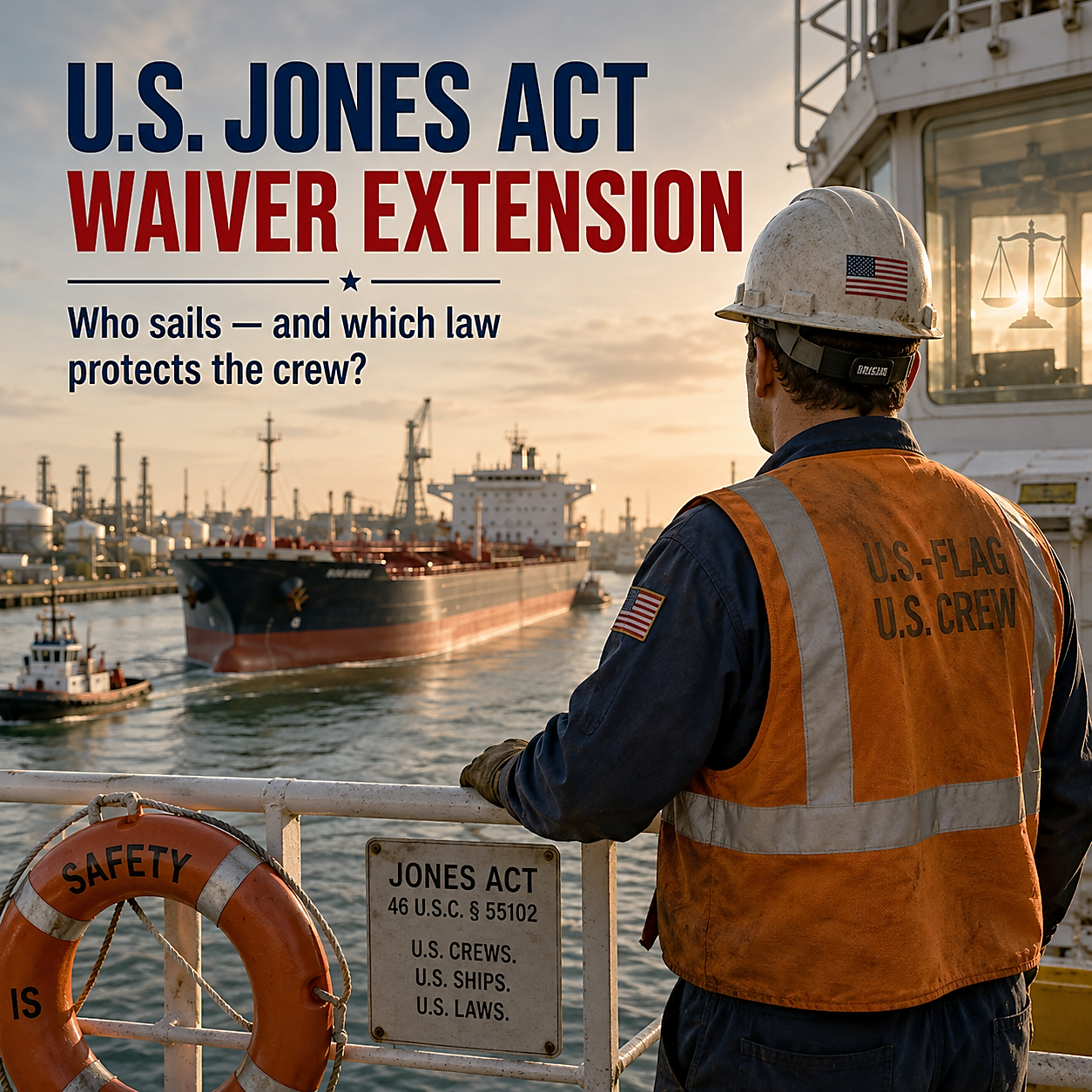
A century-old law reserving trade between American ports for American ships has been set aside three times this year, and a fourth decision is due within days. What is at stake is not only the price of a barrel of oil, but which body of law protects the crew standing on deck.
The “tarp over the hatch” cover was meant to last a week; yet it has lasted three seasons.
That is roughly where the U.S. Jones Act waiver program stands this summer.
The White House is weighing another extension of the waivers that permit foreign-flagged vessels to carry cargo between United States ports, as renewed conflict with Iran drives fresh worry about energy prices and supply disruption. Two sources familiar with the discussions described an interagency meeting earlier that week — the White House alongside the heads of the Departments of Energy, Transportation, and the Interior — convened to weigh options ahead of a possible decision before the end of July.
One option reportedly on the table is a narrower waiver carrying geographic restrictions, limiting where foreign hulls may trade domestically. A White House official stressed that no decision has been made and that the current waiver does not expire until August 16.
What the U.S. Jones Act Actually Does
The Jones Act — formally the Merchant Marine Act of 1920 — does two distinct things that are often conflated in the news coverage, and the distinction matters enormously to anyone who works on the water.
- The cabotage provision reserves the carriage of goods between U.S. ports for vessels that are American-built, American-owned, American-flagged, and crewed predominantly by American mariners. This is the part the waivers suspend.
- Section 30104 (46 U.S.C. § 30104) gives an injured seaman the right to sue his employer for negligence, with the famously low “any part, even the slightest” causation standard. This part is not waived, and cannot be — but whether it reaches a given crewman depends on the vessel he is standing on.
A waiver, in other words, does not rewrite the rights of American seamen on paper. It does something quieter and harder to litigate: it removes them from the deck. Every waiver voyage is a run that an American crew did not make. The berth is not merely lost income — it is lost sea time toward a license, lost days toward a pension, lost eligibility for the union benefits and shoreside medical coverage that attach to steady employment. A mariner cannot invoke Section 30104 against a voyage he was never hired for.
The Numbers Driving the Decision
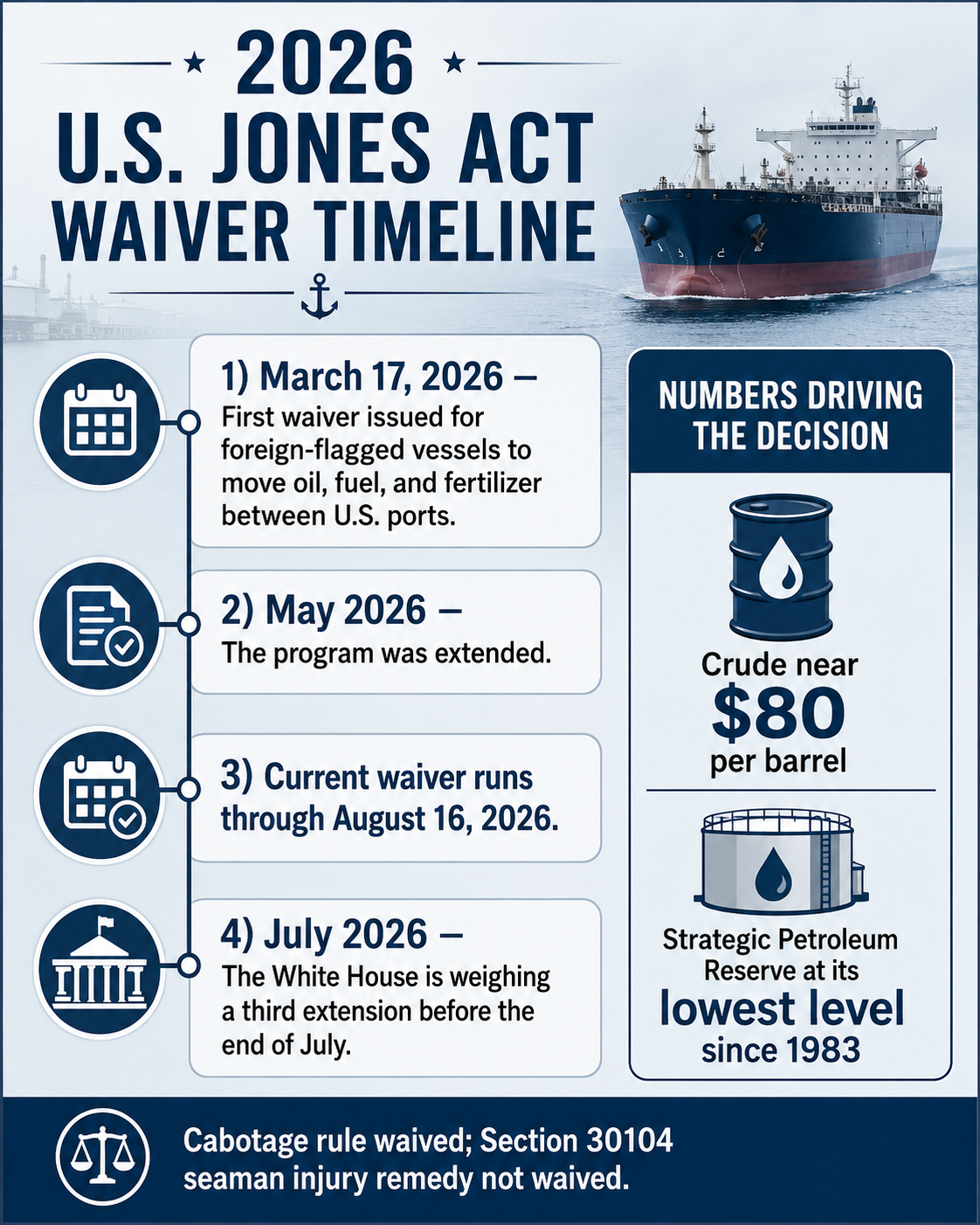
Waiving cabotage is one of several levers the administration has pulled at the incurring price of crude, which sits near $80 a barrel domestically. The other, more familiar lever — lending oil from the Strategic Petroleum Reserve (SPR) — has drawn the reserve down to its lowest level since 1983. Against that backdrop, the sequence has been brisk:
- March 17, 2026 — the first waiver issued, permitting foreign-flagged vessels to move oil, fuel, and fertilizer between U.S. ports.
- A second extension carried the waiver through August 16, 2026.
- A third extension is now under consideration, as fighting between the United States and Iran has pushed prices higher.
he White House says the waivers increased shipping capacity and moved supplies faster. Critics dispute the effect on pump prices, noting the volumes involved are modest relative to total U.S. consumption.
We have followed this program from the beginning. When the first extension landed in May, we wrote in Old Laws in a New War: The Jones Act Waiver Extension and What That Means for Mariners about what a suspended cabotage rule does to the men and women who crew the coastwise fleet. Earlier this month, in Waived Goodbye: What the Data Says About the Wartime Jones Act Waiver and National Security, we walked through the independent analysis of federal shipping data — including the finding that a substantial share of waiver voyages went to hulls built in or controlled by China, on runs U.S. vessels were available to make. A third extension would likely be the fourth chapter of this same story.
The Backlash from the Industry — and from Capitol Hill
In a June 30 letter, House Republican leadership — including Speaker Mike Johnson — asked the President to let the waiver lapse on schedule. Their argument rested on figures from the Maritime Administration (MARAD): roughly 95 percent of completed waiver voyages primarily benefit foreign operators that pay no U.S. taxes, and are not bound by American crewing and immigration rules.
The letter framed the U.S. Jones Act as the nation’s principal defense against foreign exploitation of domestic waterways, and pointed to the Administration’s own maritime revitalization plan as reason to protect the domestic fleet rather than sideline it.
Industry groups add a quieter concern: business uncertainty does its own damage. Reports suggest some decisions to build new U.S. Jones Act vessels have been deferred, while shipyards and owners wait to learn whether the coastwise trade will still be reserved to them in a year.
Why a Waiver Is a Legal Question, Not Just an Economic One
We have written before about the sharp difference in legal protection between an American crew and a foreign one working the same waters — in our coverage the crews left behind in the Strait of Hormuz, and in “A Rough Profession,” Not an Unprotected One: The Duty to Warn and Maritime Law.
When an American seaman is hurt aboard a U.S.-flagged vessel, a well-developed body of law follows him:
- U.S. Jones Act negligence — an employer answers if its negligence played any part, even the slightest, in causing the injury.
- Unseaworthiness — under the General Maritime Law, the vessel owner is strictly liable if the ship, her gear, or her crew is not reasonably fit for her intended service.
- Maintenance and cure duties — the ancient obligation to pay a seaman’s living expenses and medical care after an injury in the service of the ship, regardless of fault, until he reaches maximum medical improvement (MMI).
- The duty to warn — an affirmative obligation to tell a crew about known dangers before ordering them into harm’s way.
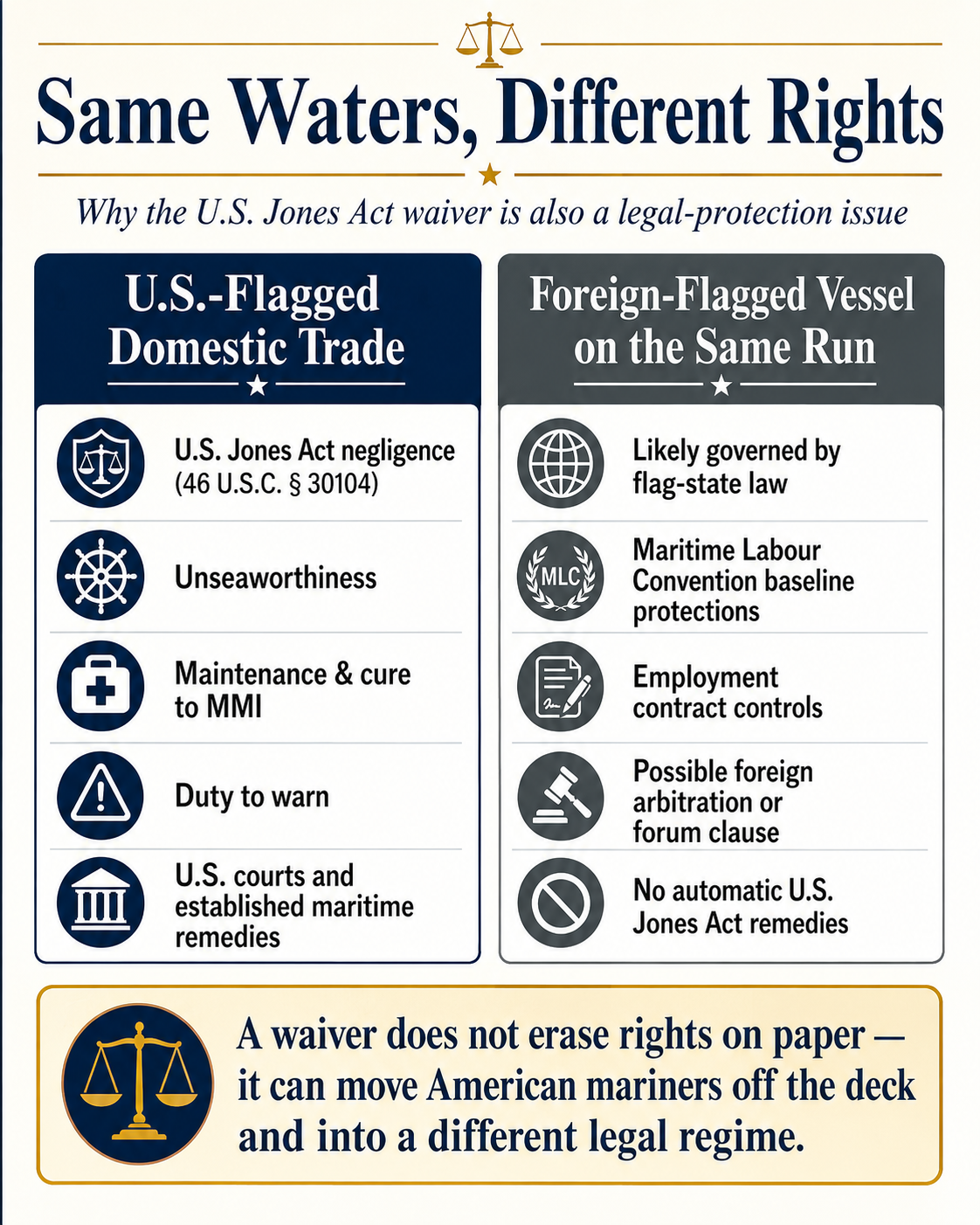
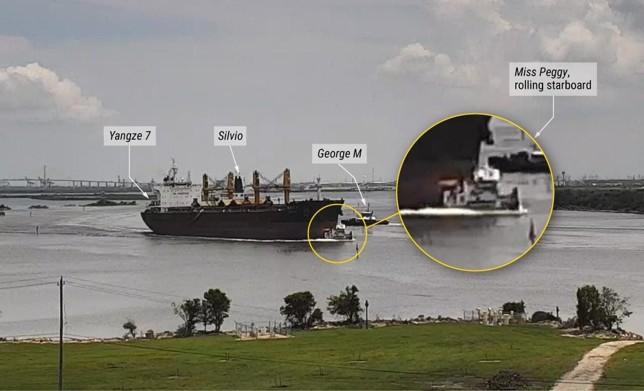
Arguably, a crewman on a foreign-flagged hull doing the same run may have none of that. In that event, their remedies are likely governed by the flag state, by the Maritime Labour Convention (MLC) of the International Labour Organization, and by whatever their contract says — often with a foreign forum (jurisdiction)-selection or arbitration clause standing between the crewman and a courthouse. This means two men can work adjacent berths on the same dock in Texas City, but perhaps stand on entirely different legal ground.
The harm runs in both directions, and both directions affect American mariners. The foreign crewman is left with thin protections and a distant and/or unfamiliar jurisdiction to pursue matters legally. The American crewman is left ashore entirely— and every voyage that goes to a cheaper foreign vessel exerts downward pressure on the wages, manning levels, and safety investment of the U.S.-flag operators still competing for the work. Standards are expensive exactly because they are protective. When the trade is opened to vessels that do not go to that expense, the operators who do are punished for it, and the crews who rely on those protective standards feel the difference first — in shorter-handed watches, deferred maintenance, and pressure to sail anyway. Where a geographic restriction is the compromise chosen, the line drawn on the chart becomes, quite literally, a line between legal frameworks.
Why This Reaches the Gulf Coast
No stretch of American coastline has more riding on this than ours. The Houston Ship Channel, Bayport, Barbours Cut, Texas City, Port Arthur, everyone living and working on the Texas Coast, and the refineries supporting them are the origin point for a large share of the fuel moving in the coastwise trade. When foreign tonnage is admitted to that trade, the cargo will still move, but the job opportunities, the crewing standards, and the applicable legal protections may not come with it.
None of which is an argument about trade policy; that is a debate for U.S. Congress and the voting public. This is an argument about knowing where you stand if you work aboard a vessel in domestic trade, and the meaning of the flag on the stern. It determines the law that will be used to protect, or not protect, those working in our waters.
A ship is only ever as safe as the rules the people ashore agree to keep. After all, the flag at the stern represents a promise, and promises are worth exactly what someone is willing to actually enforce.
Maritime Trivia Question!
Q: The U.S. Jones Act’s domestic-shipping rule is properly called a cabotage law. What does that odd word have to do with ships hugging a coastline?
A: It comes to English from the French cabotage, meaning coastal trading — sailing from cape to cape rather than striking out across open ocean. The likeliest root is the Spanish cabo (“cape”), the same word that gives us Cabo San Lucas. A rival account credits the Venetian navigator Sebastian Cabot, though most lexicographers treat that as folk etymology rather than history. Either way, the word has always described the humble, unglamorous work of the coastal trade — the short hauls that keep a nation fed and fueled.
We at the Herd Law Firm are proud to fight for seamen, maritime workers and passengers in all types of personal injury and death claims. As maritime personal injury attorneys (and sailors ourselves!) located in northwest Houston, we never waver in our commitment to help these maritime workers, passengers, and their families when they are injured or mistreated.
The information in this post is for general informational purposes only and does not constitute legal advice. For questions specific to your maritime law issue, please contact us at 713-955-3699 or at Charles.Herd@HerdLawFirm.com.
Sources
- Renshaw, Jarrett. “White House weighs extending Jones Act waivers as Iran conflict raises price concerns.” Reuters, July 15, 2026.
- “White House Weighs Jones Act Waiver Extension As Hormuz Conflict Reignites.” gCaptain, July 2026. https://gcaptain.com/white-house-weighs-jones-act-waiver-extension-as-hormuz-conflict-reignites/
- “House Republican Leaders Urge Trump to Let Jones Act Waivers Expire as Scheduled in August.” U.S. News & World Report / Reuters, July 1, 2026. https://www.usnews.com/news/politics/articles/2026-07-01/house-republican-leaders-urge-trump-to-let-jones-act-waivers-expire-as-scheduled-in-august
- Letter from House Republican leadership to President Donald J. Trump regarding Jones Act waiver expiration, June 30, 2026. U.S. House Committee on Oversight and Accountability. https://comer.house.gov/_cache/files/6/b/6b9a81c7-2912-42b0-a38e-645188b32ac6/7129BC1A939C41E9B87B5573CC64F7492C4B02674CCD53BCAA4A695EA52A985E.6.30.26-jones-act-waiver-expiration-letter—final.pdf
- Legal Information Institute, Cornell Law School. “46 U.S. Code § 30104 – Personal injury to or death of seamen” (the Jones Act). https://www.law.cornell.edu/uscode/text/46/30104
- Legal Information Institute, Cornell Law School. “46 U.S. Code § 55102 – Transportation of merchandise” (the coastwise/cabotage requirement). https://www.law.cornell.edu/uscode/text/46/55102
- International Labour Organization. “Maritime Labour Convention, 2006 (MLC, 2006).” https://www.ilo.org/international-labour-standards/maritime-labour-convention-2006