
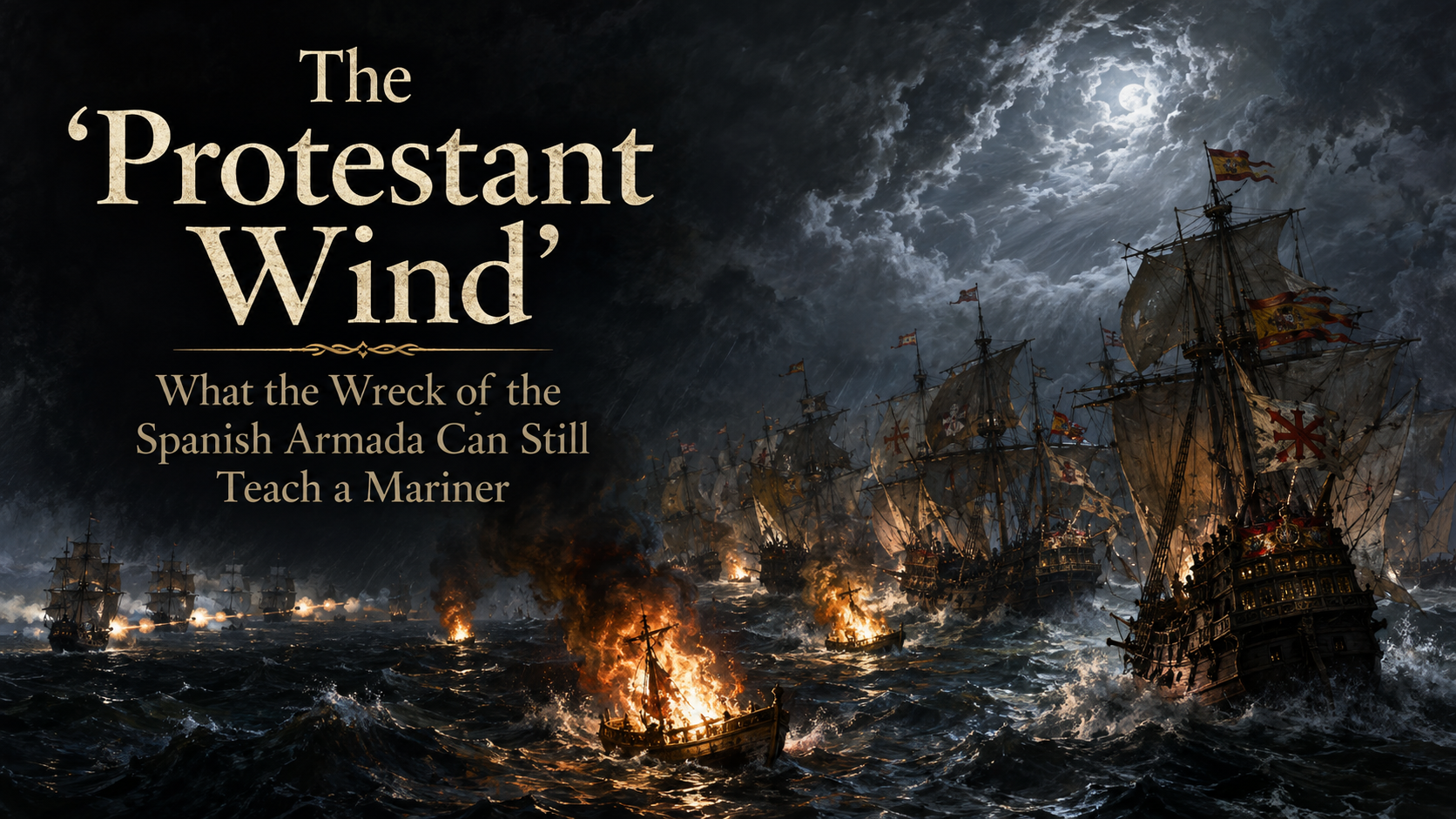
Four hundred and thirty-eight years ago, a fleet built to conquer England was undone by fireships and foul weather off the coast of France. The battle itself killed very few Englishmen — but what happened to the sailors afterward gave the world one of the first laws written to protect a mariner sent into harm’s way. That law still reaches our Gulf Coast today.
On the afternoon of July 29, 1588, a group of English captains is said to have been finishing a leisurely game of lawn bowls at Plymouth when word arrived that the feared Spanish Armada had been sighted in the English Channel.
The sailors, as they famously do, kept their nerve in the face of overwhelming odds.
Within days, that enormous Spanish fleet — roughly 130 ships, dispatched by King Philip II of Spain to unseat the Protestant queen and restore a Catholic one — would be scattered, burning, and running for the open sea. England would stay Protestant, and the map of the world would tilt on the outcome.
This is one of those ships-that-changed-the-law (or really, ships-that-changed-the world) stories — except the law it established was not about crowns or creeds, but about the men who crewed those vessels. Looking past the flags and cannonfire, the defeat of the Spanish Armada turns out to be one of the events where the modern rights of an injured seaman were first written down.
(A small note for the calendar-minded: England in 1588 still used the old Julian calendar system, so English sailors fought the decisive Battle of Gravelines on July 29, while Spain — already on the Gregorian calendar — marked it August 8. Same battle, two dates, but we use the English date here)
A Victory of Fire and Weather
For a week the two fleets fought running skirmishes up and down the English Channel. The faster, more nimble English gunships wore down the great crescent-shaped Spanish formation, but without breaking it.
The decisive blow was not a broadside shot of cannon, but a bluff. Near midnight on July 28–29, the English packed eight old vessels with everything that would burn, set them alight, and let wind and tide carry them into the Spanish ships anchored off the French coast ,near Calais.
Rather than be burned at their moorings, the Spanish captains cut their anchor cables and fled into the dark — and by dawn the fleet that had held unbreakable formation for a week was in chaos off Gravelines, where the English cannons finished the work.
Lord Howard of Effingham directed the English from the Ark Royal; Sir Francis Drake harried the Spanish line in the Revenge; and the Spanish commander, the Duke of Medina Sidonia, flew his flag on the San Martín.
(Historical note: These were sailing men-of-war military vessels, so they carry no “M/V” — Motor Vessel — prefix; that abbreviation belongs to the engines the sixteenth century had barely dreamed of. “HMS” or “Her Majesty’s Ship” was a later-used English Royal Navy convention)
But what truly destroyed the Armada was not English gunnery, but nature itself. Driven north with no safe harbor, the survivors had to round Scotland and the west coast of Ireland straight into savage autumn gales, and ship after ship went to pieces on the rocks. Of the roughly 130 Spanish that had sailed, only about half limped home, most of them broken.
Protestant England called the gale that scattered the fleet the “Protestant Wind” and read the divine hand of Providence in it. But this maritime lawyer also notices something more earthly: the whole affair hinged on the weather — and the law has been arguing about the weather ever since.
The Queen’s Fleet (That Was Mostly Not the Queen’s)
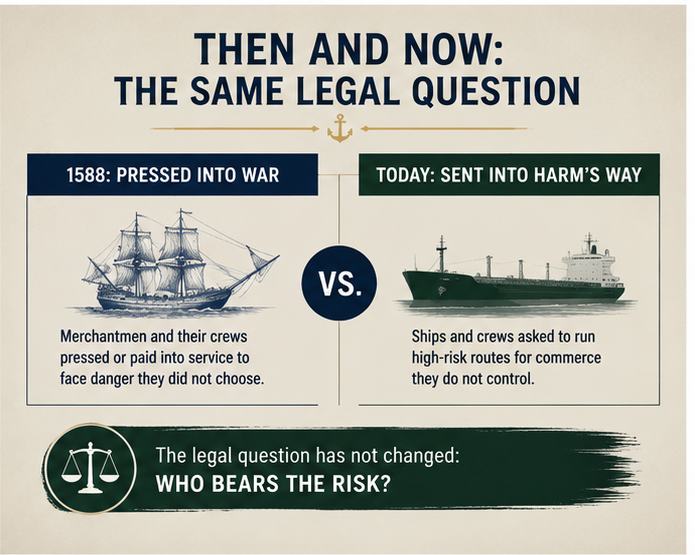
Here is a fact the history books often overlook: most of the ships that saved England did not belong to the Crown. By standard historical accounts, Elizabeth’s Royal Navy furnished only about thirty-four warships. The rest of the English fleet — about 170 vessels — were armed merchantmen and privately owned ships whose owners and crews were pressed, coaxed, or paid into national service. Ordinary sailors and fishing captains found their livelihoods, and their lives, conscripted into somebody else’s war.
The parallels to today’s headlines in the Persian gulf cannot be pissed.
That exact problem — a civilian crew ordered into danger by the people who profit from the voyage — is what modern maritime law was built to answer.
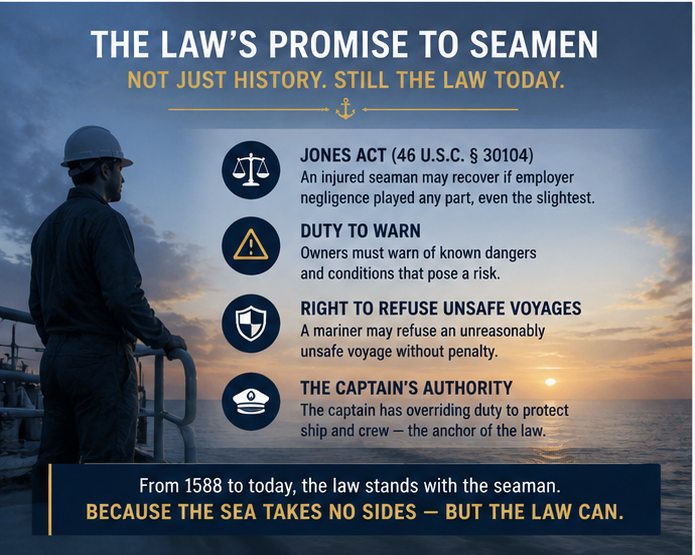
Under the U.S. Jones Act (46 U.S.C. § 30104), a seaman injured because his employer’s negligence played “any part, even the slightest,” in the harm may hold that employer accountable — a deliberately low bar, reflecting Congress’s judgment that those who send sailors to sea must answer for what befalls them there. The U.S. General Maritime Law adds an affirmative duty to warn crews of known dangers, and protects a mariner’s right to refuse a voyage that is unreasonably unsafe — with the captain’s overriding authority to protect ship and crew as the anchor of the whole arrangement.
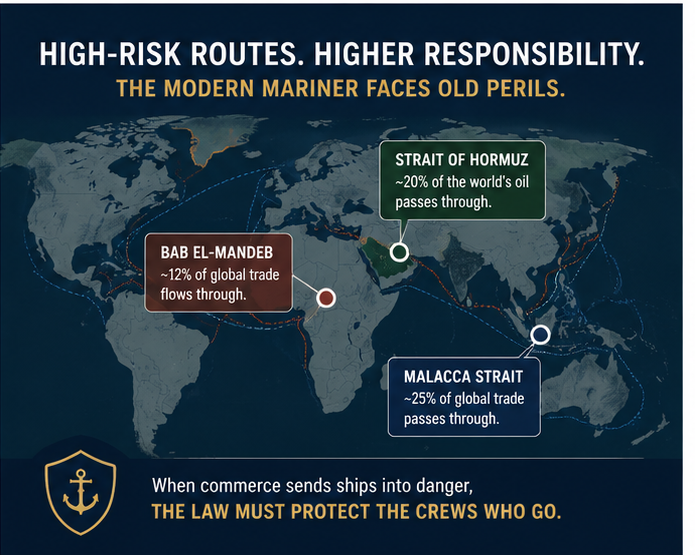
We have written about the modern face of this exact problem more than once: about crews quietly asked to run the Strait of Hormuz “dark,” transponders off, past a hostile navy (Running Dark Through Hormuz), and about what happens when a state demands a five-figure toll to cross and the owner still expects the ship to sail anyway (Tehran’s Toll Booth).
Four centuries separate those crews from the pressed merchantmen of 1588, but the legal question has not aged a day: who bears the risk when a sailor is sent where the sailor would not choose to go?
“Perils of the Sea” Is a Legal Category, Not Just a Phrase
The Spanish Armada was beaten by gunfire, but it was destroyed by weather — and weather holds a peculiar, ancient place in maritime law. Admiralty has always drawn a line between losses a diligent mariner could have prevented and those inflicted by forces no one commands: what the old legal cases call an “act of God” or a “peril of the sea”. This means a shipowner who loses cargo to an ordinary hazard he should have guarded against is considered responsible for the loss; one genuinely overwhelmed by an unforeseeable natural event usually is not. This duty runs the other way, too: the unseaworthiness doctrine holds an owner strictly liable when a vessel is not reasonably fit to meet the ordinary perils of her voyage — meaning an extreme, unpredictable storm may qualify, but a leaky, ill-maintained ship does not.
In a recent post on container detention fees, we described a spring 2026 U.S. federal appeals ruling that ocean carriers may not bill truckers for holding equipment during days when a port’s gates were bolted shut and the container physically could not be returned — because a charge that punishes the impossible serves no lawful purpose. The Armada’s storm and a shuttered Savannah cargo gate are, at law, close cousins. Both make the courts ask the same fair question: is it lawful to be held responsible for winds that never came, or a passage that would not safely open?
Ten Thousand Came Home Broken: The First “Maintenance and Cure”
Now the part that should stay with us. Of all the Englishmen who died in 1588, only about 100 are thought to have fallen in the actual fighting. Thousands more died afterward — of typhus, dysentery, hunger, and plain neglect — many of them unpaid, unceremoniously discharged onto the docks of southern England to sicken and starve. The men who had just saved the kingdom were left to rot, with no one obligated to care for them.
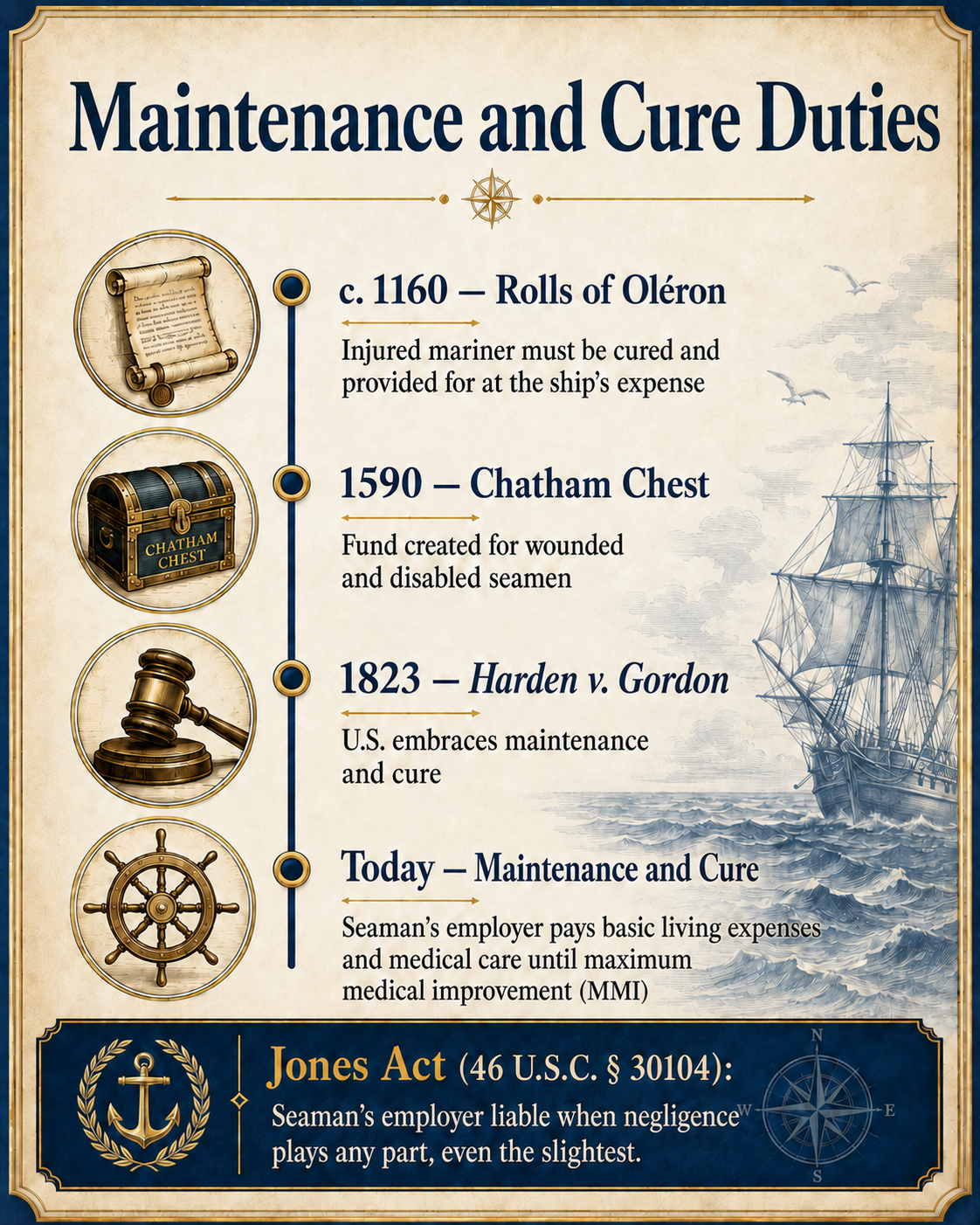
Out of that scandal came something remarkable. In 1590, three of the Armada’s own commanders — Sir Francis Drake, Sir John Hawkins, and Lord Howard of Effingham — founded the Chatham Chest, a fund into which every naval seaman paid sixpence a month and out of which the wounded and disabled drew a pension scaled to the severity of their injuries. Often called the first contributory occupational-welfare fund in Europe, it even paid the newly-maimed an immediate lump sum that the clerks called “smart money” — a phrase, and a principle, we have not completely let go of today.
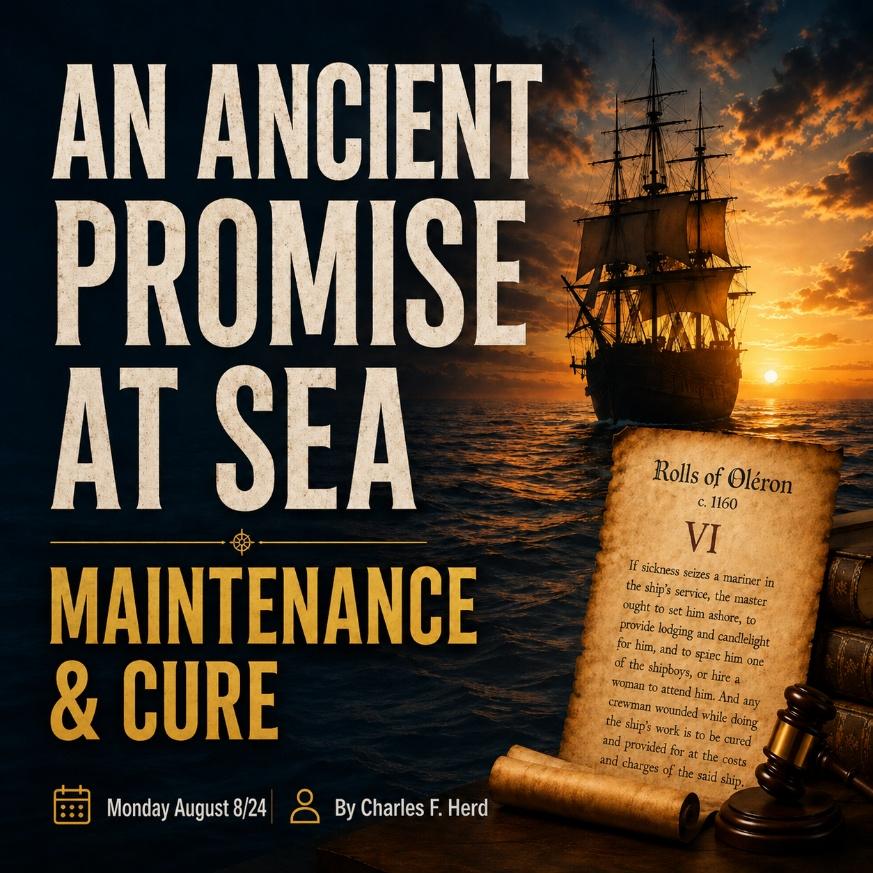
The duty to care for an injured sailor is older than England’s navy. The medieval Rolls of Oléron (about 1160) — the sea code Eleanor of Aquitaine is said to have carried north from the Mediterranean — already provided, in its Article VI, that a mariner hurt “in the service of the ship” must be cured and provided for at the ship’s expense. Henry VIII adopted those rules; English admiralty carried them forward; and in 1823 the United States took them up when Justice Joseph Story, in Harden v. Gordon, wove a seaman’s rights into American law.
Today we call it “Maintenance and Cure” — the vessel owner’s no-fault duties to pay an injured seaman’s basic living expenses (maintenance) and medical costs (cure) until he reaches maximum medical improvement (MMI), the point at which his condition will not get better with further treatment. It is among the oldest and most protective rights a mariner has — and it descends in a straight line from the historical wreckage of 1588.
Why This Reaches the Gulf Coast
The same duty that should have cared for a fevered English sailor in 1588 now protects a deckhand on Galveston Bay, a tankerman on the Sabine, and a barge crew on the Intracoastal Waterway. A modern American seaman never surrenders his rights just by working somewhere dangerous, because dangerous water is exactly where those rights were meant to be. The Spanish Armada (and especially its defeat) is a reminder that nations will always find reasons to send sailors into harm’s way. It’s the law’s job, then as now, is to make sure someone is still keeping watch to answer for those harmed once the storm has passed.
Maritime Trivia Question!
Q: When the Armada broke apart on the coast of Ireland, the shoreline filled with wreckage — and admiralty has precise words for it. What is the difference between flotsam and jetsam?
A: They are not synonyms, but legally distinct. Flotsam is wreckage or cargo that reaches the water by accident — a ship founders and her goods float free (from the Old French “floter”, “to float”).
Jetsam is what a crew deliberately throws overboard — jettisons, from the Latin jactare, “to throw” — usually to lighten an overwhelmed vessel in distress. The distinction once critical as to who could lawfully claim the goods.
(For the curious, the old law adds two more: “lagan”, jettisoned goods buoyed or marked for later recovery, and “derelict”, property abandoned at sea with no hope of return. The Armada left lots of all four scattered from Calais to County Sligo.)
We at the Herd Law Firm are proud to fight for seamen, maritime workers, and passengers in all types of personal injury and death claims. As maritime personal injury attorneys (and sailors ourselves!) located in northwest Houston, we never waver in our commitment to help these maritime workers, passengers, and their families when they are injured or mistreated.
The information in this post is for general informational purposes only and does not constitute legal advice. For questions specific to your maritime law issue, please contact us at 713-955-3699 (fax 281-462-5180), at Charles.Herd@HerdLawFirm.com, or at our office at 8826 Louetta Road, Suite 310, Spring, TX 77379.
Sources
- Royal Museums Greenwich. “The Spanish Armada: history, causes and timeline.” www.rmg.co.uk/stories/topics/spanish-armada-history-causes-timeline
- Royal Museums Greenwich. “Launch of fireships against the Spanish Armada, 7 August 1588.” www.rmg.co.uk/collections/objects/rmgc-object-11755
- World History Encyclopedia. “Spanish Armada.” www.worldhistory.org/Spanish_Armada/
- History.com. “Spanish Armada — Defeat & Definition.” www.history.com/articles/spanish-armada
- Warfare History Network. “Defeat of the Spanish Armada.” warfarehistorynetwork.com/article/defeat-of-the-spanish-armada/
- Royal Museums Greenwich. “Chatham chest.” www.rmg.co.uk/collections/objects/rmgc-object-3284
- Chatham Historic Dockyard Trust. “Top Ten Collections — Chatham Chest.” thedockyard.co.uk/news/top-ten-collections-chatham-chest/
- Oxford Reference. “Rules of Oléron” (Article VI, Rules of Maintenance and Cure). www.oxfordreference.com/display/10.1093/acref/9780198802525.001.0001/acref-9780198802525-e-4577
- Tulane Law Review. “Seamen’s Rights to Recover Maintenance and Cure Benefits.” www.tulanelawreview.org/pub/volume55/issue4/seamens-rights-to-recover-maintenance-and-cure-benefits
- Legal Information Institute, Cornell Law School. “46 U.S. Code § 30104 — Personal injury to or death of seamen” (the Jones Act). www.law.cornell.edu/uscode/text/46/30104






Leave A Comment