
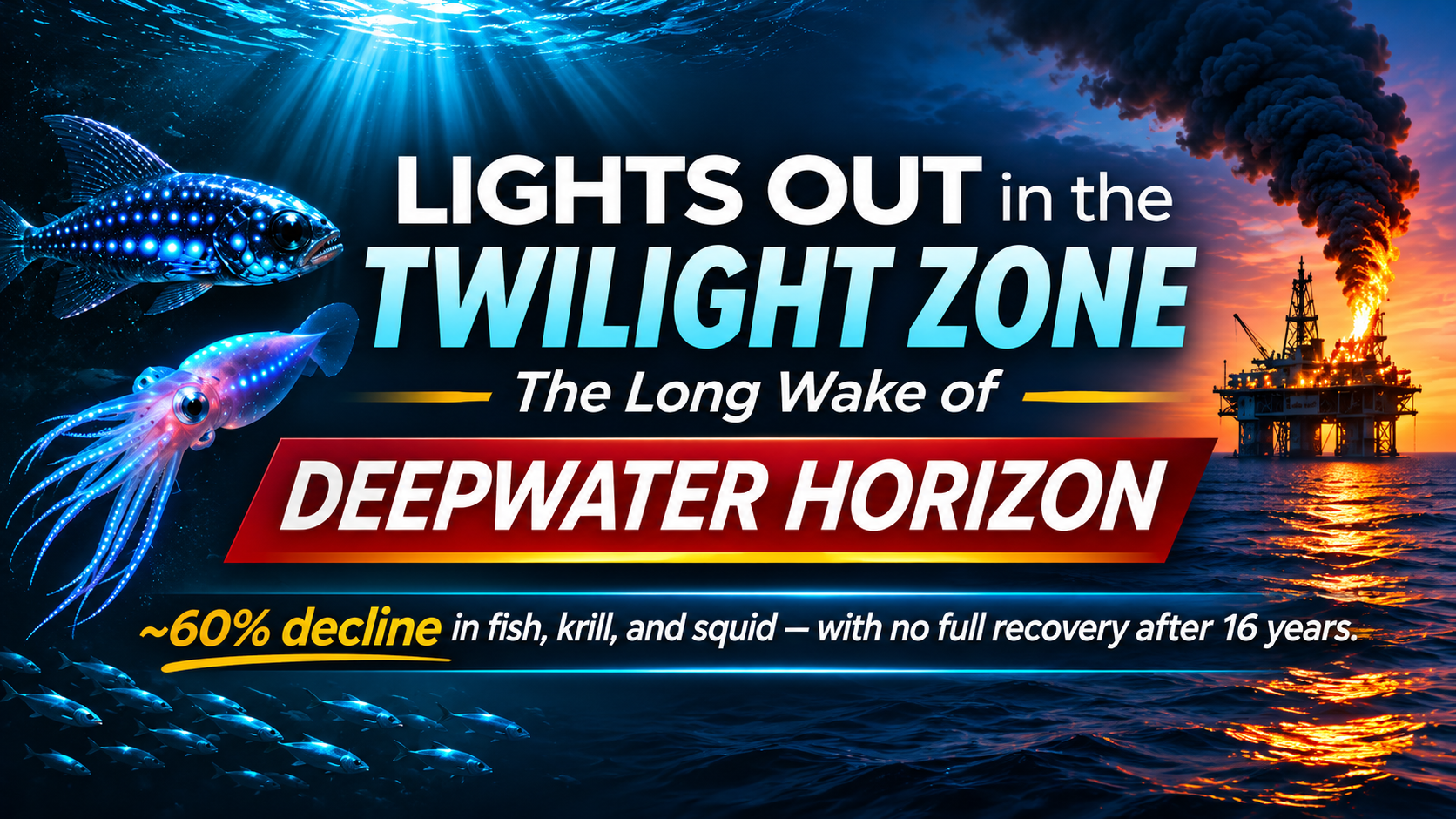
Sixteen years after the Deepwater Horizon blowout, a new study finds that the fish, krill, and squid of the Gulf of Mexico’s dim middle waters fell by roughly 60 percent — and have not come back.
November 1, 2026 · By Charles F. Herd
On August 15, 1934, off Nonsuch Island, Bermuda, the naturalist William Beebe and the engineer Otis Barton were lowered on a steel cable inside a hollow ball barely five feet across. They stopped at 3,028 feet — deeper than any human being had ever gone.
In Half Mile Down, the book that followed, Beebe described a blue light so strange he struggled to describe it, and alien fish that carried their own lamps through the gloom. He was among the first people to see the ocean’s twilight zone with his own eyes.
Ninety-two years later, scientists report that in the Gulf of Mexico, a great deal of that world sadly has gone biologically dark.
The new study, published October 19 in the Proceedings of the National Academy of Sciences (PNAS), was led by biological oceanographer Tracey Sutton of Nova Southeastern University and the Deep-Pelagic Nekton Dynamics of the Gulf (DEEPEND) consortium. Its finding was stark: animal life in the Gulf’s deep waters fell by about 60 percent after the 2010 Deepwater Horizon disaster. It has not come back.
Counting What Was Lost
Right after the spill, in 2011, researchers surveyed the Gulf from the surface down to about 5,000 feet (1,500 meters), using nets at six different depths and sonar. Three and a half years later, they went back to the same waters with the same gear. They found only a quarter to a third as much life. Between 2011 and 2015:
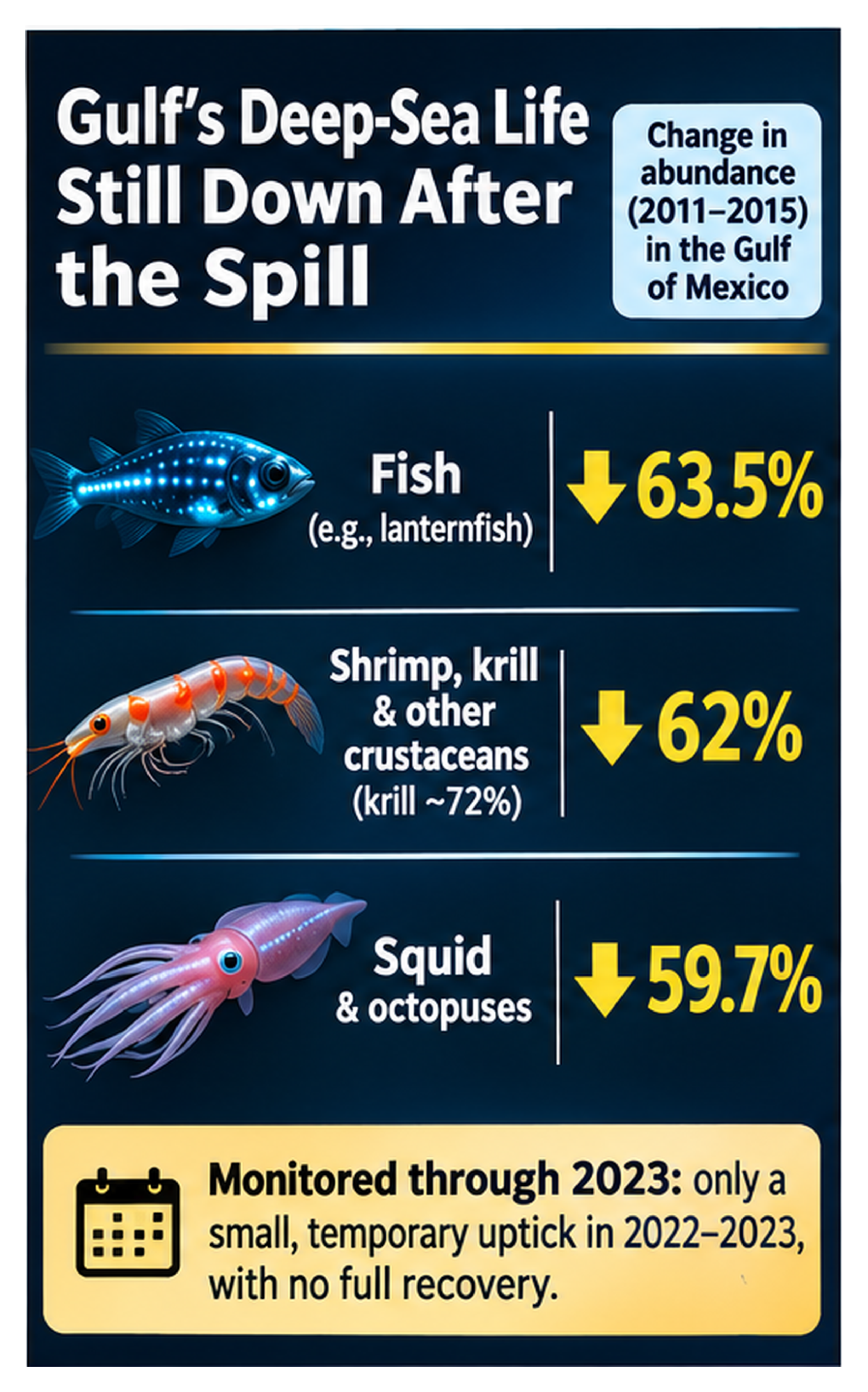
- Fish fell 63.5 percent. Lanternfish, the small glowing fish Beebe watched from his window, dropped to about a third of their old numbers.
- Shrimp, krill, and other crustaceans fell 62 percent, with krill alone down about 72 percent.
- Squid and octopuses fell 59.7 percent.
The researchers kept sampling through 2023. A small bump in 2022 and 2023 proved neither meaningful nor lasting.
They checked their work three ways: what came up in the nets, what the sonar picked up, and genetic tests showing the survivors losing diversity through inbreeding. Sutton told the Associated Press (AP) these are “foundational species.” In other words, they are what nearly everything else in the Gulf eats.
Out of Sight, Not Out of the Food Chain
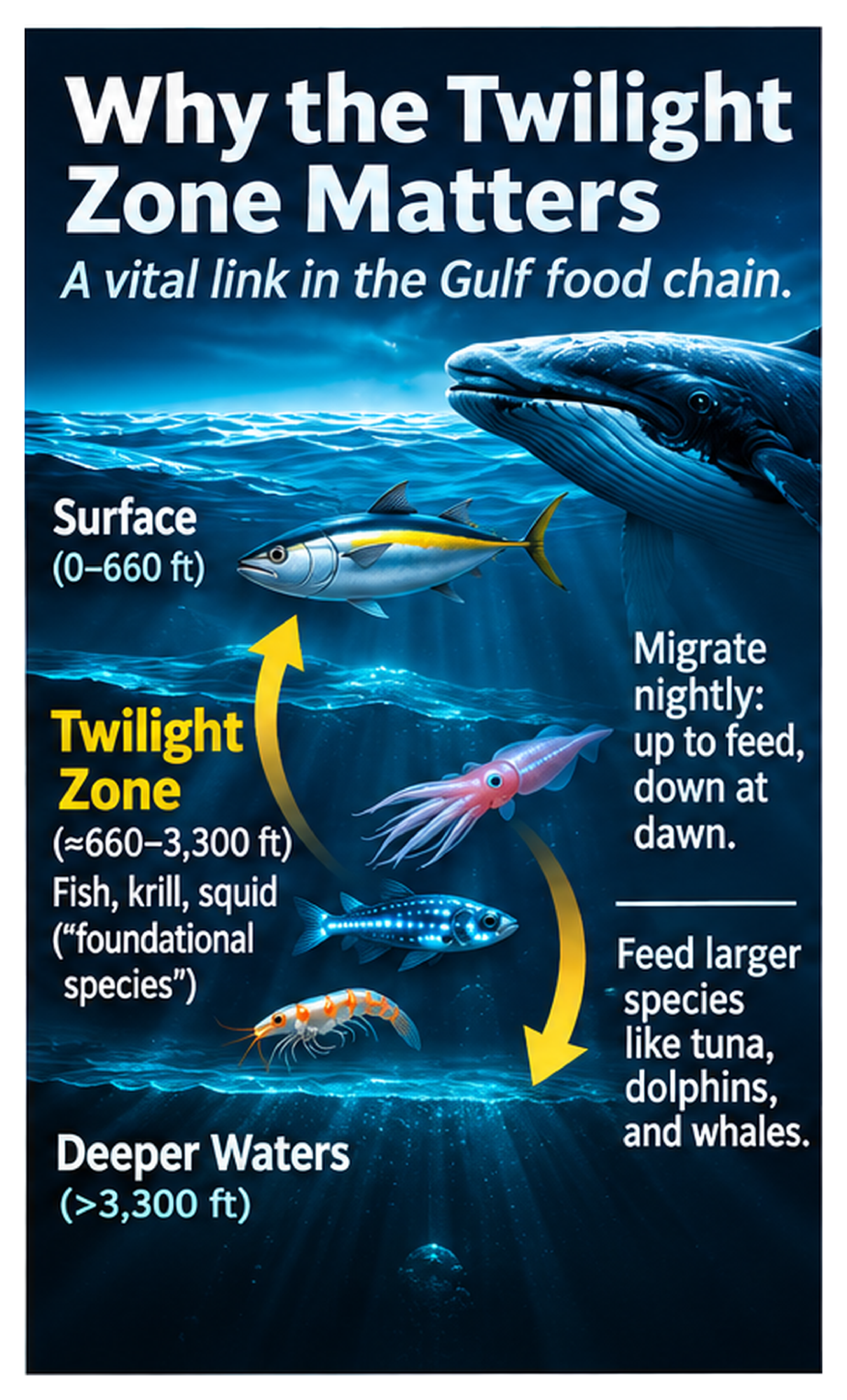
Think of the twilight zone as the ocean’s dim middle floor: too deep for sunlight, yet far above the seabed. Every night its residents swim up toward the surface to feed, and every dawn they sink back down. Whales, dolphins, and prized fish like tuna feed on that nightly traffic.
Sutton describes the Gulf as one big, pulsing system rather than a stack of separate layers. Damage in the middle spreads in both directions.
Animals higher up the food chain tell a similar story. In 2024, Scripps Institution of Oceanography scientist Kaitlin Frasier and her colleagues published ten years of underwater recordings from the northeastern Gulf. After the spill, beaked whales there declined by as much as 83 percent, and sperm whales by as much as 31 percent.
The cleanup may have made some conditions worse. Study co-author Isabel Romero, a chemical oceanographer at the University of South Carolina, explained that the oil itself was the bigger poison. However, the chemical dispersants sprayed to break it up turned it into tiny droplets which reached more of the animals living in deeper water.
Rita Colwell, the former National Science Foundation director who led BP’s ten-year, $500 million research program, suggests a different approach next time: skip the dispersants and help the ocean’s own oil-eating microbes do the work.
Science and the Courtroom Ask the Same Question
The scientists are careful not to overclaim. Sutton acknowledges his team cannot prove the spill caused the decline. Instead, they tested every natural explanation they could think of: water temperature, oxygen, and food supply. None of them matched the collapse. Only one event did — the spill.
That is very nearly how an injured person proves a toxic-exposure case in court. First, show that a substance can cause a particular harm. Then show that it did cause it here, usually with an expert who rules out the other likely causes.
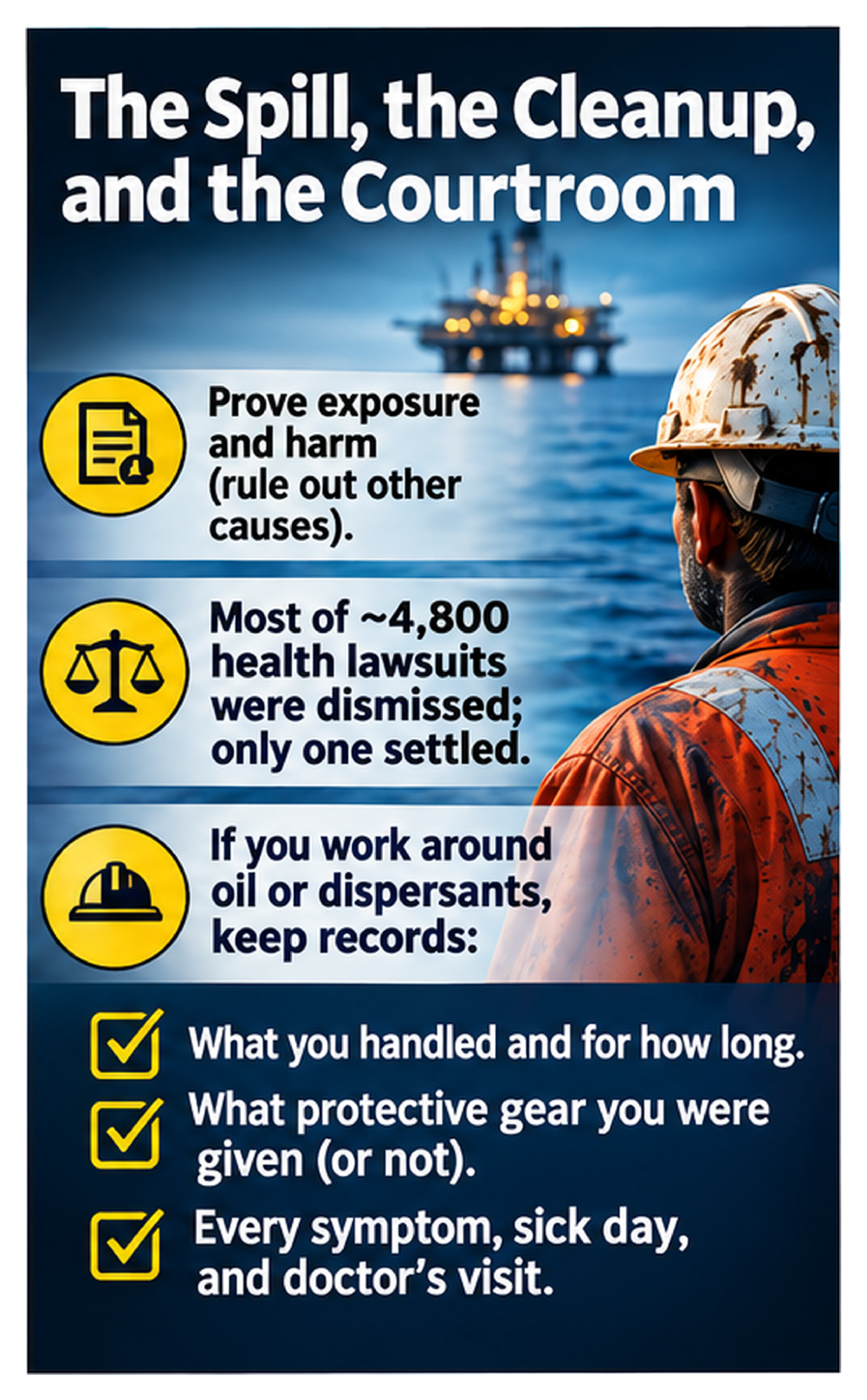
For the people who cleaned up after Deepwater Horizon, that burden has been crushing. The AP found that all but a handful of roughly 4,800 health lawsuits brought by cleanup workers and coastal residents were dismissed, and only one settled. Under a 2012 medical settlement, most claimants received $1,300 or less.
If you work around oil, chemicals, or dispersants, the lesson is simple: write it down. Keep a record of:
- What you handled, and for how long;
- What protective gear you were given — or weren’t; and
- Every symptom, sick day, and doctor’s visit that follows.
Notes made at the time are worth far more than memories pieced together years later, after an illness finally shows itself.
A Settlement That Left the Door Open
BP’s settlement with the government planned for surprises like this one. Under the 2016 consent decree resolving the federal and state claims, BP agreed to pay a $5.5 billion civil penalty under the Clean Water Act and $8.1 billion for damage to natural resources. It also agreed to pay up to $700 million more for harm that was unknown at the time but might surface later.
That money flows from the Oil Pollution Act of 1990 (OPA). Under OPA, whoever is responsible for a spill pays for the cleanup and for a range of damages, including harm to natural resources and lost income for people whose livelihoods depend on them.
A collapse deep in the food web that nobody had measured in 2016 looks a lot like the kind of “unknown condition” that reserve was meant to cover. Whether the federal and state trustees act on it is their call. But the science is now on their desks.
We looked at what scientists still did not know about the deep Gulf in The Deepwater Horizon Spill: 13 Years Later. This study fills in one of the gaps we flagged then.
Why This Reaches the Gulf Coast
The Gulf is getting busier, not quieter. Congress has ordered thirty offshore lease sales there under the 2025 reconciliation law. The third, held in August, drew $82.7 million in high bids, as we covered in U.S. Gulf Lease Sales: The “Blocks” on the Auction Block.
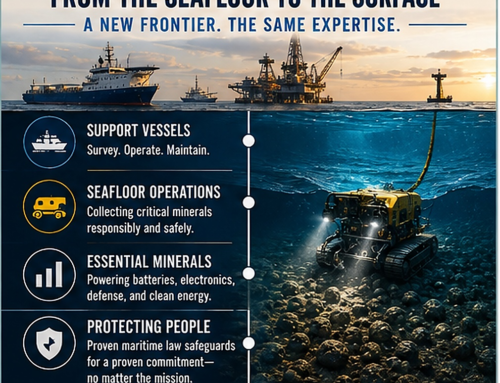
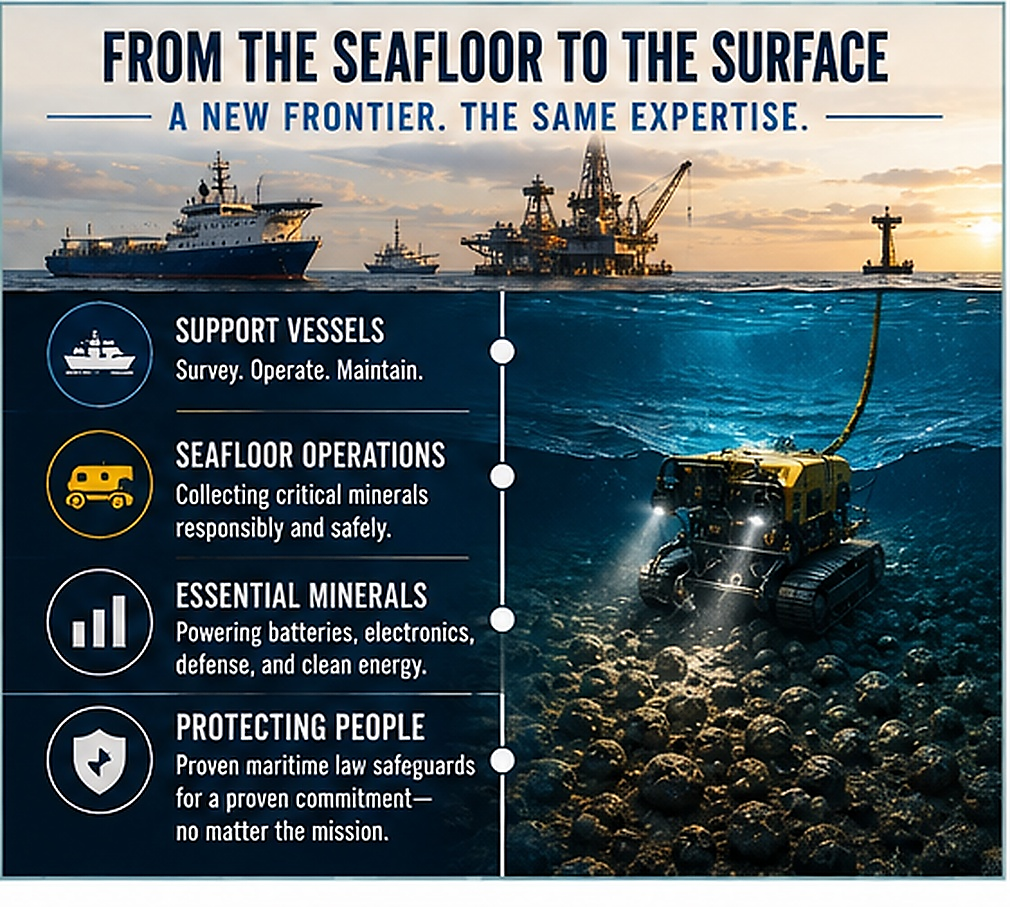
Outside experts, including Dalhousie University’s Boris Worm, say this study should weigh on decisions about deeper drilling and seabed mining — the new frontier we explored in Pacific Deep-Sea Mining and the Next Offshore Frontier.
More work in deeper water means more people in harm’s way. The eleven men killed aboard the mobile offshore drilling unit (MODU) Deepwater Horizon are a lasting reminder of that. If you are hurt offshore, your rights depend on who you are and where you work:
- Crews aboard vessels, including drillships, rigs that count as vessels, supply boats, and fishing and shrimping boats, may be Jones Act seamen. They can sue for negligence, are owed a seaworthy vessel, and are entitled to maintenance and cure when hurt or made ill on the job.
- Workers on fixed platforms are generally covered by the Outer Continental Shelf Lands Act (OCSLA), which uses the benefits system of the Longshore and Harbor Workers’ Compensation Act (LHWCA).
- Response and cleanup crews, whether sent after a spill or, as we wrote in “The Golden Tide,” after a record sargassum bloom, have rights too. Which law applies depends on the vessel, the employer, and the work.
For fishing families on the Texas and Louisiana coasts, a thinner food web far offshore is not an abstraction. It feeds the fish they catch.
Beebe went half a mile down to see what the dark was hiding. Sixteen years on, the Gulf’s twilight zone has shown us how long a single blowout can leave its mark there. The scientists kept looking — and for the people who work these waters, the law should too.
Maritime Trivia Question!
Q: Beebe titled his 1931 National Geographic account of an early bathysphere dive “A Round Trip to Davy Jones’s Locker.” Where does sailors’ oldest name for the bottom of the sea come from?
A: Nobody knows for certain. Davy Jones’ Locker means the seabed, the resting place of drowned sailors and everything lost overboard. The phrase appears in print as early as 1726, and in 1751 Tobias Smollett’s novel The Adventures of Peregrine Pickle described Davy Jones as the fiend who rules the evil spirits of the deep. Theories about the name range from the biblical Jonah to a Welsh patron saint to a real-life tavern keeper or pirate, but none is proven. A sailor’s “locker” was simply his sea chest — so to go to Davy Jones’ Locker was to be put away for keeps.
We at the Herd Law Firm are proud to fight for seamen, maritime workers, and passengers in all types of personal injury, death, and maritime commercial claims. As maritime attorneys (and sailors ourselves!) located in northwest Houston, we never waver in our commitment to help maritime workers, businesses, and their families when they are injured, mistreated, or shortchanged.
The information in this post is for general informational purposes only and does not constitute legal advice. For questions specific to your maritime law issue, please contact us at 713-955-3699 or at Charles.Herd@HerdLawFirm.com.
Sources
- Borenstein, Seth. “Marine Life Dramatically Declined in Gulf of Mexico in Years After BP Oil Spill, Study Finds.” Associated Press (via PBS News), October 20, 2026. https://www.pbs.org/newshour/science/marine-life-dramatically-declined-in-gulf-of-mexico-in-years-after-bp-oil-spill-study-finds
- Sutton, Tracey T., et al. “Immense but Not Immutable: A Sudden and Sustained Decline in Deep-Pelagic Life in a Large Oceanic Ecosystem.” Proceedings of the National Academy of Sciences, October 19, 2026. https://doi.org/10.1073/pnas.2616554123
- “Deepwater Species in the Gulf of Mexico Declined Drastically After Deepwater Horizon Oil Spill.” SeafoodSource, October 2026. https://www.seafoodsource.com/news/deep-water-species-in-the-gulf-of-mexico-declined-drastically-after-deepwater-horizon-oil-spill
- “NSU Researcher Leads Deep Gulf Study Featured by The Associated Press.” Nova Southeastern University, October 2026. https://news.nova.edu/in-the-news/nsu-researcher-leads-deep-gulf-study-featured-by-the-associated-press/
- Frasier, Kaitlin E., et al. “A Decade of Declines in Toothed Whale Densities Following the Deepwater Horizon Oil Spill.” Communications Earth & Environment 5 (2024). https://doi.org/10.1038/s43247-024-01920-8
- Brook, Jack. “15 Years After Deepwater Horizon Oil Spill, Lawsuits and Coastal Restoration Have Stalled.” Associated Press (via PBS News), April 20, 2025. https://www.pbs.org/newshour/nation/15-years-after-deepwater-horizon-oil-spill-lawsuits-and-coastal-restoration-have-stalled
- U.S. Department of Justice. “Fact Sheet: Proposed Consent Decree with BP for the Deepwater Horizon/Macondo Well Oil Spill.” https://www.justice.gov/enrd/file/780311/download
- NOAA Office of Response and Restoration. “Agreement in Principle with BP to Settle Civil Claims for the Deepwater Horizon Oil Spill.” https://response.restoration.noaa.gov/node/1506
- Legal Information Institute, Cornell Law School. “33 U.S. Code § 2702 – Elements of Liability” (Oil Pollution Act of 1990). https://www.law.cornell.edu/uscode/text/33/2702
- “BBG3 Oil and Gas Lease Sale Attracts $82.7M in High Bids.” Marine Log, August 2026. https://marinelog.com/offshore/oil-gas/bbg3-oil-and-gas-lease-sale-attracts-82-7m-in-high-bids
- Poffenberger, Leah. “August 15, 1934: World-Record Dive in the Bathysphere by Barton and Beebe.” APS News, August 2018. https://www.aps.org/apsnews/2018/08/dive-bathysphere-barton-beebe
- “A Half Mile Down: The Bathysphere Expedition of 1934.” National Geographic Society Library. https://nglibrary.ngs.org/public_home/filmpreservationblog/A-Half-Mile-Down-The-Bathysphere-Expedition-of-1934
- Quinion, Michael. “Davy Jones’ Locker.” World Wide Words. https://worldwidewords.org/qa-dav1.html
- Wilton, Dave. “Davy Jones’s Locker.” Wordorigins.org. https://wordorigins.org/big-list-entries/davy-joness-locker
- Herd Law Firm, PLLC. “The Deepwater Horizon Spill: 13 Years Later.” https://herdlawfirm.com/firm-update/the-deepwater-horizon-spill-13-years-later/
- Herd Law Firm, PLLC. “U.S. Gulf Lease Sales: The ‘Blocks’ on the Auction Block.” https://herdlawfirm.com/firm-update/u-s-gulf-lease-sales-the-blocks-on-the-auction-block/
- Herd Law Firm, PLLC. “Pacific Deep-Sea Mining and the Next Offshore Frontier.” https://herdlawfirm.com/firm-update/pacific-deep-sea-mining-and-the-next-offshore-frontier/
- Herd Law Firm, PLLC. “Who Is a Jones Act Seaman?” https://herdlawfirm.com/firm-update/who-is-a-jones-act-seaman/
- Herd Law Firm, PLLC. “The LHWCA: What You Need to Know.” https://herdlawfirm.com/firm-update/the-lhwca-what-you-need-to-know/
- Herd Law Firm, PLLC. “An Ancient Promise at Sea: How Maintenance and Cure Crossed a Thousand Years and Every Ocean.” https://herdlawfirm.com/firm-update/an-ancient-promise-at-sea-how-maintenance-and-cure-crossed-a-thousand-years-and-every-ocean/
- Herd Law Firm, PLLC. “‘The Golden Tide’: A Record Sargassum Bloom, the Fleets Sent to Fight It, and the Law That Rides With Its Crews.” https://herdlawfirm.com/firm-update/the-golden-tide-a-record-sargassum-bloom-the-fleets-sent-to-fight-it-and-the-law-that-rides-with-its-crews/

Leave A Comment