
Another in our series on the legal “lines in the water”. When a navy forced an innocent tanker into port from waters belonging to neither of them, an international court answered with its largest damages award ever, and a reminder that on the open sea a ship answers to her flag alone.
When starting series on how we define freedom and boundaries when on the water, we invoked a centuries-old idea: that the open sea belongs to no one, and therefore to everyone. The principle is easy to admire in theory and hard to defend in practice — until a court puts a price on breaking it.
The $14 Million Reminder
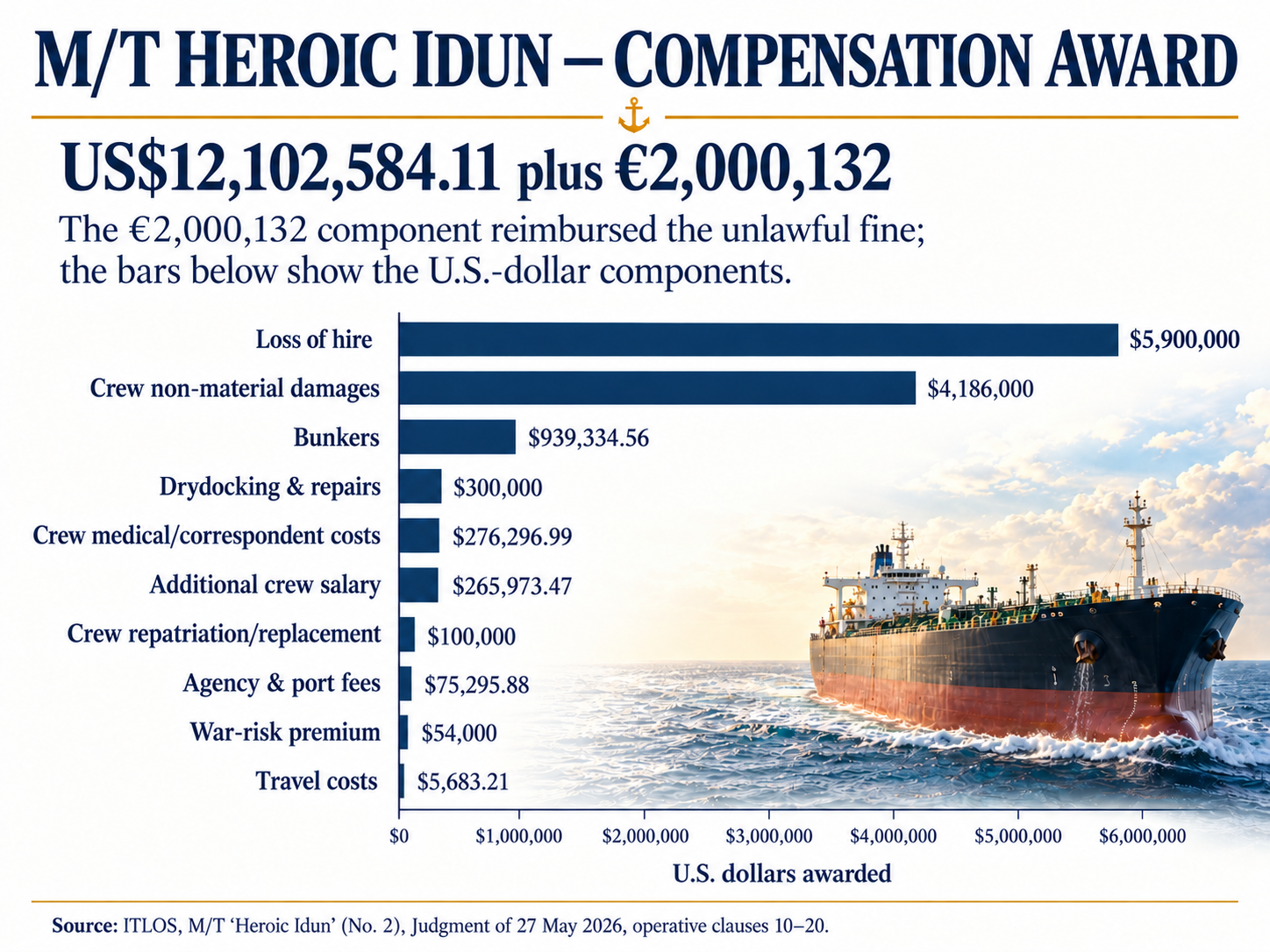
On May 27, 2026, a Special Chamber of the International Tribunal for the Law of the Sea (ITLOS) — the United Nations court for disputes under the Law of the Sea treaty — found that the Republic of Equatorial Guinea had unlawfully seized a Marshall Islands–flagged tanker and detained her crew. It ordered Equatorial Guinea to pay the Republic of the Marshall Islands more than US$14 million, plus interest: roughly $12.1 million in damages, together with a refund of the €2 million fine the shipowners had been forced to pay. The Chamber was unanimous that Equatorial Guinea broke the law of the sea; the damages carried by a 4–1 vote. It is the largest award in the tribunal’s history, and it rests on the same principle that opened this series — freedom of navigation.
What Happened to the M/T Heroic Idun
In August 2022, the M/T Heroic Idun (“M/T” for “motor tanker”) — a very large crude carrier (VLCC) flying the Marshall Islands flag — arrived at Nigeria’s Akpo Offshore Terminal to load crude oil. When the loading paperwork was not in order, her master moved the vessel to a waiting position offshore. From there, events went downhill:
- The darkened approach. In the early hours of August 8, a small craft closed in on the M/T Heroic Idun with its automatic identification system (AIS) — the transponder that broadcasts a ship’s identity — switched off. In the pirate-plagued Gulf of Guinea, a boat running dark is a dangerous warning sign, so the master declined its orders and stood farther out, drifting into the exclusive economic zone (EEZ) of neighboring São Tomé and Príncipe.
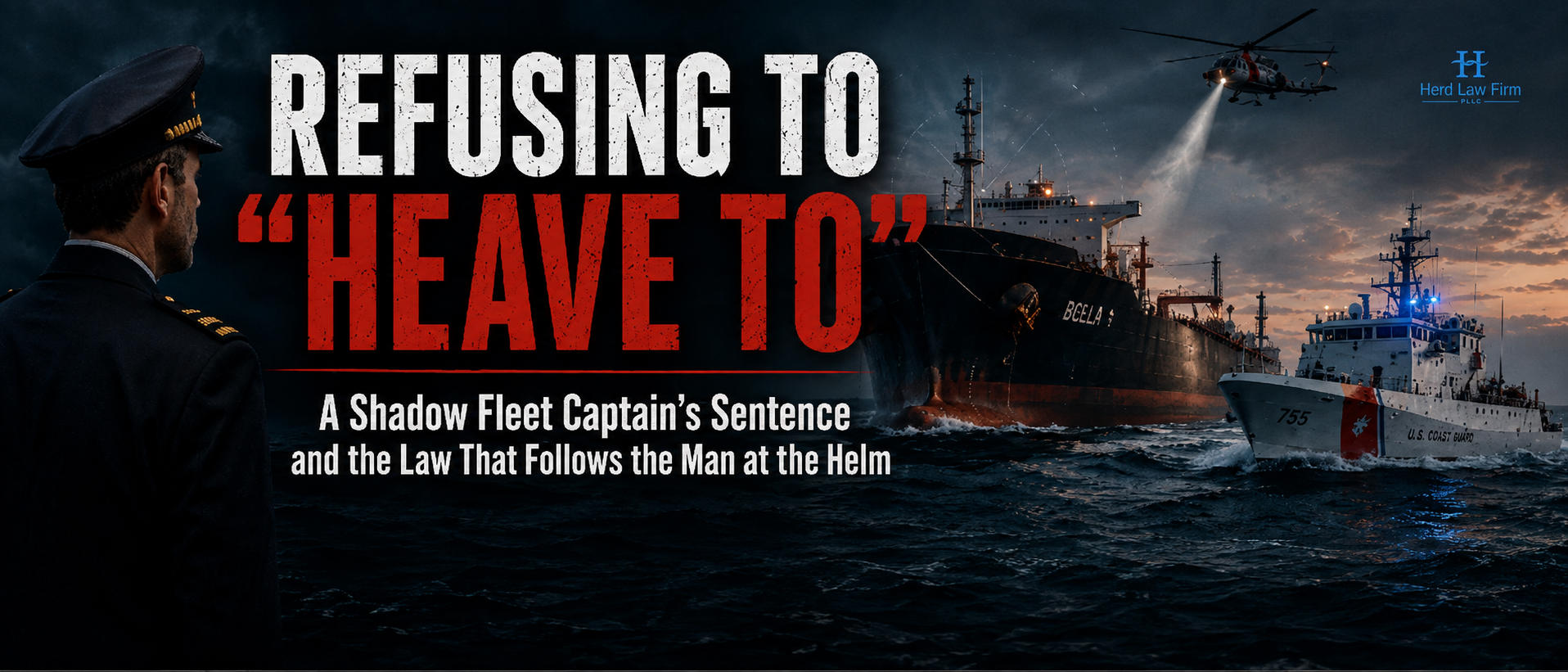
- Suspected “pirates” were actually the Nigerian navy. The craft turned out to be the Nigerian patrol vessel NNS Gongola (“NNS” for “Nigerian Navy Ship”). When the M/T Heroic Idun refused the orders, Nigeria then asked Equatorial Guinea authorities to track, arrest, and hand over the tanker, accusing the M/T Heroic Idun of raising a false piracy alarm.
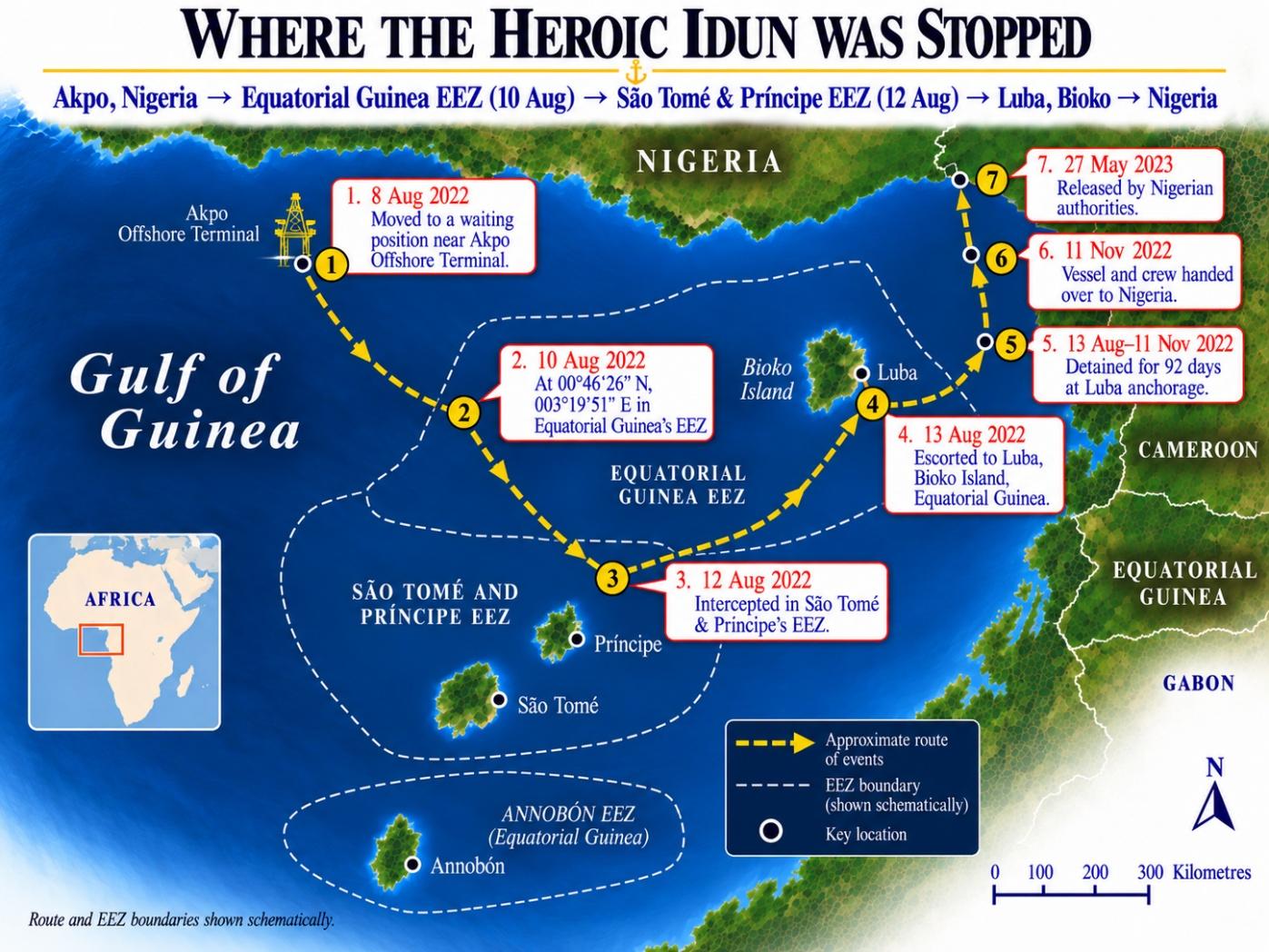
- Seizure in a third country’s waters. On August 12, the Equatoguinean naval vessel Capitán David finally intercepted the M/T Heroic Idun — but not in Equatorial Guinea’s waters. Capitán David intercepted the M/T Heroic Idun instead in São Tomé and Príncipe’s EEZ, announced they had “orders to shoot,” and forced the Idun to dock at Luba, on Bioko Island.
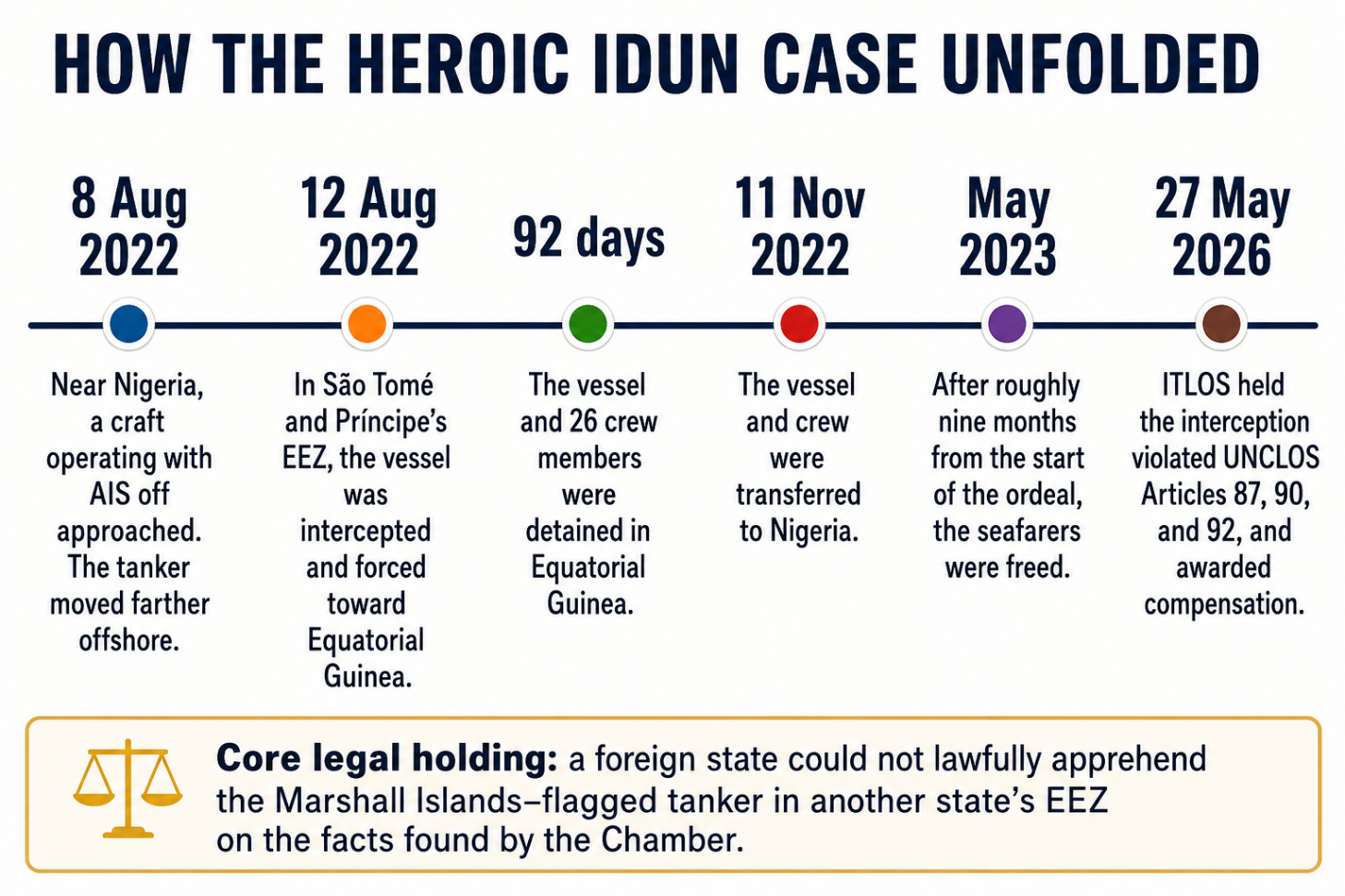
- Nine months in limbo. The ship and her 26-person crew, mostly Indian and Sri Lankan nationals, were detained in Equatorial Guinea for 92 days, and the master was fined more than €2 million, which the owners paid. However, even this payment bought no freedom: on November 11, 2022, ship and crew were then handed over to Nigeria authorities, which released them only after a plea deal on May 27, 2023 — nearly 10 months after the ordeal began, and three years to the day before the final judgment.
A Ship Answers to Her Flag
Under the United Nations Convention on the Law of the Sea (UNCLOS) — the 1982 treaty the majority of the seafaring world (and even by non-parties like the United States) would treat as the governing legal authority — a vessel on the high seas or in an EEZ falls under the exclusive jurisdiction of her flag state. Read together, Articles 87, 90, and 92 mean that a foreign navy cannot simply chase down, threaten, and divert a ship flying another nation’s flag.
Failure to observe this, the U.N. Chamber held, is a breach of international “freedom of navigation” — and that costs a nation both politically and economically. Equatorial Guinea imposed their own jurisdiction for entering its EEZ without permission and failing to display a physical flag; however, an EEZ is not territorial sea, so their jurisdiction did not apply and should not have been enforced.
“Fighting Piracy” — Not a Blank Check
Equatorial Guinea used regional anti-piracy cooperation to justify the seizure. The Chamber disagreed in terms coastal states should note: Article 100 of UNCLOS, the “duty to cooperate in repressing piracy”, “does not provide an autonomous (automatic) basis for the apprehension” of a foreign vessel — and here, the evidence did not support a real suspicion of piracy regardless. Cooperation against piracy is a duty, not a master key that opens any ship a navy finds suspicious. We have written before about how far a nation may reach when it expands its claims over navigation; this ruling marks one of the outer walls.
The Crew Is Not Collateral
Perhaps the most human part of the judgment is its accounting for the crew. International law has long treated a ship, everyone aboard, and every interest in her as a single unit under the flag state’s protection, and the Chamber put that idea into numbers: nearly $4.2 million for what the 26 seafarers endured — $1,750 per person for each of their 92 days in Equatorial Guinea’s custody — on top of their medical costs, extra wages, and repatriation. It also held that a country cannot drag foreign sailors into its territory through its own illegal act and then insist they exhaust its local courts first. That the law’s protection reaches the people on deck, not just the steel they stand on, is a theme close to our work; it runs through our writing on the Jones Act and seafarer rights and on the concepts every mariner and passenger on the high seas should know.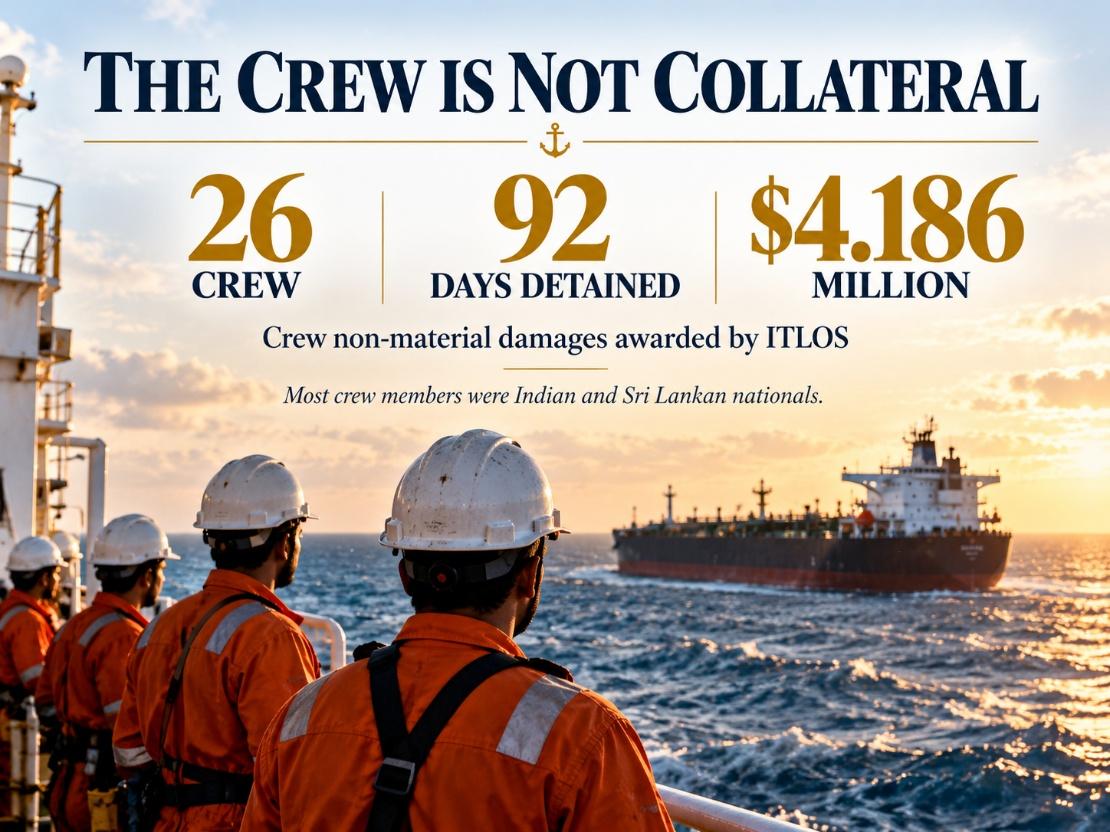
What Comes Next
Under Article 296 of UNCLOS, the judgment is final and binding on both nations. But ITLOS has no marshals and no fleet; payment rests on Equatorial Guinea honoring its treaty obligations, and on the diplomatic and reputational pressure that follows a unanimous finding of wrongdoing. As of this writing, we have seen no public announcement that the award has been paid. The tribunal, meanwhile, has entered its fourth decade: it marked its 30th anniversary on September 25, seated five new judges and elected a new president on October 1, and is already fielding fresh disputes — including a request filed today by Argentina against the United Kingdom over South Atlantic oil and gas.
Why It Reaches the Gulf Coast
A tanker off West Africa can feel a world away from a vessel off the U.S. Gulf Coast — but the principle is the same water. Freedom of navigation is what lets a vessel move without a foreign power stopping her on a pretext, and the right to pass peacefully is one we have followed closely in “The Right to Pass?”.
What the M/T Heroic Idun ruling adds is proof that the principle carries a price, and a steep one, for those who break it. For shipowners, charterers, flag states, and above all the crews aboard, the message is plain: when a vessel or her officers and crew are wrongfully stopped, the law offers a real road to recovery — and, in this case, a record one.
⚓ Maritime Trivia
Q: When we size someone up and judge them by “the cut of their jib,” what were sailors originally looking at?
A: The jib is the triangular headsail set forward of a ship’s foremast. Its particular shape — its “cut” — varied from nation to nation and yard to yard, so an experienced lookout could often guess a stranger’s home port, and sometimes her intentions, from that sail alone, long before her colors were clear. To like or distrust “the cut of his jib” was to form a first impression from the shape of things at a distance. A modern VLCC carries no jib, but the M/T Heroic Idun was judged the same old way — by a dark shape on the horizon and a navy’s suspicion — and the law had to remind everyone that suspicion is not the same as authority.
We at the Herd Law Firm are proud to fight for seamen, maritime workers, shippers, and passengers in all types of personal injury, death, and maritime commercial claims. As maritime attorneys (and sailors ourselves!) located in northwest Houston, we never waver in our commitment to help maritime workers, businesses, and their families when they are injured, mistreated, or shortchanged.
The information in this post is for general informational purposes only and does not constitute legal advice. For questions specific to your maritime law issue, please contact us at 713-955-3699, at Charles.Herd@HerdLawFirm.com, or at our office at 8826 Louetta Road, Suite 310, Spring, Texas 77379.
Sources
- International Tribunal for the Law of the Sea, Press Release 382, “The M/T ‘Heroic Idun’ (No. 2) Case (Marshall Islands/Equatorial Guinea),” May 27, 2026 — itlos.org.
- American Society of International Law (ASIL), “ITLOS Special Chamber Finds Equatorial Guinea Violated UNCLOS” — asil.org.
- Gard, “Heroic Idun: What we can learn from the landmark ITLOS ruling” — gard.no.
- Republic of the Marshall Islands Maritime Administrator statement (via AJOT), May 29, 2026 — ajot.com.
- Reed Smith, “Landmark ITLOS judgment in the M/T Heroic Idun (No. 2) Case” — reedsmith.com.
- United Nations Convention on the Law of the Sea (1982), arts. 56, 58, 87, 90, 92, 100–110, 296 — un.org.
- International Tribunal for the Law of the Sea, Press Release 388, statement of the President to the 36th Meeting of States Parties to UNCLOS, June 16, 2026 — itlos.org.
- International Tribunal for the Law of the Sea, “Latest News” (30th anniversary; election of President, October 1, 2026; Argentina v. United Kingdom request for provisional measures, October 13, 2026) — itlos.org.




Leave A Comment