
Since late August, Meta has agreed to pay the states roughly $17 billion, meanwhile Texas has secured more than $1 billion of its own, and Mark Zuckerberg has been ordered back to a Los Angeles witness stand. Here is where the fight over “addictive-by-design” platforms stands — and why the question at its center, whether a company warned of dangers it knew about, has only grown louder.
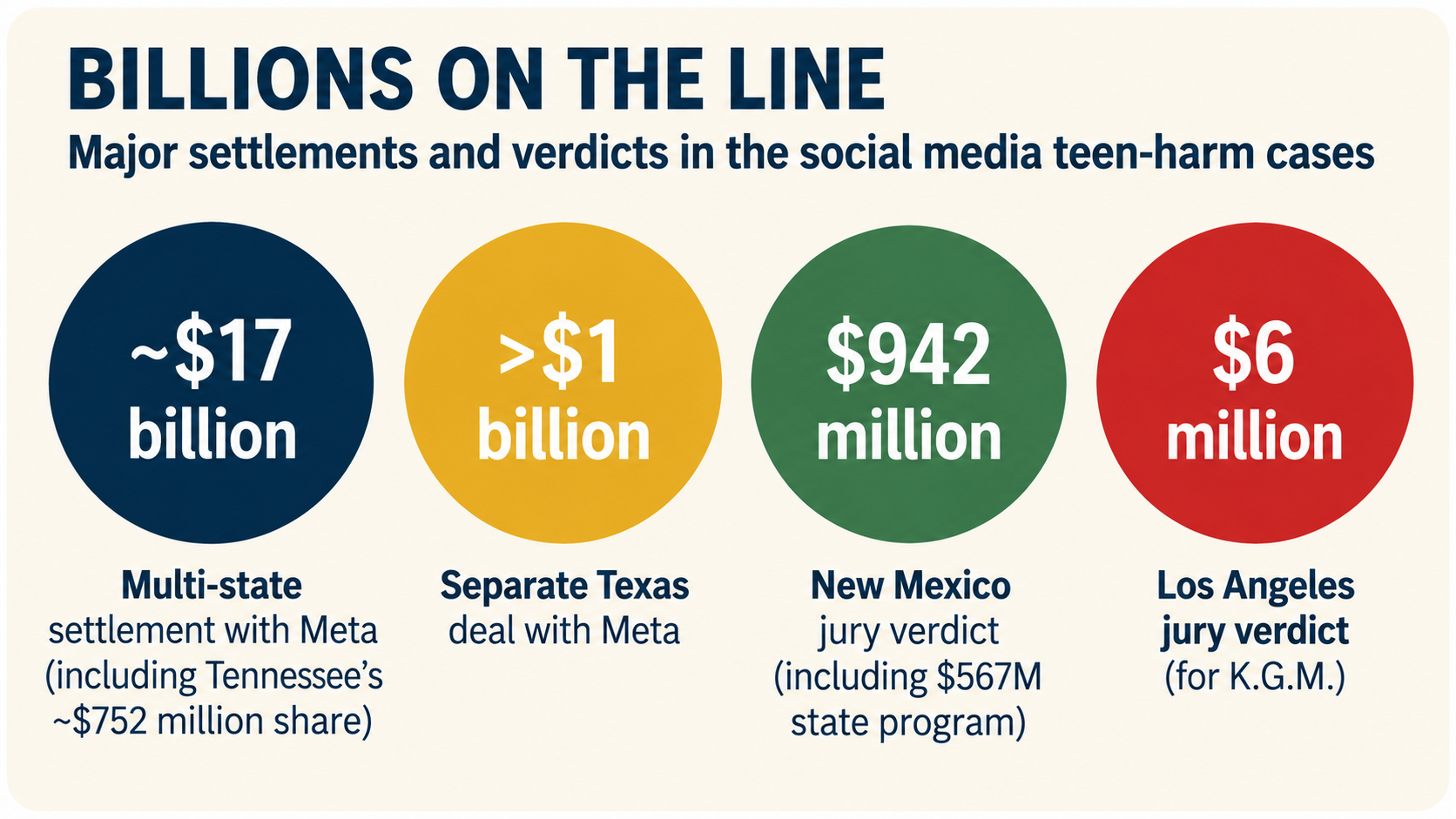
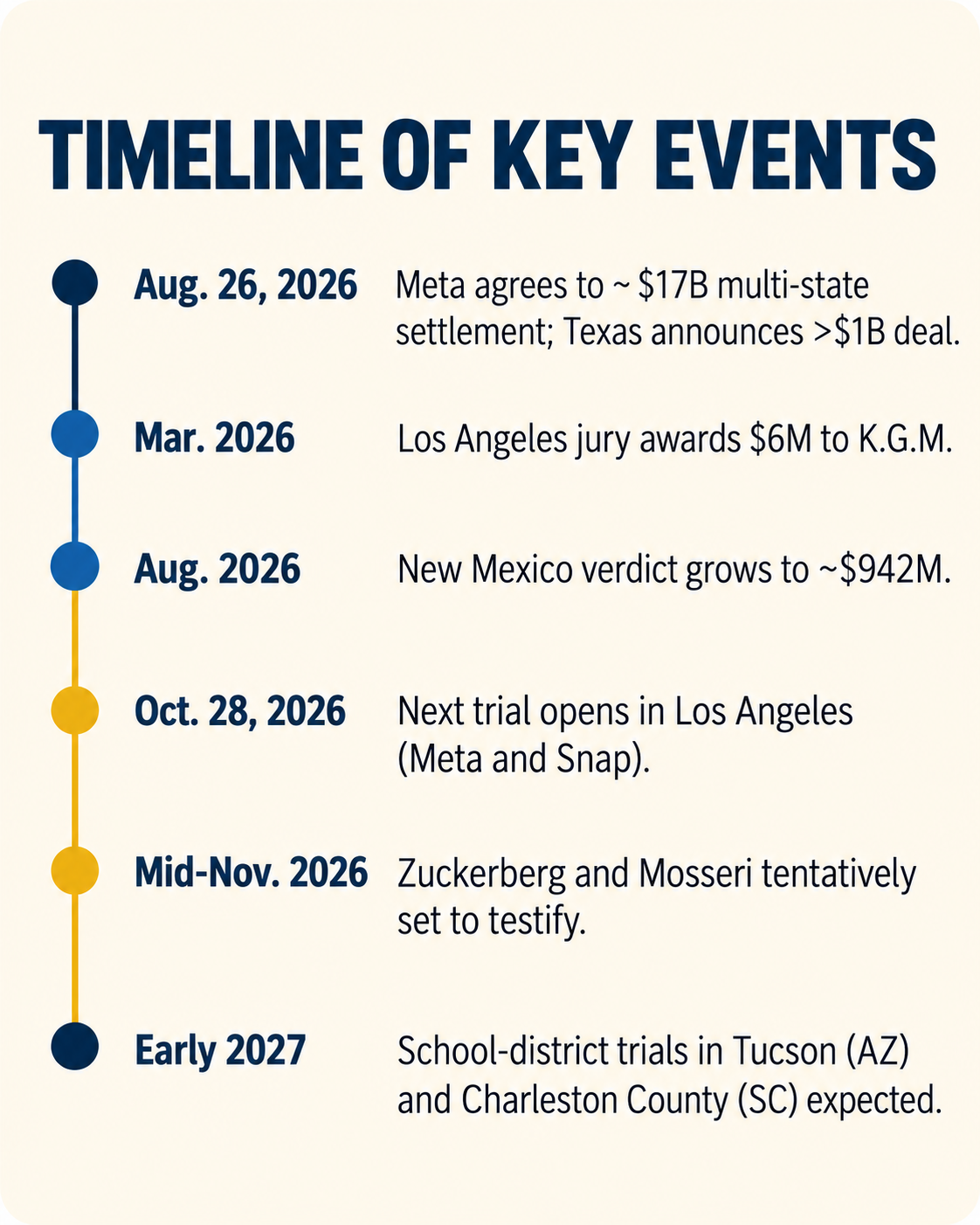
On August 26, a Nashville jury that had spent more than a month hearing Tennessee’s case against Meta went home without ever deciding it. That day, Meta agreed to a settlement with a coalition of state attorneys general (AGs) reported at up to roughly $17 billion, and Tennessee signed on for a share of about $752 million. Texas Attorney General Ken Paxton announced a separate Texas deal, worth more than $1 billion, the same day.
None of this ends the litigation. Settlement money goes to the states, not to individual families, and thousands of personal-injury and school-district claims are still moving toward trial. The next one opens in Los Angeles on October 28.
We first wrote about these lawsuits in The Battle for Accountability in 2024, when they were little more than complaints and pretrial motions. Two years on, the companies have paid out billions and lost the first verdicts to come in. Here is where each front stands.
Where the Cases Stand
- The states’ case against Meta — settled. The deal ended both the Tennessee trial and a multistate trial already under way in federal court in Oakland, California. Reported totals run from about $16.7 billion to $18 billion, depending on how future and contingent payments are counted. Meta also agreed to change how Instagram and Facebook work for teens (more below).
- Texas — a separate deal of more than $1 billion. The Texas settlement requires stronger age checks, a two-hour daily limit for teen users, notifications switched off by default during school hours, hidden “likes,” and a nighttime mode. The state says the money will fund youth mental-health services, crisis resources, and grants for Texas schools.
- Verdicts already on the books. In March, a Los Angeles jury awarded a young woman identified as K.G.M. $6 million — half of it as punitive damages — against Meta and Google’s YouTube, the first verdict in the personal-injury cases. In New Mexico, a $375 million jury verdict against Meta grew to about $942 million in August, when a judge ordered Meta to fund a $567 million program to address harm to the state’s young people.
- Los Angeles — the next trial, October 28. All three teens chosen as test, or “bellwether,” cases settled with TikTok in early August; one then dropped her claims entirely, and then YouTube settled with the other two in late September. That leaves Meta and Snap to face a jury before Judge Carolyn B. Kuhl of the Los Angeles County Superior Court. Judge Kuhl has refused to block testimony from Mr. Zuckerberg and Instagram head Adam Mosseri, who are tentatively set to take the stand in mid-November.
- Federal court — school districts next. In the federal multidistrict litigation (MDL) in Oakland, captioned In re Social Media Adolescent Addiction/Personal Injury Products Liability Litigation, the first test case — brought by Kentucky’s Breathitt County Schools — settled with all four companies before its June trial. Trials for the Tucson Unified (Arizona) and Charleston County (South Carolina) school districts are expected in early 2027.
Designed to Hold On, Now Redesigned
At bottom, these lawsuits never claimed merely that harmful content exists online. They claim the products were engineered to be hard to put down, and that the companies knew it. Meta’s settlement with the states now answers several of those features directly:
- endless scroll and autoplay, which removed every natural stopping point — now met with a two-hour daily limit for teens across Instagram and Facebook, with required breaks along the way;
- late-night use — now met with an overnight lockout from midnight to 6 a.m.;
- push notifications engineered to pull a user back in — now quieted during school hours; and
- public “like” counts and beauty filters that feed comparison — now limited for young users.
Some of those limits grow stricter, and last longer, if Snapchat, TikTok, and YouTube adopt comparable protections — an open invitation to the rest of the industry.

The Biggest Question in Product Liability
Strip away the dollar figures and this remains a product-liability story, built on a duty the law has recognized for generations: a company that profits from a product owes the people who use it a warning about hazards it knows of and they cannot see.
A settlement is not a verdict, and none of these deals is a finding that the companies did what the plaintiffs allege. Still, a two-hour limit, an overnight lockout, and a quiet phone during the school day look a great deal like the safeguards plaintiffs say should have been there from the start.
We press the same theory in our firefighting-foam work — the AFFF (aqueous film-forming foam) litigation — where manufacturers stand accused of knowing that PFAS (per- and polyfluoroalkyl substances) were dangerous, yet staying silent.
Defenses remain. The companies argue that their feeds are editorial judgments protected by the First Amendment, and that Section 230 of the Communications Decency Act (CDA) shields them from liability for what users post. Courts have allowed design-based claims to proceed while dismissing claims that merely repackage third-party content; that line will be tested again in Los Angeles this month.
Why This Reaches Texas Families
Texas now has its own settlement with Meta, and its protections will reach phones across the state. That money, however, flows to the state for programs and schools; it does not compensate any individual child or family. Families whose children were harmed keep their own claims — and those claims run on their own clock.
Under Texas law, a personal-injury suit generally must be filed within two years, but for a child, that period usually does not begin to run until the child turns 18 (Tex. Civ. Prac. & Rem. Code §§ 16.001, 16.003). A parent’s own claims, such as for medical bills, may run on a shorter schedule.
If your family has been affected, keep records: when use began, which apps were involved, what changed, and what treatment followed. And do not assume a product is beyond accountability simply because the company behind it has attorneys, too.
As this subject touches self-harm: if you or a young person you love is struggling, the 988 Suicide & Crisis Lifeline (call or text 988) is available around the clock.
We at the Herd Law Firm, PLLC, are mindful of the minds and well-being of the young people who most deserve our protection. As personal-injury trial attorneys (and parents) in northwest Houston, we fight for victims in all types of personal injury and death claims, and we never waver in our commitment to help injured people and their families secure the answers and compensation they deserve.
The information in this post is for general informational purposes only and does not constitute legal advice. For questions specific to your legal issue, please contact us at 713-955-3699 or at Charles.Herd@HerdLawFirm.com.
Sources
1. Klibanoff, Eleanor. “Meta to Pay Texas $1 Billion in Child Safety Case.” The Texas Tribune (via Insurance Journal), Aug. 26, 2026. insurancejournal.com
2. “Tennessee to Receive More Than $750M in $17B Meta Settlement Over Teen Social Media Addiction.” WSMV, Aug. 26, 2026. wsmv.com
3. “Meta Reaches $16.68 Billion Settlement Over Social Media Harms to Children.” Reuters (via U.S. News & World Report), Aug. 26, 2026. usnews.com
4. “New Mexico Judge Orders Meta to Pay $567M for Youth Harm Abatement Fund.” Source NM, Aug. 6, 2026. sourcenm.com
5. “Meta, YouTube Must Pay $6M in Calif. Damages Over Youth’s Mental Health.” MLex, March 2026. mlex.com
6. Knauth, Dietrich. “TikTok Settling Three Teen Social Media Lawsuits Ahead of Trial.” Reuters (via Insurance Journal), Aug. 3, 2026. insurancejournal.com
7. “App Addiction Plaintiff Drops Meta, Google, Snap Lawsuit.” Bloomberg Government, Aug. 20, 2026. news.bgov.com
8. “YouTube Settles as Meta Executives May Testify in Addiction Trial.” Daily Journal, Sept. 29, 2026. dailyjournal.com
9. “Meta Reaches Settlement Before First Federal Social Media Addiction Bellwether Trial.” Daily Journal, May 21, 2026. dailyjournal.com
10. “First Social Media Addiction MDL Bellwether Trial Settlement.” Seeger Weiss LLP (co-lead plaintiffs’ counsel), June 1, 2026. seegerweiss.com
11. Meta Platforms, Inc. Form 10-Q for the quarter ended June 30, 2026 (Youth-Related Actions). U.S. Securities and Exchange Commission. sec.gov
12. Tex. Civ. Prac. & Rem. Code §§ 16.001, 16.003. Texas Legislature. statutes.capitol.texas.gov
13. Herd, Charles F. “The Battle for Accountability: Social Media Giants Face Lawsuits Over Teen Mental Health Crisis.” Herd Law Firm, Nov. 21, 2024 (prior coverage). herdlawfirm.com
14. Herd, Charles F. “Firefighting Foam (AFFF) Lawsuits: The Current Legal Landscape.” Herd Law Firm, Oct. 15, 2024. herdlawfirm.com











Leave A Comment