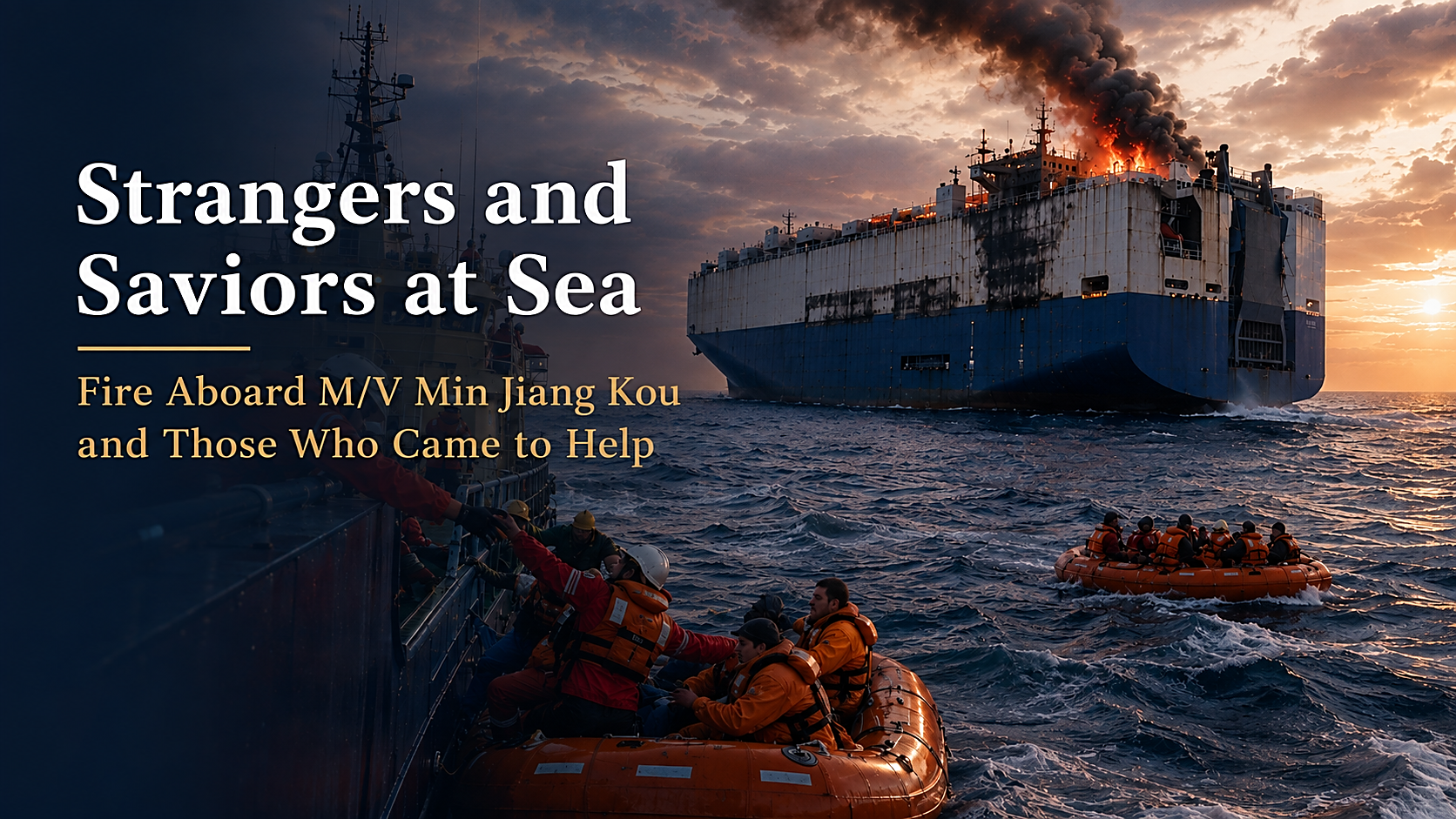
630 miles from the nearest shore, an engine-room fire drove 22 mariners off a Marshall Islands car carrier and into their lifeboats. What sent two passing merchant ships racing to reach them was not luck, but a historical duty older than the U.S. Coast Guard itself — and a reporting system whose roots run all the way back to the RMS Titanic.
A Distress Call From the Middle of Nowhere
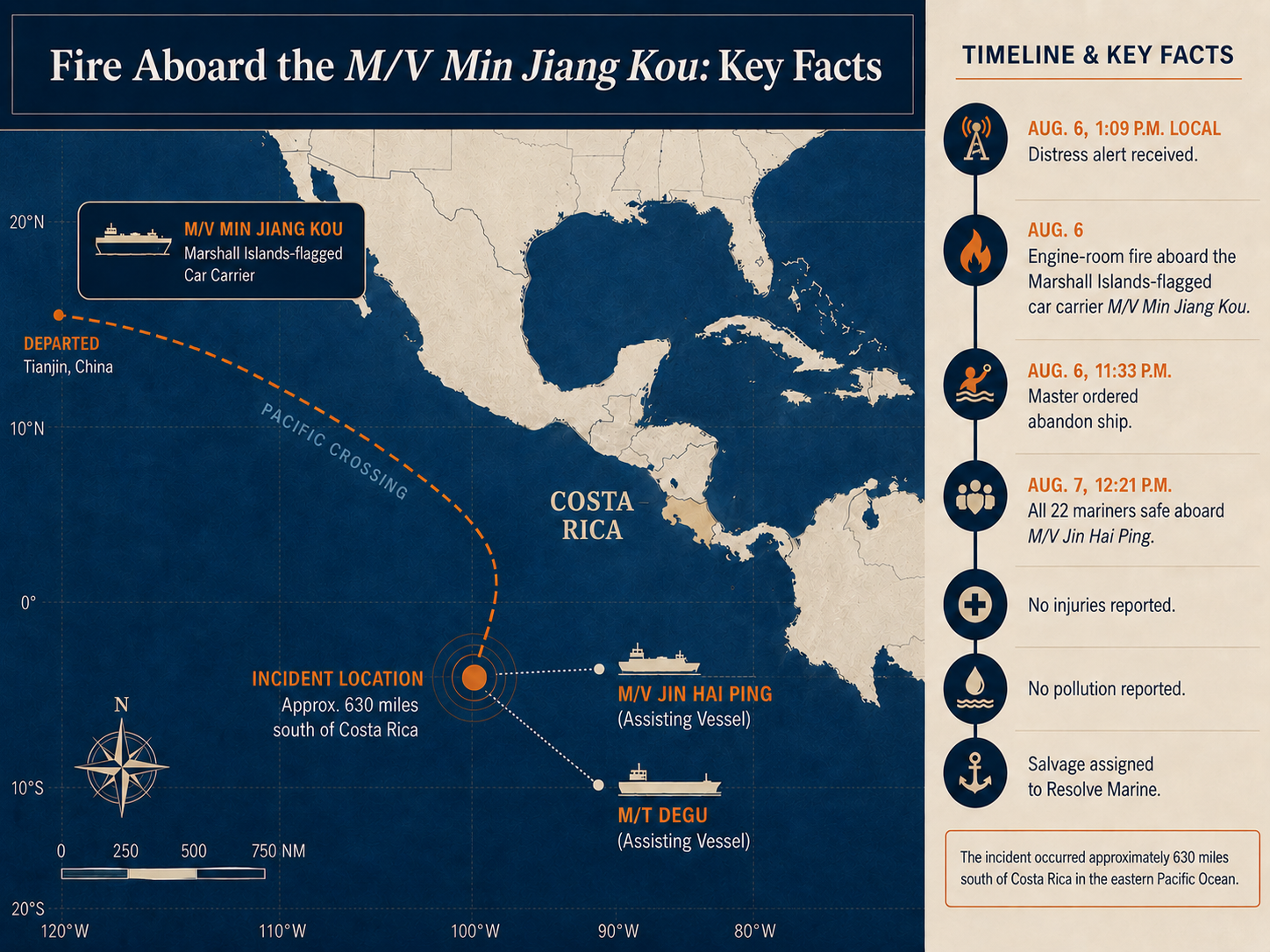
On Thursday, August 6, at 1:09 p.m. local time, watchstanders at the U.S. Coast Guard (USCG) Southwest District picked up an Inmarsat distress alert from the M/V Min Jiang Kou, a Marshall Islands‑flagged car and truck carrier (PCTC) roughly 630 miles south of Costa Rica, near the end of a Pacific crossing from Tianjin, China. An engine‑room fire had broken out aboard the 2024‑built, liquefied‑natural‑gas‑ (LNG‑) dual‑fuel vessel.
The crew did what they were trained to: they flooded the space with the ship’s carbon dioxide (CO₂) fire‑suppression system, which at first appeared to smother the blaze. The Coast Guard raised the ship’s manager and, because no cutter or aircraft could arrive for many hours, reached for a tool built precisely for this kind of distance (explained below) to summon help from whatever vessels happened to be near.
By late that night the fire again had the upper hand. At 11:33 p.m., with smoke thickening, the master ordered all twenty‑two crew into the lifeboats — then stayed aboard himself to keep watch over his burning ship. Two merchant vessels had already changed course:
- The M/V Jin Hai Ping, a motor vessel, pulled every one of the twenty‑two mariners from the lifeboats; and
- The M/T Degu, a motor tanker, stood by on scene to lend whatever aid was needed.
By 12:21 p.m. the next day, Friday, August 7, all 22 were safe aboard the M/V Jin Hai Ping, bound for Akita, Japan. No one was reported hurt, and no pollution reached the water. The M/V Min Jiang Kou herself was left to a salvage company, Resolve Marine, for recovery.
Capt. Jessica Davila of the U.S. Coast Guard’s Southwest District called the rescue a reminder of the maritime community’s “extraordinary commitment … to protecting life at sea.”
The Duty That Made Them Turn Around
It is worth noting why two commercial ships — on their own schedules, with their own cargo, answerable to their own owners — would break off and sail toward a fire. Part of the answer is the oldest duty sailors keep: you go and help. However, that ethic is also law.
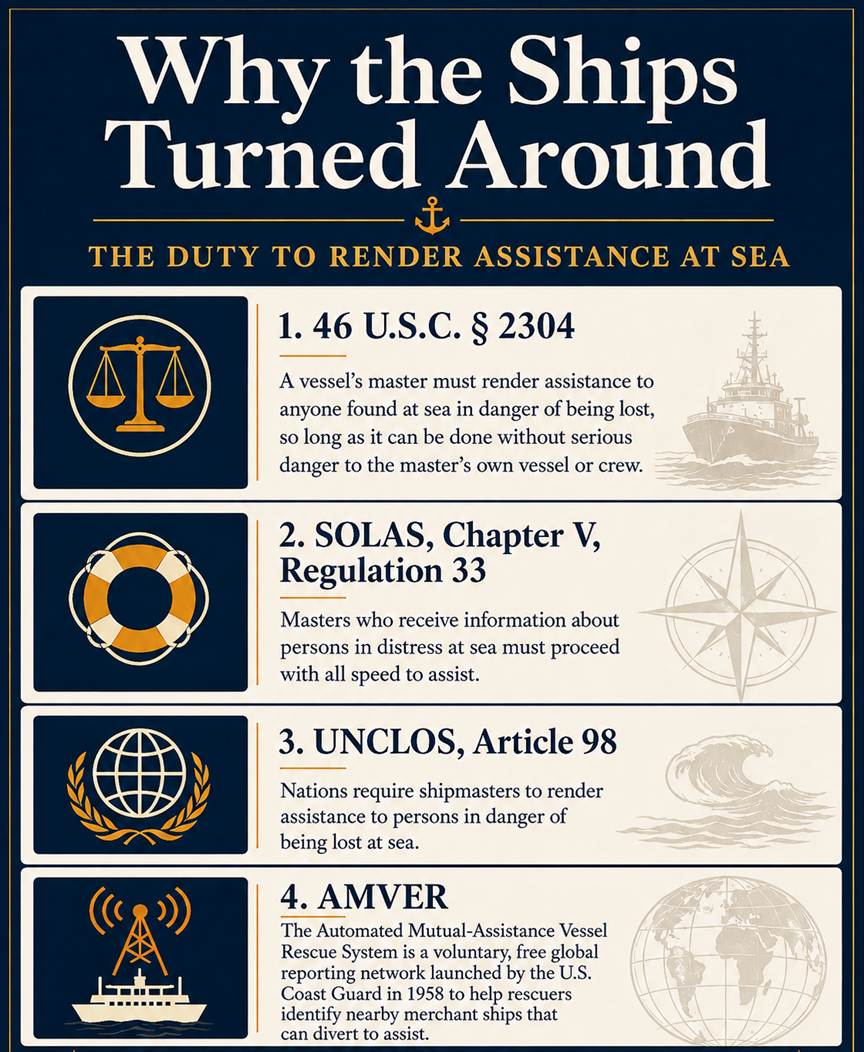
- United States law. A vessel’s master must render assistance to anyone found at sea in danger of being lost, so long as it can be done without serious danger to the master’s own ship and crew (46 U.S.C. § 2304). Refusal is a federal crime, not merely a breach of custom.
- The treaty framework. The same duty is written into the two great laws of the sea — Regulation 33 of Chapter V of the International Convention for the Safety of Life at Sea (SOLAS), and Article 98 of the United Nations Convention on the Law of the Sea (UNCLOS) — each of which commands a master who learns of persons in distress to proceed “with all speed” to help.
AMVER: A Quiet Answer to an Old Tragedy
The tool the Coast Guard reached for, in this case, was AMVER — the Automated Mutual‑Assistance Vessel Rescue System. It is a voluntary, free global reporting network: merchant ships share their positions and voyage plans, and when an emergency erupts in some empty quarter of the ocean, rescue coordinators can see which vessels are close enough to help, and ask them to divert and do so.
AMVER’s history, like many safety tools, is a lesson in learning from disaster. When the RMS Titanic went down in 1912, ships within sight of her distress rockets tragically mistook them for celebration; the idea of a system that could find and marshal nearby help was born of that failure.
It took another half‑century and the arrival of the computer to make it a reality — the U.S. Coast Guard launched AMVER in 1958. Today, it blankets essentially all of the world’s navigable ocean, and its most notable achievement (rarely tested and rarely wrong) is that no place at sea lies more than a day’s steaming from an AMVER ship.
This time, it did exactly what it was built to do.
Why This Reaches the Gulf Coast
The crew of the M/V Min Jiang Kou were foreign nationals aboard a foreign‑flag ship, and their remedies will be governed by the law of that flag and their contracts. But the doctrines this rescue calls to mind are the same ones that protect a tankerman on the Houston Ship Channel, a deckhand at Barbours Cut, and a towboat crew on the Intracoastal Waterway. For an American seaman, an engine‑room fire is not just a casualty — it is a legal event.
- Unseaworthiness. Under the general maritime law, a shipowner is strictly liable when a vessel or its equipment is not “reasonably fit” for its purpose. An engine room that catches fire, or fire‑suppression and escape systems that fail when they are needed, can render a vessel unseaworthy regardless of anyone’s intent. We walk through these claims in “Claims for Seamen Under the Jones Act: A Lifeline for Injured Sailors.”
- Jones Act negligence. A seaman injured in such a casualty need only show that the employer’s negligence played “any part, even the slightest,” in causing the harm — a deliberately low, worker‑friendly threshold.
- Maintenance and cure. If a mariner is hurt or falls ill in the vessel’s service, the seaman’s employer must pay daily living expenses and medical costs, regardless of fault, until the seaman reaches maximum medical improvement (MMI).
Not every maritime worker is a “seaman,” and the line can be fine; those who fall outside it may instead be covered by the Longshore and Harbor Workers’ Compensation Act (LHWCA). Since the proper classification turns on the facts of the job, we gave the question its own post: “What Is a Jones Act Seaman?” And as we have written about crews sent into far more dangerous waters, in “Narrow Waters, Wide Wake: The Scars of the Strait of Hormuz Crisis,” those protections do not evaporate simply because the danger is severe — if anything, that is where they matter most.
The mariners off Costa Rica were lucky in the way that matters: strangers came to help. But luck is a thin thing to build a system on, which is why mariners are legally protected— and why, when those rights are breached and a mariner is hurt, the law has an answer.
After all, every mariner rests a little easier knowing the horizon will reveal of ships that will turn around — and a law that expects them to.
Maritime Trivia Question!
Q: Everyone recognizes SOS as the universal distress signal. But does it actually stand for “Save Our Ship” or “Save Our Souls”?
A: Neither. SOS was never an acronym. It was adopted internationally in the early twentieth century because its Morse-code pattern — three dots, three dashes, three dots — is unusually simple, distinctive, and difficult to mistake amid radio interference. Phrases such as “Save Our Ship” and “Save Our Souls” were attached to it later as convenient memory aids. Its real virtue was practical rather than poetic: when a ship was in grave danger, those nine unmistakable signals could cut through the noise.
We at the Herd Law Firm are proud to fight for seamen, maritime workers, and passengers in all types of personal injury and death claims. As maritime personal injury attorneys (and sailors ourselves!) located in northwest Houston, we never waver in our commitment to help these maritime workers, passengers, and their families when they are injured or mistreated.
The information in this post is for general informational purposes only and does not constitute legal advice. For questions specific to your maritime law issue, please contact us at 713-955-3699 or at Charles.Herd@HerdLawFirm.com.
Sources
1. U.S. Coast Guard. “Coast Guard coordinates rescue of 22 crew members from vessel fire 630 miles off Costa Rica.” Press Releases, August 2026. news.uscg.mil
2. gCaptain. “Car Carrier Abandoned After Catching Fire 630 Miles Off Costa Rica.” August 2026. gcaptain.com
3. Marine Insight. “Fire Breaks Out In Engine Room Aboard Car Carrier Off Costa Rica.” August 2026. marineinsight.com
4. The Maritime Executive. “COSCO Car Carrier Catches Fire off Costa Rica, 22 Seafarers Rescued.” August 2026. maritime-executive.com
5. World Cargo News. “COSCO car carrier evacuated after engine-room fire off Costa Rica” (vessel particulars). August 2026. worldcargonews.com
6. Legal Information Institute, Cornell Law School. “46 U.S. Code § 2304 — Duty to provide assistance at sea.” law.cornell.edu
7. The Maritime Executive. “UNCLOS and the Duty to Render Assistance” (UNCLOS art. 98; SOLAS ch. V, reg. 33). maritime-executive.com
8. Professional Mariner. “Coast Guard’s Amver program marks a half century of saving lives.” professionalmariner.com