
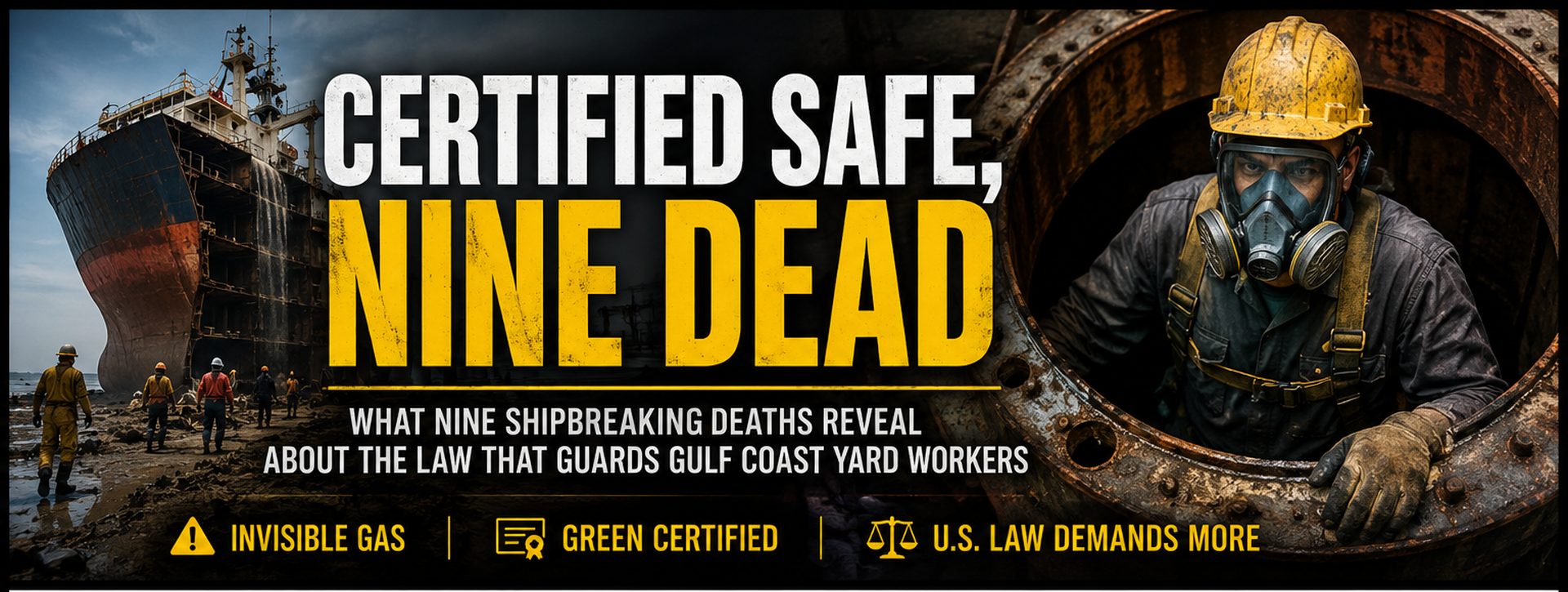
Nine men died breaking apart a retired gas carrier at a South Asian yard the world had certified as “green.” The tragedy unfolded an ocean away — but the same work is done every day on the Texas coast, where the law asks a great deal more before anyone climbs into a tank.
It was Friday — usually a day of rest and prayer for the Bangladeshi shipyard — when nine men descended into the tank. They were cutting apart the M/T Rasi, a retired liquefied natural gas (LNG) carrier hauled up onto the tidal flats at the Ferdous Steel Ship Recycling Industries yard in Sitakunda, Bangladesh, to be dismantled for scrap. Somewhere in her hull, hydrogen sulfide (H₂S) — a gas with no color and, in high enough concentration, no smell — had been silently gathering.
Two workers dropped almost at once. A safety officer and several others climbed in after them to pull them clear, and the gas took them too. By the time it was over, nine were dead. The youngest was seventeen.
The yard where they died was no outlaw operation working in the shadows. It held the very certifications the maritime world created to make this work safe. And that is precisely why a Gulf Coast reader should care — because the men who climb into “clean” tanks on ships to take ships apart on the Texas coast do the same dangerous work, but under very different laws.
The Vessel and the Blind Spot
The M/T Rasi was a twenty-six-year-old gas carrier built in 2000, formerly the HL Ras Laffan. She had spent her working life moving LNG before she was sold for scrap through a cash buyer and reflagged to Saint Kitts and Nevis — a flag of convenience — shortly before being driven up onto the flats to be cut apart.
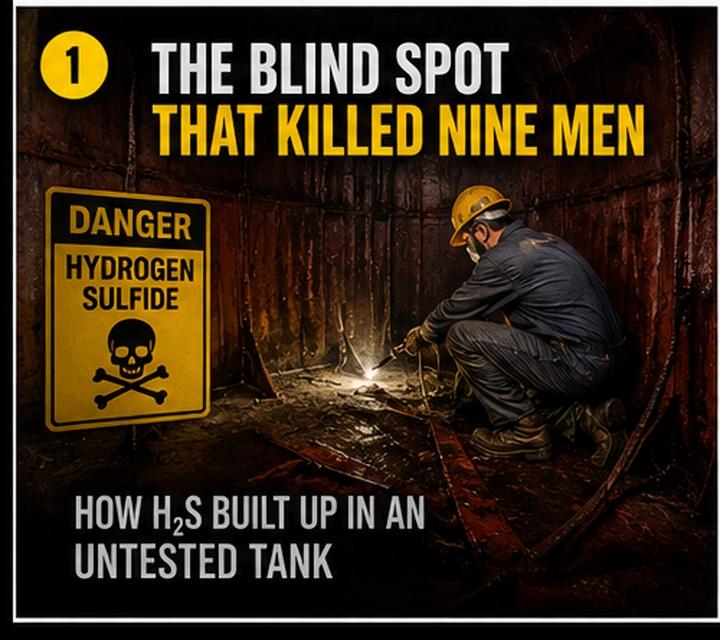
By the account of the yard’s own manager, the hydrogen sulfide had collected in a water-ballast tank beside the cargo tank — a space that was never gas-tested at all, because ballast tanks are routinely treated as non-hazardous and the inspectors had focused on the fuel and cargo tanks. A post-accident inspection found lethal concentrations of H₂S in that same ballast section. One investigator called it a fatal blind spot.
Hydrogen sulfide is not exotic: it forms as organic residue and marine growth decompose in enclosed, oxygen-starved spaces — exactly the conditions inside an old ship’s tanks. The hazard is well enough known that the whole architecture of shipyard-safety law is built on a single rule: test the air before anyone goes in.
Certified Safe, and Still Deadly
To see why that matters, you have to know the history of shipbreaking as one of the most dangerous jobs on earth. Typically, retired ships are run aground on tidal beaches and taken apart — largely by hand — and the workers who open them up face asbestos, heavy metals, oil sludge, and pockets of toxic gas — often with scant training and less protective equipment.
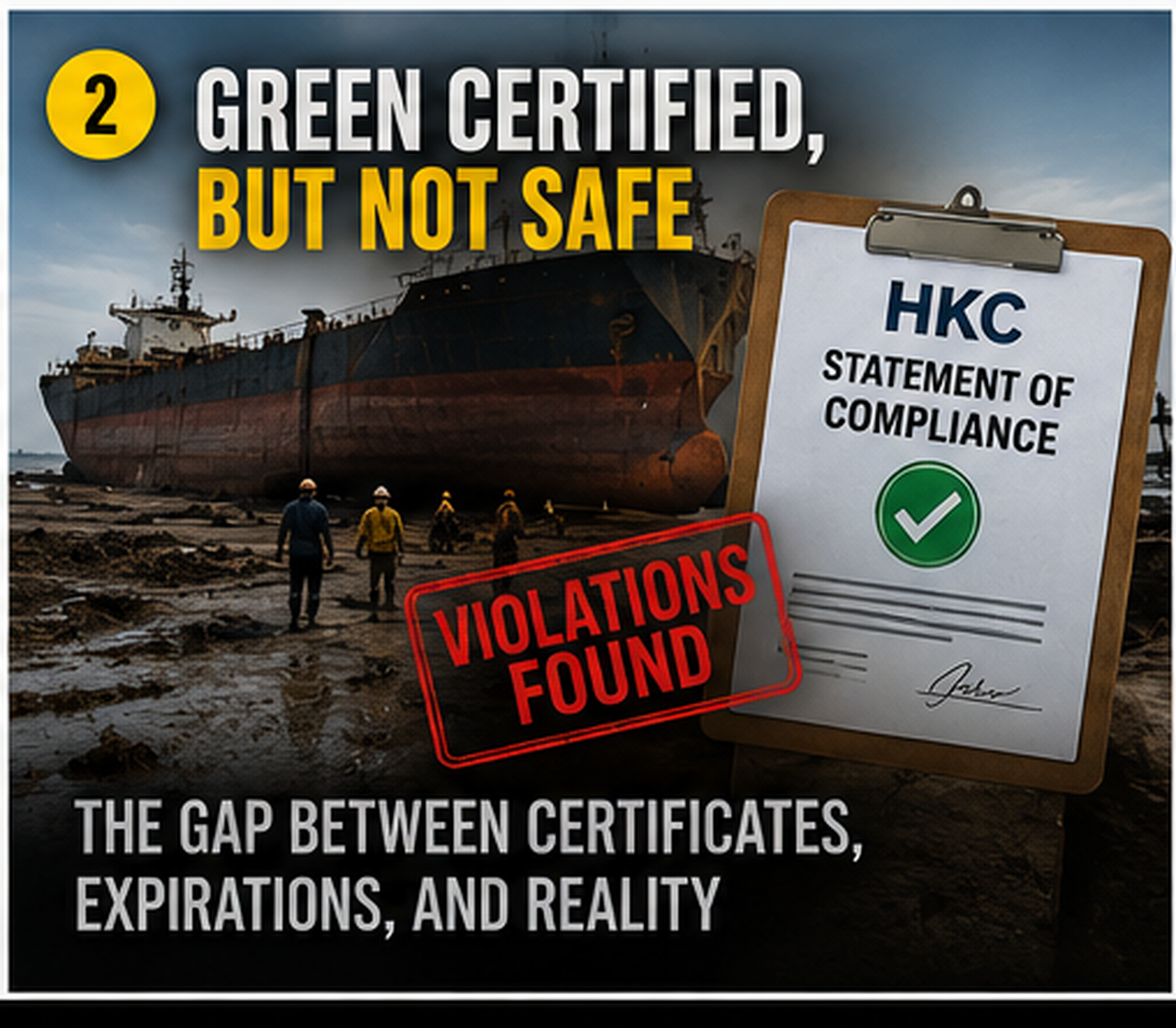
For the past decade the industry has been trying to shed that reputation through what it calls a “green” transition: yards seeking formal certification that they now recycle ships safely and cleanly. The centerpiece is the Hong Kong International Convention for the Safe and Environmentally Sound Recycling of Ships (HKC) — the first binding global framework for ship recycling, in force since June 26, 2025. Bangladesh alone now counts roughly two dozen certified “green” yards.
Ferdous Steel was, on paper, a showcase of that effort, holding an HKC statement of compliance along with certifications from the Indian Register of Shipping (IRClass), Japan’s ClassNK, and Bureau Veritas.
The certificates, however, told a tidier story than the yard’s own recent history:
- Bangladesh’s Department of Inspection for Factories and Establishments (DIFE) had sued the yard in July 2026 over safety violations — roughly one month before the deaths.
- The yard’s environmental clearance from the Department of Environment (DoE) had lapsed on August 12 — two days before the accident — while roughly a third of the vessel remained to be cut.
- The Bangladesh Ship Recycling Board (BSRB), which oversees the green-yard program, has since ordered Ferdous Steel to suspend all operations pending investigation.
Sadly, this was no freak event: by a tally compiled from the Bangladesh Institute of Labour Studies, the country’s yards recorded 84 accidents in the roughly fourteen months after the HKC took force — 15 workers killed and 81 injured. A local seafarers’ welfare organization counts 161 shipbreaking deaths since 2014.
The gap between a certificate and a safe tank, it turns out, can be measured in bodies.
The Similar “Confined Spaces”, on the Texas Coast
This is not a distant-shore problem. The United States breaks ships too, and the American capital of the trade sits on the Gulf — at the Port of Brownsville, Texas, reached by a seventeen-mile channel to the Gulf of Mexico (which the current Administration designates the Gulf of America, or GOA). Most of the nation’s ship-recycling companies operate there, dismantling everything from commercial tankers to retired Navy warships.
Which means the fundamental hazard that killed nine men on a beach in Chattogram is present on our own coast: men cutting into tanks that once held fuel, cargo, and chemical residues, working in confined spaces where invisible gases can collect. What differs — sharply — is the law that governs what must happen before and after a worker enters that tank.
What U.S. Law Demands Before Anyone Enters a Tank
Two bodies of American law bear directly on this work, and both point the opposite direction from what happened aboard the M/T Rasi.
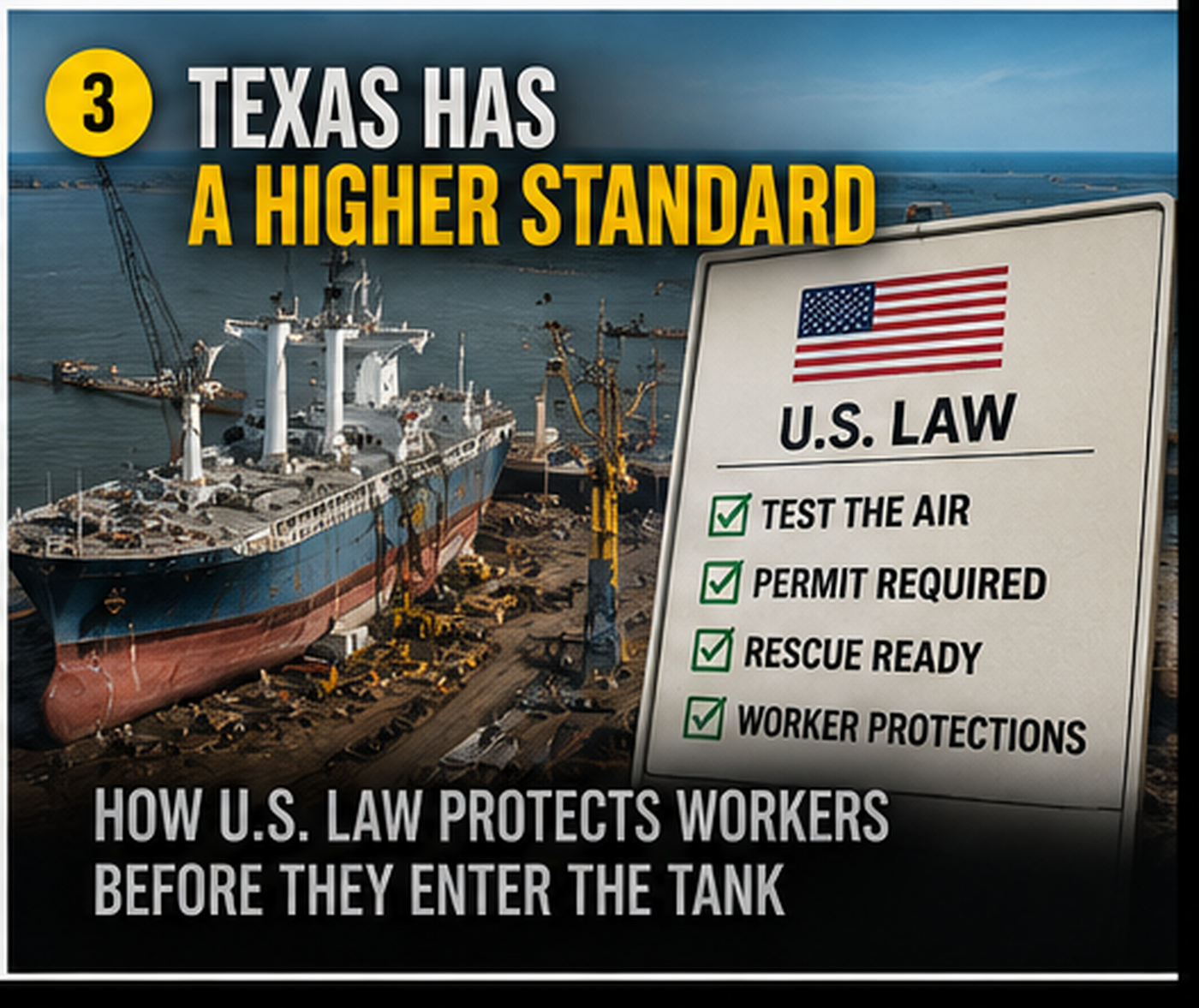
- Before entry — the gas-free rule. Under the Occupational Safety and Health Administration’s (OSHA) shipyard-employment standards (Title 29 of the Code of Federal Regulations (CFR), Part 1915, Subpart B), a confined or enclosed space in a U.S. shipbreaking yard must have its atmosphere tested before a worker sets foot inside. A Certified Marine Chemist (CMC) or a designated Shipyard Competent Person measures the space and certifies it “Safe for Workers”; where flammable or combustible residues are or were present, a Marine Chemist’s certificate is required before any hot work — cutting or welding — begins. A space that cannot be ventilated to safe limits is labeled “Not Safe for Workers,” and no one may enter. The entire regime exists to prevent precisely this: a worker cutting into an untested tank.
- After injury — the Longshore Act. A ship-breaker is not a “seaman,” so the Jones Act — the seaman’s remedy — does not reach him (we have explained that seaman line before). But Congress wrote dismantling work into a different statute. The Longshore and Harbor Workers’ Compensation Act (LHWCA), 33 U.S.C. § 901 and following, defines a covered “employee” to include a “ship-breaker” by name (§ 902(3)). It provides no-fault compensation, medical care, and — crucially — survivor benefits to the families of workers killed on the job (more on how the LHWCA works here). And where a vessel’s own negligence causes the harm, § 905(b) preserves a separate negligence action against that vessel.
Underlying both is an old principle of maritime law: the employer who profits from dangerous work bears an affirmative duty to identify and warn of known hazards. A gas with no color that, at lethal concentrations, robs a worker of the very ability to smell it is exactly the kind of latent danger those testing rules were written to catch. This firm has made a similar point about workers sent to handle toxic substances they were never warned about — the hazard changes, the duty does not.
Why This Reaches the Gulf Coast
For the men and women who work the recycling yards and repair slips from Brownsville to the Houston Ship Channel, the takeaway is not that American law makes this work safe — no law does that. It is that the law stands squarely on their side. An employer who skips the atmospheric test, a vessel owner who hides a known hazard, a contractor who sends a crew into a space marked unfit — each has crossed a line the Longshore Act and the maritime duty to warn were written to enforce. A certificate on the bulkhead is a starting point, not a defense.
The work will always carry risk. What the law can promise — and what we are here to make it keep — is that no worker is sent into an unbreathable dark to learn the danger for himself.
Maritime Trivia
Q: A ship like the M/T Rasi — sold off, stripped, and sent to be cut apart — is what sailors once called a “hulk.” Today the word means anything big and clumsy. Where did it start?
A: “Hulk” began, in Old English, as the name for a kind of ship — arriving by way of the Greek holkas, a towed merchant vessel. By the 1670s the word had narrowed to something more melancholy: the body of an old, worn-out ship, stripped of her rigging and no longer fit for sea, kept afloat only to be used up or taken apart. From that same root we get “hulking,” for anything large and unwieldy. A vessel bound for the breakers ends her days as a hulk — the last, and least glamorous, of all the names she will bear.
We at the Herd Law Firm are proud to fight for seamen, longshoremen, harbor and shipyard workers, and maritime workers of every kind in all types of personal injury and death claims. As maritime personal injury attorneys (and sailors ourselves!) located in northwest Houston, we never waver in our commitment to help these maritime workers, passengers, and their families when they are injured or mistreated.
The information in this post is for general informational purposes only and does not constitute legal advice. For questions specific to your maritime law issue, please contact us at 713-955-3699 or at Charles.Herd@HerdLawFirm.com. (9/8/2026)
Sources
- Schuler, Mike. “Nine Workers Killed at Hong Kong Convention-Certified Shipbreaking Yard in Bangladesh.” gCaptain, August 17, 2026. gcaptain.com
- “Nine Killed in Toxic Gas Accident at HKC-Certified Shipbreaking Yard.” The Maritime Executive, August 2026. maritime-executive.com
- “Shipbreaking Yards: ‘Green’ on Paper, Deadly on Ground.” The Daily Star, August 2026. thedailystar.net
- “Shipbreaking Tragedy: Yard ‘Forgot’ to Renew DoE Clearance.” The Daily Star, August 2026. thedailystar.net
- “How ‘Green’ Are Bangladesh’s Shipbreaking Yards If Workers Keep Dying?” The Business Standard, August 2026. tbsnews.net
- “Toxic Hydrogen Sulphide Leak Kills 9 Workers at Bangladesh’s Sitakunda Ship Recycling Yard.” Marine Insight, August 2026. marineinsight.com
- Occupational Safety and Health Administration. “Shipyard Employment eTool — Shipbreaking: Confined or Enclosed Spaces, Testing the Atmosphere” (29 CFR 1915.12). osha.gov
- Legal Information Institute, Cornell Law School. “33 U.S. Code § 902 — Definitions” (LHWCA; “employee” includes ship-breaker). law.cornell.edu
- Burnett, John. “When the Ship Comes In to Brownsville, Rip It Up.” NPR, July 25, 2012. npr.org


Leave A Comment