An International Maritime Organization rule took effect this January, and shipboard aqueous film-forming firefighting foam or AFFF is being removed from vessels worldwide. Regulatory compliance may be a matter of finding a replacement, but the harder questions — namely, who answers for sixty years of spraying the hazardous material— are a maritime injury issue now coming due.
There is no outrunning a fire at sea, no anchoring clear of one, and no calling for a tow. For sixty years, the answer to a fuel fire aboard a ship has been Aqueous Film-Forming Foam (AFFF) — a concentrate that spreads a sealing film across burning hydrocarbons and smothers them. It works remarkably well, and it works because of the very chemistry now ending its tenure at sea.
As of the first survey on or after January 1, 2026, a major class of that foam is no longer allowed aboard. Owners are swapping it out; depots are restocking. Behind all those logistics is a generation of engineers, pumpmen, and firefighting-team members who handled the old product bare-handed, with no warning label worth the name.
WHAT ACTUALLY CHANGED ON JANUARY 1
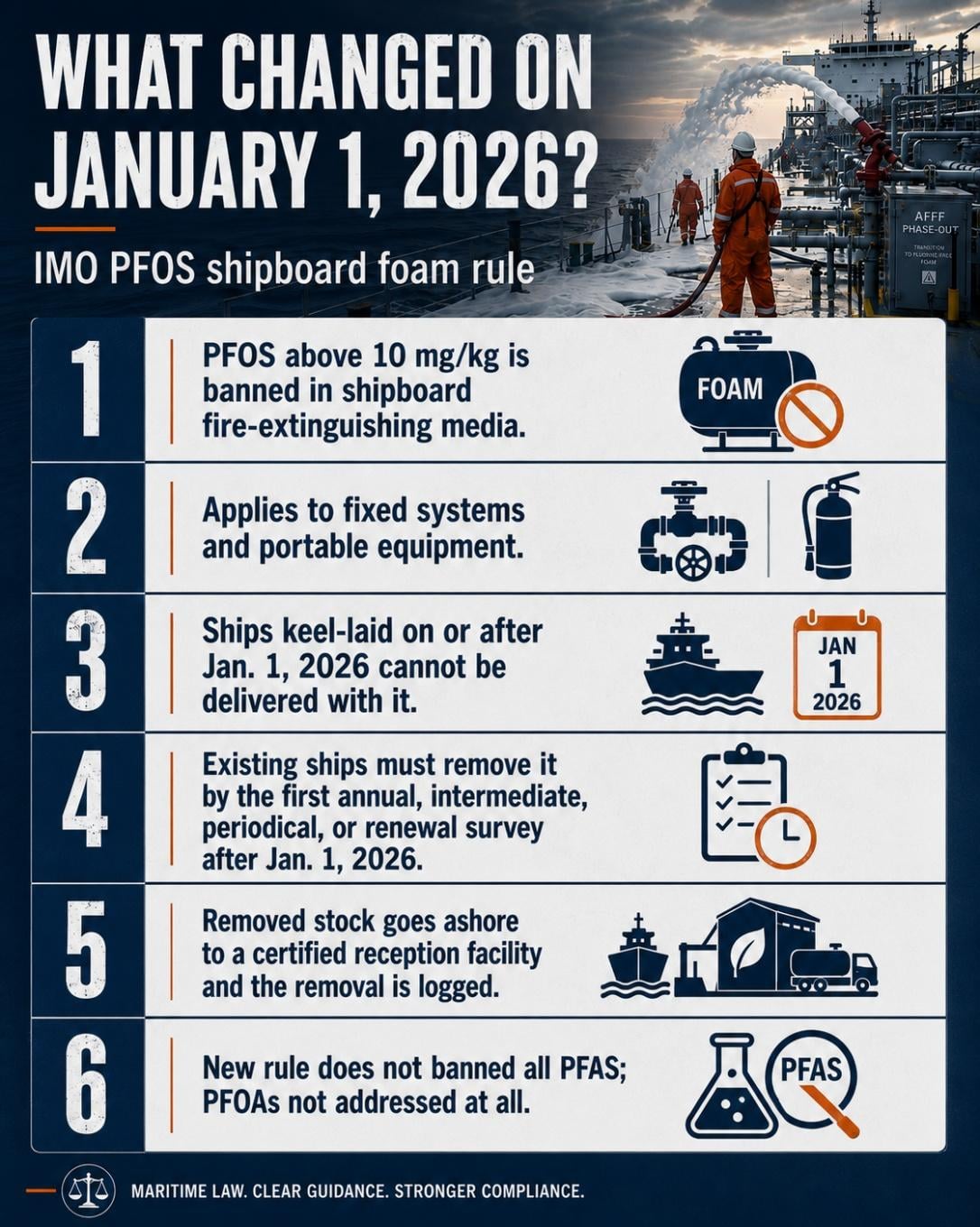
The International Maritime Organization (IMO) adopted the amendment by Resolution MSC.532(107) back in 2023, writing it into Safety of Life at Sea (SOLAS) Chapter II-2, Regulation 10.11, with parallel changes to the 1994 and 2000 High-Speed Craft Codes. It entered into force on January 1, 2026.
The substance of it is short:
- What is banned: fire-extinguishing media containing perfluorooctane sulfonic acid (PFOS) above 10 mg/kg — that is one-thousandth of one percent by weight. This includes fixed systems and portable equipment alike.
- Who it hits, and when: ships keel-laid on or after January 1, 2026 cannot be delivered with it at all. Existing ships must be clear by their first annual, intermediate, periodical, or renewal survey after that date. For many vessels, that survey is this year.
- What compliance looks like: a manufacturer’s PFOS-free declaration with foam type, batch, and type-approval reference — or, absent paperwork, laboratory sampling of the foam actually in the tank. Removed stock goes ashore to a certified reception facility, and the removal is logged.
One distinct clarification matters more than the rest, because industry coverage keeps blurring it: this is a PFOS rule, not a PFAS rule. Per- and polyfluoroalkyl substances (PFAS) are a family of thousands of compounds — the “forever chemicals,” so-called because the carbon-fluorine bond is among the most stubborn in organic chemistry, and does not weather out of soil, water, or blood.
PFOS is only one such member. SOLAS II-2/10.11 prohibits PFOS; by its terms, it does not prohibit perfluorooctanoic acid (PFOA) or the rest of the family, though the European Union and other regulators are moving that direction.
The result: a particular foam can be fully SOLAS-compliant and still be fluorinated. A material safety data sheet (MSDS) that only states “PFOS-free” may answer a regulator’s questions, but not the health and safety concerns of the crew.
THE AMERICAN SIDE OF THE LEDGER
The United States Coast Guard (USCG) has not yet rewritten its Salvage and Marine Firefighting regulations to force a foam changeover. But the Coast Guard Authorization Act of 2025 (enacted this past December as part of the FY2026 National Defense Authorization Act) carries vessel response plan language requiring covered vessels to carry response equipment employing “the best technology economically feasible.” However, what the best economically-feasible system changes year-to-year. Phrases like this also have a way of becoming the “measuring stick” a jury is handed years later.
The science, meanwhile, has been confirmed. In 2023, the International Agency for Research on Cancer (IARC) classified PFOA as Group 1 — carcinogenic to humans — the same tier as asbestos and benzene — and PFOS as Group 2B, possibly carcinogenic. More than twenty thousand personal injury and contamination claims now sit consolidated in the federal AFFF multidistrict litigation in South Carolina, brought largely by firefighters, military personnel, and airport crews alleging the manufacturers knew and did not say.
CHOOSING THE REPLACEMENT: WHAT OPERATORS ARE WEIGHING
For owners and salvage responders working through the transition, the trade press and the equipment specialists converge on the same checklist:
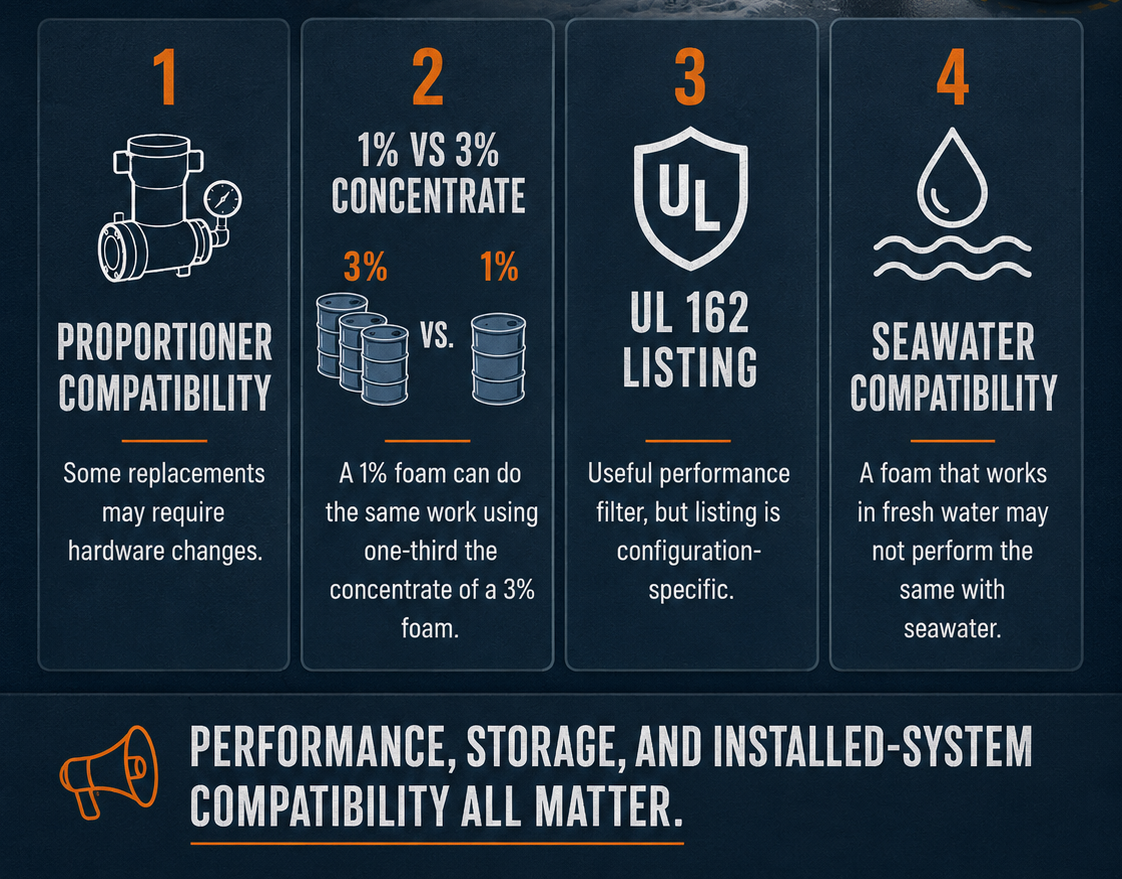
- Not all fluorine-free foams perform alike. Foam is not sprayed neat. Concentrate is drawn from a tank, blended with water at a fixed ratio by a device called a proportioner, then aerated into the blanket that smothers the fire. Early fluorine-free replacements often needed a heavier flow of finished foam to knock down the same fire, or would not blend correctly through the proportioners already plumbed into a vessel — which meant tearing out and replacing fixed hardware, not simply refilling a tank.
- Concentrate percentage is a stowage problem. The percentage is the blend ratio: a 3% foam means three parts concentrate to ninety-seven parts water. A 1% foam does the same work on a third of the concentrate. That is not an academic difference aboard ship — it is tank volume you do not have to surrender, weight you do not have to carry, and drums you do not have to move down a dock.
- A UL 162 listing is a useful filter. UL 162 is the Underwriters Laboratories (UL) standard for foam concentrates and the equipment that delivers them — a listed product has been fire-tested by an independent lab and published in UL’s directory, not merely advertised. Two cautions: the listing is configuration-specific, covering a particular concentrate percentage, discharge equipment, and fuel type, so confirm it matches what is actually installed. And it measures performance only — a foam can be UL 162 listed and still be prohibited under SOLAS.
- Salt-water compatibility is not universal. Seawater is full of various dissolved salts that can thin a foam blanket or keep it from forming properly — and at sea, the main source of water for fighting fire draws from over the side. A foam that performs well shoreside with fresh water, but poorly with seawater, is not a shipboard foam.
WHAT DOES U.S. MARITIME LAW SAY ABOUT THE OLD FOAM?
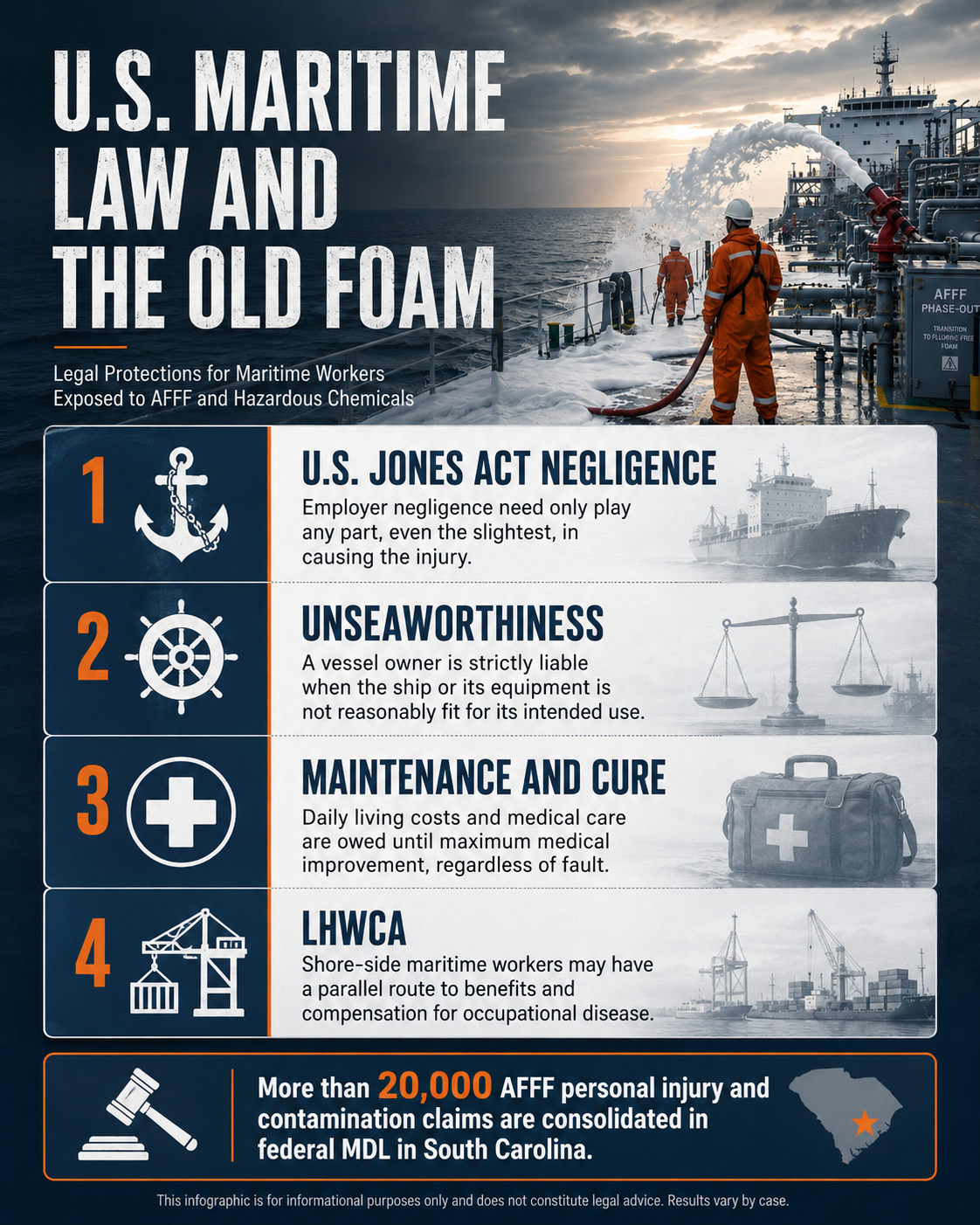
When a U.S. Jones Act seaman develops a disease years after handling a product his employer required him to handle, three familiar doctrines do the work:
- U.S. Jones Act negligence. An employer’s negligence need only have played “any part, even the slightest” in causing the injury. The threshold is deliberately low. Failing to supply protective equipment, failing to train on handling and decontamination, or continuing to stock a product long after the hazard was public knowledge are all ordinary negligence questions. The chemistry does not make them exotic.
- Unseaworthiness. Under U.S. General Maritime Law, a vessel owner is strictly liable when the ship, her equipment, or her appurtenances are not reasonably fit for their intended use. A firefighting system charged with a medium the owner knows to be toxic, without the protective gear and decontamination procedures that make it safe to handle, is a condition of the vessel — not merely a supplier’s problem.
- Maintenance and cure duties. The oldest obligation in admiralty, and the one most often overlooked in latent-illness cases. The two words mean two different things. Maintenance traditionally is the daily cost of living ashore that the ship would otherwise have covered — room and board, the food and bunk a seaman gives up by being sick instead of aboard, plus related living expenses incurred when living at home. Cure is the medical care itself: doctors, hospitals, medication, testing, travel, etc..
Both are owed by the employer regardless of fault — a seaman does not have to prove anyone did anything wrong, only that the illness manifested while in (or from) the service of the vessel. Payment continues until maximum medical improvement (MMI), the point at which further treatment will not make the seaman better, whether that means full recovery or a condition that has simply stopped improving.
Three features of the duty matter a great deal in a chemical-exposure case:
- It attaches to illness, not only to accidents, so a cancer that surfaces years later can qualify just like a slip-and-fall,
- Genuine doubt is resolved in the seaman’s favor (a rule the Supreme Court has stated plainly and repeatedly), and
- An employer who refuses payment unreasonably can be liable for attorney’s fees and punitive damages on top of the benefits themselves. This is a point this firm has made before in the context of other illness aboard ship, such as during the COVID-19 pandemic.
A fourth obligation runs beneath the other three: the duty to warn. U.S. General Maritime Law obliges an employer to warn a crew of dangers it knows or should know. Given that the IMO adopted this amendment and the IARC established AFFF cancer classification in 2023, and that the litigation has been public since 2019, any operator who put a AFFF hose in a wiper’s hands in 2024 would have a harder time arguing the hazard was unknowable.
And for the shoreside half of the waterfront, such as terminal firefighting teams, shipyard and repair-yard responders, dock workers who do not sail, the Longshore and Harbor Workers’ Compensation Act (LHWCA) provides the parallel route to medical benefits and compensation, with occupational disease expressly covered.
WHY THIS REACHES THE GULF COAST
No stretch of water in America feels this more than ours. The Houston Ship Channel moves petrochemicals in a volume that makes firefighting foam a daily working reality than an emergency abstraction. Bayport and Barbours Cut, the Texas City and Baytown terminals, the supply boats out of Port Fourchon, the tank barges on the Intracoastal Waterway — every one has foam aboard, and most have had it aboard for decades.
If you have worked around AFFF on a vessel, at a terminal, or in a yard, two things are worth doing now, regardless whether if you are currently or ever were sick:
- Write down what you still remember — vessels and dates, whether you handled concentrate or ran live-foam drills, what protective equipment you were given, and what you were told about the product.
- Keep your diagnosis records together. Latent-onset claims turn on timelines, and timelines are built from paper.
These protections do not narrow because of the form the injury took. A seaman keeps the U.S. Jones Act, the warranty of seaworthiness, and maintenance and cure whether he was hurt by a parting line, a bad ladder, or a chemical he was handed and told to use. What the law asks is whether the work caused the harm — not whether the harm happened in an instant, or took twenty years to surface.
The IMO has told the fleet to change the foam. That’s the easy part; the harder half — owed to the men and women who fought the fires with what they were handed — is still at anchor, waiting on the tide.
Maritime Trivia Question!
Q: We speak of dousing a fire as if the word had always belonged to firefighters. It did not. Where does it come from?
A: From the sail locker. To douse was a seaman’s order meaning to lower or take in quickly and decisively — douse the topsail, douse the glim (put out the lamp). Only later did the sense of dropping something suddenly slide into the sense of drowning it in water. So the modern fire captain shouting to douse the flames is, without knowing it, giving a sail order. (A note of honesty: the deeper root is contested — likely Middle Dutch dossen, “to strike,” though some trace it to a dialectal English verb meaning “to plunge”. The nautical career of the word is well attested; its birth certificate is not.)
We at the Herd Law Firm are proud to fight for seamen, maritime workers and passengers in all types of personal injury and death claims. As maritime personal injury attorneys (and sailors ourselves!) located in northwest Houston, we never waver in our commitment to help these maritime workers, passengers, and their families when they are injured or mistreated.
The information in this post is for general informational purposes only and does not constitute legal advice. For questions specific to your maritime law issue, please contact us at 713-955-3699 or at Charles.Herd@HerdLawFirm.com.
Sources
- “Fluorine-Free Firefighting Foam: Choosing a Shipboard AFFF Replacement Before the Deadline.” gCaptain (sponsored feature), July 20, 2026. gcaptain.com
- Lloyd’s Register. “Prohibition of use of PFOS in fire extinguishing media” (Class News 16/25, IMO Resolution MSC.532(107); IACS Unified Interpretation SC309). lr.org
- DNV. “PFOS Prohibited in Fire-Extinguishing Media from 1 January 2026.” dnv.com
- Bureau Veritas Marine & Offshore. “Prohibition of the Use or Storage of Extinguishing Media Containing Perfluorooctane Sulfonic Acid (PFOS) — Entry into Force 1 January 2026.” bureauveritas.com
- Britannia P&I. “Perfluorooctane Sulfonic Acid (PFOS) Update,” September 2025. britanniapandi.com
- U.S. House Committee on Transportation & Infrastructure. “Coast Guard Authorization Act of 2025” (H.R. 4275; enacted via S. 1071, National Defense Authorization Act for FY2026). transportation.house.gov
- Congress.gov. Coast Guard Authorization Act, Sec. 401, Vessel Response Plans (“best technology economically feasible”). congress.gov
- Legal Information Institute, Cornell Law School. “46 U.S. Code § 30104 – Personal Injury to or Death of Seamen” (the Jones Act). law.cornell.edu
- Legal Information Institute, Cornell Law School. “33 U.S. Code § 901 et seq. – Longshore and Harbor Workers’ Compensation Act.” law.cornell.edu