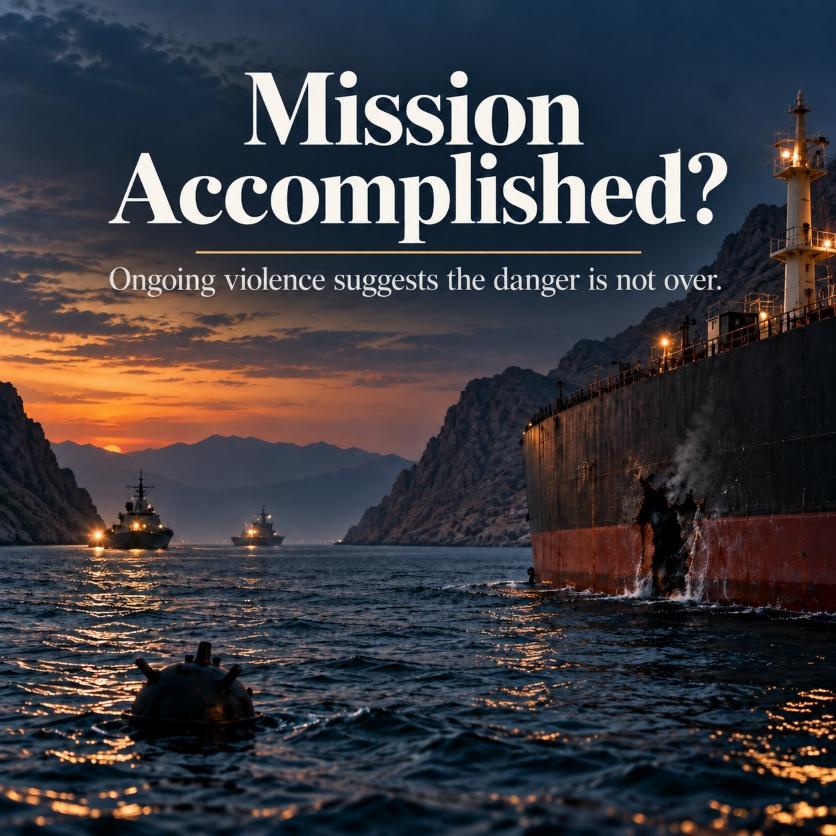
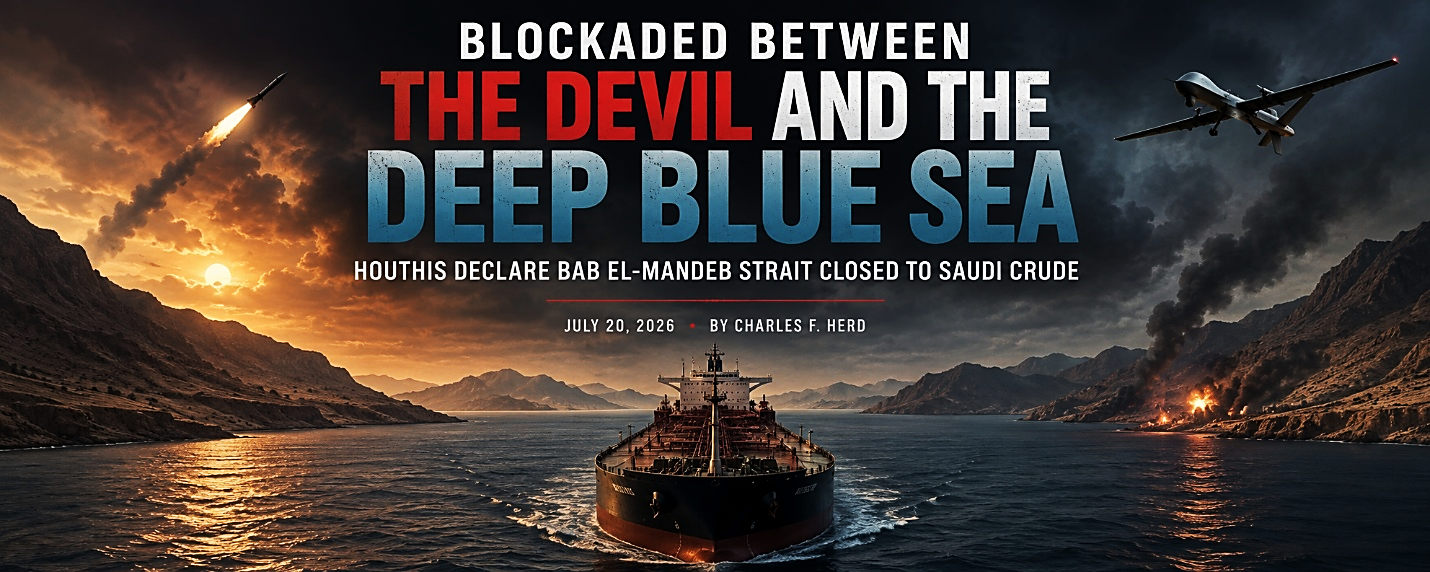
Yemen’s Houthis have declared a maritime embargo against Saudi Arabia and signaled the closure of the Bab el-Mandeb Strait — the very waterway the Kingdom has leaned on since the Strait of Hormuz slammed shut. With both chokepoints now contested at once, the crews caught in the middle are running out of safe water.
In Homer’s ancient Greek epic The Odyssey, the mythological terrors Scylla and Charybdis — a six-headed monster and a ship-swallowing whirlpool — were said to guard opposite shores of the narrow Strait of Medina, such that any sailor who dared the passage faced destruction on all sides. Odysseus was told plainly that there was no route through which cost nothing; he had only to choose what it would cost.
Christopher Nolan’s blockbuster IMAX retelling of Odysseus’ famous tale of drama and adventure opened just last weekend, and audiences are watching those monsters and many more rendered in all their grotesque might. Meanwhile, the world’s tanker fleets are living the same story, albeit less glamorously, in the Middle East — only the dangers on either side are no figures of myth, but missiles, mines, and drones. As of today, both shores are guarded.
The Gate of Tears
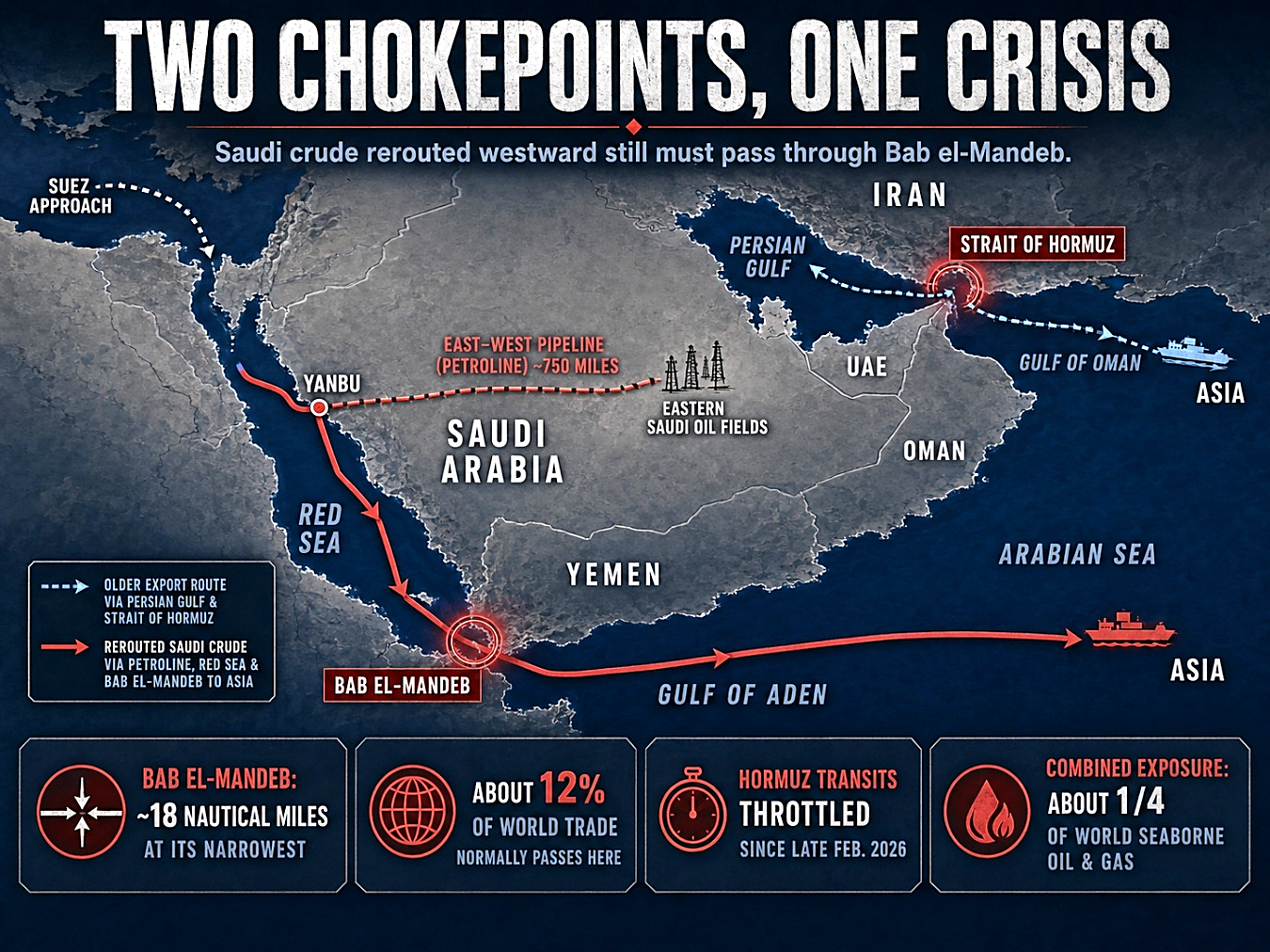
The Strait of Bab el-Mandeb — Arabic for “Gate of Tears” — is the narrow passage between Yemen and the Horn of Africa linking the Red Sea to the Gulf of Aden. Barely eighteen nautical miles across at its tightest, it is the southern doorway to the Suez Canal, and roughly twelve percent of world trade normally moves through it.
On Monday, July 20th, Houthi military spokesman Yahya Saree announced in a televised statement that the group was imposing an immediate maritime embargo on Saudi Arabia, framing it as “an eye for an eye — blockade for blockade” and citing a years-long Saudi-led siege of Yemeni ports and airports, along with a recent strike on Sanaa International Airport. A deputy head of the Houthi media office went further, stating on social media that the strait itself would be closed. The group offered no detail on how the embargo would be enforced, and Riyadh had not publicly responded at the time of writing.
A Week of Whiplash
Last Monday, July 13, President Trump declared the United States the “Guardian of the Hormuz Strait” and floated a twenty-percent “reimbursement” fee on all cargo crossing it. By Tuesday, the fee had been dropped by the administration after Gulf of Oman pushback and a reminder from the International Maritime Organization (IMO) Council that transit through an international strait is meant to stay toll-free, and replaced with promised trade and investment deals from Gulf of Oman states.
Although the toll concept has been discontinued, the blockade has not. At 4:00 p.m. Eastern last Tuesday, U.S. Central Command (CENTCOM) reimposed a naval blockade of Iran. In plain language, the rules put forth by CENTCOM are the following:
- Ships bound to or from Iranian ports, or carrying Iranian cargo, may be intercepted, diverted, boarded, or captured.
- Neutral vessels transiting between non-Iranian ports may still pass — but they may be stopped and searched for contraband or blockade-running.
- Humanitarian shipments of food and medicine may proceed only after U.S. Navy vetting, and remain subject to inspection.
The Joint Maritime Information Center (JMIC) told ships to expect heavy naval activity, hailing over very-high-frequency (VHF) radio, and monitoring by Iran’s Islamic Revolutionary Guard Corps (IRGC), and to keep thirty nautical miles clear of U.S. warships.
Last month, Washington lifted an earlier blockade on June 18 under a brief memorandum of understanding (MOU), then restored it weeks later as attacks on shipping resumed.
The Traffic Tells the Truth
The President said oil was “flowing like never before”, but the data says otherwise:
- JMIC counted just four Hormuz transits on July 12 and twelve on July 13, this against a historical average of nearly 138 ships a day.
- JMIC threat level held at SEVERE, citing ten Iranian attacks since June 25, mine risk, and interference with vessels broadcasting on the Automatic Identification System (AIS).
- After a tanker was struck off Qalhat, Oman, JMIC raised the Gulf of Oman to SUBSTANTIAL.
- Three tankers were hit on the southern Omani route on July 13 alone — among them the M/T Mombasa B and M/T Al Bahyah — leaving one crewman dead and several injured.
Why the Timing Is Devastating
Consider the developments leading up to these announcements:
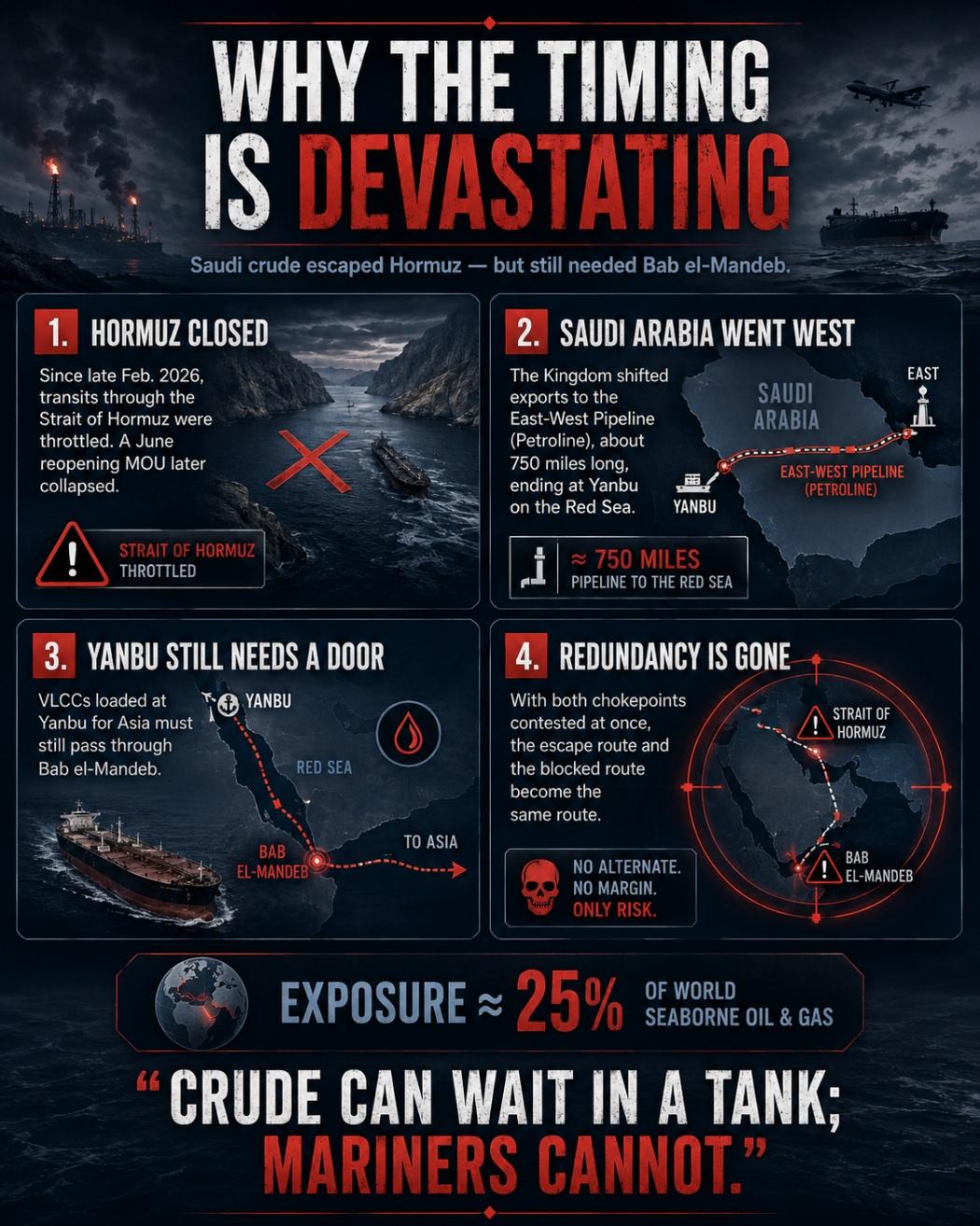
- Hormuz closed. Since the U.S.-Israeli strikes on Iran in late February 2026, transits of the Strait of Hormuz have been throttled to a fraction of the historical average, and the interim June memorandum of understanding (MOU) that briefly reopened it has since collapsed.
- Saudi Arabia went west. The Kingdom shifted enormous volumes onto its East-West Pipeline (Petroline), which runs roughly 750 miles from the eastern oil fields to the Red Sea port of Yanbu. Reporting on first-half July loadings indicates the great majority of Saudi crude and condensate exports moved through Yanbu rather than the Gulf.
- Yanbu still needs a door. Every very large crude carrier (VLCC) loaded at Yanbu bound for Asia must still thread Bab el-Mandeb. The pipeline bypasses Hormuz; it does not bypass the Gate of Tears.
- Redundancy is gone. With both chokepoints contested simultaneously, the escape route and the blocked route are, functionally, the same route. Analysts have put the combined exposure at a quarter of the world’s seaborne oil and gas.
The market reaction has so far been muted (Brent had already spiked past ninety dollars a barrel on war news before dropping) but oil prices are a poor proxy for mariner safety. Crude can wait in a tank; mariners cannot.
A Threat With a Track Record
The Houthis have demonstrated the capability before, and recently. Beginning in late 2023, the group attacked more than a hundred vessels in and around this waterway, and in July 2025 sank the bulk carriers M/V Magic Seas and M/V Eternity C near Hodeidah, Yemen, killing four seafarers. A missile strike on a Dutch-flagged cargo ship in the Gulf of Aden that September killed another.
The U.S. Maritime Administration (MARAD) has kept a standing advisory in force for the Red Sea, Bab el-Mandeb, the Gulf of Aden, and the Somali Basin, and has specifically cautioned that U.S.-flagged vessels transiting with their Automatic Identification System (AIS) transponders switched on face heightened targeting risk. The Joint War Committee of the Lloyd’s Market Association has long designated the strait a listed area — underwriter shorthand for “risk priced as a war zone.” The threat here has been well-documented, published, and quantified, and nobody in this trade should credibly call it a surprise.
What U.S. General Maritime Law Says When Crews Are Ordered Into a War Zone
An embargo declared by one belligerent against another is, on its face, a matter for navies and diplomats. But when a shipowner or operator orders a crew to sail into it anyway, United States maritime law has more to say. Several longstanding protections apply to mariners who can invoke U.S. General Maritime law:
- Jones Act negligence. An employer’s negligence need only have played “any part, even the slightest” in causing a seaman’s injury. That deliberately low threshold reflects a congressional judgment that those who profit from sending sailors to sea bear responsibility when those sailors are harmed. Ordering a vessel into a strait an armed group has publicly declared closed — after government advisories and war-risk underwriters have both priced the danger — is precisely the decision that standard was written to test.
- Unseaworthiness. Under the General Maritime Law, a vessel owner is strictly liable when the ship is not reasonably fit for the voyage ordered — a standard that reaches her equipment, her condition, her officers and crew, and her suitability for the particular passage. A run past hostile anti-ship missile and drone positions without adequate hardening, communications protocols, or escort arrangements may well fall short of that mark.
- Maintenance and Cure duties. Regardless of fault, an owner owes an injured seaman his ongoing living expenses and medical care until he reaches maximum medical improvement (MMI). This ancient admiralty obligation does not pause at the boundary of a war-risk zone.
- The Duty to Warn. The General Maritime Law imposes an affirmative obligation on employers to warn crews of known dangers. When a belligerent announces a blockade on television, when MARAD has a standing advisory in force, and when ships have already been sunk on the route in question, the hazard is neither hidden nor speculative. Sending a crew in without adequate warning — or without their informed consent to the voyage — can supply a basis for liability.
Layered over all of this, employment contracts and collective bargaining agreements covering conflict-zone work almost always carry war-risk provisions: enhanced insurance obligations, war-risk bonuses, and — critically — a crew’s right to refuse an unsafe passage. As both the International Maritime Organization (IMO) and the International Transport Workers’ Federation (ITF) have consistently stressed, the ship’s master overriding authority to protect ship and crew is the legal anchor the whole system holds to.
Why This Reaches the Houston Ship Channel
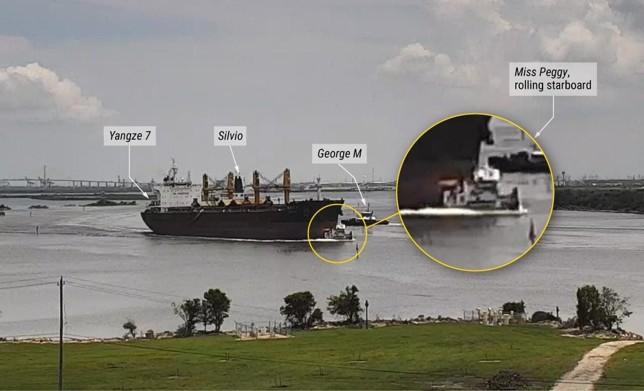
It is easy enough to read all of this as one more development in someone else’s war, half a world away. But for an American citizen, the same laws that protect a tankerman loading at Yanbu are the same that protect a deckhand on the Houston Ship Channel. A U.S. seaman does not surrender the Jones Act, maintenance and cure, the duty to warn, or the right to a seaworthy vessel simply by working somewhere unusually dangerous. Those places are exactly where such rights prove their worth.
Odysseus, facing his own two-sided strait, steered nearer the monster Scylla and lost six sailors rather than risk the whole ship to Charybdis. That was an ancient captain’s grim arithmetic — and it is worth noticing that the men he sacrified were intentionally never informed or consulted.
Today’s mariners are “caught between the devil and the deep blue sea” in a similar way: a blockade astern at the Strait of Hormuz, a declared closure ahead at Bab el-Mandeb, and no safe water in between. The difference is that they are not simply nameless cargo in someone else’s calculation, but real human beings owed a warning, a seaworthy ship, care if they are hurt, and a genuine right to refuse a passage that cannot be made safely — with a master whose duty to protect ship and crew overrides any schedule on any charter party contract.
Modern maritime law exists so that no sailor is ever considered an acceptable loss. The water between the devil and the deep blue sea is where those laws do their hardest work.
Maritime Trivia Question!
Q: This whole piece has been about being caught between two hazards with no clean way through — which is exactly what we mean by being “between the devil and the deep blue sea.” Where does that phrase come from?
A: By old sailors’ lore, the “devil” was the long seam running along a wooden ship’s hull near the waterline — the most awkward and dangerous seam aboard to caulk to stay watertight. A man sent over the side to work it hung quite literally between that devil and the sea below, with nowhere safe to fall. Another similar term is “chock-a-block” — when two blocks of a ship’s tackle are hauled so tight they jam, leaving no slack left to give.
We at the Herd Law Firm are proud to fight for seamen, maritime workers, and passengers in all types of personal injury and death claims. As maritime personal injury attorneys (and sailors ourselves!) located in northwest Houston, we never waver in our commitment to help these maritime workers, passengers, and their families when they are injured or mistreated.
The information in this post is for general informational purposes only and does not constitute legal advice. For questions specific to your maritime law issue, please contact us at 713-955-3699 or at Charles.Herd@HerdLawFirm.com.
Sources
- Magdy, Samy. “Yemen’s Iranian-Backed Houthis Announce a Maritime Embargo Against Saudi Arabia.” Associated Press / PBS NewsHour, July 20, 2026. https://www.pbs.org/newshour/world/yemens-iranian-backed-houthis-announce-a-maritime-embargo-against-saudi-arabia
- “Yemen’s Houthis Declare Naval Blockade of Saudi Arabia: What to Know.” Al Jazeera, July 20, 2026. https://www.aljazeera.com/news/2026/7/20/yemens-houthis-declare-naval-blockade-of-saudi-arabia-what-to-know
- “Yemen’s Houthis Threaten Bab el-Mandeb Closure in Embargo on Saudi Arabia.” Euronews, July 20, 2026. https://www.euronews.com/2026/07/20/yemens-houthis-threaten-bab-el-mandeb-closure-in-embargo-on-saudi-arabia
- “Houthi Embargo Puts Saudi Red Sea Oil Route at Risk.” Seatrade Maritime News, July 20, 2026. https://www.seatrade-maritime.com/security/houthi-embargo-puts-saudi-red-sea-oil-route-at-risk
- “Iran’s Houthi Allies Declare Maritime Embargo Against Saudi Arabia, Escalating Threat to Oil Market.” CNBC, July 20, 2026. https://www.cnbc.com/2026/07/20/iran-houthi-yemen-saudi-arabia.html
- “Houthis Block Saudi Arabia From Transiting Bab el-Mandeb Strait.” United Press International, July 20, 2026. https://www.upi.com/Top_News/World-News/2026/07/20/yemen-saudi-arabia-oil-embargo/8071784559246/
- “Rebels Threaten New Key Waterway as US-Iran Fighting Intensifies.” Semafor, July 20, 2026. https://www.semafor.com/article/07/20/2026/red-sea-gateway-at-war-risk-as-us-iran-fighting-intensifies
- U.S. Maritime Administration. “2026-006 — Red Sea, Bab el Mandeb Strait, Gulf of Aden, Arabian Sea, and Somali Basin — Houthi Attacks on Commercial Vessels.” MARAD Maritime Security Communications with Industry. https://www.maritime.dot.gov/msci/2026-006-red-sea-bab-el-mandeb-strait-gulf-aden-arabian-sea-and-somali-basin-houthi-attacks
- “Houthis Declare Red Sea Blockade — and Insurers Face a Two-Front Crisis.” Insurance Business, June 8, 2026. https://www.insurancebusinessmag.com/us/news/breaking-news/houthis-declare-red-sea-blockade–and-insurers-face-a-twofront-crisis-578048.aspx
- Herd, Charles F. “Between the Devil and the Deep Blue Sea: The Hormuz Blockade Returns.” Herd Law Firm Blog, July 20, 2026. https://herdlawfirm.com/firm-update/
- International Maritime Organization. “Middle East — Strait of Hormuz” (situation updates and security guidance). https://www.imo.org/en/mediacentre/hottopics/pages/middle-east-strait-of-hormuz.aspx
- Legal Information Institute, Cornell Law School. “46 U.S. Code § 30104 — Personal Injury to or Death of Seamen” (the Jones Act). https://www.law.cornell.edu/uscode/text/46/30104