In the past, we covered how ships and crew have survived stranded in the Strait of Hormuz; some “running dark” with their transponders off, crews in constant danger of bombs, bullets, missiles and mines, hunted by foreign navies and pirates alike. But are the profits worth the risk?
Now, the ledger’s other side comes into view: a suspected fortune has been made by one South Korean shipowner by ignoring the warnings, dodging the missiles, and “running dark” — the boldest bet of the war, at the cost of mariner health and safety.
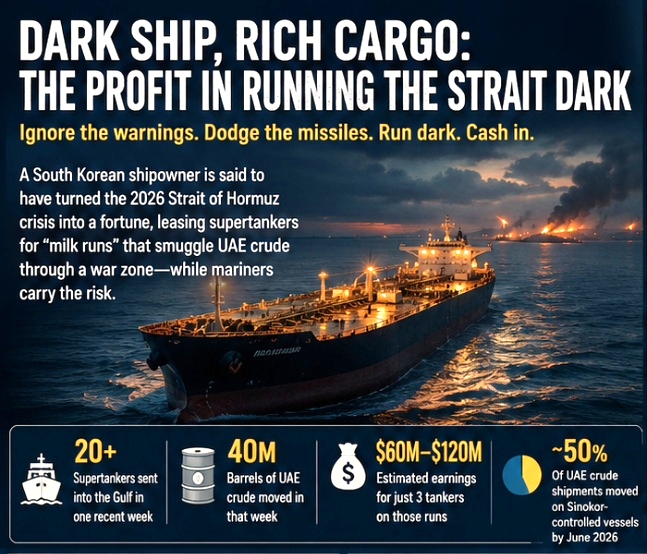
Bloomberg reported this week that a private Korean shipping magnate, Ga-Hyun Chung, has quietly become one of the biggest winners of the 2026 Strait of Hormuz crisis. His Sinokor Group leased supertankers to the Abu Dhabi National Oil Company (Adnoc) for what traders nicknamed the “milk runs” — repeated quick trips carrying United Arab Emirates (UAE) crude out of the war zone. By June, nearly half of all Emirati crude shipments were moving on Sinokor-controlled vessels; in a single recent week the company sent more than twenty supertankers into the Gulf, enough to carry some forty million barrels.
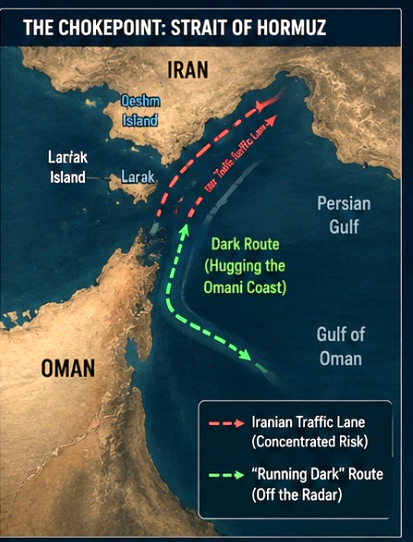
How the oil moved will be familiar to anyone who read our earlier post, Running Dark Through Hormuz. Many of these tankers sailed or ran “dark”, meaning their Automatic Identification System (AIS) — the transponder that continuously broadcasts a vessel’s identity, position, course, and speed — was switched off while sailing, often at night, hugging the Omani coast in convoy before passing their cargo to waiting ships in the calmer Gulf of Oman. Brokers estimate that three tankers on those runs alone may have earned Sinokor between sixty and one hundred twenty million dollars.
Why a Ship Goes Dark
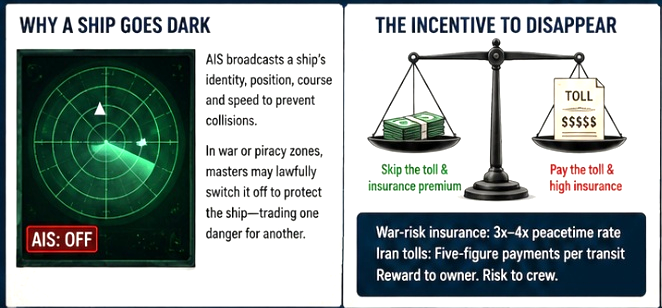
AIS exists for one purpose above all others: to keep ships from striking one another. Under the International Convention for the Safety of Life at Sea (SOLAS), Regulation V/19, every cargo vessel of 300 gross tonnage (GT) or more on an international voyage must carry AIS and keep it running whenever underway or at anchor.
There is a narrow exception: the International Maritime Organization (IMO) permits a master to switch the system off when he reasonably believes that keeping it on would compromise the safety or security of his ship — the textbook case being waters plagued by piracy or war.
With merchant ships struck by drones and projectiles, crews seized, and mines left unswept in the lanes, the Strait of Hormuz fit this description. Going dark, in that scenario, can be a defensible act of self-preservation. But it answers one danger by creating another — and it quietly rearranges who is left exposed to the rest.
The Incentive to “Disappear”
War-risk insurance premiums for a Hormuz transit ran three to four times the peacetime rate, and Iran’s self-declared Persian Gulf Strait Authority began demanding five-figure tolls to cross, as we described in Tehran’s Toll Booth. Together those facts create a powerful — and troubling — incentive. An owner can pay the toll and sail in the open, or he can darken the ship, skip the toll, and pocket the premium. The reward for accepting the risk is enormous, and flows to the owner, while the physical exposure and risk rides with the ship’s officers and crew.
A Crowded, Blacked-Out Chokepoint
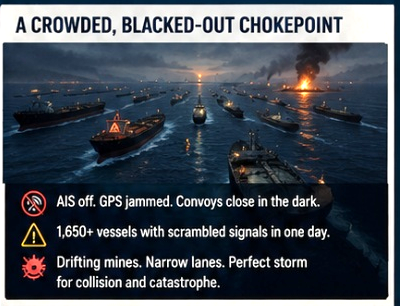
Switching off AIS does not make a three-hundred-thousand-ton tanker vanish from the water — only from the screen. The situation in the Strait was already chaotic: Iran funneled traffic into a single narrow lane near Larak and Qeshm islands; add widespread jamming of GPS (one analytics firm counted more than 1,650 vessels with scrambled signals in a single day), convoys moving and drifting close together in darkness, and deadly drifting minefields, and you have a “perfect storm” of conditions for potential collisions and casualties.
The Human Freight, Continued
In our last post, The Human Freight of the Hormuz Strait, we wrote about the roughly 8,000 seamen still stranded in the Gulf after the strait reopened, and the resurgence of Somali piracy that has turned the voyage home into its own gauntlet — forty-four mariners are, as of this week, still held captive aboard hijacked ships.
Comparing this human cost of operation in the Strait, to “running dark” profits, and the imbalance is extreme. These mariners, often from developing countries, may see virtually none of these huge war-risk profits, all while being threatened, shot at, bombed, and — if the pirates get their chance — held for ransom, too.
When the Lights Go Out, the Duties Do Not
In a situation like the Strait of Hormuz, here are the key legal protections that matter most for American mariners:
- Jones Act negligence — An employer is liable if its negligence played “any part, even the slightest” in causing injury. That low bar reflects Congress’s view that those who profit from sending sailors to sea bear responsibility when they’re harmed.
- Warranty of Seaworthiness — A vessel owner is strictly liable for injuries when the ship isn’t “reasonably safe” for voyage ordered, covering the equipment, ship condition, officers, and crew.
- Maintenance and Cure benefits— An old admiralty obligation requiring owners to cover a seaman’s living expenses and medical costs after an injury incurred in service of the vessel, regardless of fault, until the seaman reaches maximum medical improvement (MMI).
Additionally, U.S. General Maritime Law law imposes an affirmative duty to warn the crew of known dangers, alongside a seafarer’s right to refuse unsafe passage — protections we examined through the M/T Settebello and the duty to warn.
For a U.S mariner aboard a vessel:
- Ordered into an active combat zone, such as where military forces have already fired on merchant ships,
- Operating with a deliberately-disabled tracking and collision-avoidance system,
- Without protection, communication or regulatory compliance protocols,
- In a darkened (dim/no lights) convoy,
- At night,
- After international regulators warned against it, and insurers priced against the danger,
It is likely the above legal protections would apply.
However, for international mariners, which body of law governs turns on the vessel’s flag, the crew’s nationality, and where the harm occurs. Many of the world’s tankers fly “flags of convenience”, and their crews must look first to the Maritime Labour Convention (MLC) — which can be internationally complex to enforce. But the ancient principle underneath all of it is the same: those who profit from sending sailors to sea must answer when those sailors are harmed.
Why This Reaches the Gulf Coast
Though few of our clients will run the Strait of Hormuz, the principles are the same. Every day, seamen out of Galveston, the Houston Ship Channel, the wider Gulf, and everywhere on or near U.S. waters are asked to work in conditions their employers chose — short-handed, hurried, or aboard equipment that is not fit of safe — and are told the risk is simply part of the trade. We disagree; whether the hazard is a mine in the Coast of Oman, or a missing guardrail off a Galveston ferry, the same body of law asks the shipowner to answer for it, and the same question decides the case: did the owner act reasonably, and stand behind the crew?
A Fortune and Its Cost
Ga-Hyun Chung’s run through Hormuz is a genuine feat of nerve and timing, and the world’s oil kept flowing because someone was willing to run that gauntlet. But a fortune built on sending crews through a war zone in the dark carries an obligation that never appears on the balance sheet; a ship may run dark, but a shipowner’s duty to the men and women aboard her never does.
Maritime Trivia Question!
Q: The phrase “run the gauntlet” — to pass through or between danger — has a seafaring past. Where did the word gauntlet in that phrase come from?
A: Not from the french armored glove gantelet, but instead from Swedish gatlopp (literally “lane-run”), a military and naval punishment in which an offender ran between two rows of shipmates who struck him as he passed. English sailors borrowed it in the 1600s as “gantlope,” A naval version of the gauntlet was historically used in the British Royal Navy as a punishment for minor offences such as leaving the crew berths in an unsanitary state, or failing to return on time from leave. The condemned was ordered to make a prescribed number of circuits around the ship’s deck, while his shipmates struck him with knotted rope Over time and familiarity, this gradually reshaped into the “gauntlet” we say today.
We at the Herd Law Firm are proud to fight for seamen, maritime workers and passengers in all types of personal injury and death claims. As maritime personal injury attorneys (and sailors ourselves!) located in northwest Houston, we never waver in our commitment to help these maritime workers, passengers, and their families when they are injured or mistreated.
The information in this post is for general informational purposes only and does not constitute legal advice. For questions specific to your maritime law issue, please contact us at 713-955-3699 or at Charles.Herd@HerdLawFirm.com.
Sources
1. Soon, Weilun; Longley, Alex; Di Paola, Anthony. “The Tanker Tycoon Making Millions on Hormuz Shuttle Runs.” Bloomberg, July 6, 2026 (syndicated by Fortune). https://fortune.com/2026/07/05/supertanker-tycoon-sinokor-ga-hyun-chung-hormuz-oil-tanker-shuttles/
2. Soon, Weilun, and Stephen Stapczynski. “The Race to Rescue 8,000 Sailors Still Stranded Behind Hormuz.” Bloomberg, July 5, 2026. https://www.bloomberg.com/news/articles/2026-07-03/strait-of-hormuz-sailors-remain-trapped-despite-iran-us-ceasefire
3. Schuler, Mike. “IMO Chief Urges Immediate Release of 44 Seafarers Held by Somali Pirates.” gCaptain, July 6, 2026. https://gcaptain.com/imo-chief-urges-immediate-release-of-44-seafarers-held-by-somali-pirates/
4. International Maritime Organization. “AIS transponders” (SOLAS Chapter V, Regulation 19). https://www.imo.org/en/ourwork/safety/pages/ais.aspx
5. Maritime Mutual. “Automatic Identification System (AIS) — ‘cloaking’ and consequences” (IMO Resolution A.1106(29)). https://maritime-mutual.com/risk-bulletins/automatic-identification-system-ais-cloaking-and-consequences/
6. SAFETY4SEA. “‘Going dark’ is a red flag — AIS tracking and sanctions compliance.” https://safety4sea.com/going-dark-is-a-red-flag-ais-tracking-and-sanctions-compliance/
7. Windward. “GPS Jamming Surges in the Middle East Gulf, 1,650 Ships Hit.” https://windward.ai/blog/gps-jamming-surges-in-the-middle-east-gulf-1650-ships-hit/
8. International Labour Organization. “Maritime Labour Convention, 2006 (MLC, 2006).” https://www.ilo.org/international-labour-standards/maritime-labour-convention-2006
9. Legal Information Institute, Cornell Law School. “46 U.S. Code § 30104 — Personal injury to or death of seamen (Jones Act).” https://www.law.cornell.edu/uscode/text/46/30104
10. Legal Information Institute, Cornell Law School. “46 U.S. Code § 30302 — Cause of action (Death on the High Seas Act).” https://www.law.cornell.edu/uscode/text/46/30302
11. U.S. Coast Guard, Navigation Center. “AIS Requirements.” https://www.navcen.uscg.gov/ais-requirements