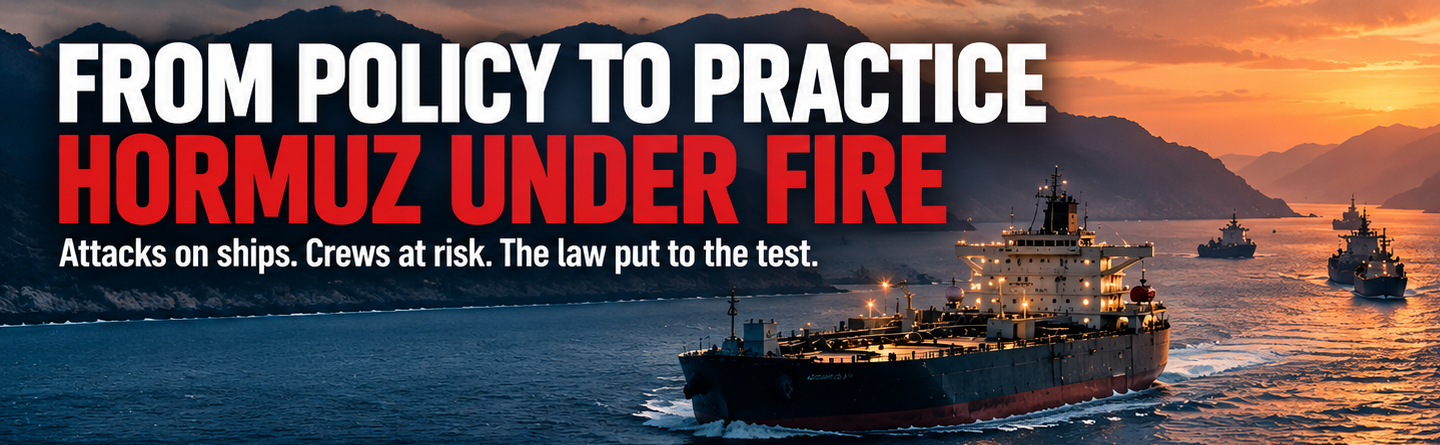
After nearly four months of conflict, President Trump and Iranian President Pezeshkian have put pen to paper. Tankers are sailing again, but mines lie in wait, insurance premiums remain stratospheric, and the hardest negotiations are just beginning.
On the evening of June 17, 2026, at the Palace of Versailles, President Donald Trump signed a 14-point Memorandum of Understanding (MOU) with Iran’s President Masoud Pezeshkian. The Strait of Hormuz, closed to normal commercial traffic since late February, is now formally open. By Thursday morning, oil tankers will be moving through it for the first time in two months.
If you are a maritime worker or a member of their family employed in the area, you have been watching this harrowing situation for months. However, now is the moment that, as is usually the case in maritime law and in geopolitics alike, that the fine print really matters.
What the Deal Actually Says
The memorandum of understanding is an interim, or temporary framework, not a permanent peace treaty. Its most immediate provisions include:
- the Strait of Hormuz reopening toll-free for sixty days,
- the U.S. naval blockade of Iranian ports being lifted, and
- the two countries enter a negotiating window to resolve deeper questions — most significantly, the future of Iran’s nuclear program.
- A ceasefire in Lebanon, where Iran demanded an end to Israeli operations as a condition of any deal, is also embedded in the agreement, though Israel’s government has signaled it will keep troops in southern Lebanon indefinitely. How that tension resolves will shape the durability of everything else.
The passage of the word “toll-free” in the text is not incidental. Throughout the conflict period, Iran’s newly constituted Persian Gulf Strait Authority (PGSA) was charging vessels reported sums of approximately $2 million per transit — a fee Tehran described as compensation for navigational and environmental services. At that level of expense, many operators found routing a supertanker around the Cape of Good Hope was already cheaper.
The deal, at least for the next sixty days, now removes this complication. What happens after those sixty days is a question that remains to be answered.
The Mine Problem
Here is the part that matters most to anyone actually putting a hull through the strait in the near term: there are still mines in the water. And the MOU’s language on removing them deserves to be read carefully, because it is considerably weaker than the headlines suggest.
Point 5 of the memorandum states that Iran “will make arrangements using its best efforts for the safe passage of commercial vessels” and that “demining by the Islamic Republic of Iran will be instated within 30 days.” Three things stand out from a legal and practical standpoint.
- “Best efforts” is one of the weakest obligation standards in contract law. That is not a guarantee, not a warranty, and not a firm commitment to complete the job, only a promise to “try”.
- The 30-day target refers to restoring commercial traffic to pre-war levels, but NOT to completing demining. Ships can be moving through a corridor that still contains uncleared mines, and the MOU states exactly that.
- The demining obligation falls on Iran, not on the U.S.-led multinational coalition that France and Britain have spent months organizing. Whether Iran has the capability, the intention, or the willingness to accept allied minesweeping assistance alongside its own efforts is not addressed.
The Pentagon’s private estimate, shared in a classified briefing to the House Armed Services Committee, put full mine clearance at up to six months (a figure the Pentagon publicly disputed but did not replace with a firm alternative). The optimistic 40-day floor assumes known mine locations, no interference, and favorable conditions. At least one advanced Iranian device — the Maham-7, a seabed weapon specifically designed to defeat the sonar systems of Western minesweepers — has been identified as a particular clearance challenge with no easy analog in prior Gulf operations.
For historical context: after the 1990–91 Gulf War, multinational coalition forces took more than two years to declare the northern Gulf mine-free, though the scale there was much larger.
France and Britain have been working for months on a coordinated demining and escort mission, and G7 partners issued a statement affirming their commitment to “playing their part” in restoring safe passage. That mission has not yet formally launched. The Joint Maritime Information Center (JMIC), the U.S.-led maritime security body in Bahrain, downgraded the Hormuz threat level from “SEVERE” to “SUBSTANTIAL” after the deal was announced; However, its advisory still warns that “an attack is still a strong possibility” and that “caution is advised on all approaches.”
Insurance: The Second Gate
Even before the first mine is cleared, commercial shipping faces a second chokepoint: insurance. War-risk premiums for Hormuz transits surged to between one and five percent of hull value during the conflict — roughly twenty to twenty-five times their pre-conflict rates. P&I clubs, the mutual insurers that cover liability, pollution, and crew injury for roughly ninety percent of the world fleet, cancelled their Gulf and Hormuz coverage extensions as early as March 5, 2026. The Lloyd’s Joint War Committee has expanded its high-risk designation to cover the entire Persian Gulf, a classification that historically takes years to unwind.
As one unnamed war-risk underwriter told investingLive (a market and stocks news analysis source) this week: premiums are quick to go up, and slow to come down. A memorandum of understanding is not the same as demonstrated safety on the water over time. The major container lines — Maersk, MSC, CMA CGM, Hapag-Lloyd — have all signaled they will not assume a return to pre-conflict conditions just because a deal has been signed. MOL (Mitsui O.S.K.), one of the world’s largest shipping groups, has publicly stated its vessels will not resume normal Hormuz transit until safety is demonstrated in practice.
What This Means for Maritime Workers Legally
The conflict period exposed legal questions that will take years to fully resolve. Thousands of seafarers were stranded in the Gulf theater during the height of the crisis — the IMO (International Maritime Organization) logged forty-six maritime incidents in the strait and fourteen fatalities. Workers who were injured during minesweeping operations, ordered into the transit zone during active hostilities, or trapped aboard stranded vessels in a war zone may have claims that look very different from an ordinary Jones Act or maintenance-and-cure analysis.
War-risk provisions in employment contracts and collective bargaining agreements (provisions that most seafarers have never needed to read carefully) suddenly became the most important words in those documents. The question of whether an employer adequately warned crew of a known danger, whether crew were ordered into harm’s way without sufficient information or protection, and whether the Iran transit-fee payments by shipowners created any sanctions exposure under U.S. secondary sanctions law are all active issues. The deal’s silence on whether prior transit-fee payments constitute a General License or merely a political understanding leaves compliance lawyers with more questions than answers.
Sixty Days, and Then What?
The deal buys sixty days of toll-free passage and a negotiating window. Iran’s lead negotiator Mohammad Baqer Ghalibaf said this week that “the Strait of Hormuz will not return to pre-war conditions” and that Iran intends to collect fees for maritime services going forward. Tehran has acknowledged the agreement, but its Deputy Foreign Minister cautioned publicly that “the hardest part” still lies ahead.
The nuclear question is unresolved, as well as the conflict in Lebanon question. The question of permanent Iranian sovereign leverage over the most important energy chokepoint in the world is entirely unresolved.
What the deal does accomplish is a return of ships to the water, and a starting point for the slow, hard work of rebuilding confidence. The WTO (World Trade Organization) recorded a ninety-five percent reduction in crude carrier transits and a ninety-nine percent reduction in LNG (liquefied natural gas) carrier transits during the closure.
We at the Herd Law Firm are proud to fight for seamen, maritime workers and passengers in all types of personal injury and death claims. As maritime personal injury attorneys (and sailors ourselves!) located in northwest Houston, we never waver in our commitment to help these maritime workers, passengers, and their families when they are injured or mistreated.
The information in this post is for general informational purposes only and does not constitute legal advice. For questions specific to your maritime law issue, please contact us at 713-955-3699 or at Charles.Herd@HerdLawFirm.com.
Sources
1. NBC News, “The US-Iran war deal is signed and tankers are moving through Hormuz again,” June 18, 2026.
2. NPR, “U.S. and Iran announce an initial deal to end the war and reopen the Strait of Hormuz,” June 15, 2026.
3. CNBC, “Strait of Hormuz reopening may take weeks to ease shipping backlog and oil pressure,” June 18, 2026.
4. PBS NewsHour, “What to know about the demining and escort mission that U.S. allies want for the Strait of Hormuz,” June 17, 2026.
5. Al Jazeera, “What the Trump-Iran agreement says about Lebanon, Hormuz and uranium,” June 18, 2026.
6. CBC News, “U.S. and Iran sign deal that includes plan to reopen Strait of Hormuz, 2-month window for nuclear talks,” June 18, 2026.
7. Tech Times, “Strait of Hormuz Reopens: US-Iran Deal Ends 107-Day Blockade but Mines Remain,” June 15, 2026.
8. House of Saud, “Hormuz Mine Clearance Will Take Months After Iran Deal,” June 15, 2026.
9. Paul Morgan, gCaptain, “The Numbers Tell an Interesting Story,” June 2026 (pasted analysis).