A U.S. Navy drone just rescued two Apache pilots from the waters off Oman. Meanwhile, a Rhode Island startup is about to fly passengers over the ocean at 180 mph. The water is getting a lot more interesting — and maritime law must catch up.
On the morning of June 8, 2026, a U.S. Army AH-64 Apache attack helicopter went down near the coast of Oman while conducting patrol operations over the Strait of Hormuz. According to U.S. Central Command (CENTCOM), both crew members were recovered from the water within approximately two hours and were reported in stable condition. Though some U.S. officials, including President Trump, have indicated the cause of the crash to be an Iranian drone strike, the incident remains under investigation.
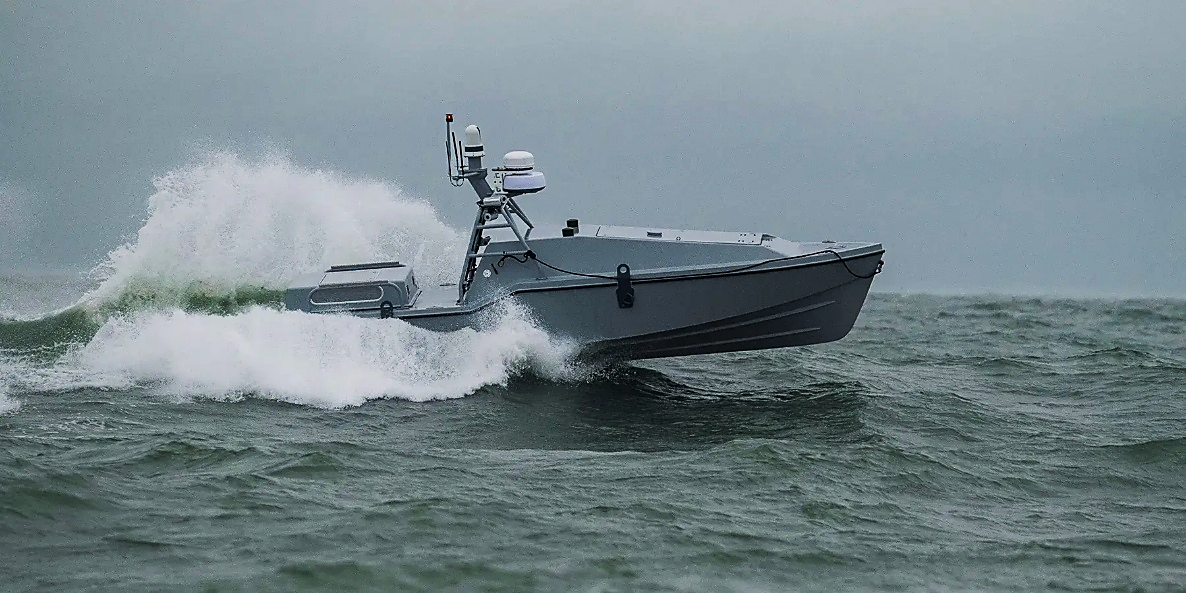
What made the rescue remarkable was the vehicle that performed it: a Saronic Corsair, a 24-foot autonomous surface vessel (ASV), or drone, operated by the U.S. Navy’s Task Force 59, the dedicated unit for integrating unmanned systems and artificial intelligence into maritime operations in the Middle East. As Navy Captain Tim Hawkins, a CENTCOM spokesperson, described it to Reuters: the drone picked the pilots up from the water, and then transported them to a location where a helicopter could hoist them to safety.
This is, by all accounts, the first publicly reported U.S. military personnel rescue conducted via drone.
The Corsair is a diesel-powered platform capable of carrying up to 1,000 pounds and operating over 1,000 nautical miles without a crew. The vessel combines radar, cameras, satellite communications, and autonomous navigation software, allowing it to operate independently while maintaining awareness of surrounding traffic and hazards.
Regardless of what ultimately happened in the air above the Strait of Hormuz, the operational significance of what happened on the water below it is clear: unmanned vessels are no longer experimental platforms, but a real operational force, doing real missions.
However, the Corsair is not Saronic’s only drone platform. In May 2026, the company launched its first Marauder Medium Unmanned Surface Vessel — a 180-foot autonomous ship capable of speeds exceeding 25 knots, ranges of up to 5,400 nautical miles, and payloads of up to 150 metric tons, including standard shipping containers.
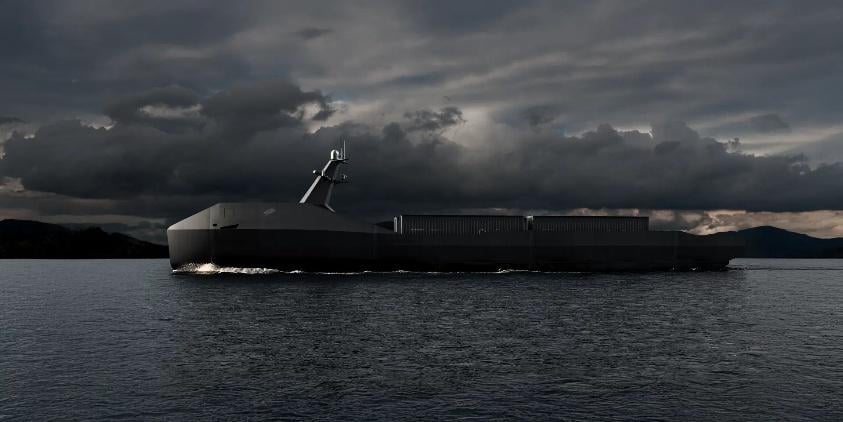
According to the company, the first Marauder hull progressed from initial design to on-water trials in less than a year. Multiple hulls are already under construction at Saronic’s shipyard in Franklin, Louisiana, where the company ultimately aims to produce up to 20 vessels annually.
Saronic also has developed the Mirage, a 52-foot autonomous surface vessel with a range of 2,500 nautical miles and a payload capacity of 3,500 pounds, designed to work alongside both manned and unmanned teams across a range of maritime operations in any ocean. The Mirage is built for longer range as well: extended patrols, ISR, and operations in potentially contested waters far from port.
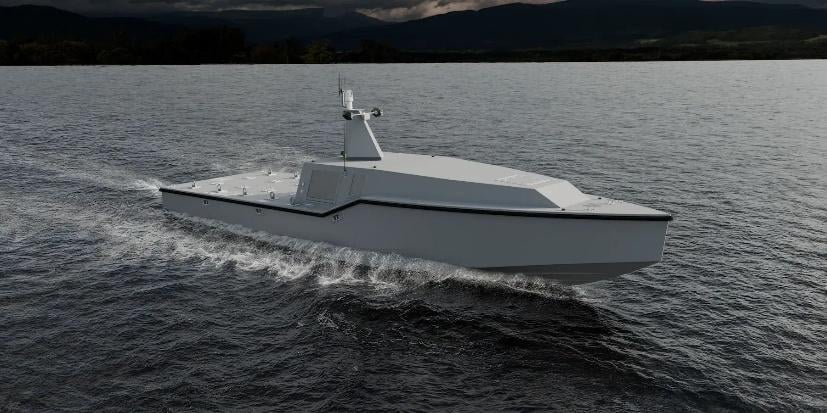
Together, the Corsair, Mirage, and Marauder represent something the U.S. Navy has not had before: a family of purpose-built autonomous surface vessels/drones spanning the full range, from coastal patrol to open ocean logistics, produced domestically at scale. In April 2026, Saronic raised $1.75 billion in Series D funding at a valuation of $9.25 billion, one of the largest fundraising rounds in maritime technology history.
In December 2025, the U.S. Navy awarded Saronic a $392 million production contract — one of the fastest transitions from prototype to production in recent Navy acquisition history.
The company already has positioned itself not just as an autonomy developer but as a shipbuilder, helping to expand U.S. industrial capacity to compete with China’s growing maritime dominance.
Enter the Seaglider: Neither Boat, Nor Plane
While the Oman rescue was unfolding, a quieter but equally significant story was playing out in Narragansett Bay, Rhode Island. A company called REGENT (Regional Electric Ground Effect Nautical Transport) has been conducting sea trials of a craft called the Viceroy Seaglider, a 55-foot, 65-foot-wingspan vehicle designed to carry 12 passengers and 2 crew at 180 mph just above coastal waters, powered entirely by batteries, for up to 180 miles.
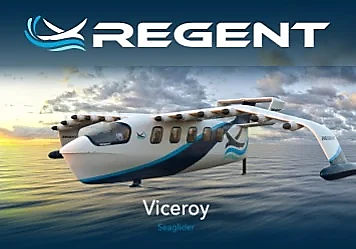
The Viceroy Seaglider vessel operates exclusively over the water in three modes: floating on the hull (like any boat), foiling on hydrofoils, and flying/gliding. The intermediate “foiling mode” enables the vessel to glide smoothly above the water, enhancing speed, agility, and passenger comfort while preparing for wing-in-ground effect flight.
However, rather than flying at altitude, the Viceroy utilizes what engineers call the wing-in-ground (WIG) effect, which uses the aerodynamic cushion that forms between its wings and the water surface to generate extra lift and dramatically reduce drag. The result is something that operates exclusively over but within one wingspan of the water — on its hull, on hydrofoils, or by wing — and is regulated by maritime authorities rather than aviation regulators. That distinction means it is regulated by the U.S. Coast Guard (USCG) and global maritime authorities—not the FAA (Federal Aviation Administration), which may simplify both its legal certification and commercial deployment.
In April 2026, REGENT also completed the first autonomous WIG flight of its smaller Squire Seaglider defense drone (the first defense-focused WIG craft to fly in the U.S.) and is developing the platform for ISR (intelligence, surveillance, reconnaissance), logistics, search and rescue, and anti-submarine warfare missions.
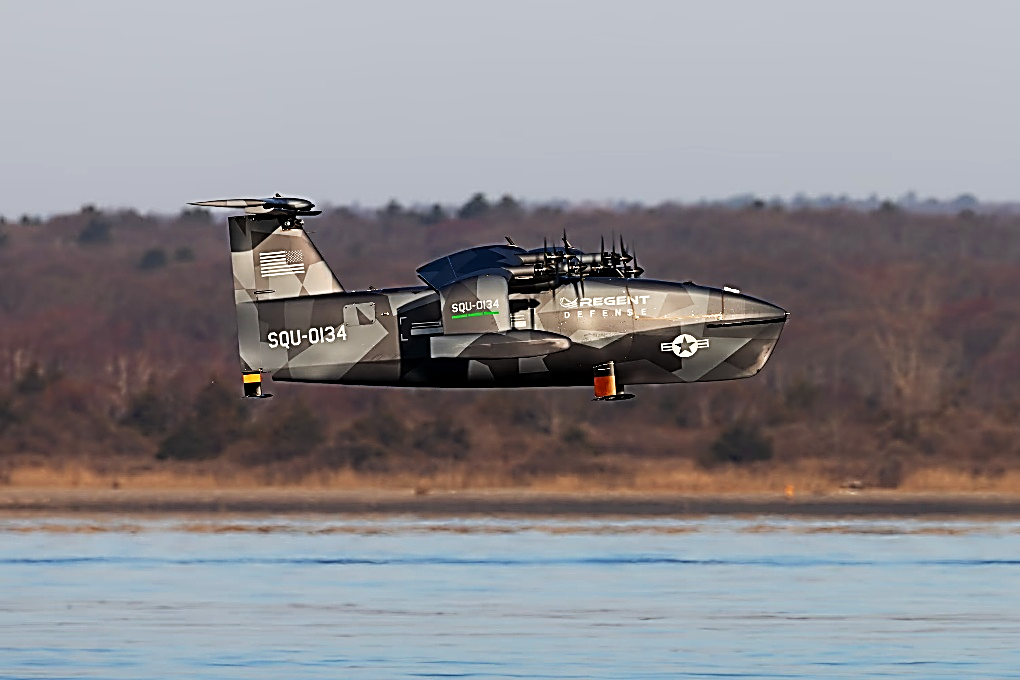
Multiple other Viceroy variants are in development as well, including a crewed hybrid with a range of 1,400 nautical miles.
One of the clearest signals that the Seaglider is moving from promising prototype to commercial reality came in recent weeks, when Mitsui O.S.K. Lines (MOL), Japan Airlines (JAL), Lloyd’s Register, and REGENT announced a joint agreement to develop certification and operational approval processes for Seaglider vessels in Japan — the first collaboration in that country involving a classification society aimed at commercializing the technology.
For those outside the maritime industry, the involvement of Lloyd’s Register may not sound like headline news. It is. Classification societies are the gatekeepers of maritime commercial operation, and their approval processes are what stand between a promising vessel concept and an insured, financed, port-admitted commercial service. When Lloyd’s Register signs on as independent technical and safety advisor tasked with establishing a certification framework— alongside two of Japan’s most significant transportation operators— it signals the Seaglider is being treated as a serious commercial platform.
MOL and JAL bring more than capital to the partnership: decades of operational experience managing passenger and cargo movements across some of the world’s most complex maritime and aviation corridors. Japan, with its island geography and dense coastal population, is in an ideal early market for high-speed electric coastal transport. The parties have set a current target of commercial Seaglider operations around 2030.
Certification frameworks developed with Lloyd’s Register for this Japanese market will inform how Seagliders are approved in other jurisdictions as well — including, eventually, the United States, where coastal ferry routes between cities like Houston, Galveston, San Francisco, Berkley, NYC and the New Jersey area, and other points along the American coastline could one day be served by exactly this kind of craft.
What This Means for Maritime Law and Operations
These two technologies — the autonomous surface vessel and the wing-in-ground-effect craft — raise a set of legal and practical issues that the maritime industry has just begun to address:
- Liability and the unmanned vessel. When an autonomous vessel causes damage, who bears responsibility? The operator? The manufacturer? The entity that programmed the mission? Traditional maritime law assigns liability based on relationships between owners, operators, and crew. When there is no “crew” (at least in the normal sense), those frameworks may fail. The Jones Act, the Longshore and Harbor Workers’ Compensation Act, and the general maritime law remedies available to injured seamen all assume human beings in harm’s way. Autonomous systems blur those lines considerably.
- The regulatory status of WIG craft. In the United States, the U.S. Coast Guard regulates Seaglider vessels as maritime craft — a deliberate choice by REGENT that reduces regulatory burden and cost compared to FAA certification. But WIG craft operate at the intersection of maritime and aviation law, and that intersection is not yet clearly mapped. International Maritime Organization (IMO) guidelines on WIG craft date to 2002, and were written with very different (likely larger and heavier) vehicles in mind.
- Offshore and maritime workers. For workers in offshore industries, the expansion of autonomous vessels and high-speed WIG craft creates both opportunity and risk. Autonomous vessels can perform dangerous missions without putting crew members in harm’s way, such as what happened in the Oman rescue. But they also change the nature of the maritime workforce, and they operate in environments where the legal protections for injured workers were written for an era of crewed vessels.
- Collision rules and “Rules of the Road”. The IMO’s 1972 COLREGS (Convention on the International Regulations for Preventing Collisions at Sea) were written for vessels with human watch-keepers making real-time decisions, and autonomous vessels will interpret and apply those rules through software. However, a WIG craft crossing a shipping lane at 180 mph, a foot above the water, is something no conventional lookout has ever been trained to handle. As these platforms multiply, the question of how they interact with conventional maritime traffic in similar scenarios will become increasingly important.
The Bigger Picture
The Oman rescue and the Seaglider trials represent the evolving relationship humans have with the sea. Even though U.S. Navy Task Force 59 has been integrating unmanned systems into daily maritime operations in the Persian Gulf, Gulf of Oman, Red Sea, and surrounding waters since 2021, the promise of applied autonomous and semi-autonomous maritime platforms has so far mostly lived in presentations and prototype demonstrations. Whatever the political controversy surrounding the underlying incident, the Oman rescue demonstrated that these platforms are now doing real work in real conditions. REGENT’s Viceroy program shows us how commercial maritime transport may potentially be on the verge of tech transformation.
We at the Herd Law Firm are proud to fight for seamen, maritime workers and passengers in all types of personal injury and death claims. As maritime personal injury attorneys (and sailors ourselves!) located in northwest Houston, we never waver in our commitment to help these maritime workers, passengers, and their families when they are injured or mistreated.
Sources:
Reuters / CENTCOM: U.S. military statement and Navy Capt. Tim Hawkins quotes on the Oman rescue, June 8–9, 2026.
gCaptain: “In a First, Navy Surface Drone Rescues Army Apache Pilots After Crash Off Oman.” June 2026.
Saronic Technologies: Company statement on Corsair ASV rescue operation, June 2026; U.S. Navy $392 million Corsair production contract, December 2025.
REGENT Craft official announcement: “REGENT Squire Seaglider Drone Performs Ground-Effect Flight,” April 13, 2026. regentcraft.com
Naval News: “REGENT’s Squire Seaglider Drone Performs Ground-Effect Flight,” April 14, 2026.
Defense One: “Flying Boats and AI-Run Factories Pitched at ‘Reindustrialize’ Event,” July 22, 2025.
Army Recognition: “U.S. Tests New Squire Seaglider Drone to Sustain Marine Corps Littoral Forces Without Airfields,” April 15, 2026.
Autonocion.com: “It’s Not a Plane, and It’s Not Quite a Boat: REGENT’s Viceroy Seaglider,” June 2026.
The information in this post is for general informational purposes only and does not constitute legal advice. For questions specific to your maritime law issue, please contact us at 713-955-3699 or at Charles.Herd@HerdLawFirm.com.