
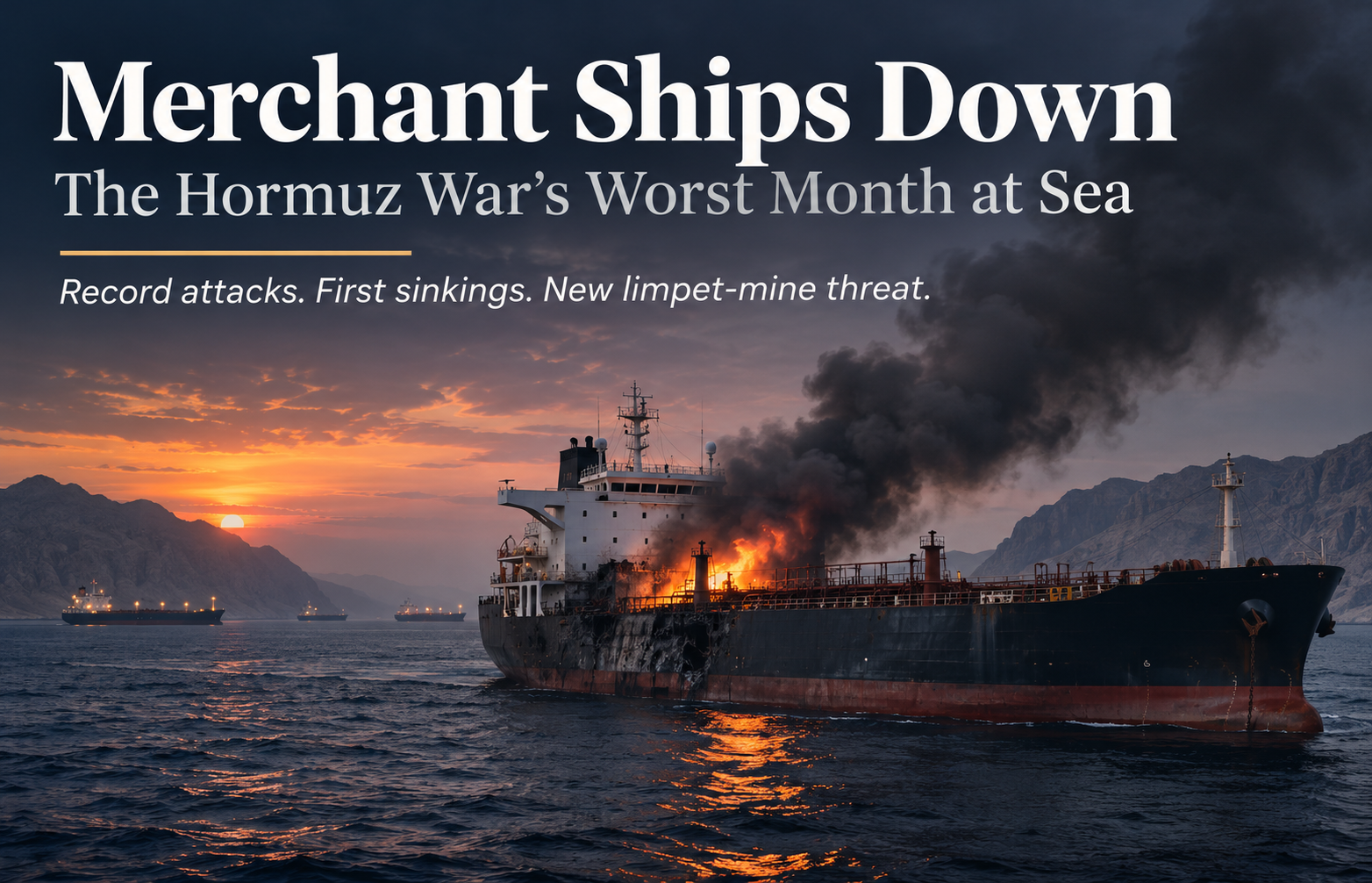
October brought more attacks on shipping than any month of the Hormuz war: the first large cargo ships sunk, a new weapon in the water, and hundreds of vessels waiting at anchor. Here is what the law owes their crews.
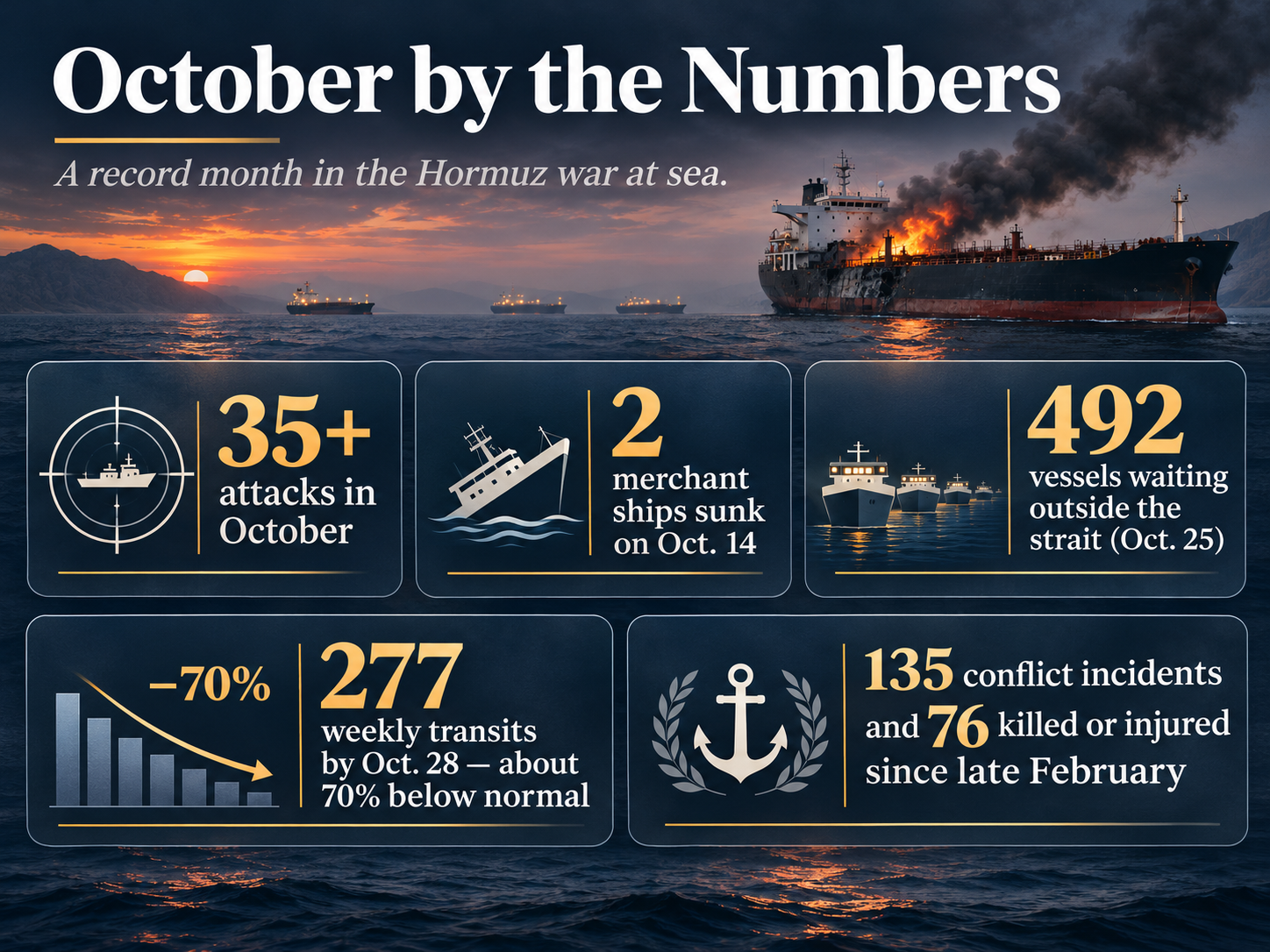
No captain wants to give the order “abandon ship.” In October, more crews near the Strait of Hormuz came close to hearing it than in any month of the war. The International Maritime Organization (IMO) counted 35 attacks on commercial shipping, topping March’s roughly 30, the war’s previous worst. And for the first time, large cargo ships went to the bottom. November has brought no relief.
In a number of our past posts (such as From Policy to Practice, Hormuz Under Fire), we wrote about the covert commercial crews running the Strait of Hormuz “dark” (at night without lights, transponders, or radio). The risks they were steering around have now become reality.
The First Ships Lost
For seven and a half months, the war had damaged merchant ships, set them ablaze, even killed crew. A tug went down in March, and a bulk carrier split apart off Bandar Abbas in July, but no oceangoing container ship or bulker had been sunk by an attack. On October 14, that changed.
Fortunately, all 21 crew of the container ship M/V GFS Pride were off the ship when she sank under tow after a strike and fire; Singapore’s Maritime and Port Authority (MPA) confirmed no crewmen were hurt.
The bulk carrier M/V Cape Dao followed her down that same day. Her crew had abandoned ship in late September after a strike off Oman killed one of their own, and salvage efforts had failed.
A Month of Attacks
The sinkings came in the middle of that record month. United Kingdom Maritime Trade Operations (UKMTO) recorded 12 attacks in the week of October 5–11 and 12 more in the week ending October 16. Among the ships hit:
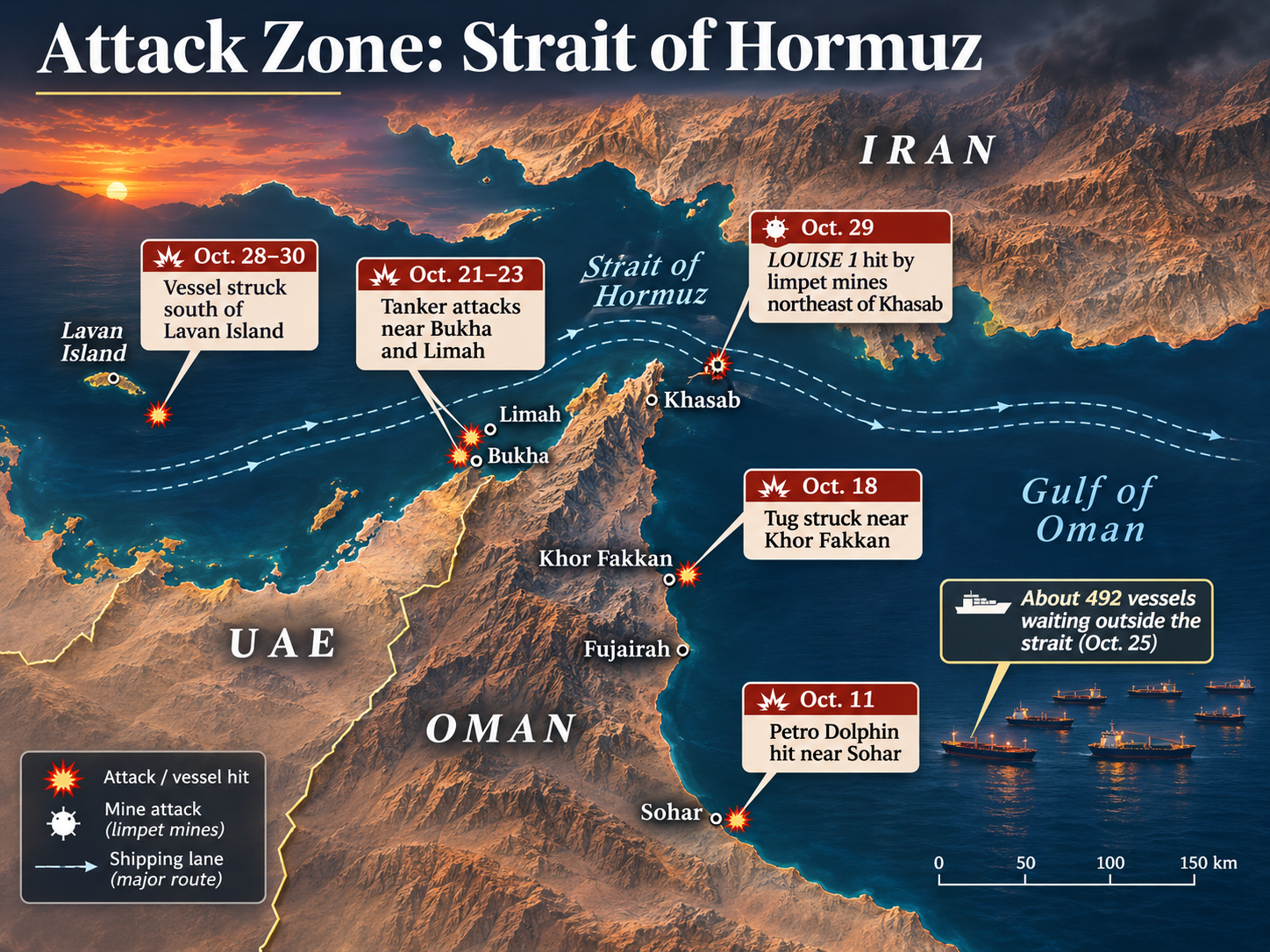
- M/T Petro Dolphin, hit by a drone at the Sohar anchorage off Oman on October 11. Nine of her 11 Indian crew were rescued; as of late October, two remained missing.
- M/T ACER, attacked by drones on October 7. One Filipino seafarer was injured, rescued by Qatari forces, and treated in Doha; his 24 crewmates were safe.
- M/T Valthera, struck by a projectile that started a fire. All 11 Indian crew were reported safe.
- M/V GFS Giselle, sister ship of M/V GFS Pride, struck but able to reach a safe anchorage with all 22 crew unhurt.
- M/V Ocean Molica, a Panama-flagged bulker disabled by a U.S. fighter jet after her crew ignored repeated warnings and tried to run the U.S. blockade of Iranian ports. U.S. Central Command (CENTCOM) reported no injuries.
The strikes also are getting more precise. Bloomberg counted 23 attacks in or near the strait in the first two weeks of October; at least five hit engine rooms, which no September strike in the strait had done. That puts engineers and oilers, who stand watch beside the machinery, closest to the blast.
The Weeks After the Sinkings
The destruction did not let up:
- October 16. The Marshall Islands-flagged very large crude carrier (VLCC) M/T ST 3 was hit about 68 nautical miles northeast of Al Jubail, Saudi Arabia, starting an engine-room fire and cutting her power. All 15 Indian crew were evacuated to a container ship flagged in the United Arab Emirates (UAE).
- October 18. A tug about 20 nautical miles northeast of Khor Fakkan, UAE, was struck by two projectiles. One crew member was slightly hurt; the tug carried on.
- October 21. A tanker was hit about 11 nautical miles west of Bukha, Oman, at the mouth of the strait. The fire was eventually extinguished.
- October 22–23. A liquefied petroleum gas (LPG) tanker was struck northeast of Limah, Oman, and an outbound tanker was disabled in the strait; her crew were safe.
- October 28–30. The outbound VLCC M/T ARZANAH was struck in the strait. The tanker M/T RITI lost propulsion after a strike near Khasab, and the Royal Navy of Oman evacuated all 25 crew. The Qatari liquefied natural gas carrier (LNG/C) LNG/C AL MAYEDA caught fire about 40 nautical miles south of Iran’s Lavan Island; no one was hurt.
- November 1. The offshore tug M/V Selat Storm was struck northwest of Oman’s Musandam Peninsula and later sank, and the product tanker M/T Largo Atom was hit by two projectiles inside the Persian Gulf.
- November 2. The Indian-flagged dhow MSV Al Jusufi (mechanised sailing vessel) was struck by an unidentified aerial object near Limah, Oman. Gandhar Nahim Ajij of Gujarat was killed; the Omani Coast Guard rescued his 13 crewmates.
- November 4–5. The product tanker M/T Velos Sapphire, sailing empty toward Bahrain, was struck about 50 nautical miles north of Madinat ash Shamal, Qatar, carrying the attacks into the middle of the Persian Gulf. A Filipino seafarer, first reported missing, was later found fatally injured aboard.
- November 7. A tanker identified by open-source analysts as M/T Navig8 Messi caught fire about eight nautical miles northwest of Khasab, and her crew evacuated. She had been hit once before, in August, and returned to the same trade after repairs. The same day, a U.S. aircraft disabled the St. Kitts and Nevis-flagged bulker M/V Huda after repeated attempts to run the blockade.
UKMTO counted at least 11 ships attacked in the week ending November 6; three sank. By then, the IMO counted at least 25 seafarers killed since the war began on February 28.
Throughout, Iran’s Islamic Revolutionary Guard Corps (IRGC) has claimed that unnamed tankers hit its mines on “unauthorized” routes, including two on November 1 and three on November 3. None of those claims has been independently confirmed.
A New (Old) Weapon in the Water
On October 29, the outbound tanker M/T LOUISE 1 met a weapon straight out of the Second World War. About 25 nautical miles northeast of Khasab, a small boat came alongside and fixed two explosive charges to her hull above the waterline. The blasts started an engine-room fire and briefly disabled her. Her crew put out the fire and she resumed her voyage, but security sources call it the war’s first successful limpet-mine attack on a merchant ship.
The danger is greatest for ships at anchor. As one security analyst warned, “a limpet mine below the waterline will cause significant damage and water ingress.” The Joint Maritime Information Center (JMIC) counted about 492 vessels waiting outside the strait on October 25, and about 490 on November 1. Each is an easy target for a small boat, and each has a crew aboard.
Two Claims to One Strait
Iran says the strait is unsafe for any ship that does not clear its route with Tehran’s new Persian Gulf Strait Authority (PGSA). The IRGC blames M/V GFS Pride’s loss on a mine and says the tankers hit since had switched off their transponders and strayed into zones Iran has declared off-limits.
CENTCOM tells a different story. It says M/V GFS Pride was struck by an IRGC projectile, that the strait had been swept clear of mines, and, in the words of its commander, Admiral Brad Cooper, that “the Strait of Hormuz is controlled by the United States and our regional partners, not Iran.”
Not everyone is so sure about the mines. On October 20, IMO Secretary-General Arsenio Dominguez said Iranian forces “still have mines” and that the threat is hard to verify.
On October 28, U.S. Naval Forces Central Command (NAVCENT) advised ships with no need to transit to “remain well clear,” warning that even neutral vessels may be questioned, boarded, and searched under the blockade.
Both narratives can hold some truth, as the shipping data suggests:
- Tankers willing to take the risk have pushed Persian Gulf oil flows near pre-war levels, according to Bloomberg, even as the U.S. blockade has cut Iran’s own crude exports close to zero.
- Yet UKMTO logged only 277 transits in the week to October 28, roughly 70% below normal, and in the week to November 10, still about 65% below.
- Brent crude oil reached $110 a barrel in mid-October for the first time since May.
- By mid-October, UKMTO had recorded 135 conflict-related incidents and 76 killed or injured since early March, and it warns those numbers run low because many attacked ships no longer report. By November 8, JMIC’s count had reached 177 incidents.
Talk of a deal hangs over it all. On November 9, Qatar’s prime minister, Sheikh Mohammed bin Abdulrahman Al-Thani, carried talks from Tehran to the White House. President Trump then said he would hold off on new strikes but keep the blockade. Iran wants the blockade lifted, sanctions waived, and frozen assets released before the strait fully reopens, and senior U.S. and Gulf officials doubt a deal is imminent. Until one is signed, nothing changes for the crews in the strait.
In short: the oil may be moving, but the people moving it often are paying the real price.
When the Ship Is Gone
Sinking a vessel does more than end a voyage. Crews can lose their jobs, housing, belongings, and way home all at once. The law has remedies for each, but which apply depends on the seafarer’s flag, contract, and nationality.
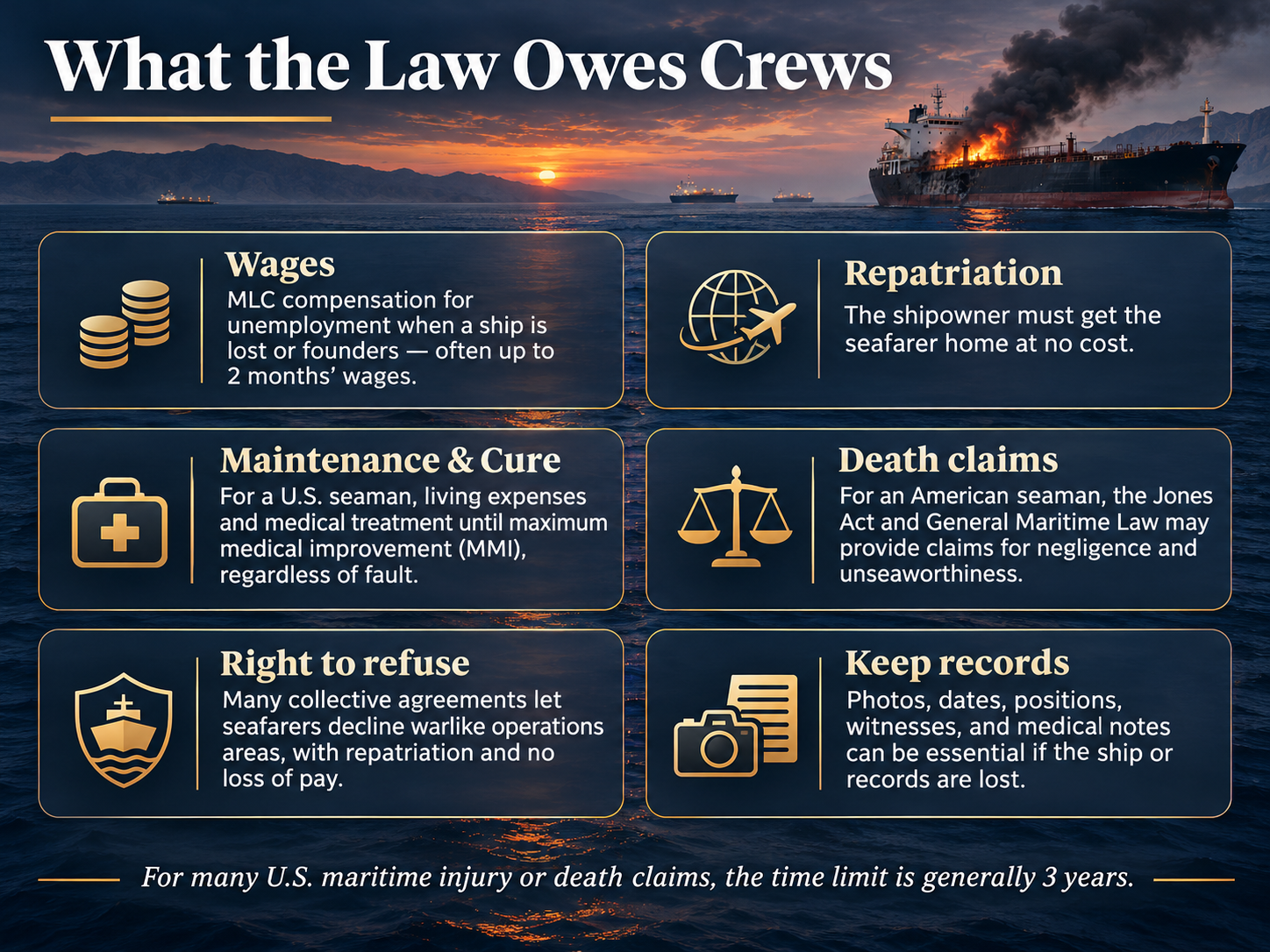
- Wages and loss of employment. The Maritime Labour Convention, 2006 (MLC) requires flag states to provide unemployment compensation when a ship is lost or founders, usually up to two months’ wages. Many collective agreements go further.
- Repatriation. Under the MLC, the shipowner must get the seafarer home at no cost. With thousands still stranded in the Gulf (the IMO’s last estimate was about 20,000) and hundreds of ships idling off the UAE, this is no formality.
- Maintenance & Cure Duties. A crew member hurt in an attack is owed care. If U.S. law applies, the General Maritime Law requires the employer to pay Maintenance and Cure regardless of fault: daily living expenses and medical treatment until maximum medical improvement (MMI) is reached.
- Death. When a seafarer is killed, the family’s rights depend on the flag, the contract, and where a claim can be brought. For an American seaman, the Jones Act (46 U.S.C. § 30104) and the General Maritime Law give the family claims for negligence and unseaworthiness, but the Death on the High Seas Act (DOHSA) provided limits.
- The Right to Refuse. Many collective agreements, such as those negotiated through the International Bargaining Forum (IBF), let seafarers decline to sail into designated warlike operations areas (WOAs), with repatriation at company expense and no loss of pay.
Waiting carries its own risks. A crew riding at anchor off Fujairah for weeks is still at work, still owed wages, and still owed a reasonably safe ship. When U.S. maritime law applies, an owner who leaves a vessel exposed to a known threat, such as small boats mining anchored ships, or sends a repaired ship back where she was hit, without reasonable precautions may face Jones Act negligence or unseaworthiness claims.
Some injuries take time to notice. Mariners often walk away without a scratch yet carry the event home. Concussions from nearby blasts, and the psychological trauma that follows, are real injuries, and every seafarer aboard after such an event should be evaluated.
Keeping records matters more now than ever. If UKMTO cannot count every attack, seafarers cannot count on the official record to prove their injuries. Photographs, notes of dates and positions, details of any boarding or inspection, crewmate witnesses’ contact information, and copies of any medical notes made aboard will be essential if the ship’s records are lost.
Why This Reaches the U.S. Gulf Coast
Houston crews, Gulf Coast operators, and American tankermen all work in the supply chain now running past Oman, and the price of oil touches every ship in every port. When a ship goes down in Hormuz, medical bills and unanswered questions come home to families around the world. Under U.S. law, the time limit for an injury or death claim under the Jones Act and the General Maritime Law is generally three years (46 U.S.C. § 30106). Some protections, especially maintenance and cure, matter most in the first weeks after an injury, so DO NOT WAIT to consult an experienced maritime attorney!
Maritime Trivia Question!
Q: The charges fixed to M/T LOUISE 1’s hull are called “limpet mines.” Where does the name come from?
A: From the limpet, a small sea snail whose cone-shaped shell clamps onto tidal rocks so tightly that pounding surf cannot pry it loose. The word reaches back to Old English lempedu, and “to cling like a limpet” has long meant never letting go. Early in the Second World War, British designers borrowed the name for a charge a swimmer or small boat could fix to a hull. Its most famous use came in 1942, when Royal Marines paddled canoes up the Gironde estuary and mined German-held cargo ships at Bordeaux, a raid remembered as the “Cockleshell Heroes.” Eight decades later, the idea has resurfaced in the Strait of Hormuz.
We at the Herd Law Firm are proud to fight for seamen, maritime workers, and passengers in all types of personal injury and death claims. As maritime personal injury attorneys (and sailors ourselves!) located in northwest Houston, we never waver in our commitment to help these maritime workers, passengers, and their families when they are injured or mistreated.
The information in this post is for general informational purposes only and does not constitute legal advice. For questions specific to your maritime law issue, please contact us at 713-955-3699 or at Charles.Herd@HerdLawFirm.com.
Sources
- Reuters (via Arab News). “Two Ships Sink Near Hormuz After Being Hit by Projectiles.” October 14, 2026. https://www.arabnews.pk/middle-east/two-ships-sink-near-hormuz-after-being-hit-by-projectiles-3004135
- The Maritime Executive. “Iran Claims Containership Hit Mine and Sank in Strait of Hormuz.” October 14, 2026. https://maritime-executive.com/article/iran-claims-containership-hit-mine-and-sank-in-strait-of-hormuz
- Marine Insight. “Iran Attacks 3 Tankers Near Oman and Strait of Hormuz After U.S. Disables Bulker.” October 12, 2026. https://www.marineinsight.com/iran-attacks-3-tankers-near-oman-and-strait-of-hormuz-after-u-s-disables-bulker/
- Khaleej Times. “Hormuz Attack: India’s Seafarers Union Seeks ‘Urgent Update’ on Missing Sailors.” October 12, 2026. https://www.khaleejtimes.com/world/asia/hormuz-attack-mt-petro-dolphin-us-iran-war-attack-indian-sailor-missing
- Siasat. “12 Days On, Two Indian Sailors Remain Missing off Oman.” October 2026. https://www.siasat.com/12-days-on-two-indian-sailors-remain-missing-off-oman-3563125/
- The Manila Times. “DMW Assists Filipino Seafarer Injured in Persian Gulf Drone Attack.” October 14, 2026. https://www.manilatimes.net/2026/10/14/news/dmw-assists-filipino-seafarer-injured-in-persian-gulf-drone-attack/2445050
- Gulf News. “Indian Crew Safe After Tanker Incidents in Strait of Hormuz and Romania: Minister.” October 16, 2026. https://gulfnews.com/world/asia/india/indian-crew-safe-after-tanker-incidents-in-strait-of-hormuz-and-romania-minister-1.500713630
- Al Jazeera. “US and Iran Both Claim Control of Strait of Hormuz Amid Attacks on Vessels.” October 17, 2026. https://www.aljazeera.com/news/2026/10/17/us-and-iran-both-claim-control-of-strait-of-hormuz-amid-attacks-on-vessels
- ANI. “Tugboat Struck by 2 Unknown Projectiles Near UAE’s Khor Fakkan Port: UKMTO.” October 18, 2026. https://aninews.in/news/world/europe/tugboat-struck-by-2-unknown-projectiles-near-uae8217s-khor-fakkan-port-ukmto20261018120053/
- Splash247. “Hormuz Attacks Overwhelm UKMTO.” October 19, 2026. https://splash247.com/hormuz-attacks-overwhelm-ukmto
- Arab News (AFP). “Ship Attacked Near Strait of Hormuz: Maritime Agency.” October 21, 2026. https://www.arabnews.com/middle-east/ship-attacked-near-strait-of-hormuz-maritime-agency-3007496
- Critical Threats Project and Institute for the Study of War. “Iran Update, October 21, 2026 (citing Bloomberg, October 20, and the IMO Secretary-General’s remarks to Fox News).” https://www.criticalthreats.org/analysis/iran-update-october-21-2026
- gCaptain. “Tanker Disabled in Strait of Hormuz Attack, Another Vessel Reported on Fire in Persian Gulf.” October 26, 2026. https://gcaptain.com/tanker-disabled-in-strait-of-hormuz-attack-another-vessel-reported-on-fire-in-persian-gulf/
- gCaptain (Bloomberg). “US Tells Ships to Avoid Unnecessary Transits Through Hormuz.” October 28, 2026. https://gcaptain.com/us-tells-ships-to-avoid-unnecessary-transits-through-hormuz/
- gCaptain. “Tanker Hit by Limpet Mines in Strait of Hormuz as New Threat to Shipping Emerges.” October 30, 2026. https://gcaptain.com/tanker-hit-by-limpet-mines-in-strait-of-hormuz-as-new-threat-to-shipping-emerges/
- Middle East Eye. “Hormuz Shipping Traffic Remains 70% Below Pre-War Levels, UKMTO Says.” October 31, 2026. https://www.middleeasteye.net/live-blog/live-blog-update/hormuz-shipping-traffic-remains-70-below-pre-war-levels-ukmto-says
- Critical Threats Project and Institute for the Study of War. “Iran Update, October 31, 2026.” https://www.criticalthreats.org/analysis/iran-update-october-31-2026
- The Jerusalem Post. “Two Oil Tankers Explode After Hitting Mine in Hormuz Strait, IRGC Says.” November 1, 2026. https://jpost.com/middle-east/iran-news/article-913514
- gCaptain. “Industry Groups Urge Gulf States to Act as 20,000 Seafarers Remain Stranded by Hormuz Crisis.” https://gcaptain.com/industry-groups-urge-gulf-states-to-act-as-20000-seafarers-remain-stranded-by-hormuz-crisis/
- International Labour Organization. “Maritime Labour Convention, 2006, Regulations 2.5 (Repatriation) and 2.6 (Seafarer compensation for the ship’s loss or foundering).” https://www.ilo.org/international-labour-standards/maritime-labour-convention-2006
- Legal Information Institute, Cornell Law School. “46 U.S. Code § 30104 (the Jones Act).” https://www.law.cornell.edu/uscode/text/46/30104
- Legal Information Institute, Cornell Law School. “46 U.S. Code § 30106 (time limit for maritime torts).” https://www.law.cornell.edu/uscode/text/46/30106
- Herd Law Firm, PLLC. “From Policy to Practice, Hormuz Under Fire.” October 8, 2026. https://herdlawfirm.com/firm-update/from-policy-to-practice-hormuz-under-fire/
- Seatrade Maritime News. “Iran Oil and Gas Exports Nearly Zero, Malaysia EOPL Reserves Dry Up.” November 10, 2026. https://www.seatrade-maritime.com/tankers/iran-oil-and-gas-exports-nearly-zero-malaysia-eopl-reserves-dry-up
- The Star. “Tugboat Sinks in Strait of Hormuz, Three Sailors Missing.” March 9, 2026. https://www.thestar.com.my/aseanplus/aseanplus-news/2026/03/09/tugboat-sinks-in-strait-of-hormuz-three-sailors-missing
- Safety4Sea. “Bulk Carrier Splits and Partially Sinks off Bandar Abbas.” July 2026. https://safety4sea.com/bulk-carrier-splits-and-partially-sinks-off-bandar-abbas/
- gCaptain. “New Wave of Attacks Hits Tankers and LNG Carrier in Strait of Hormuz and Persian Gulf.” November 2, 2026. https://gcaptain.com/new-wave-of-attacks-hits-tankers-and-lng-carrier-in-strait-of-hormuz-and-persian-gulf/
- Seatrade Maritime News. “Tanker Hit off Saudi and Offshore Tug Struck in Hormuz.” November 2, 2026. https://seatrade-maritime.com/security/tanker-hit-off-saudi-and-offshore-tug-struck-in-hormuz
- Seatrade Maritime News. “US-Sanctioned Ships Dropped from Iran’s PGSA Blacklist.” November 2026. https://www.seatrade-maritime.com/security/us-sanctioned-ships-dropped-from-iran-s-pgsa-blacklist
- Seatrade Maritime News. “Indian Seafarer Killed in Hormuz Dhow Strike.” November 3, 2026. https://www.seatrade-maritime.com/security/indian-seafarer-killed-in-hormuz-dhow-strike
- Khaleej Times. “One Indian Dead, 13 Rescued After Vessel Attacked off Oman Coast, Says Minister.” November 3, 2026. https://www.khaleejtimes.com/asia/indian-sailor-killed-rescued-vessel-attacked-off-oman-coast
- Free Press Journal. “Indian Seafarer Killed After Indian-Flagged Vessel Attacked off Oman Coast, 13 Rescued by Coast Guard.” November 2026. https://www.freepressjournal.in/india/indian-seafarer-killed-after-indian-flagged-vessel-attacked-off-oman-coast-13-rescued-by-coast-guard
- Reuters (via Arab News). “Seafarer Killed in Suspected Missile Attack on Tanker in Gulf.” November 6, 2026. https://www.arabnews.pk/middle-east/seafarer-killed-in-suspected-missile-attack-on-tanker-in-gulf-3006299
- Asia News Network. “Persian Gulf Drone Strike Kills Filipino Seafarer.” November 2026. https://asianews.network/?p=313668
- The Maritime Executive. “Tanker Burns After Strike in Strait of Hormuz.” November 8, 2026. https://maritime-executive.com/article/tanker-burns-after-strike-in-strait-of-hormuz
- Seatrade Maritime News. “Crew Abandon Tanker in Hormuz, US Strikes Bulker in Gulf of Oman.” November 8, 2026. https://www.seatrade-maritime.com/security/crew-abandon-tanker-in-hormuz-us-strikes-bulker-in-gulf-of-oman
- Marine Insight. “At Least 25 Seafarers Killed in Strait of Hormuz Since War Began, Says IMO.” November 8, 2026. https://www.marineinsight.com/imo-25-seafarers-killed-strait-of-hormuz-since-war-began/
- Gulf News. “Hormuz Shipping ‘Below Normal, but Not Stalled’: UKMTO.” November 2026. https://gulfnews.com/world/mena/hormuz-shipping-below-normal-but-not-stalled-ukmto-1.500741839
- Al Jazeera. “Iran and US Explore Diplomacy Amid Rising Threats of War.” November 1, 2026. https://www.aljazeera.com/news/2026/11/1/iran-and-us-explore-diplomacy-amid-rising-threats-of-war
- Reuters (via Al-Monitor). “Trump Says Qatar, Saudi Prefer Peace in Iran Conflict.” November 9, 2026. https://www.al-monitor.com/originals/2026/11/trump-says-qatar-saudi-prefer-peace-iran-conflict
- Khaleej Times. “Trump Says Qatar, UAE, Other Gulf Allies Prefer ‘Status Quo’, to Keep Up Hormuz Blockade.” November 10, 2026. https://www.khaleejtimes.com/gulf/trump-uae-qatar-saudi-arabia-iran-conflict-hormuz-blockade
- Newswav (The Manila Times). “Survivors of Hormuz Attack Back in Manila.” September 30, 2026. https://newswav.com/article/survivors-of-hormuz-attack-back-in-manila-A2609_LfGxDz









Leave A Comment