
Washington has taken another step toward the first deep-sea mineral lease sales in United States waters — one part of a push to open the ocean floor for commercial use, and a whole slate of offshore frontiers. Though while the frontier fairly new, the workers and the laws that protect them are not.
In late August, the newly created Marine Minerals Administration (MMA) published a “Proposed Leasing Notice” for federal waters off the Commonwealth of the Northern Mariana Islands (CNMI), laying out the terms for a possible commercial mineral lease sale in the western Pacific.
This follows a similar “Notice of Availability” published last month for waters off American Samoa, which could result in the first federal deep-sea mineral lease sale in the nation’s history (though any sale likely remains several regulatory steps and environmental reviews away).
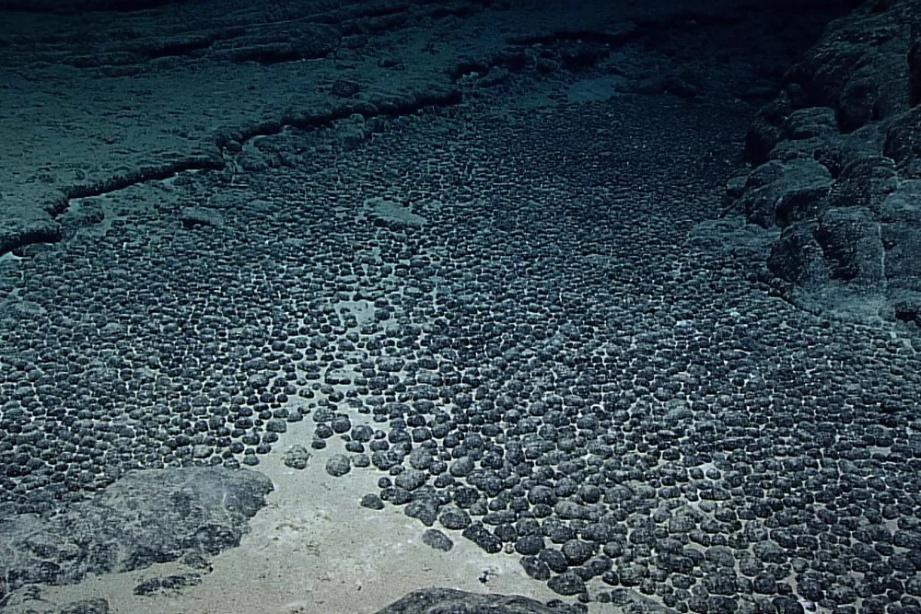
The prize is not oil, but the polymetallic nodule — a lumpy, potato-sized concretion that grows on the deep-ocean floor across millions of years, rich in manganese, nickel, cobalt, copper and other elements which make batteries and electronics possible. Washington wants them, and it preferably wants them from American waters, rather than from supply chains dominated by foreign competitors.
A Widening Frontier, Not a Single Lease
The Marianas are only the newest front in a much larger reorientation of the American offshore. Federal regulators have opened critical-minerals evaluation off American Samoa, Alaska, and Virginia; the National Oceanic and Atmospheric Administration (NOAA) is advancing seabed-mining applications in international waters under the Deep Seabed Hard Mineral Resources Act (DSHMRA), including in the mineral-rich Clarion-Clipperton Zone.
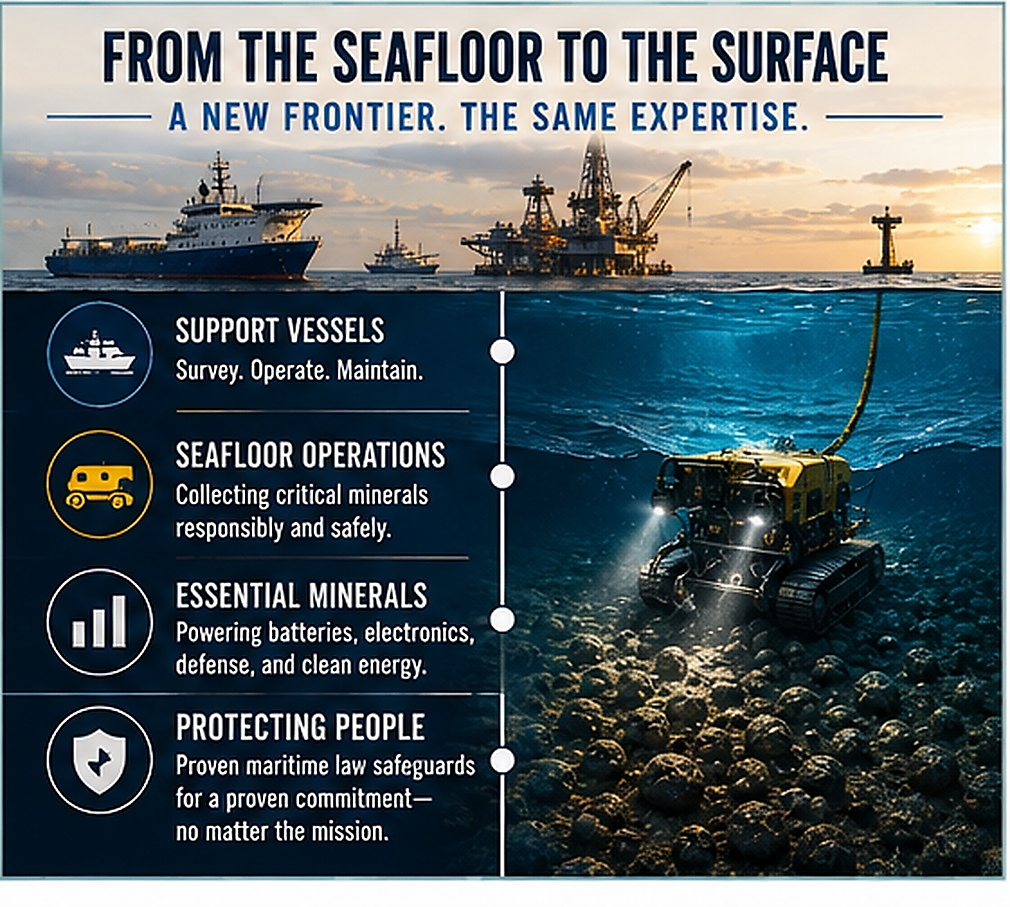
The same offshore engineering that built the oil-and-gas industry is now being aimed at carbon capture and storage, offshore critical minerals, proposals for offshore nuclear power, and even space-launch and recovery platforms on the Outer Continental Shelf (OCS).
Industry leaders describe the Gulf of Mexico (which the current Administration styles the “Gulf of America,” or GOA) as the country’s offshore “innovation laboratory,” where each new frontier is solved by the same fabricators, geoscientists, mariners, and offshore workers who solved the last one, on one of the most dangerous workplaces on earth.
The Frontier Is New — the Worker Is Not
However exotic the cargo, the law that protects the people doing the work has not changed. It remains the same durable body of maritime doctrine that has looked after sailors for centuries. Three protections travel with the American seaman:
- Jones Act negligence. The Jones Act (46 U.S.C. § 30104) gives a seaman injured by his employer’s negligence the right to sue, under a famously low causation standard — the employer’s fault need only have played “any part, even the slightest,” in the injury. A crewman aboard a vessel supporting seabed-mining operations is a seaman like any other.
- Unseaworthiness. Under the General Maritime Law, a vessel owner is strictly liable when the ship — its gear, its crew, its fitness for the voyage — is not reasonably fit for its purpose. Novel equipment in
- Maintenance and Cure. The old admiralty obligation to pay an injured seaman’s living expenses and medical costs — regardless of fault — until he reaches maximum medical improvement (MMI) applies no differently to a mining-support crew.
When the Worker Is Not a “Seaman” — OCSLA and the Substantial Nexus
Many of these workers will never set foot on a “vessel” in the legal sense — they will be stationed on fixed installations, or on structures that simply do not qualify — so they are not Jones Act seamen at all. Maritime law anticipates exactly that, with a second layer built for offshore mineral work. The Outer Continental Shelf Lands Act (OCSLA) extends the Longshore and Harbor Workers’ Compensation Act (LHWCA) to injuries occurring “as the result of operations conducted on the outer Continental Shelf” for the purpose of extracting its resources (43 U.S.C. § 1333(b)).
In Pacific Operators Offshore, LLP v. Valladolid, 565 U.S. 207 (2012), the Supreme Court held that a worker need not be hurt on the shelf to be covered; he must show a “substantial nexus” between his injury and his employer’s extractive operations there. That test was written with oil and gas in mind, but its logic follows the extraction — and seabed critical-minerals recovery on the OCS is extraction by another name.
One honest caution belongs here. OCSLA and its coverage provisions grew up around hydrocarbons, and as the frontier shifts to hard minerals, carbon storage, and other novel uses, the precise contours of who is covered — and under which statute — will be tested case by case. Which law governs a given worker (the Jones Act, LHWCA through OCSLA, or state law) is often the whole ballgame, and who counts as a “seaman” remains a fact-bound question our courts have wrestled with since the Deepwater Horizon era. For clients, the takeaway is practical: at a new frontier, do not assume you know which law applies — ask early.
Consolidating the Watch
The agency now presiding over all of this is itself brand new. The MMA was created in July 2026 by Secretarial Order, reunifying the Bureau of Ocean Energy Management (BOEM) and the Bureau of Safety and Environmental Enforcement (BSEE) into a single agency — reversing the split that the Interior Department put in place after the 2010 Deepwater Horizon disaster, precisely to separate the office that promotes offshore leasing from the office that polices its safety.
Supporters call the merger a matter of efficiency. Others note that the original separation existed for a reason: an agency that both sells the leases and inspects the rigs faces an inherent tension between revenue and safety. Whatever one’s view of the policy, the practical point for workers is simple — when oversight is consolidated, vigilance matters more, not less. We have covered what the Deepwater Horizon spill taught the Gulf about safety and complacency; those lessons do not expire because the resource sought has changed.
Why This Reaches the Gulf Coast
The expertise that comes from experienced professionals building nodule collectors, carbon-storage wells, and whatever else will likely be sourced from the Texas and Louisiana fabrication yards, engineering firms, and vessel operators that already service our Gulf offshore industry — just like when offshore wind first looked toward Texas waters. New industry, built on old offshore experience, and crewed by the same.
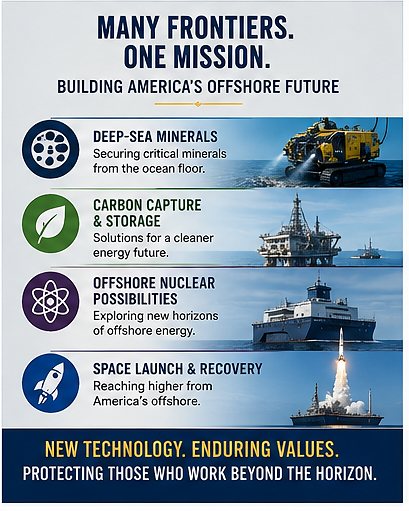
For mariners, all of this means something concrete — the next job. And the promise of American maritime law is that when that job goes wrong, as dangerous jobs sometimes do, the worker is not left to the mercy of whatever employer sent him out. The Jones Act, duties of Maintenance and Cure, the warranty of seaworthiness, and OCSLA’s longshore coverage follow him to the newest frontier as surely as they protected their ancestor on a 1950s platform.
Maritime Trivia Question!
Q: The very sea floor these lease sales concern is still charted in fathoms — and to fathom a hard problem is to get to the bottom of it. Why does one word do both jobs?
A: Because both begin with a sailor’s outstretched arms. Fathom comes from the Old English fæðm, “the outstretched arms” or “an embrace” — the span from one fingertip to the other, roughly six feet. By the 1600s, crews were measuring water depth by paying out a knotted sounding line and hauling it back arm over arm, each armspan a “fathom”; the unit stuck, and NOAA still prints United States charts in fathoms today. The figurative sense arrived in the same era: to fathom something is to sound or measure it all the way to the bottom — in other words, to understand it fully.
We at the Herd Law Firm are proud to fight for seamen, maritime workers, and passengers in all types of personal injury and death claims. As maritime personal injury attorneys (and sailors ourselves!) located in northwest Houston, we never waver in our commitment to help these maritime workers, passengers, and their families when they are injured or mistreated.
The information in this post is for general informational purposes only and does not constitute legal advice. For questions specific to your maritime law issue, please contact us at 713-955-3699 or at Charles.Herd@HerdLawFirm.com.
Sources
- Schuler, Mike. “Trump Administration Moves Closer to Pacific Seabed Mining Lease Sale.” gCaptain, August 17, 2026. gcaptain.com
- Bureau of Ocean Energy Management. “BOEM Advances Next Steps for Potential Outer Continental Shelf Mineral Leasing Offshore the CNMI.” Notes to Stakeholders. boem.gov
- “Commercial Leasing for Outer Continental Shelf Minerals Offshore the CNMI — Request for Information and Interest.” Federal Register, November 12, 2025. federalregister.gov
- Congressional Research Service. “Seabed Mining for Critical Minerals on the U.S. Outer Continental Shelf: Issues for Congress.” Report R48302, July 2, 2026. congress.gov
- Liskow & Lewis, APLC. “Establishment of the Marine Minerals Administration” (Secretarial Order No. 3451, reunifying BOEM and BSEE). liskow.com
- Milito, Erik. Testimony before the U.S. House Natural Resources Subcommittee on Energy and Mineral Resources, “Deep Dive: Examining the Regulatory and Statutory Barriers to Deep Sea Mining,” January 22, 2026 (and op-ed, “The Gulf of America Remains the World’s Offshore Innovation Laboratory,” August 17, 2026). docs.house.gov
- Pacific Operators Offshore, LLP v. Valladolid, 565 U.S. 207 (2012). Justia. supreme.justia.com
- Legal Information Institute, Cornell Law School. “43 U.S. Code § 1333 — Laws and regulations governing lands” (OCSLA) and “46 U.S. Code § 30104” (Jones Act). law.cornell.edu
- Executive Order 14285, “Unleashing America’s Offshore Critical Minerals and Resources,” April 24, 2025. govinfo.gov






Leave A Comment