

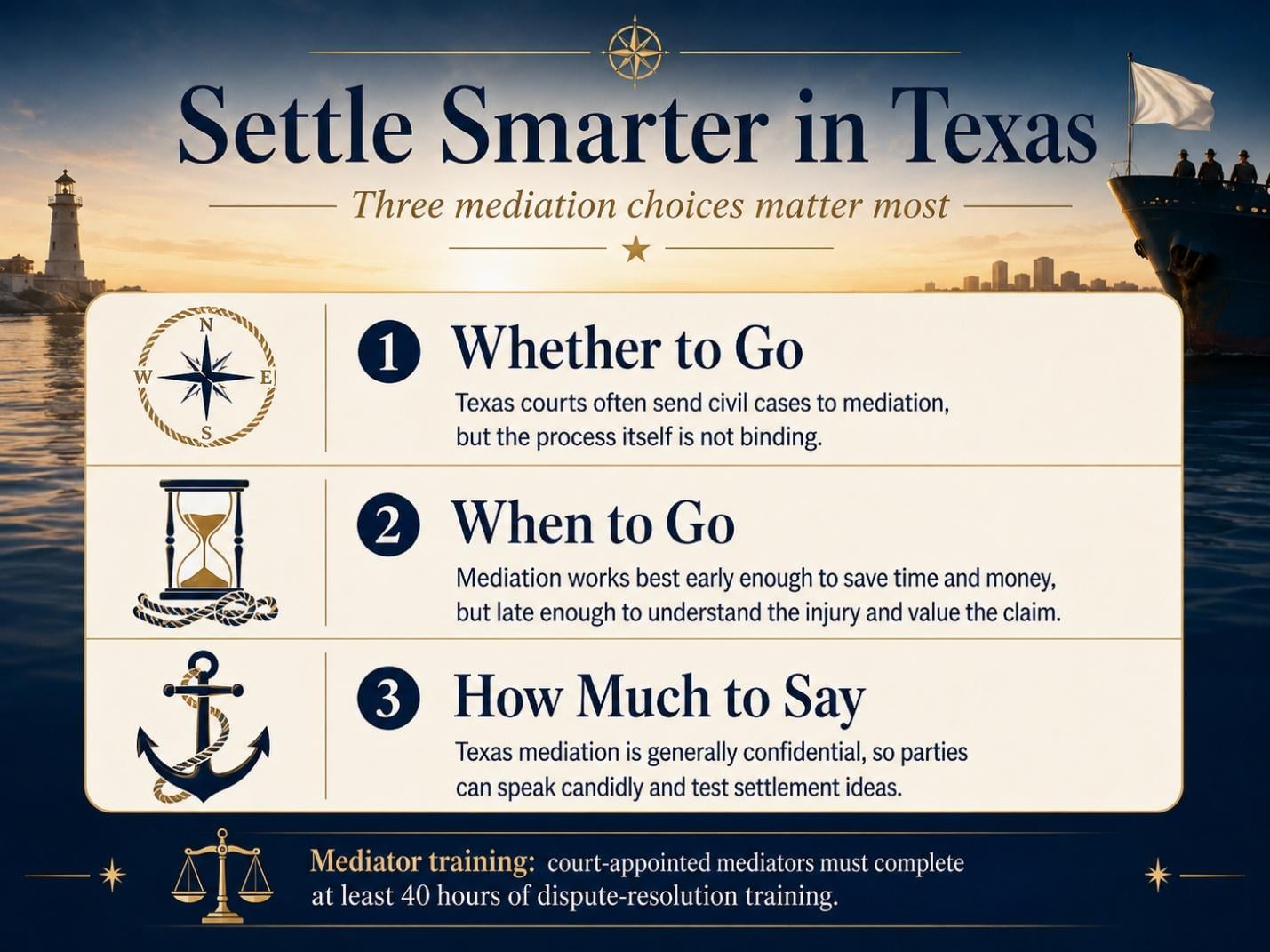
Texas built one of the busiest mediation systems in the country on a single, sensible idea: it is cheaper, faster, and kinder to settle a dispute than to fight it to the end. For an injured party, three choices decide how well that system works — whether to go, when to go, and how much to say.
A capable mariner, like any skilled professional, learns through hard work and experience that the wisest response to a confrontation is often not the loudest one. In ages past, two ships closing for battle could still run up a flag, hold their fire, and talk — under a flag of parley, as it was called— and more than one conflict was gratefully settled on that quiet deck without any bullets or cannon fire.
Modern Texas courts have institutionalized the same idea legally through the mediation process, and for the injured Texas worker, consumer or business interest, knowing how it works — and how to use it well — is as valuable or more than any argument you might make in a courtroom.
Mediation’s Current State of Play
The backbone of alternative dispute resolution (ADR) in Texas is the Texas Alternative Dispute Resolution Procedures Act, codified as Chapter 154 of the Texas Civil Practice and Remedies Code. Since 1987 it has declared the policy of the state of Texas “to encourage the peaceable resolution of disputes and the early settlement of pending litigation.”
This policy is more than aspiration. Under Chapter 154, a Texas court may refer a pending case to mediation on a party’s motion or entirely on its own — sua sponte, Latin for “of its own accord.” In plain terms, the judge can send the parties to the negotiation table without either one having to ask. That authority does real work: it spares either side from having to be the first to propose settlement — a step litigants often resist for fear it signals weakness — and it lets the court steer a crowded docket toward resolution rather than trial. Most civil judges make regular use of it.
Mediation is not binding: a court can send you to the table, but it cannot make you sign. The Texas Judicial Branch states the goals plainly — to give parties a faster, fairer forum, to cut the time and cost of litigation, and to ease the courts’ crowded dockets.
A few features to keep in mind:
- The mediator is a trained neutral, not a judge. Court-appointed mediators must complete at least 40 hours of dispute-resolution training under Section 154.052, and the Texas Mediator Credentialing Association (TMCA) maintains a voluntary registry of those who meet its standards.
- You usually pick your own. Courts generally do not recommend mediators; the parties agree on one and split a reasonable fee, which the court may tax as costs.
- Houston is well-supported by mediators. The Dispute Resolution Center (DRC) of Harris County and the University of Houston’s A.A. White Dispute Resolution Center are long-standing, low-cost resources for parties who want an accessible neutral party.
For an injured seaman, this matters because of a quirk of maritime law. A U.S. mariner’s work injury claim falls under federal law, and would ordinarily belong in federal admiralty court — where cases are heard by a judge alone, without a jury.
(Historical Note: This is because admiralty developed as a separate body of law — in the civil law courts of medieval Europe and, later, the English High Court of Admiralty — which delegated maritime disputes to specialized judges rather than juries. U.S. federal courts kept both the jurisdiction and its jury-free process, which is why the American constitutional Seventh Amendment’s right to a civil jury has generally never applied to a case brought only in federal admiralty court (Waring v. Clarke, 1847).)
However, a provision nearly as old as the country itself, the “saving-to-suitors” clause (now codified at 28 U.S.C. § 1333), preserves an injured worker’s right to bring most maritime claims in state court instead, before a jury of ordinary citizens. For a U.S. Jones Act plaintiff, that choice means the same Chapter 154 framework that governs a car wreck on a Texas freeway can also govern a deckhand’s claim from the Gulf Coast.
Why Sooner Beats Later
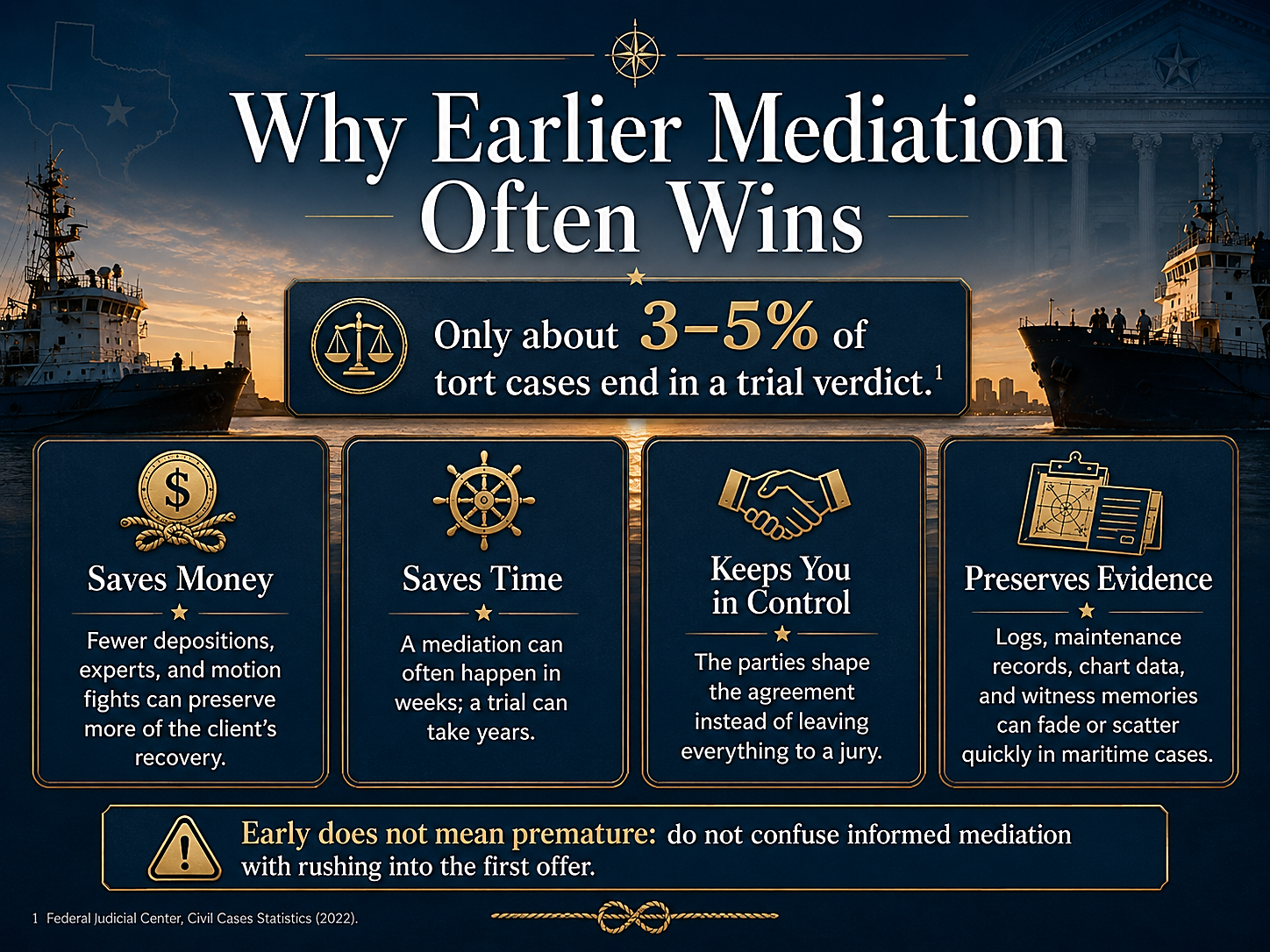
Note the statute singles out not just settlement, but early settlement. Studies of civil litigation consistently find that only about 3 to 5 percent of tort cases — the category that includes personal injury — are ever decided by a trial verdict, a figure drawn from Bureau of Justice Statistics (BJS) data. The overwhelming majority settle. If your case is almost certain to resolve by agreement, often, the only real questions are how much you spend getting there, and how much leverage you burn along the way.

Coming to the table early tends to help on both counts:
- It saves money. Litigation costs climb with every deposition, expert, and motion — fees that routinely come straight out of a client’s eventual recovery. A case mediated before full discovery keeps more of the settlement in the injured worker’s pocket.
- It saves time. Mediation can be scheduled in weeks and often resolves in a single day, while a contested trial can take years. For a worker off the job with medical bills and lost wages, that difference is not academic.
- It keeps you in control. A jury’s verdict is out of your hands; a mediated agreement is not. Both sides shape the terms, and they can craft resolutions a court could never order.
- It preserves the evidence. Maritime cases live and die on perishable proof — vessel logs, chart-plotter data, maintenance records, and shipmates who rotate off to other vessels within months. Reaching a negotiation before that evidence scatters protects your position.
One honest caveat: early is not the same as premature. Vessel owners and their insurers often press an injured crew member to sign a release within days of an accident, before anyone knows whether the injury is permanent.
“Early mediation” means getting to a real negotiation once the case is understood — ideally when the medical picture is clear enough to value future care and maintenance and cure, a point doctors call
maximum medical improvement (MMI). It does not mean simply accepting the first offer; the goal is to negotiate early, not to surrender early.
The Value of Keeping Quiet
One feature of Texas mediation does more work than clients expect: almost nothing said inside the room can be used against them outside it. Section 154.073 of the Civil Practice and Remedies Code makes communications in an ADR proceeding confidential, not subject to disclosure, and inadmissible as evidence against a participant. Section 154.053 goes further still: unless the parties agree otherwise, all matters — including the conduct and demeanor of the parties and their counsel — are confidential and “may never be disclosed to anyone, including the appointing court.”
The reason is practical. Maintaining an honest dialogue between all parties is essential to the mediation process, and few people feel comfortable engaging if every concession can be quoted back at trial. Confidentiality lets a party propose a number, concede a point, or test a compromise without arming the other side. Texas courts guard that promise closely — but not absolutely. Three cases mark the boundaries:
- You cannot “reach across the table”. In In re Empire Pipeline Corp. (Tex. App.—Dallas 2010), a party tried to use mediation discussions to undo the very settlement they had produced. The court refused, holding all such discovery barred by Section 154.073.
- A truly new “wrong” is handled differently. In Avary v. Bank of America, N.A. (Tex. App.—Dallas 2002), beneficiaries alleged that a fiduciary committed a fresh, independent tort during the mediation of a wrongful-death case. The court allowed narrow discovery, reasoning that confidentiality does not shield a brand-new wrong committed at the negotiation table — a deliberately very limited exception.
- Pre-existing evidence stays discoverable. In In re Learjet Inc. (Tex. App.—Texarkana 2001), the court held that documents which exist independently of the mediation do not become secret just because they were carried into the room. Mediation is not a means of excluding otherwise-discoverable proof.
The advice I give my mediation clients is simple: speak freely with your mediator about the strengths and soft spots of your case, but do not treat the mediation table as a confessional for conduct unrelated to the dispute — and never assume a document becomes privileged just because you brought it along.
Why This Reaches the Gulf Coast
Every principle above applies with equal force across the Texas Gulf Coast. Mediation is not a detour from the fight for a seaman’s rights; for the overwhelming majority of cases, it is where that fight is best fought. The worker who understands the system, comes to the table early but informed, and who speaks freely inside a room the law has sealed, may actually hold the strongest hand.
Maritime Trivia Question!
Q: When two hostile ships wished to talk instead of fight, they would call for a “parley.” The word is now standard in negotiation and mediation — but where does it come from?
A: From the Old French “parler”, “to speak,” which traces back through Late Latin “parabolare” to the Latin “parabola” (“comparison, speech”) and ultimately the Greek “parabolē”. By the late fifteenth century, English sailors and soldiers used “parley” for a conference held under a flag of truce — later formalized in the Hague Conventions — to discuss surrender, prisoner exchanges, or terms of peace. It also shares a root with palaver, an old sailors’ word for a long shipboard talk. Every mediation is, in the truest sense, a parley: a pause in the fighting to see what words can settle.
We at the Herd Law Firm are proud to fight for seamen, maritime workers, and passengers in all types of personal injury and death claims. As maritime personal injury attorneys (and sailors ourselves!) located in northwest Houston, we never waver in our commitment to help these maritime workers, passengers, and their families when they are injured or mistreated.
The information in this post is for general informational purposes only and does not constitute legal advice. For questions specific to your maritime law issue, please contact us at 713-955-3699 or at Charles.Herd@HerdLawFirm.com.
Sources
- Texas Civil Practice & Remedies Code, Chapter 154 (Alternative Dispute Resolution Procedures), §§ 154.002, 154.021, 154.052. Texas Legislature. statutes.capitol.texas.gov
- Texas Civil Practice & Remedies Code § 154.053 (Standards and Duties of Impartial Third Parties) and § 154.073 (Confidentiality of Certain Records and Communications). Justia. law.justia.com
- Texas Judicial Branch, “Mediation – ADR” (goals of ADR; referral procedures). txcourts.gov
- State Bar of Texas / Texas Association of Mediators, “ADR Texas Style” (overview of Chapter 154 and confidentiality). texasadr.org
- Avary v. Bank of America, N.A., 72 S.W.3d 779 (Tex. App.—Dallas 2002, pet. denied). FindLaw. caselaw.findlaw.com
- In re Empire Pipeline Corp., 323 S.W.3d 308 (Tex. App.—Dallas 2010), and In re Learjet Inc., 59 S.W.3d 842 (Tex. App.—Texarkana 2001), as discussed in “Impact of the Texas ADR Act on the Role of the Mediator,” Hirsch & Westheimer, P.C. hirschwest.com
- U.S. Bureau of Justice Statistics, civil trial data (share of tort cases resolved by trial verdict), summarized in “When Do Personal Injury Cases Go to Mediation?” brandonjbroderick.com
- Saving-to-suitors clause, 28 U.S.C. § 1333; Jones Act claims in state court, and the perishability of maritime evidence. law.cornell.edu
- “Parley,” etymology and historical usage (flag of truce; Hague Conventions; doublet of “palaver”). Online Etymology Dictionary and Collins English Dictionary. etymonline.com










Leave A Comment