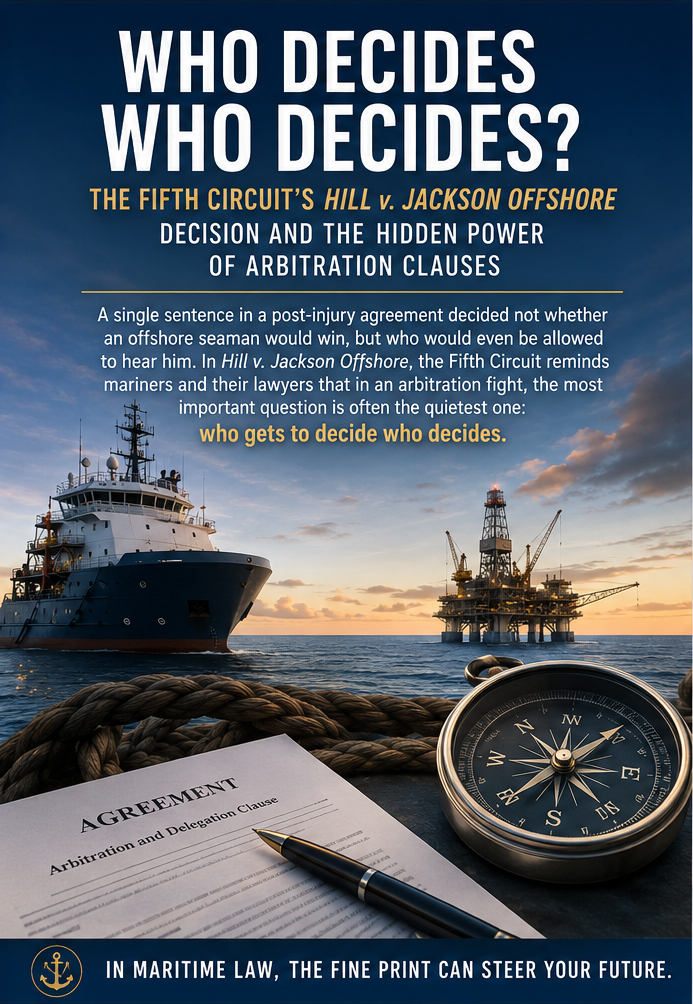
A single sentence in a post-injury arbitration agreement decided not whether an offshore seaman would win, but who would even be allowed to hear him. In Hill v. Jackson Offshore, the U.S. Fifth Circuit reminds mariners and their lawyers that in an arbitration fight, the most important question is often the quietest one: who gets to decide who decides.
Every sailor knows the difference between the helm and the chart room: one is where you steer, the other is where you decide where to steer. A recent decision from the U.S. Court of Appeals for the Fifth Circuit hinges on almost exactly that distinction — not on a ship’s deck, but in the fine print of a contract. And for offshore workers up and down the Gulf Coast, it is worth understanding before you ever sign your name to anything after an injury.
The case in question is Hill v. Jackson Offshore Holdings, L.L.C., decided May 5, 2026. It did not decide whether an injured seaman was wronged, but instead decided something stranger, more technical and, in some ways, more powerful: who is even allowed to answer that question — a judge and jury? Or perhaps, a private arbitrator? The answer came down to one clause most people never read.
A SEAMAN, AN INJURY, AND AN OFFER
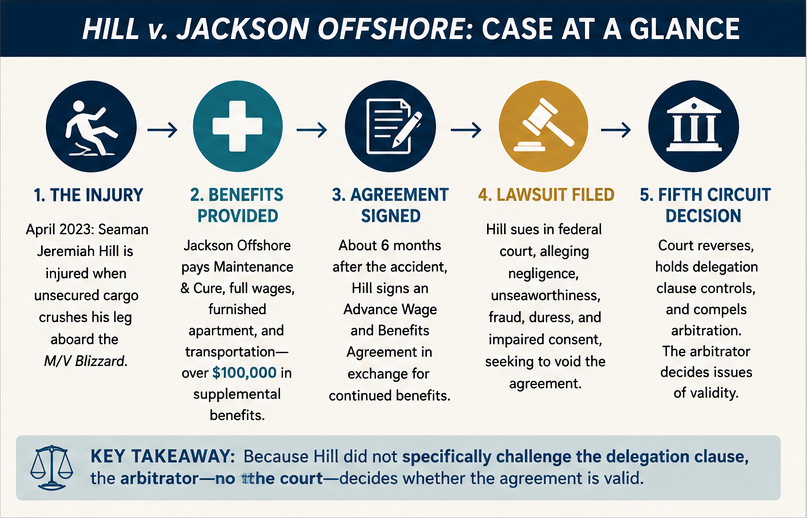
Jeremiah Hill was an able seaman aboard the M/V Blizzard, an offshore supply vessel. In April 2023, he alleged that unsecured cargo crushed his leg, causing injury serious enough to require multiple surgeries, roughly a month in the hospital, and another month of inpatient rehabilitation.
His employer, Jackson Offshore itinially did what maritime law requires: it paid Maintenance and Cure benefits, the ancient admiralty duty to cover an injured seaman’s daily living expenses and medical care until he reaches maximum medical improvement (MMI). Jackson Offshore does allege they also providing full wages, a furnished apartment local to the hospital, and transportation.
However, according to Hill, that generosity came with a whisper. He alleged that the company’s CEO warned him, more than once, that the extra help would stop if he hired a lawyer. Then, about six months after the injury occurred, company executives arrived at his apartment with a document to sign: an Advance Wage and Benefits Agreement. In exchange for Jackson’s Officers continuing those supplemental benefits, Hill had to agree that any future claims would go to binding arbitration, rather than to a courtroom.
THE SENTENCE INSIDE THE SENTENCE
Buried in that agreement was a second, subtler promise — what lawyers call a delegation clause. Its language was short:
“Any dispute relating to the validity, interpretation, or application of this Agreement shall be submitted to the arbitrator for resolution.”
A typical arbitration clause says we will settle our fights in arbitration, but a delegation clause says something one level up: even the fight about whether this contract is valid at all goes to the arbitrator, not the judge. It is the chart room, not the helm. It decides who decides.
TWO LOCKS ON THE COURTHOUSE DOOR
Hill sued in federal Eastern District Court of Louisiana, alleging negligence and unseaworthiness, and asked the federal trial court to throw out the post-arbitration agreement as the product of fraud, duress, and impaired consent. The trial judge was sympathetic enough to deny arbitration and allow some discovery. The U.S Fifth Circuit reversed and sent the case to arbitration.
The Fifth Court’s reasoning was not about sympathy (or lack thereof), but about “aim”. Picture the courthouse door with two locks: the first lock asks whether the dispute belongs in arbitration at all, and the second asks who gets to answer that first question. Under the Supreme Court’s Rent-A-Center decision, a delegation clause is treated as its own self-contained “lock” or contract, distinct and severable from everything around it. The consequences are stark:
- A general attack is not enough. Arguing that the whole agreement was procured by fraud or duress sends the whole dispute — fraud claim included — straight to the arbitrator.
- Naming the clause is not the same as challenging it. Hill’s brief even said he was attacking the arbitration language “specifically,” but he never explained why the delegation sentence itself was defective.
- You must “aim” to unlock the second lock, separately and precisely. To keep the case in front of a judge, a plaintiff has to explain why the fraud or duress poisoned his consent to letting an arbitrator decide validity — not just his consent to the deal as a whole.
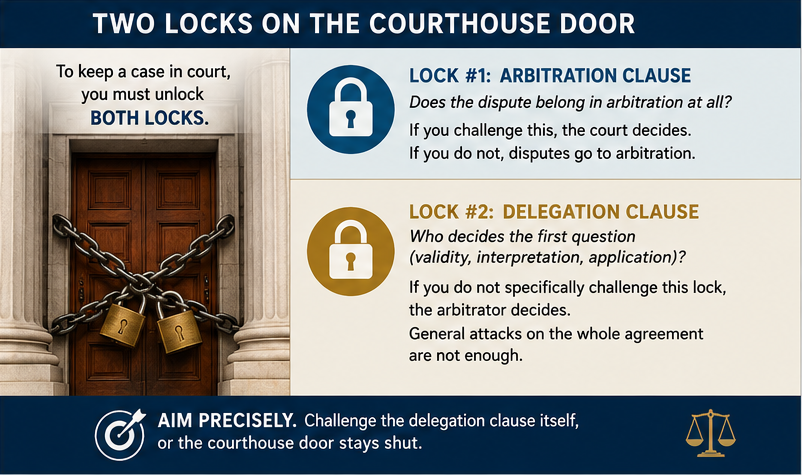
Because Hill “aimed” at the contract, but not specifically at the delegation sentence inside it, the second lock held. The court never reached whether his allegations were true. As the panel put it, absent a challenge to the delegation clause itself, the clause is treated as valid, and arbitration is compelled. The merits — the crushed leg, the alleged threats, the apartment-door signing — all now belong to the arbitrator.
A QUIET PROCEDURAL AFTERSHOCK
The court added one more point worth notice: Jackson Offshore was allowed to appeal immediately, even though the trial court had denied arbitration only “without prejudice” and had invited more discovery first. In a previous case, the Fifth Circuit held that such a denial is still immediately appealable under Section 16(a) of the Federal Arbitration Act (FAA). Translation for the layman: a trial judge cannot easily stall an arbitration ruling by calling it temporary. In cases like this, the appellate door opens right away.
Two judges wrote separately and, notably, disagreed with each other about whether a court must first confirm that a contract was ever formed before enforcing a delegation clause. That fault line is likely where future fights over forgery, incapacity, or a contract that never truly existed will likely be won or lost.
WHY THIS REACHES THE GULF COAST
It would be easy to judge this as a puzzle for the lawyers. The truth? The same document that sent Jeremiah Hill to arbitration (and kept him there!) could just as easily be slid across a kitchen table to a deckhand working the Houston Ship Channel, a tankerman on the Intracoastal Waterway, or an offshore rigger in the Gulf of Mexico, or the crewman of a ship sailing from India. Post-injury agreements — trading continued benefits for a signature — are common, and they are often presented at the seaman’s worst possible moment: hurt, out of work, and worried about the next month’s rent.
The lesson of Hill is not that these clauses are unbeatable, but that precision is everything. The fine print of any such contract deserves a lawyer’s eye before the pen touches the page.
For maritime employers, this case rewards the use of clear, explicit delegation language.
For an injured seaman, it is a clear warning: what you sign during recovery can quietly decide the room your case is heard in, long before anyone weighs whether you were wronged.
MARITIME TRIVIA QUESTION!
Q: To “know the ropes” and to be given “a wide berth” are common phrases now, but another is “to pass with flying colors.” What did a ship’s “colors” actually have to do with passing?
A: A ship’s “colors” are her flags — chiefly her ensign, the national flag flown at the stern. A vessel returning from a hard voyage or a battle she had won would come into port with every flag still flying high, colors streaming, so onlookers could read and relay news of her victory from a distance before she ever dropped anchor. A beaten ship would have struck, or taken down her colors, and came in bare-flagged.
In some ways, this parallels legal work: often, it is not enough to survive a fight — sometimes, we have to come home with and with all of the “right flags” still flying, precisely “raised”, for the record to reflect that you truly won.
We at the Herd Law Firm are proud to fight for seamen, maritime workers and passengers in all types of personal injury and death claims. As maritime personal injury attorneys (and sailors ourselves!) located in northwest Houston, we never waver in our commitment to help these maritime workers, passengers, and their families when they are injured or mistreated.
The information in this post is for general informational purposes only and does not constitute legal advice. For questions specific to your maritime law issue, please contact us at 713-955-3699 or at Charles.Herd@HerdLawFirm.com.
SOURCES
- U.S. Court of Appeals for the Fifth Circuit. Hill v. Jackson Offshore Holdings, L.L.C., No. 24-30554 (5th Cir. May 5, 2026) (published opinion). ca5.uscourts.gov
- Justia. “Hill v. Jackson Offshore Holdings, No. 24-30554 (5th Cir. 2026)” (opinion summary). law.justia.com
- Bloomberg Law. “Fifth Circuit Moves Seaman’s Negligence Lawsuit Into Arbitration,” May 5, 2026. news.bloomberglaw.com
- Haynes Boone. “Arbitration in the Fifth — May 2026,” discussing Hill v. Jackson Offshore Holdings, L.L.C., 175 F.4th 324 (5th Cir. 2026). haynesboone.com
- Spencer Fane. “The Delegation Clause — a Key Locking the Courthouse Doors Unless Precisely and Appropriately Targeted,” May 27, 2026. spencerfane.com
- U.S. Supreme Court. Rent-A-Center, West, Inc. v. Jackson, 561 U.S. 63 (2010). supremecourt.gov
- Legal Information Institute, Cornell Law School. “9 U.S. Code § 16 — Appeals” (Federal Arbitration Act). law.cornell.edu