Micro Switch Failure Results in $1.1 Million Houston Ship Channel Collision: Steering Transfer System Vulnerabilities
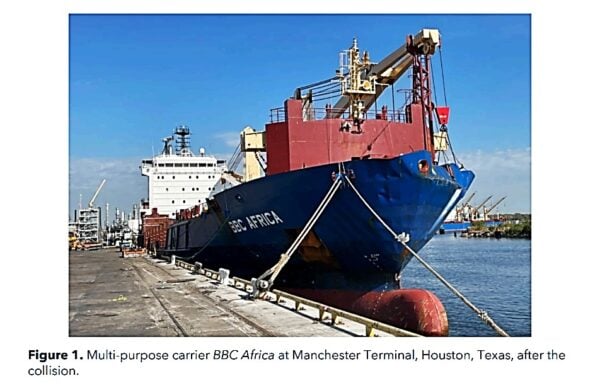 On August 25, 2023, a steering control system failure aboard the multi-purpose carrier M/V BBC Africa resulted in a collision with the bulk carrier M/V Common Faith in the Houston Ship Channel, causing $1.1 million in damages.
The National Transportation Safety Board’s (NTSB) investigation has now provided critical insights into the engineering vulnerabilities that caused the incident.
When operating in confined areas of the Houston Ship Channel, modern vessels utilize multiple steering control stations around the ship to accommodate different environments: bridge wing stations for close quarters maneuvering and docking operations, and center helm positions for standard navigation.
This collision occurred as the 390-foot M/V BBC Africa was departing the Houston Ship Channel. While transferring steering control from the port bridge wing to the bridge’s center helm, the vessel’s rudder swung hard to port, against both the pilot’s orders and helmsman actions.
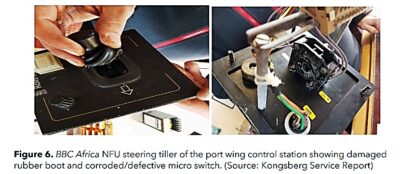 Post-collision investigation identified the failure of a bridge wing tiller micro switch as the probable cause of the steering malfunction. Micro switches serve as critical interface components in ship steering systems, providing position feedback and control status information between different steering stations.
The NTSB report emphasizes that “steering control system failures can result in damaging consequences,” particularly noting that in confined channels where “immediate hazards are in proximity and therefore response time is critical to avoiding a casualty, steering system failure contingencies require immediate crew response.”
The investigation also revealed significant delays in implementing emergency steering procedures. Despite multiple attempts by the chief officer to regain primary steering control, approximately one minute elapsed before the master successfully activated the emergency override function—insufficient time to prevent the collision in the confined channel environment. The NTSB noted that this contributed to the collision outcome, emphasizing that emergency procedures must be executed within seconds (rather than minutes) when operating in restricted waters.
Data Recording System Deficiencies
A significant complicating factor in the investigation was the inoperative status of the M/V BBC Africa‘s simplified voyage data recorder (S-VDR), which had been non-functional since August 17, 2023, eight days prior to the collision. This equipment failure prevented investigators from accessing critical audio records and parametric data that would have provided detailed insights into the sequence of events and crew actions.
Industry Response and Corrective Measures
Following the incident, the vessel operator implemented comprehensive system modifications, replacing three components that could have contributed to the steering failure: the port bridge wing tiller, the power supply transformer in the control cabinet, and the push button relays for “in command” status requests.
The steering gear manufacturer responded by issuing a safety bulletin specifically addressing micro switch failure modes and their potential to cause unintended rudder movements.
The NTSB emphasized the critical importance of “training in steering recovery procedures, including scenario-based drills for bridge and engine teams,” noting that such preparation is “critical to ensure crews can respond in the shortest possible time.”
The report’s overall findings support the need for enhanced maintenance protocols for electronic components, improved crew training for emergency situations, and reliable operation of safety recording equipment.
We at the Herd Law Firm are proud to fight for seamen, maritime workers and passengers in all types of personal injury and death claims. As maritime personal injury attorneys (and sailors ourselves!) located in northwest Houston, we never waver in our commitment to help these maritime workers, passengers, and their families when they are injured or mistreated.
9/3/2025
Image Credit: NTSB.gov