On June 9, 2026, U.S. forces fired on a tanker in the Gulf of Oman, killing three Indian merchant sailors. A week later, at the G7, India’s prime minister raised the incident directly with the president. The response? “It’s a rough profession.”
On the night of June 9, 2026, in the Gulf of Oman, a U.S. aircraft fired precision munitions into the engine room of the Palau-flagged oil tanker M/T Settebello after her crew “repeatedly failed to comply with directions from American forces” enforcing the ongoing U.S. blockade of Iranian ports. The vessel carried 24 Indian crew members. Twenty-one were rescued. Three were not — their bodies were later located and identified.
India’s shipping minister confirmed their deaths publicly on June 11.
They are believed to be the first civilian merchant mariners killed directly by U.S. military force since the current Gulf conflict began in late February.
Unfortunately, the M/T Settebello was not alone. In the following days, U.S. forces also disabled the Palau-flagged M/T Marivex — which was attempting to reach an Iranian port — and the Guinea-Bissau-flagged M/T Jalveer, a bitumen tanker with 20 Indian seafarers aboard. All 20 on the M/T Jalveer survived and were evacuated to the Omani port of Shinas. The pattern in each case was the same: a U.S. aircraft fired after the crew failed to comply with blockade instructions.
External Affairs Minister S. Jaishankar has since called on Secretary of State Rubio to register India’s “strong protest” over what New Delhi described as unjustified attacks.
On June 16, at a G7 outreach session in Evian, France, Prime Minister Narendra Modi sat beside President Trump and told the assembled leaders: “Several Indian civilians have also lost their lives. The safety of seafarers, who connect nations through global maritime trade, is our responsibility.”
“We must ensure that sea routes remain secure and that seafarers can carry out their work without fear.”
President Trump’s response was brief: “It’s a rough profession, there’s no question about it, and we work together on it.”
A Blockade, a Closed Strait, and Hundreds of Ships in the Middle
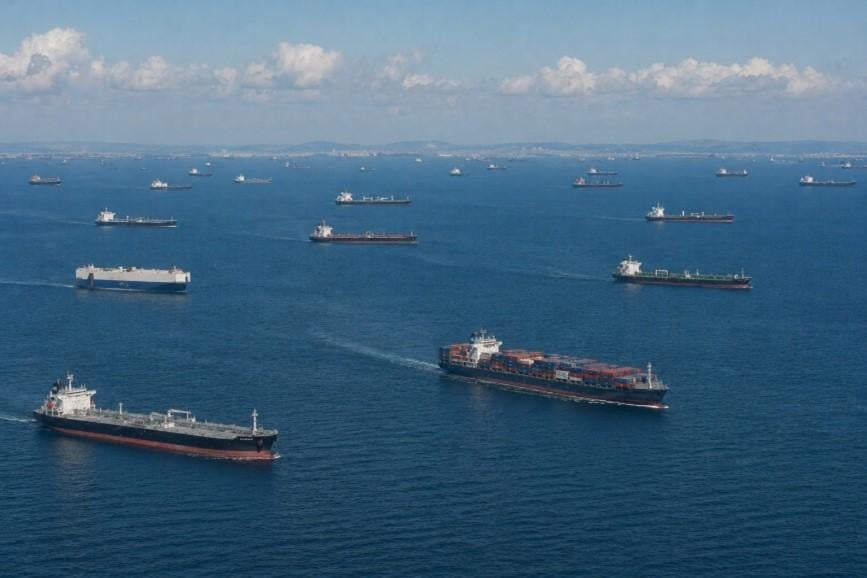
Since late February 2026, when U.S. and Israeli airstrikes against Iran triggered Iran’s closure of the Strait of Hormuz, the Persian Gulf has become the most legally and physically dangerous stretch of water on Earth for merchant mariners. When Iran mined the strait and effectively closed it to commercial traffic, the U.S. responded with a naval blockade of Iranian ports, ordering all vessels in the region to comply with U.S. military direction or face interdiction. CENTCOM (U.S. Central Command) reported that, as of mid-June, it had disabled eight non-compliant vessels, redirected 134 ships, and allowed 42 vessels carrying humanitarian aid to pass since the blockade began on April 13.
However, even since before the blockade in March 2026, the International Maritime Organization (IMO), formally condemned attacks against commercial vessels, and called for a coordinated safe-passage framework.
These vessels caught in this conflict are not warships, but tankers and cargo ships crewed by working sailors. According to India’s Ministry of Ports, Shipping and Waterways, as of mid-June 2026, approximately 562 Indian seafarers were aboard Indian-flagged vessels in the region, with 329 in the Persian Gulf west of the Strait of Hormuz, and 233 in the Gulf of Oman east of the strait. That figure does not include the hundreds more serving aboard foreign-flagged ships like the M/T Settebello.
11,000 Seafarers, One Evacuation, and a New Attack
At its peak, the IMO estimated roughly 20,000 seafarers aboard approximately 3,200 vessels were unable to safely leave the Persian Gulf. Following last week’s U.S.–Iran peace agreement, that number had fallen to around 11,000 still stranded. On June 23, IMO Secretary-General Arsenio Dominguez announced a large-scale phased evacuation, coordinated with Iran, Oman, the United States, and the maritime industry. Oman established a temporary maritime corridor through the Strait, and vessels were assigned to departure batches and directed to waiting areas in international waters before receiving transit instructions. The IMO had, in its own words, “secured the necessary safety guarantees” and “thoroughly verified the conditions for safe navigation.”
Sadly, that coordinated safety corridor lasted only one day. On June 25 (coincidently, the International Day of the Seafarer) a Singapore-flagged containership was struck on its starboard side by an unknown projectile approximately 7.5 nautical miles southeast of Dahit, Oman, after transiting the Strait. The vessel was not participating in the IMO evacuation framework, and no casualties were reported, but the ship’s bridge was damaged. The IMO immediately suspended the entire evacuation operation to reassess whether safety guarantees remained in place.
Iran’s Persian Gulf Strait Authority (PGSA) meanwhile issued a warning that ships using routes outside its designated framework would not receive “safe passage guarantees” and would not be entitled to insurance coverage, with all liability intended to fall on the “owner, operator, and vessel commander.” The Baltic and International Maritime Council (BIMCO) called the attack “a setback in the plans to evacuate ships” and pointed directly at the core problem: “The wording of the U.S.–Iran MoU [Memorandum of Understanding] is currently not sufficiently clear.”
As of this writing, the evacuation remains suspended, with over 11,000 seafarers still waiting.
What Maritime Law Says When Crews Are Sent Into Harm’s Way
The Jones Act and America’s General Maritime Law were built around a simple fact of maritime work: it may be impossible to truly leave the job if conditions become dangerous. The ship is the workplace, and when the employer controls whether you go into harm’s way, the law puts significant obligations on that employer.
Three principle maritime law obligations bear on situations like the M/T Settebello:
- Jones Act negligence requires an employer’s negligence to have played “any part, even the slightest” in causing an injury. That deliberately low threshold reflects Congress’s judgment that those who profit from sending sailors to sea must bear responsibility when those sailors are harmed. Ordering a vessel into a zone where military forces have already fired on merchant ships — after regulators have warned against it and insurers have priced the risk accordingly — is the kind of decision that invites that inquiry.
- Unseaworthiness under general maritime law holds a vessel owner strictly liable when the ship (including its equipment, its condition, or its fitness for the voyage ordered) is not “reasonably safe”. A voyage ordered into an active combat zone without adequate protection, communication protocols, or means of compliance with blockade instructions could likely qualify.
- Maintenance and cure is the old admiralty common-law obligation requiring vessel owners to pay a seaman’s ongoing living expenses and medical costs after an injury in service of the vessel, regardless of fault, until the seaman reaches maximum medical improvement (MMI).
None of these protections are suspended because the danger in question is a foreign navy, rather than a storm or a broken piece of equipment. However, the question now is the same one asked in many other war-risk maritime cases: did someone with a duty of care fail to meet these obligations?
War Risk Provisions and the Duty to Warn
Employment contracts and collective bargaining agreements for mariners operating in conflict zones almost always contain war risk provisions. These may specify additional rights and compensations for voyages transiting designated high-risk areas, such as the right to refuse a voyage, enhanced employer insurance obligations, and war risk bonuses.
General Maritime Law also imposes an affirmative duty to warn crew of known dangers; by the time the M/T Settebello was struck by the U.S. Navy, the danger was very real and known. The IMO had formally condemned military attacks on merchant vessels., India’s own directorate has issued an advisory restricting crew deployments, and other tankers in the region had already been disabled by U.S. forces.
In these kinds of senarios, if a vessel is ordered into these hazardous areas without adequate warning (or without obtaining the crew’s informed consent to the voyage), that failure is a potential basis for legal liability.
“A Rough Profession”
At Evian, Modi addressed President Trump: “You are aware that hundreds of thousands of Indian seafarers are working across the world, performing their duties along international maritime trade routes — including the Strait of Hormuz — and their safety is of utmost importance to us.”
President Trump’s response of “It’s a rough profession, there’s no question about it” is not wrong — seafaring is a very challenging vocation. However, “rough profession” does not constitute a legal defense.
What Maritime Workers and Their Families Should Know Now
If you or a family member is working on a vessel in the Persian Gulf or Gulf of Oman right now, a few things are worth knowing.
- Your employment contract matters. Read the war risk provisions. Understand what additional pay you are owed for transiting high-risk areas, what your collective bargaining agreement says about your right to refuse a dangerous voyage, and whether your employer has formally designated this region as a war zone, triggering those provisions.
- Insurance coverage is critical. Maritime workers in conflict zones are often covered by additional policies beyond standard P&I club protection. Know what coverage your employer has enrolled you in, and make sure your family knows how to file a claim if the worst occurs.
- Warning and consent have legal weight. Under U.S. General Maritime Law, an employer has a duty to warn crew of known dangers. If a vessel is ordered into a blockade zone where military forces have already fired on merchant ships — and where the IMO and a flag-state directorate have both issued formal warnings — a failure to adequately inform the crew and obtain their consent to that voyage is a potential basis for liability.
- If you or a family member is injured or killed, speak to an knowledgeable maritime attorney FIRST. War-risk maritime claims require careful analysis of the specific facts by a specialized legal professional, including the voyage orders, the contract terms, the warnings given (or not given), and the full range of available Jones Act, unseaworthiness, and maintenance-and-cure remedies. The legal landscape in these situations is often significantly more complex than it appears from the outside.
The three men who died on the M/T Settebello had not only jobs, employers and contracts, but families who must now navigating a complex legal situation in a language many people don’t speak or read. These families, and all those like them, deserve to know how maritime law should protect those working in dangerous waters, and not just what diplomatic statements say.
Maritime Trivia Question!
When a ship is said to be sailing under “false colors,” what does it mean, and when has maritime law historically permitted it?
Answer:
Sailing under “false colors” means flying a flag other than your own, typically to deceive an enemy or evade a blockade. Under the law of naval warfare, it has historically been permitted as a “ruse de guerre” or battle tactic, with one critical condition: you must raise your true colors before opening fire. However, for merchant vessels, flying false colors to evade capture or destruction of its cargo and crew would be treated differently. Regardless, the flag a vessel chooses to sail under is one of the most consequential details of maritime law.
We at the Herd Law Firm are proud to fight for seamen, maritime workers and passengers in all types of personal injury and death claims. As maritime personal injury attorneys (and sailors ourselves!) located in northwest Houston, we never waver in our commitment to help these maritime workers, passengers, and their families when they are injured or mistreated.
The information in this post is for general informational purposes only and does not constitute legal advice. For questions specific to your maritime law issue, please contact us at 713-955-3699 or at Charles.Herd@HerdLawFirm.com.
Sources
1. Al Jazeera. “India says US hit another ship off Oman, confirms 3 dead in separate attack.” June 11, 2026. https://www.aljazeera.com/news/2026/6/11/india-says-incident-on-vessel-off-oman-confirms-3-dead-in-seperate-strike
2. Middle East Eye. “US attack kills three Indian sailors in Gulf of Oman.” June 2026. https://www.middleeasteye.net/news/us-attack-kills-three-indian-sailors-gulf-oman
3. The Federal. “India says US Navy behind attack on MT M/T Settebello, lodges protest.” June 11, 2026. https://thefederal.com/category/news/india-lodges-protest-says-us-navy-behind-attack-on-mt-M/T Settebello-246274
4. Outlook India. “PM Modi Raises Indian Seafarers’ Safety With Donald Trump at G7 Summit.” June 17, 2026. https://www.outlookindia.com/international/pm-modi-raises-indian-seafarers-safety-with-donald-trump-at-g7-summit
5. The Statesman. “With Trump by his side, PM Modi raises seafarers’ safety at G7 days after 3 Indians killed in US Navy attack.” June 2026. https://www.thestatesman.com/world/with-trump-seated-beside-him-pm-modi-raises-seafarers-safety-at-g7-summit-days-after-3-indians-killed-in-us-navy-attack-1503606669.html
6. ITLN. “India urges seafarers to avoid Gulf conflict zones amid risks.” June 2026. https://www.itln.in/amp/shipping/india-urges-seafarers-to-avoid-gulf-conflict-zones-amid-risks-1359496
7. Mondaq / India. “Maritime Law Updates March 2026 Newsletter” (IMO Extraordinary Session on Hormuz; Jones Act waiver). April 1, 2026. https://www.mondaq.com/india/marine-shipping/1767718/maritime-law-updates-march-2026-newsletter
8. U.S. Central Command (CENTCOM). Public statements on interdiction of MT M/T Settebello, MT Marivex, and MT Jalveer. June 9–11, 2026.