Twenty thousand seafarers are stranded in the Persian Gulf, caught between two blockades and a war they didn’t start. Here’s what the law says — and what their employers owe them.
An old saying among mariners says that the sea takes no notice of your plans. Nowhere is that truer right now than in the Persian Gulf, where some twenty thousand seafarers have been living for weeks on very limited rations while anchored near Iranian ports, listening to the cacophony of a war they did not choose and cannot leave.
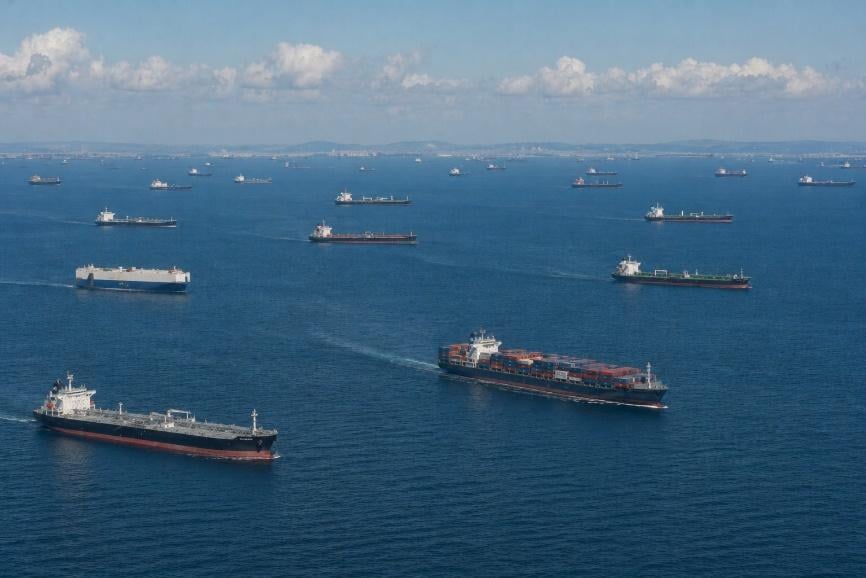
According to the latest data, these seafarers aboard hundreds of oil and gas tankers, cargo ships, bulk carriers, and other vessels are currently trapped in the Gulf, unable to transit the Strait of Hormuz. The strait, a narrow chokepoint connecting the Persian Gulf to the Arabian Sea, normally carries roughly a fifth of the world’s seaborne oil and LNG (liquefied natural gas).
How We Got Here
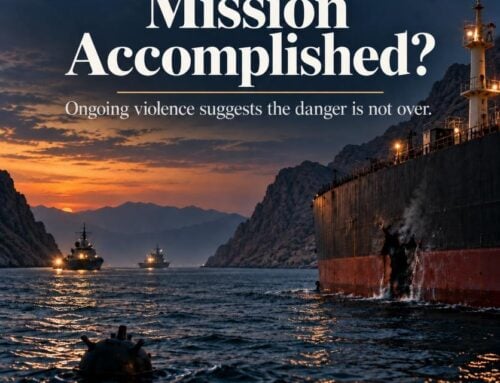
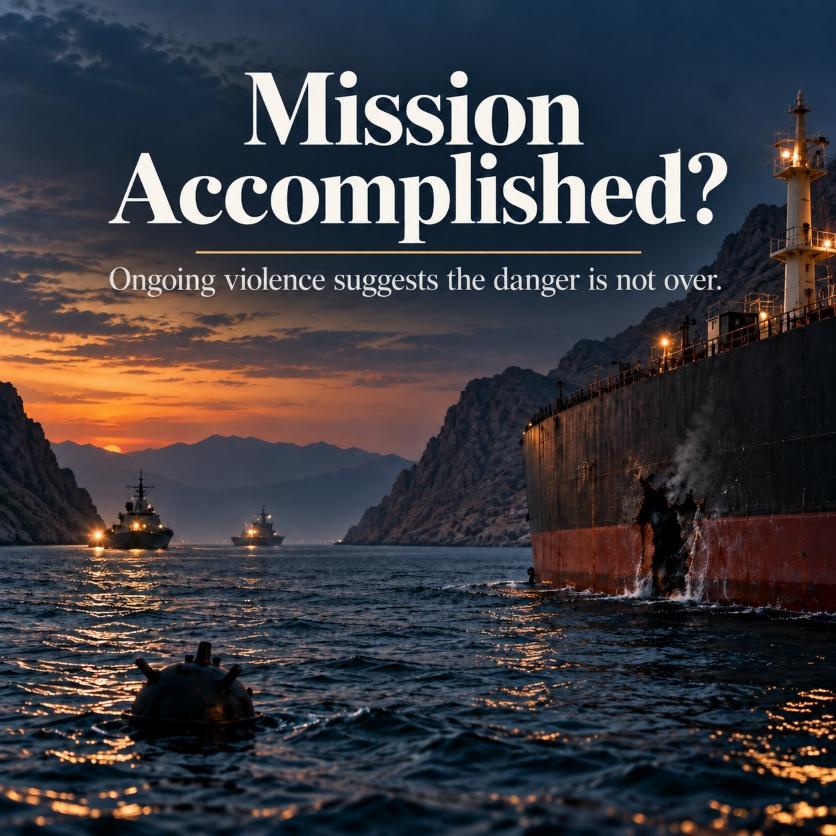
Since late February 2026, when the United States and Israel launched military operations against Iran, the Islamic Revolutionary Guard Corps (IRGC) has imposed a blockade on commercial shipping, laying sea mines, firing on vessels, and boarding merchant ships. In response, on April 13th, the U.S. Navy imposed its own blockade of Iranian ports, creating what many analysts are calling a “dual blockade.” Transit traffic that once ran at 130 or more vessels per day has fallen to around 80 ships in an entire week, and for many ships, the number is effectively zero.
Despite the April 17th announcement made by Iranian Foreign Minister Abbas Araghchi declaring the strait open to all commercial ships during the ceasefire on a coordinated route, the reality is that passage is highly conditional, and only a very small fraction of vessels will even qualify. The few vessels that have attempted transit have almost all been turned back, due to lack of clearance and/or the U.S. naval blockade.
The IMO Secretary-General put it plainly: “There is no safe transit anywhere in the Strait of Hormuz.”
For the crews of small vessels carrying other cargo between Iran, Kuwait, and Oman, the mathematics are brutal. Some could theoretically sail to Oman and be repatriated, but the continued U.S. blockade has made that impossible. In some reported cases, shipping companies have refused to fly crew home, unwilling to absorb the surging cost of airfare. The Indian government has repatriated roughly 2,680 Indian seafarers so far, though three Indian sailors have lost their lives, primarily from explosions. On April 18th alone, two Indian-flagged vessels were fired upon by the IRGC while attempting to transit the strait.
Stranded mariners at ports like Khorramshahr have described the situation as a waking nightmare, with more than 100 explosions reported from the anchored vessels. Some seafarers have told reporters that the only thing keeping them occupied is praying they aren’t hit during an attack.
What the Law Says, And What It Doesn’t Do
As a maritime attorney, I think about these situations through a particular lens: the architecture of international law, and the frustrating gap between what the rules promise and what actually happens when geopolitics intervene.
The Maritime Labour Convention of 2006 (MLC 2006, sometimes called the “Seafarers’ Bill of Rights”) is the governing international framework for seafarer welfare. It is the fourth pillar of international maritime law, alongside SOLAS (International Convention for the Safety of Life at Sea), STCW (Standards of Training, Certification, and Watchkeeping), and MARPOL (International Convention for the Prevention of Pollution from Ships). and it has been ratified by states representing over 97% of world gross shipping tonnage. Under the MLC, shipowners have clear obligations: adequate food and water, safe working conditions, timely wages, and most critically, repatriation at the end of a contract.
The MLC also addresses conflict zones specifically. Under Standard A4.3, a seafarer cannot be compelled to enter a declared war zone without written consent. If they consent, they must receive enhanced compensation, war risk bonuses, and full coverage of evacuation and repatriation costs. Repatriation expenses are the employer’s obligation, regardless.
There are credible reports of shipping companies refusing to pay elevated airfares to repatriate their crews. This is a clear failure of legal duty, and potentially a violation of the MLC’s repatriation provisions, dressed up in the language of corporate inconvenience. The fact that a conflict has made tickets expensive does not excuse an obligation; if anything, it triggers it.
There is also the matter of flag state responsibility. The presence of, for example, “convenience-flagged” vessels in this crisis illustrates a well-known problem: vessels registered under flags of convenience, which are usually small island nations with limited maritime regulatory and law enforcement capacity (often favorable for the owner’s and/or operator’s bottom line) create accountability vacuums when international crises such as these arise. The MLC’s port state control mechanisms can help, but only when ships are in ports of signatory states which are willing to act.
A Pattern with Precedent
This is, sadly, not a new problem. The COVID-19 pandemic left hundreds of thousands of seafarers stranded at sea when ports refused crew changes. Russia’s invasion of Ukraine trapped sailors in Black Sea ports under fire, and Houthi attacks in the Red Sea have already reshaped global shipping routes. Each crisis exposes the same structural vulnerability: the people who move 90% of the world’s trade are among the least protected when things go wrong.
India is one of the world’s top three suppliers of seafarers, with over 300,000 at sea globally. Their welfare — and the question of whether that workforce will continue to accept deep-sea work in an era of escalating maritime conflict — is not merely a humanitarian concern. It also is a supply chain concern, an insurance market concern, and ultimately a concern for every port, every refinery, and every consumer downstream.
What Should Happen
For those following this situation, here is what I believe needs to occur, both practically and legally:
Shipping companies must honor their repatriation obligations under the MLC — elevated costs notwithstanding. If a company is withholding repatriation to protect its bottom line while crew members subsist on potatoes and tomatoes in a war zone, it should expect regulatory scrutiny and, eventually, litigation.
Flag states have incontrovertible duties under the MLC to enforce the convention’s provisions. States with meaningful enforcement capacity, like India, have leverage through port state control to pursue non-compliant owners.
The international community has a template from past crises: the IMO’s extraordinary sessions on the Ukraine conflict produced calls for humanitarian corridors and seafarer key worker status. Similar mechanisms should be activated here immediately.
Governments, particularly India’s, deserve credit for the repatriations already accomplished — but diplomatic pressure must continue. The IRGC’s willingness to negotiate safe passage for some national-flagged vessels demonstrates that the option exists.
A Final Word
Every one of those 20,000 stranded mariners is part of the proud tradition of seafaring. But they are also ordinary people, young men and women just doing their jobs and providing for their families, but now fearing for their lives far from home, waiting for someone — their companies, their governments, the international community — to finally honor their obligation to them.
We at the Herd Law Firm are proud to fight for seamen, maritime workers and passengers who are injured at sea. If you or your company have crew members stranded in the Gulf region, or have questions about war risk obligations, MLC compliance, or repatriation rights, please don’t hesitate to reach out.
5/1/2026
The information in this post is for general informational purposes only and does not constitute legal advice. Reading this blog does not create an attorney-client relationship.
Sources
1. Reuters / ABC News — Tired and worried, seafarers have been stranded in the Persian Gulf for weeks (April 27, 2026)
2. Euronews — Strait of Hormuz standoff leaves 20,000 seafarers stranded on cargo ships (April 27, 2026)
3. NPR Illinois — Thousands of seafarers stranded by ongoing U.S. blockade on Strait of Hormuz (April 24, 2026)
4. Wikipedia — 2026 Strait of Hormuz crisis
5. gCaptain — Seafarers Trapped by Hormuz Crisis Face Growing Humanitarian Emergency
6. International Labour Organization (ILO) — Maritime Labour Convention, 2006
7. ITF Seafarers — Your rights under the MLC
8. SeaEmploy / Marine Insight — War Zones and High-Risk Areas — Rules, Pay, and Seafarers’ Rights (October 2025)
9. Marine Insight — Labour Rights of Seafarers in Piracy, Armed Robbery Against Ships and War Zones
10. Taylor & Francis / Tandfonline — Analysis of impact of the maritime labour convention, 2006: A seafarer’s perspective